Tag: American Colonial History

  • England in the 1600s: The Beginning of England’s Rise to Global Power and Wealth


    INTRODUCTION


    In 1600, England had been an insular and agricultural nation, trading primarily with nearby northern Europe. By 1700, England’s commerce was complex and global, as London competed successfully with Amsterdam for American produce and Asian luxuries.


    Alan Taylor,  American Colonies:  The Settling of North America, 258.


    A theme that runs through this essay is the global maritime rivalry with Holland. England and Holland became global trade rivals in the 1600s. They fought three wars that weakened Holland and eliminated it as a naval rival. 


    England’s main instrument in its rivalry with the Dutch in Asia was the English East India Company (EIC). In America and the West Indies, it was the Navigation Acts.


    By the end of the century, England was on its way to becoming a global maritime trading and naval power. The Dutch had lost out in North America but had established a vast trading network throughout Asia, centered in the Dutch East Indies (Indonesia). It was generally not competitive with the main Asian trade of the EIC or competitive with England as a European political power.


    This essay on the spectacular economic progress of England in the 1600s also provides background and context for three other essays on this blog. 


    American Colonial History, 1607-1775


    This background essay helps explain the changing relationship between England and her North American colonies in the context of England’s expanding global trade. It emphasizes the importance of England’s Navigation Acts to the American colonies. The objective was to reduce the role of the Dutch in the American colonies and the West Indies and monopolize all trade with the American colonies and the British West Indies.

    The Dutch were instrumental in financing early sugar production in Barbados. They also dominated early financing and shipping of the tobacco industry in the Chesapeake (Virginia and Maryland). Dutch shipping rates were lower than those of the English. 


    The English sugar islands in the West Indies, mostly Barbados, was the largest source of English imports in the 1600s and an important source of import taxes. In the North American English colonies, England was able to take over the Dutch settlement at New Amsterdam, renamed New York, and using the Navigation Acts, to eliminate Dutch shipping that dominated the trans-Atlantic tobacco trade from the Chesapeake.


    NAVIGATION ACTS


    As part of its maritime rivalry with Holland, England passed the Navigation Acts.


    First enacted in 1651 and strengthened in 1660 and 1663, the Navigation Acts were aimed at the Dutch. All exports and imports of the American colonies and West Indies had to go through England, on English or American ships. Even foreign goods bound for the Americas had to pay custom duties in England. The only exceptions were American exports other than the main exports of tobacco, rice, and indigo. As sugar production in the West Indies, exploded after starting in the 1600s, most other American exports went to the British West Indies.


    England imposed high taxes (custom and excise duties) on American tobacco exported to England. During 1660s, new Navigation Acts regulations forced American tobacco growers to ship all their tobacco to England on English ships. Before that, Dutch ships controlled much of the tobacco trade because their rates were lower than English ships. This hurt the tobacco growers because this caused a tobacco glut in England, fewer ships competed for the tobacco trade, and now all tobacco had to go to England and pay high import taxes.


    The Navigation Acts were an important part of the mercantilist policies of England. According to mercantilism, the government had the right and the power to shape trade in the political interests of the country. This meant economic war, especially with the Dutch. 


    The Dutch and English waged three wars, in 1652-54, 1664-67, and 1672-74. The second war was triggered when an English fleet in 1664 conquered Holland’s American colony New Amsterdam, renaming it New York.


    ENLAND AND HOLLAND IN THE AMERICAS

    England’s main instrument in its rivalry with the Dutch in Asia was the English East India Company (EIC). In America and the West Indies, it was the Navigation Acts.

    This rivalry was part of the wider political and economic environment of the American colonies in the 1600s.

    In the 1600s, the West Indies became the most valuable part of the English colonial empire. Sugar from the West Indies was far more valuable than tobacco from the Chesapeake.

    In 1686, London imported West Indian produce worth £674,518, compared with £207,131 obtained from all the North American mainland colonies.  Sugar constituted £586,528 of the West Indian total, while tobacco accounted for £141,600 of the mainland produce.

    Taylor, 205

    In 1650, the main sugar island of Barbados had a greater white population than the Chesapeake and New England combined. 

    After failing to raise tobacco and cotton, Barbados struck it rich with sugar, starting in the 1640s. By 1660, Barbados accounted for more trade than all other American colonies combined.

    The sugar planters developed a strong lobby in England, partly because many wealthy sugar planters retired to England. They protected sugar imports from high import taxes. The tobacco growers along the Chesapeake were not so lucky. 


    In 1668-69 the West Indian sugar crop sold for about £180,000 after it paid about £18,000 in customs duty – compared with the £50,000 reaped (netted) by Chesapeake planters over and above their customs duty of £75,000.

    Taylor, 216

    This suggests a number of things about the Virginia tobacco growers. It was probably one reason the Barbados planters were wealthier than the Virginia planters, and why Virginia planters went into debt to buy luxuries and expand production (buy land and slaves). It is also intriguing to speculate that this was one reason American tobacco growers complained about being “slaves” to the English crown and merchants who lent them credit. Some of Virginia’s largest planters supported and led the American Revolution.


    By 1775, the American colonies were England’s largest trading (imports and exports) partner. 


    The new set of Navigation Acts in the 1660s made the economic situation worse for Chesapeake tobacco growers. One aim was to eliminate Dutch ships from buying and transporting Virginia tobacco. This drove down prices and worsened the tobacco glut in England.


    England and Holland became global trade rivals in the 1650s and 1660s. In the Americas and West Indies, the Dutch captured most of the carrying trade because they charged less than the English. England passed the Navigation Acts to prohibit American exports to use Dutch ships. In addition to being forced to use English and American ships, almost all produce had to go to England and, in the case of tobacco, pay high excise taxes.


    The English East India Company:  Trade with Asia


    THE START OF EUROPEAN TRADE WITH ASIA. PORTUGAL IN THE 1500s


    Spices and luxury goods from Asia were limited and prices went up after the Ottoman Turks conquered Constantinople in 1453. The last leg of trade with Asia was dominated by Venice.


    Before the seventeenth century, trade across Eurasia was mostly conducted in short segments along the Silk Road and maritime routes through the Indian Ocean. Business was organized by family firms, merchant networks, and state-owned enterprises. Trade was dominated by Chinese, Indian, and Arab traders. 


    In 1492, Catholic Spain, after a 400-year crusade, finally conquered the last Muslim area. Spain then bankrolled Columbus’ voyages, expecting he would bring back gold and silver from Asia. The national government expected to use this wealth to finance a continuation of its crusade by conquering Muslim North Africa. 


    After more than 80 years of trying, in 1497-8 a Portuguese fleet went around the bottom of Africa (Cape of Good Hope) and reached India. And returned laden with spices. It was a very profitable trip. Following voyages established Portuguese trading positions in India and links with Asia east of India. Portugal discovered and conquered the Spice Islands, which were the major source of Asian spices exported to Europe.


    Portugal had shown in the 1500s that long-distance voyages from Europe around Africa to India and beyond were both possible and profitable.


    But Portugal was a small and poor country. It had a small merchant class. Portugal, relying on a combination of state support (with political objectives) and charted private shipping (much of it foreign), was not able to fully exploit the profit potential of the trade. The number of trips were small, partly because financing was sporadic and inadequate. 


    Portugal’s Asian trade and Spain’s conquest of Latin America meant that rivalry among Europe’s nation-states was no longer confined to Europe and the Mediterranean. It was now global. Trade and conquest outside of Europe brought new wealth to European countries; the wealth could finance increased national power.


    The spice trade from Asia to Europe was both highly profitable and risky. By 1600, both England and Holland were ready to try.


    THE ENGLISH EAST INDIA COMPANY:  TRADING WITH ASIA

    England had defeated a Spanish attempt at invasion in 1588 and was thinking about how to become a colonial power. The country began thinking about colonies in North America and the West Indies. 


    The merchants of both countries realized that the traditional way to finance trading voyages – merchants and ship owners raising capital for each voyage separately and distributing profits and capital after the voyage – would be inadequate for the huge capital requirements of a sustained, large scale, risky trading venture in Asia. Merchants, investors, and shipowners would have to solicit outside investors to raise enough capital.


    They succeeded. For 200 years, the EIC and the VOC were the two largest private companies in Europe, based on book value (total capitalization).


    The instrument of England initiating trade with Asia in 1600 was the English East India Company (EIC), a government sanctioned trading monopoly. The goal throughout the century was to reduce or eliminate the competition from the Dutch East India Company (VOC). 


    Eventually, the EIC evolved into a quasi-state that ruled most of India. The EIC brought great wealth to England’s merchant class and helped develop new financial institutions.


    THE ENGLISH EAST INDIA COMPANY (EIC) AND DEVELOPMENT WITH TRADE WITH ASIA


    Why England and Holland both decided to make very large investments in the long-distance Asian trade at this time.


    • Both countries had a poor chance of becoming continental powers in Europe. 
    • Both countries had small populations compared to France, Spain, and Austria.
    • Both countries were Protestant, often at war with the larger Catholic countries of Europe.
    • Neither could compete with the Catholic countries in European continental wars.


    In contrast, both countries were maritime countries with a strong merchant class growing rich on maritime trade and finance.


    • ·      Holland was a republic dominated by its merchant class. 
    • ·      England was a constitutional monarchy where Parliament had to approve taxes.
    • ·      Both had a shipbuilding industry and experienced sailors, the basis of strong navies.
    • ·      Both were capable of building large merchant ships that were often armed.
    • ·      Financing trade made Amsterdam the financial capital of Europe.


    ADVANTAGES OF A PRIVATELY-FINANCED, LONG-DISTANCE TRADING MONOPOLY


    The merchants of both countries realized that the traditional way to finance trading voyages – merchants and ship owners raising capital for each voyage separately and distributing profits and capital after the voyage – would be inadequate for the huge capital requirements of a sustained, large scale, risky trading venture in Asia. Merchants, investors, and shipowners would have to solicit outside investors to raise enough capital.


    They succeeded. For 200 years, the EIC and the VOC were the two largest private companies in Europe, based on book value (total capitalization).


    THE EIC AND VOC IN ASIA


    The English East India Company (EIC) was founded in 1600 and the Dutch equivalent (VOC) in 1602. Both had charters that gave them a monopoly on trade between their home country and Asia. They almost immediately became rivals. 


    In Asia, the EIC suffered defeats at the hands of the competing Dutch East India Company (VOC). The Dutch, led by a very aggressive director, defeated and replaced the Portuguese in the Spice Islands. Then the VOC was able to repulse attempts by the EIC to capture the islands. The Dutch eliminated English attempts to establish entrepots in the Dutch East Indies (Indonesia). The VOC also was the only foreign country allowed to trade with the isolationist Tokugawa shogunate in Japan. The VOC sold the Japanese desired products from all over Asia in exchange for the silver needed to finance the inter-Asian trade and products exported to Holland.


    The EIC early centered their operations on the entrepot trade in western India. The EIC’s first ships arrived in India in 1608, received permission to establish a factory (trading center) in 1613, and was granted permission by the Mughal emperor in 1615 to establish factories throughout the Mughal Empire.


    A historical look at the early evolution of global trade and how this led to the creation and dominance of the European business corporations English East India Company (EIC) and Dutch East India Company (VOC).


    Both countries saw an opportunity to become rich using their merchants, merchant capital, and shipping.


    The Beginning of the Industrial Revolution in England

    This essay describes the most immediate causes of the Industrial Revolution starting in the late 1700s, including some of the reasons it happened in England. But England had undergone changes in the prior two centuries that increased the chances the Industrial Revolution would start there. Economic growth had depended on England developing a global trading system partly based on its imperial empire. Trade (importing raw materials and exported finished goods), shipping, increased wealth, and a rising merchant class prospering from trade were key to this change. This transformation began in 1600.


    THE RISE OF ENGLAND AS A NAVAL AND MARITIME TRADING POWER IN THE 1600s


    Except for the Dutch, no other European nation depended on foreign trade for such a high proportion of its employment and gross national product.


    English merchant shipping more than doubled, from 150,000 tons in 1640 to about 340,000 in 1686.


    Taylor, 259


    The explosion of imports from the West Indies was one reason for the large increase in English shipping in this period. A related reason was the Atlantic slave trade, which England came to dominate. Barbados needed a large number of slaves to harvest sugar cane and produce sugar. The port of Bristol became wealthy by specializing in this trade. The town later put up a statue to one of its wealthiest slave traders. It was pulled down in 2020 in a Black Lives Matter rally.


    Shipbuilding remained a major industry in England into the 1900s.


    By 1700, England was the leading naval power in Europe, with the largest fleet. The English navy was twice as large as the Dutch navy.  London was Europe’s most important center for commerce and finance, passing Amsterdam. England’s power and wealth now depended on overseas trade and commerce. 


    In 1600, England had very little trade outside of Europe. By 1700, about 40% of English shipping tonnage carried American and Asian goods. 


    England had developed a global trading system. It would begin to assemble a global imperial system. Holland could not match England but continued to own a very lucrative colony in the Dutch East Indies and carried out extensive intra-Asian trade.


     INTO THE FUTURE


    The main point of the essay on the EIC is that the creation of the modern corporation and the extension of long-distance international trade developed together. These created great wealth in England, especially in its trading, shipping, and merchant class. Unlike wealth in land, this wealth was liquid (mobile) and would later be invested in railroads and manufacturing.


    Like the EIC, railroads and manufacturing companies were able to raise large amounts of capital, partly because the companies were limited liability companies and shareholders could sell their shares on the stock exchange. The “railroad mania” of the 1840s was the first stock market speculative bubble of the industrial age. It didn’t end well but it didn’t discourage widespread ownership in new companies.


    Also suggests reasons why England was in the best position to start the Industrial Revolution. England was manufacturing goods to be sold in the new English colonies; these markets, especially America, would expand in the 1700s. By mechanizing cotton textile production, England opened up a new, major source of trade revenue. England imported cotton from India and exporting cotton textiles to India and rest of the world.


    Later, in the 1800s, America would become the dominant source of cotton for English textile mills. Also the basis for America’s cotton textile industry. Sadly, this rescued slavery from possible extinction. 

    In both countries, the production of cotton textiles was the first industry of the Industrial Revolution. Cotton textiles were England’s largest source of exports throughout the 1800s. Cotton was the main export of the United States in the 19th century. Export earning helped pay for importing machinery and other industrial inputs.


    For a description of the EIC’s structure and strategy, see

    The English East India Company:  Trade with Asia

    For a conjecture that the EIC might be a model for future multinational corporations, see

    The English East India Company (EIC):  Model for Future Multinational Corporations?


    For an excellent survey of colonial America and the historical context, see

    Alan Taylor,  American Colonies:  The Settling of North America.


    For all posts in this blog, including links, see 

    List of Posts by Topic

    There are essays on colonial American History, American Economic History, and why England and America were the countries that started the Industrial Revolution. Also essays on;

    China.

    Information, innovation, and how markets work. 

    Business, finance, and economics. 

    Global and national demographics, population projections, and how they interact and influence economies. 

    Rome.
     

  • American Colonial History, 1607-1775

    American Colonial History, 1607-1775


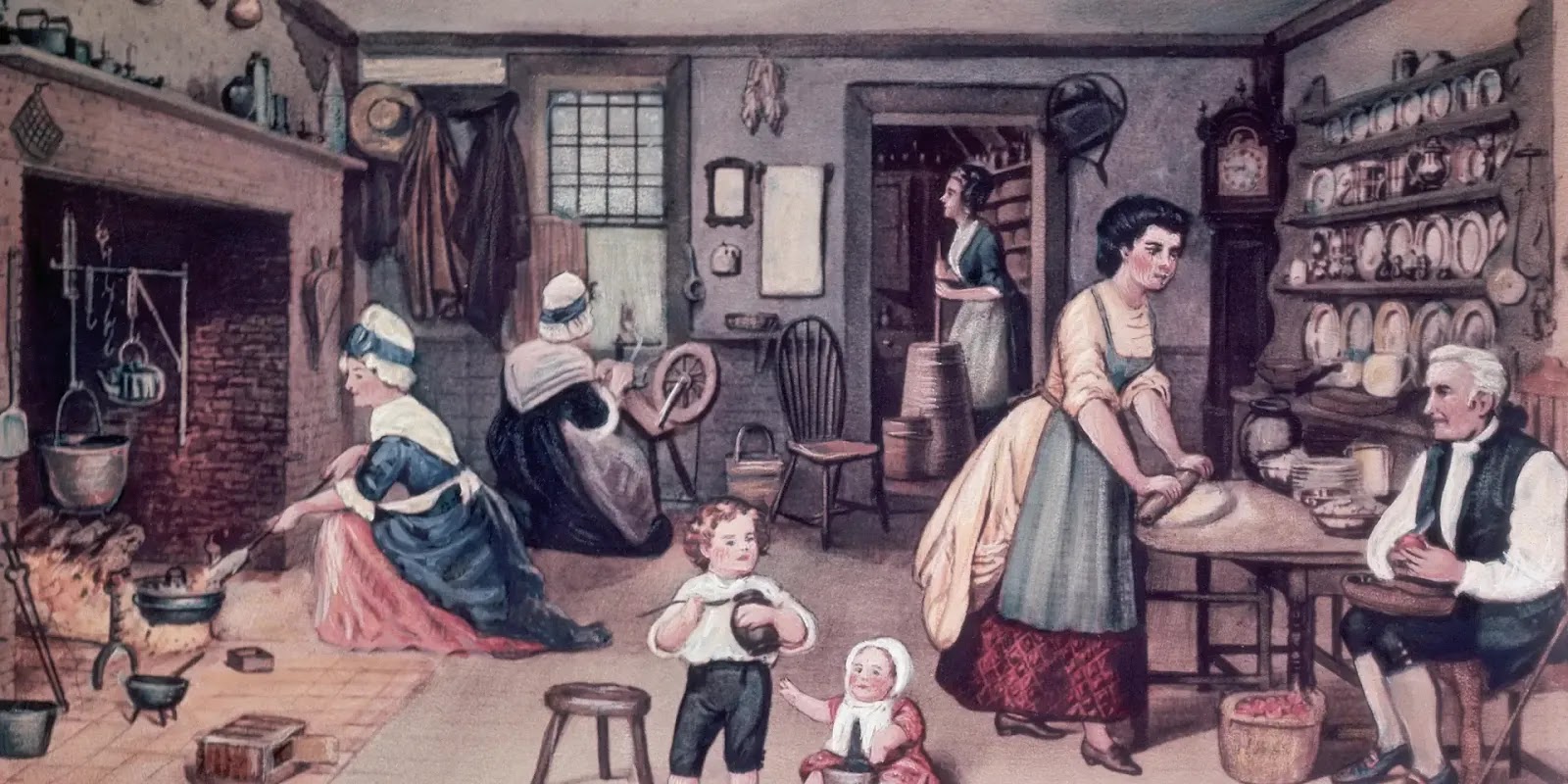
    Colonial Farm Kitchen. Notice clock in the corner.


    THE 1600s


    Preliminary Comments


    About 350,000 Europeans emigrated to the American colonies in the 1600s. They were risk-takers. They left long-settled communities and societies to get on small, crowded sailing ships to make the dangerous 3,000 voyage to a new land that was mostly wilderness. About 5% died. They had to adapt to a new, frontier environment of forests and swamps. They had to “tame the howling wilderness.” 


    A high percent of the European immigrants in this period were from England. Almost all were Protestants.


    Emigrants from England came over in three “waves.”  Then a fourth ‘wave” came to the North American colonies in the 1700s. They were four distinctly different groups of people from different areas of the English isles.


    To understand why these four groups left England and Scotland, at different times and for different reasons, it is necessary to know a little bit of English history during this period.


    The Failure of the First Settlements


    The earliest settlements of Pilgrims coming to Plymouth (1620) and immigrants coming to Jamestown (1607) were failures. About half of the Pilgrims died on the voyage or in the first year. Very few new immigrants came to Plymouth. The English Pilgrims actually came from Holland; they were worried that they were being assimilated into Dutch society.


    The company that settled Jamestown continued to send over thousands of new immigrants and many supply ships. The first settlers were mostly single men looking for gold; only later did the Virginia Company send over families. In the first 15 years, about 75% of the settlers died. There were many reasons, including that Jamestown was built on a malarial swamp. Neither group was prepared to deal with the harsh “wilderness” of America.


    But there was one success. Some of the Jamestown settlers began growing tobacco.


    The First Wave – Puritans coming to the Boston area. (1629-1642)


    English background. In the early 1600s, there was political tension and conflict in England. The English kings thought they could rule without consulting Parliament; Charles I suspended Parliament for eleven years. But many people in England thought the King and Parliament should rule together. They opposed the king’s right to rule without Parliament. 


    At the same time, there was a bitter conflict over who would control the Church of England. The Church of England was the official, government-supported church. It was Protestant (it was illegal to be a Catholic in England at this time). Most English were members. Some members wanted a church controlled by its bishops, who were appointed by the king. Top-down, hierarchical control. Others wanted to “reform” or “purify” the Church, move it further away from traditional practices and beliefs. Some even thought individual congregations should be able to appoint their ministers without interference from the bishops. These people were called Puritans.


    The fights over who should control the government and who should control the Church of England were connected. Supporters of the king also supported a Church controlled by its leaders, the bishops. Many supporters of Parliament were also Puritans.


    By the late 1620s, it was obvious that the king and the bishops had won the fight over power and control. Puritan ministers were being removed from their pulpits. Many Puritans recognized they had lost and wanted to leave England. They came to the American colonies.


    From 1629 to 1642, 15,000-20,000 Puritans came to the Boston area and quickly spread out. Few new immigrants arrived in the rest of the 1600s, only about 7,000. This area was known as the Massachusetts Bay Colony. They were highly organized and well-prepared to set up towns and farms. They came in families, brought farm equipment and supplies, and their own Puritan ministers. They laid out towns and distributed land for family farms. They quickly set up a seminary to train new Puritan ministers; we now call this school Harvard. They prospered and their numbers increased rapidly. They spread out into much of New England and beyond.


    They wanted to set up a Puritan society that they controlled. They discouraged anyone who wasn’t a Puritan from settling in New England. Non-Puritans were forced to deport and not return on threat of death. Four Quakers who came back were hung.


    The Second Wave – Royalists coming to Virginia (1649-1660)


    In 1642, civil war broke out in England – the Puritans and Parliament supporters against the king and his supporters. Supporters of the king were called royalists (also called cavaliers). Many were members of landowning aristocratic and gentry families.


    The king and his supporters lost. The king was executed. Many royalists didn’t want to live under a government and church controlled by Parliament and Puritans. Some emigrated to the British West Indies and some to Virginia, where a pro-royalist governor created a stratified society dominated by royalists. He gave them large tracts of land, the basis of the spread of tobacco plantations. 


    They tried to recreate the kind of society and government they ruled before the civil war. Fortunately, there was hundreds of miles of wilderness between Virginia and Massachusetts.


    About half of the European immigrants in the 1600s were poor people who couldn’t afford the ship passage to America. To get to America, they became “indenture servants.” Most came to Virginia and Maryland.


    The tobacco growers owned great amounts of land but very few people to work it and process the tobacco. They encouraged “indentured servants” to come to Virginia. When the ships landed in America, the immigrants were auctioned off to pay the shipowners for passage. Typically, an indentured servant “agreed” to work for their owners for four to seven years. They had almost no rights. After their indenture was complete, they were free; some received some compensation. They were offered free or cheap land, so they had little reason to continue working on plantations. But since most of the good land along the rivers of Virginia was owned by earlier immigrants and their descendants, the new immigrants had to move west to the unsettled frontier, much of which were the foothills and valleys of the Appalachian Mountains. Tobacco growing spread rapidly and was by far the American colonies largest export in the 1600s and 1700s. 


    The Third Wave – Quakers coming to Pennsylvania (1680s and early 1700s)


    Not everyone in England belonged to the official Church of England. They were called “dissenting sects.” One of the most prominent was the Quakers.


    The Quakers were persecuted by government and church officials. In the 1680s, William Penn worked out a deal with the king, who granted Penn, who had converted to Quakerism, ownership and control over a large area in America in exchange for cancelling loans the king owed to the Penn family. Pennsylvania. It became a haven for Quakers. Many of the Quakers in England, over 20,000, emigrated to Pennsylvania and nearby areas. They established a society based on radical Quaker ideals. They were later joined by German sects with similar beliefs. 


    By the end of the 1600s, there were about 250,000 European immigrants and their descendants along the Atlantic coast. A very high percent, maybe 90% or more, were from England and Wales. Their numbers increased rapidly because of immigration and the high birth rates in New England.


    FROM 1700 TO 1775 (THE FIRST YEAR OF THE AMERICAN REVOLUTION)


    Immigration was different in the 1700s than in the 1600s. There were four main groups:


    English – less than 100,000

    Scots and Scots-Irish – about 150,00

    German speaking – about 100,000

    African slaves – about 250,000

    Small numbers of other groups, including French Huguenots (Protestants) and Irish Catholics.


    Total immigration in the 1700s was around 600,000 people. English immigrants were a minority of the European immigrants and a small minority of total immigrants. By 1775, the American colonies were made up of a diverse population; English immigrants and their descendants may have been a minority of the total population.


    English Immigrants

    The composition of English immigrants in the 1700s were somewhat different than that of English immigrants in the 1600s. They were not part of distinct religious or political groups. They were generally poor. They came from different parts of England, including the borderlands with Scotland. Many, maybe as many as 50,000, or over 50%, were criminals or convicts (in England, you could be sent to prison for not paying a debt). England emptied its jails and sent the inmates to America. Most ended up in Virginia and Maryland because that was where the ships were going, to pick up tobacco. The convicts were indentured for up to 14 years and did not get any land or compensation. They were treated no better than slaves. Most became part of the landless poor after their indenture was up. If they survived.

    People from the borderlands between northern England and Scotland (1700s) and Highland Scotland

    The Scots and Scots-Irish

    Fighting between northern English and lowland Scots, and among Scottish clans, had been going on for hundreds of years. This was a frontier, lawless area – little organized government or military control. There was much violence, including raids to cause destruction, pillage, and steal cattle. In addition, there was family and clan feuds on the Scottish side of the border.


    In the 1600s and 1700s, England completed its campaign of clearing out Irish Catholics from Northern Ireland. Favored English were given large land grants. Many of the farm workers came from Scotland. They were Protestant. They were called Scots-Irish.


    In the 1700s, a stronger English government successfully established control over northern England. Through battles and brutal military campaigns, England subdued the lowland (borderland) Scots. Many didn’t like the new order. At the same time, highland Scot landowners began clearing out their tenant farmers, who became landless. Many Scots went to Northern Ireland to work. But conditions were not much better than in Scotland. In the 1700s, about 100,000 Scots and Scots-Irish emigrated to the American colonies.


    Many of the settled colonies weren’t happy about the less “civilized” new immigrants. But the expanding plantation colonies of Virginia (tobacco) and South Carolina (rice) needed their labor.


    Many of the borderland people and Highland Scots settled into a frontier environment in the foothills, valleys, and mountains of the Appalachian Mountains (the western geographical border of the colonies). Some Highland Scots settled in parts of North Carolina, a borderland region between Virginia and South Carolina. For a long time, there was little government or legal presence. Few churches and little organized religion. Disputes were often settled by violence. Many raised cattle as in the borderlands. In America, they were called the “backcountry” people.


    German-Speaking Immigrants

    Many of the German-speaking immigrants came to America to avoid religious persecution. They held similar religious beliefs as the Quakers. They also were persecuted by German governments and their official (state-supported) religions. When the Quakers established Pennsylvania, it was a safe haven for the German sects, including the German-speaking Amish, Mennonites, Moravians and Schwenkfelders. About three-quarters of the Germans landed in Philadelphia.


    The German sects, like the Puritans and the Quakers, tended to come over as families and often with their ministers. They moved to the new lands west of the Quaker-dominated region around Philadelphia. Even today, part of their settlement is called the “Pennsylvania Dutch” country. The word “Dutch” is derived from the German word for Germans.


    Because of the waves of Scot and German immigration, Pennsylvania’s population exploded from about 18,000 in 1700 to about 120,000 in 1750. The Quakers had become a minority in their own colony.


    African Slaves


    The largest colonial immigrant group was African slaves. About 250,000 African slaves were brought to the American colonies up to 1775. The number started to go up in the late 1600s and then accelerated after 1725. The total black population of colonial North America in 1775 was probably over 500,000, mostly slave but a small percent were free. Most of the slaves in the South worked on plantations, especially in Virginia, Maryland, South Carolina, and North Carolina.


    Why were there African slavery in colonial America but not in England? There are demand side and supply reasons. 


    The short answer is: the rapid expansion of the production of plantation crops. The limiting growth factor, as always in colonial America, was labor. Expansion originally depended on indentured servants. But many immigrants, including indentured servants, didn’t want to work on plantations. German-speaking immigrants went to Pennsylvania, not Virginia, Maryland, or South Carolina. Many Scottish immigrants avoided indenture. Then there were the long-run costs. Indentured servants only worked for four to seven years. Plantation owners had to buy new servants to replace the freed servants. For complicated reasons, the number of  immigrant indentured servants fell and the cost of  rose in the late 1600s. African slaves cost more but they were slaves for life. In addition, children of slaves belonged to the slaveowner, a cheap source of future labor.


    South Carolina was a special case. Plantation agriculture started when a few slaveowners and their slaves migrated from Barbados. Rice, not sugar, was the most profitable crop. Rice was exported to Europe and to Caribbean islands. By the late 1700s the rice growers in South Carolina were some of the richest families in America.


    Slaves were available. The American continent was importing large number of slaves in the 1700s, mostly for the sugar-producing Caribbean islands and Brazil. Much of the trade to the Caribbean was controlled by English slavers. It was a short step to expand to the North American colonies. New England merchants and shipowners also entered the slave trade.


    Native Americans


    I have not mentioned Native Americans. There is currently much writing and discussion about Native Americans. It is a complicated topic. For the early relations  between Native Americans and European immigrants, see Ken Burns’ documentary The American Revolution.


    There were attempts to enslave Native Americans. The attempts failed.


    In the end, unlike Spanish or Portuguese America, the rapid increase in the European population, combined with the pressure to expand farming into Native American lands with relatively small Native American populations, doomed Native American independence in parts of colonial and early Federalist America. Some tribes adapted. Some moved west. The Iroquois Confederation avoided most of the pressure and remained independent up to the American Revolution. But the long, tragic history of land-hungry white Americans taking Native American lands had begun.


    CONSEQUENCES


    Many of the European immigrants came to America to avoid religious and political persecution. Almost all early English immigrants had grievances against the English government when they emigrated. German-speaking immigrants had no ties with England. Many Scots hated the English. Equally important was the lure of unlimited new farmland. Rather than being tenant farmers (paying rent to a landowner) or landless farm laborers in Europe, immigrants had a chance to own large farms (by European standards) and be independent. For many, religious freedom and economic independence went together. For Africans, the exact opposite happened.


    All groups had different ideas about how government, religion, and society should be organized. Or not organized. After the American Revolution, as the separate colonies became the United States, the clash of their different ideas would become the basis of many of America’s future political conflicts.


    The rapid increase in the population of these groups and their westward expansion looking for new farmland would have a profound influence on American history. The first consequence was that the western movement to new lands was a contributing factor in causing the American Revolution.


    AMERICA IN 1775


    America in 1775 was a much different colony than the America of 100 years earlier. Population near the end of the 1600s of around 250,000 – almost all of English descent and few slaves – had become a society of about 2 million people in 1775 – about 1.5 million European immigrants and their descendants and about 500,000 African slaves. The white population had become more diverse and less English. The African slave population was around 25% of the total population. 

    With high birth rates, plentiful and diverse food, and open immigration, Americans could expect their population to double by 1800.


    Why the change? 


    ·      Access to “unlimited” free and cheap land for farming. 

    ·      Geographic mobility – individuals, families and groups leaving settled communities to move west. 

    ·      Fortunes to be made producing plantation crops and exporting into protected English markets (similar to the sugar islands in the Caribbean). 

    ·      Expanding merchant and shipping class to handle rapidly expanding domestic and foreign trade.

    ·      Development of craft production to fill rapidly rising standards of living. 

    ·      Overall opportunity – fewer obstacles to personal and family advancement than in England and Europe. Individual and political freedom and democratic government compared to Europe and even England.


    The Economy


    Almost all Americans, about 90%, engaged in agriculture. By 1775, about half of the white population owned their farms. 

    Agriculture by 1775 was very different than the subsistence (producing food just for the farm family) agriculture in most of the rest of the world. Americans with large family-owned farms and plantations, produced enough food to make Americans well-fed, plus a surplus of grain and commercial crops for sale to local markets, towns, and for export.


    Americans produced a surprising variety of food and crops. For example, many farms and plantations had apple orchards. The apples were mostly used to produce cider. I was also astonished to learn that bananas were grown in South Carolina. 


    Americans had begun to experiment with growing mulberry trees throughout the colonies. Mulberry trees were the food for silkworms. Americans were trying to develop a silk industry. This venture would eventually fail. But many towns and rural areas even today have a Mulberry Street. Including Boston.  


    America’s largest exports in colonial times were the plantation crops of tobacco and rice, followed by indigo (a blue dye from the indigo plant for England’s growing textile industry). The colonies also exported grain and other products like lumber and horses to the sugar-producing islands in the Caribbean. 


    The American colonists imported most of their manufactured products from England. Everything from cloth, clothes, shoes, guns, swords, clocks, furniture, dinnerware, china (including Wedgwood), silverware and silver products, and all sorts of manufactured metal products including pots and shoe buckles. Wealthy planters imported luxury goods from England and Europe, imitating the wealthy landowning class of England. And tea.


    The American colonies were England’s largest trading partner by 1775. While sugar from the West Indies was a more valuable English import than American tobacco, America with its large and growing population of prosperous farmers, planters, and merchants was a major market for English exports.  


    In the 1600s, almost all this trade was carried on English ships and controlled by English merchants. But by 1775, the American colonies had become major ship builders, about one-fourth of the total merchant ships of England and America. More of the trade with England was carried in American ships. And more of the trade was organized by a growing merchant class in American ports. 


    And by 1775, Americans were producing some of their own manufactured goods. Most farm families made cloth. American craftsmen were producing furniture, dinnerware, and silver products. The most famous silversmith was Paul Revere.


    The colonial image above shows a farm family with metal pots and other metal goods, a gun over the mantel, metal buckles on man’s shoes, a butter churn (owned cows?), and a spinning wheel to make yarn. They also owned a grandfather clock. These products were of a simple style; other than the metal products, some of them were probably made in America. England would regret exporting rifles to America.


    With seemingly unlimited land and a rapidly-growing population, rising exports, and new types of economic activity, the American economy was also rapidly growing and developing. On average, white Americans enjoyed a high average standard of living by 1775. Possibly the highest in the world. 


    Politics and Government


    America was more democratic than England. No king, no aristocracy who dominated land-holding and political power. Much higher literacy rates. A much higher percent of white males voted and were active in local government than in England. America was almost entirely self-governing for almost 150 years before England attempted to tighten control in 1763.


    Americans were highly literate; about 70% of white males and 50% of white females could read and write. The percents in Puritan New England were very high – about 90% for men and 80% for women. New England had its first printing press by 1640. 


    The literacy rates in England were much lower.


    The American colonies had more newspapers than England, which had a larger population. Foreign observers often remarked that Americans seemed to love to read and talk about politics (often in taverns).


    By 1775, over 50% of free adult males were qualified to vote. And Americans were very active voters, with high turn-outs at election times (free food and alcohol from the candidates helped raise turn-out rates). In England, by contrast, fewer then 5% of adult males were qualified to vote. In over half of parliamentary elections, there was only one candidate. 


    American colonies were self-governing. At both the local and provincial (colony) level, most of the government officials were democratically elected. The exception was that most of the provincial governors were appointed by London. But their salaries had to be approved by provincial assemblies, which gave them control over the governors.


    One example of America’s independence from English control was that Americans found it easy to evade the Navigation Acts. The Navigation Acts basically said that most of American exports and imports had to be with England or English colonies. But Americans routinely ignored the Navigation Acts by trading with other countries and their colonies. Although illegal, Americans and American ships imported goods from other countries. England had too few officials and ships in America to stop this smuggling (sneaking in illegal imports). Probably the best-known smuggler was John Hancock.


    England began to crack down on smuggling in 1763, after the end of the French and Indian War.


    OVERVIEW 

    By 1775, the American colonies had become a rather unique society. It was very different than most of the rest of the world, even England. Large, family-owned farms. New land on the frontier. Commercially active. Literate. Democratic and politically engaged. Economic opportunity – few barriers to start new businesses or develop new skills (no guilds). Physical (move west) and economic mobility. King far away and no aristocratic landowning class. No long-settled rural class society.  No large standing army. Low taxes approved by local governments.


    One partial exception. By 1720, five colonies, and Westchester County in New York, had “established” religions, that is, religions supported by taxes. They were Congregational  (Puritan) in Massachusetts and Connecticut, and Church of England (Anglican) in Virginia, North Carolina, and South Carolina. By 1775, other Protestant denominations, besides Quakerism, were flourishing, including Presbyterians (Scots), Baptists, Methodists, and German pietist sects. After 1740, America was swept by waves of evangelical enthusiasm.


    By 1775, Europeans had become or were becoming Americans. England’s North American colony was less “English” and more diverse than a century earlier. Puritans were becoming Yankees; many were challenging their Puritan roots and moving away from the Boston area.  By the early 1700s, many New Englanders thought Harvard (established to train Puritan ministers and teachers), had become too “liberal.” Virginia royalists had become plantation owners, with African slaves replacing European indentured servants. England had virtually outlawed slavery in 1772 and was moving to stop the African slave trade. Many had gone from being Tories (supporters of king and aristocrats) to becoming Whigs (critics of king and his royal governors of Virginia) as they engaged in bitter political battles with appointed English governors and resented high tariffs imposed on their tobacco exports to England. 


    The Virginia planter class, somewhat unexpectedly given their backgrounds, would contribute many of the leaders, supporters and military officers in the coming American Revolution, including George Washington, Thomas Jefferson, James Madison and James Monroe. And the father of Robert E. Lee.


    Quakers came to America as a small persecuted religious group and had become the dominant merchant and political group in the greater Philadelphia regions. Maybe the Scots and Scots-Irish, relatively late arrivers, probably changed the least by 1775, but many hated the English for the brutal conquest of Scotland and already had a strong sense of personal independence.


    The German-speaking farmers in Pennsylvania challenged the political monopoly of the Quakers and forced them to share political power.


    There was individual mobility. The most famous example was Benjamin Franklin, who went from being a penniless “immigrant” from Boston to the richest man in Philadelphia. He was an urban entrepreneur and a major investor in urban real estate. An anglophile (lover of the English), he also went from a man who retired to England and expected to die there to be one of the leaders of American independence from England.


    The Manigault family went from penniless religious refugees (French Huguenots) to the richest family in South Carolina in three generations. (They would be followed after the Revolution by the du Pont family, French political refugees.)


    This was not a settled or stagnant society. By the standards of the time, colonial America was a “modern” society. The main threat to dynamic change and growth was that America was still an English colony. That would change.

      ==========================================================

    See the next post in this series, 

    The American Revolution and the New Country: American History, 1755-1790

    followed by

    A New Nation, America from 1789 to 1860

    The classic book on colonial America is Albion’s Seed: Four British Folkways in America, a 1989 book by David Hackett Fischer. Long, incredibly detailed about all aspects of colonial American life. If you get through the entire book (last section optional), you should consider becoming an American History major.


    For an excellent survey of colonial America and the other colonies in North America, see Alan Taylor, American Colonies:  The Settling of North America, 2001. 


    For a discussion of how the North American and West Indies colonies fit into the wider English imperial empire that began in the 1600s, see


    England in the 1600s: The Beginning of England’s Rise to Global Power and Wealth


    This essay includes a discussion about how the American colonies fit into the English imperial system, especially the Navigation Acts.