 |
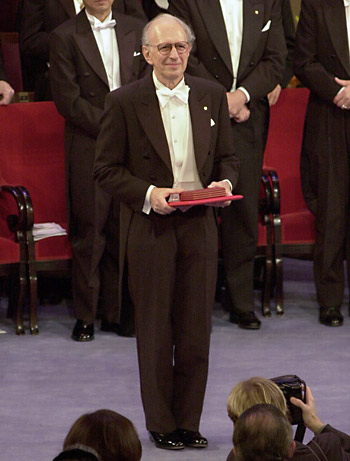
| Eric Kandel Receiving Nobel Prize |
There is a private liberal arts college near me. They allow outsiders to audit summer courses
(applying the profound wisdom that if there are empty seats, the marginal cost
of one more student is zero. Any revenue
is pure gain.) I was interested in a
course Introduction to Neuroscience.
I checked out the course. That
got me thinking about the economics of a college course.
This college charges students about $4,000 a course. The course is probably taught by a full-time
professor, probably an Assistant Professor since it fulfills a liberal arts field
requirement. There are no
pre-requisites. The prof probably is
paid about $8,000 to teach this course.
Assuming 20 students in the course, each student is paying $400 to
listen to the prof. About 10% of the
total cost. What does the other 90% buy
you?
The main reading is In
Search of Memory by Eric Kandel, who won a Nobel Prize for his research in
neuroscience. He is an engaging,
wonderful writer; I had already read another book by him. So I bought this book for my Kindle; it cost
$9.99. I read it. Much of the book talks about Dr. Kandel’s
personal and intellectual odyssey that led to his Nobel Prize. He also patiently summarized the past
research that laid the foundation of ideas and conjectures for his
research. The difficult parts were the
explanations of his research. Some
background in very basic biochemistry and a little bit of explanation on the
structure of the brain is needed (many illustrations in the book). I would guess that about two good lectures
would do it.
The rest of the readings were supplemental and available on
the Internet. One other point. To really understand Dr. Kandel, it is
necessary to know more of the background history in the intellectual climate of
Vienna, especially during the 60
years before the Nazis marched in, in 1938.
Dr. Kandel talks a lot about this and how important it was to him (his
family, like many others he talks about in this book, were refugees fleeing
Hitler). No reading on the historical
background was assigned. I doubt if the prof knows much about the historical
background.
Another point. To be
really prepared to understand the technical material on how the brain functions
and particularly how we remember, a good course on the structure and dynamics
of the brain is necessary. Maybe there
is a course at this college; if so, it would cost another $4,000. Or you could spend about $50 to buy and watch
a great video course on this topic from Great Courses, given by a
neuroscientist who is the Professor of Cell and Development Biology in the
School of Medicine, and Professor of Neurosciences in the College of Arts and
Sciences at Vanderbilt University. (I’ve
seen it.) But this college won’t give you
three credits to watch this course.
So better, far less expensive alternatives are
available. So why does the course cost
so much and why does 90% of the cost go to the college and not the prof? What exactly are you buying for $4,000?
First of all, the classroom.
But classrooms can be rented cheaply and not necessarily at the
college. The local public library has a
meeting room that is equipped as well as any classroom. In fact, profs from this college teach
lifelong learning courses there to idle adults like me. At $75 a course. Let’s hear it for price discrimination. The
difference? I don’t get any college
credits for taking the course.
You are also buying a whole bundle of goods and services
that the college offers outside the classroom.
This college has a modern gym and pool it just built. So you are saving $50 a month so you don’t
have to go to a comparable gym and pool a mile away. You are buying psychological counseling,
tutoring, cultural events, social events, networking opportunities, career
counseling and other services. You get
to play sports. You get access to an
excellent library, which might not be worth much to you, given the
Internet. What is all this worth to
you? It depends (you knew I would say
that somewhere in this blog). But I
doubt if all this adds up to anywhere near $36,000 a year.
Go to the admin buildings.
You will probably be amazed at how many people it takes to administer a
college. How many vice-presidents, deans,
associate deans, assistant deans, directors, assistant directors and onward
down the bureaucratic food chain. Marvel
on how nice their offices are. Notice
particularly the size of the admissions department and read in the annual
report how much the college spends on marketing. This is a very competitive industry. It takes a lot of money to convince a few
hundred students to come to this college.
The ones who choose to go there pay for all this marketing.
But the most expensive thing you are buying is a
degree. Colleges form a self-regulating
cartel that determines who can issue a college degree. Inexpensive alternatives are simply
forbidden. Well, not simply. You would not believe the state and
self-accrediting requirements to be a degree-issuing college. No wonder it
takes so many people to do so much paperwork.
But very little of this has anything to do with the cost or quality of
the education you receive. A few
accredited for-profit colleges strip away much of the auxiliary services,
charge lower tuition and still make a good profit.
This is also a strange business. The buyer (you) has virtually no say in the
courses offered, the requirements for graduation, when the courses are taught,
or what they contain. The immediate
service provider, the prof, is probably also tenured, which means he can’t be
fired for incompetence. You can’t
complain. It also means he can pretty
much choose what courses he wants to teach.
The list of economics electives at this college is rather strange. Many of them should probably be in the
sociology or political science department.
You won’t learn very much about how the American economy actually
functions. For example, there is no
course on financial markets.
So, hopefully, you’re mostly buying the middle-class admissions
ticket. But wait. So are a whole lot of other students. The college industry is one of the great
growth industries (and one of the worse managed but that doesn’t matter). So now you have to go to graduate
school. This is where education gets
serious. You have to choose a narrower
field of study and really learn it.
Unfortunately, you (and/or the rest of society) have already spent
$160,000 to get you there. And you
better be successful because you probably have some big student loans to pay
back.
Footnote. If I
understand what Dr. Kandel and others have learned about memory, then lazy
students are rational learners. If you
are taking a course you’re not interested in (it fulfills a graduation
requirement, it’s offered at a convenient time, the prof is an easy grader,
etc.), then it makes sense not to study very much. Cram just before the exams. Develop good guessing skills, especially if
the prof is lazy and gives multiple-choice tests. Get as much of the material you think will be
on the test into your short-term memory just before the test. Ignore the rest. After the test, you’ll probably forget most
or all of it (it doesn’t make it to your long-term memory). Don’t worry about it – that’s how your brain
works. Blame it on evolution.
________________________________________________________________________
You might be interested in the related post, College of the Future.