Tag: cordite

  • KELP IS ON THE WAY:  How American Kelp Helped Save the English Explosives Industry in World War I

    KELP IS ON THE WAY: How American Kelp Helped Save the English Explosives Industry in World War I


    Dr. Andrea Dragon


    Seaweed Saves England


        Each of the hundreds of millions of shells Great Britain fired from thousands of field guns, howitzers and mortars during World War I contained two explosives: cordite, a kind of nitrocellulose (what Americans call smokeless powder) to propel the shell out of the artillery piece and send it flying toward the target, and TNT, the shell’s high explosive payload to blow up the target on impact.  

    In the early months of the war, the demand for cordite far exceeded the manufacturing capacity of Great Britain’s explosives factories.  To meet production demands, in October, 1914, the British Army contacted representatives from DuPont and its 1912 spinoff Hercules, who were the leaders of New Jersey’s established explosives industry, and signed agreements with them to produce nitrocellulose and cordite, load it and TNT into shells, and ship them from New Jersey ports to the Western Front.

           But cordite was different from the nitrocellulose-based smokeless powder products New Jersey explosives pioneers had been manufacturing in “powder towns” since the late 19th century. Unlike American smokeless powder, cordite included nitroglycerin transforming it into a “double-base” explosive.  Although New Jersey’s powder industry had decades of experience with nitroglycerin (at that time, anything, even a liquid, that exploded was a “powder”), no one had ever added it to smokeless powder because nitroglycerin damaged gun barrels.  That’s why the British cordite formula (30% nitroglycerin, 65% nitrocellulose, 0.8% acetone) also included 5% vaseline to coat and shield gun barrels from this kind of damage.

           At first, executives of the New Jersey explosives industry believed nothing much stood in the way of them making tons of cordite and tons of money. Not only was manufacturing nitroglycerin in sufficient quantities fairly easily done, vaseline could be sourced from the large Cheeseborough-Ponds factory in Perth Amboy. America’s vast railroad network could transport the cotton needed to make nitrocellulose from southern states to New Jersey’s powder towns.  Everything seemed to be in place to start building factories for cordite production, but there was still one very big problem the explosives industry had to solve – where to obtain acetone.

           Most readers are familiar with the organic chemical acetone because it’s useful to have around the house not only as a nail polish (which is mostly nitrocellulose) remover but also because there’s nothing better for removing paint or sticky gunk children have spread around.  Bought at the local home improvement center, acetone efficiently cleans off lacquer and oily finishes from metal surfaces before repainting.  Today, it’s one of the many products produced by the petroleum industry and is inexpensive and ubiquitous, but during WWI acetone was scarce because Germany had been the world’s leading supplier.

           It wasn’t as if Great Britain’s early 20th century chemists didn’t know how to make acetone, which was a by-product of burning wood to make charcoal.  The basic principles of acetone production had been known since the Middle Ages, weren’t covered by patents, and didn’t require sophisticated technical equipment. 

    Output estimates vary, but roughly speaking it took a hundred tons of wood to yield just one ton of acetone.  When the war began in 1914, most of Great Britain’s forest reserve was long gone, but Germany’s vast Black Forest had ample trees for making acetone and dominating the market.

           Since 1862, when Louis Pasteur discovered that alcohol was a product of fermentation by clostridium bacteria, chemists had been experimenting with fermentation to learn how the process produced various alcohol-like substances.  One of these chemists, Chaim Weizmann, a Russian immigrant scientist and one of the founders of the modern state of Israel, was researching methods of producing synthetic rubber at the University of Manchester when he discovered that acetone, butanol and ethanol could be created by fermenting starchy grains or potatoes using a type of clostridium bacterium (other, more sinister clostridia bacteria cause botulism and C. difficile) commonly found in soil.  Weizmann patented it two years later.  This breakthrough meant that instead of clear-cutting and burning up Great Britain’s meager remaining forests, acetone could be produced much more efficiently by fermenting an (easily) renewable crop like corn.

           Soon tons of American-grown corn were being shipped to Great Britain to be fermented into acetone, but this process became problematic for three reasons.  First, German U-boat activity made trans-Atlantic shipping  risky.  Second, corn took up precious space in ships that could be used for more high-value cargo.  Third, corn was a food crop and during the war many people in Great Britain were hungry, making it hard for the government to justify turning food into an industrial chemical.  England was importing 30% of its food consumption from U.S. and Canada.  Clearly, other sources of fermentable starch had to be found.  For a while, British children were encouraged to gather horse chestnuts, but fermenting them was unsuccessful and the search for ways to make acetone continued.  

    In 1916, the situation had become so desperate that Prime Minister Lloyd George proposed taking over all distilleries in the United Kingdom and transforming them into acetone factories.

             American explosives manufacturers weren’t sure how they would solve the acetone problem.  Nevertheless, in February of 1915 Hercules Powder Company signed a contract to produce millions of pounds of cordite at its New Jersey nitrocellulose “powder works.”  The contract stipulated that Hercules would have to find an acetone supplier who wasn’t part of any current supply chain to prevent Hercules from either reducing the existing supply of acetone, or from cornering the market.  Not only that, to get the cordite contract, Hercules promised to keep track of all the acetone it used and supply Great Britain with an equal amount. 

           Why was acetone required to make cordite?  Why was a solvent needed to make any kind of smokeless powder?  At its most basic level, nitrocellulose is simply cotton that has been soaked in nitric acid and then dried until it forms a stiff, white mass.  Because ignited nitrocellulose burns first on its surface, forcing a solid mass of nitrocellulose through a large extruding machine not unlike a modern pasta-maker increases its external surface by transforming the single mass into many spaghetti-like strands, or cords.  But before that could happen, the stiff lump of nitrocellulose had to be mixed with a solvent to change it into a gelatinous dough pliable enough to go into the hopper of the extruding machine, be forced through the holes, and come out the other end as strands of cordite.

           Hercules and other American smokeless powder manufacturers used ether-alcohol as a solvent, but the British specified acetone because cordite made with it required less of the gun barrel-corroding nitroglycerin than powder made with ether-alcohol.  At first, Hercules management tried to make acetone from acetic acid bought from manufacturers of table vinegar but weren’t successful.  Then the company tried arranging with industrial distillers of wood alcohol to produce acetone, but the process was developing too slowly and didn’t produce the quantities needed to fulfill the cordite contract.  Not only was Hercules falling behind the cordite production schedule to the tune of a million pounds a month, it was also woefully short on its promised deliveries of acetone to Great Britain.

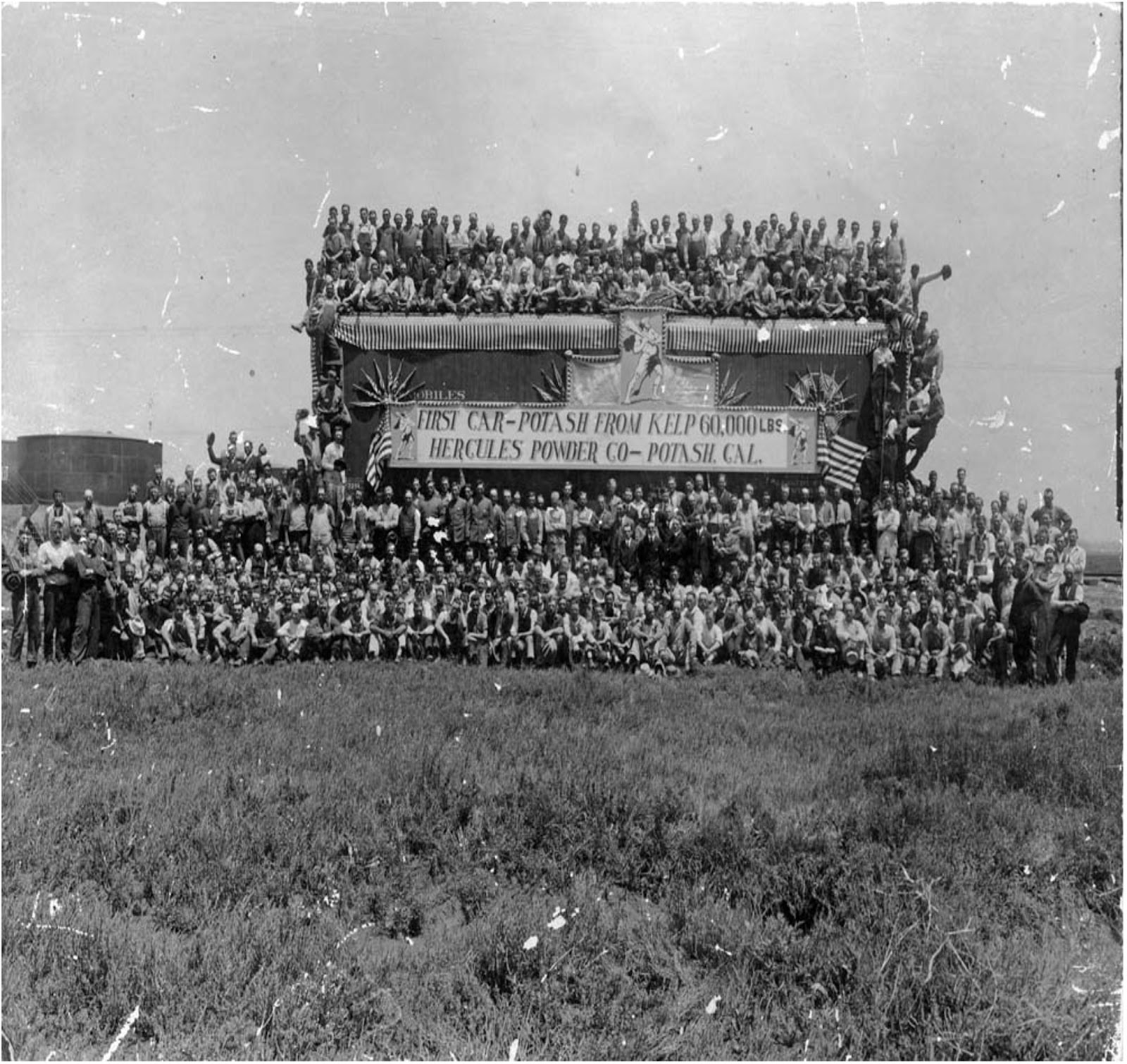
             Hercules’s management investigated making acetone from beer slop, molasses, and wood pulp without much success.  The company’s situation was bleak when George Markell, vice-president and general manager of the company’s New Jersey operations, read in an old encyclopedia that Scots living near the coast once gathered kelp from the ocean, dried and burned it in retort-like ovens recovering potash which they used as a fertilizer.  After he learned that acetic acid could be produced by fermenting kelp, Markell developed a plan to harvest kelp from the Pacific Ocean off the coast of Southern California, put it in vats, allow it ferment like beer, capture the acetic acid given off in the fermentation process, and make acetone from the acetic acid.

           Markell knew a huge bed of kelp existed a short distance from San Diego and best of all, it was essentially free.  Markell went to California in 1915 and began buying up land near Chula Vista, then contracted with a Midwest farm equipment manufacturer to design and build a large hay-mower capable of operating in sea water.  Hercules wasn’t the only explosives company seeking to cash in on the skyrocketing demand for acetone so Markell concocted a cover story claiming his company was going to “farm” kelp to make potash fertilizer.  Soon 1,500 Hercules employees were using the special mowers to harvest tons of kelp, load it onto barges which transferred it to shore where some of it was used to make potash while the rest was put into two-hundred 50,000-gallon wooden tanks and allowed to ferment producing acetic acid that was further processed yielding not only acetone, but other useful ketones such as methyl-ethyl ketone, a lacquer thinner, as well as potassium nitrate (saltpeter) one of the ingredients of black gunpowder. By the middle of 1917, nearly one million pounds of acetone, produced from 600,000 tons of kelp, had been loaded into railroad tank cars and shipped to New Jersey where 5,000 tough, brave powder men and women working in hazardous conditions made cordite for Great Britain at a rate of 100,000 pounds per day.

           After the war, Hercules closed its Chula Vista operation in 1919 and today the site is a nature center.

           Recently, I ran across a 2022 scholarly article describing new efforts to produce acetone from kelp harvested off the coast of Scotland.  This article ran to forty-two pages, had eleven authors, and contained eighty-five footnotes but not a single word about the Americans who fermented kelp, produced acetone, and made the cordite that helped Great Britain achieve victory in World War I.


    Dr. Dragon teaches a course at Rutgers University, New Brunswick, New Jersey on the New Jersey explosives industry.


    Related essays by Dr. Dragon:


    The Maxim Machine Gun and Smokeless Powder


    New Jersey Artillery Explosives Production in World War I


  • The Maxim Machine Gun and Smokeless Powder

    The Maxim Machine Gun and Smokeless Powder

    Written by Andrea Dragon, Ph.D. Dr. Dragon investigates and writes about New Jersey’s industrial history. Professor Dragon will be teaching a continuing education course on “New Jersey’s Explosive History” at Rutgers – New Brunswick, starting on October 8, 2025. For details, see the course description at the end of this essay. 


    Hiram Maxim and his machine gun

    Hiram and Hudson Maxim:  Inventors of the Machine Gun and Developers of Smokeless Powder


    New Jersey’s eccentrically brilliant brothers, Hudson Maxim (1853-1927) and his cantankerous, womanizing older brother Hiram Stevens Maxim (1840-1916) were both born into a poor, rural Maine family. Hudson claimed receiving his first shoes when he was sixteen. He rarely attended school and was self-taught. Astonishingly, Hudson Maxim’s earliest claim to fame was as the author of a popular “teach yourself” book on penmanship. He also possessed a breathtakingly large ego, once bragging that he could write an article on almost any subject in the world without doing any research.


    Both brothers were prolific inventors; Hiram received 200 patents in his lifetime, the most significant was for the machine gun. Hudson was also a serial inventor and tinkerer who received 60 patents, including one for smokeless powder. 


    In 1881, when he was twenty-eight, Hudson sailed to London to help his brother Hiram establish an English branch of Hiram’s company, U.S. Electric Lighting Company headquartered in New York. Hiram was not only the company’s founder, but he was also the chief engineer who supervised the installation of the first electric lights in a New York office building. Hiram also claimed to be the original inventor of the light bulb, saying Thomas Edison knew more about patent law than electricity. When the brothers sailed for London, Hiram Maxim had a home in Fanwood, New Jersey, where he lived with his wife and three children. He may have had business reasons for travelling to England, but in addition he wanted to escape the public uproar over his bigamous marriage to his mistress who was traveling with him. He had another reason to beat it out of New Jersey – he may have fathered a child by a 15-year-old girl who claimed he had bigamously married her.


    The Maxim Machine Gun


    Hiram may have begun developing the machine gun while living in New Jersey, but after moving to England and with financial backing from Albert Vickers, Hiram was able to build a workshop where he refined his machine gun, receiving a patent in 1883 then establishing the Maxim Gun Company in 1884. It wasn’t until 1889 that Maxim was able to sell a manufacturing license to the British Army. 


    In 1888, Maxim hit the road selling his gun. One of his early targets was the German army but negotiating a license with arms manufacturers there was a cumbersome process involving several entities that already had interests in his British operation as well. He finally sold a seven-year license to his machine gun to the German company Ludwig Lowe in1892.  The Lowe Company joined with Mauser in 1896 to form Deutsche Waffen-und Munitionsfabriken AG and the Maxim license was re-negotiated.


    Long before the war, the Vickers company had become a major shareholder in the Maxim Machine Gun Company and in 1897 Hiram Maxim sold all his remaining shares to Vickers.


    Hudson Maxim

    Smokeless Powder


    The Maxim brothers knew Hiram’s machine gun could revolutionize the way artillery was used in warfare, but until a way could be found to reduce the smoke it produced, promoting the gun was challenging. While the Maxim gun could fire up to 600 rounds per minute, the smoke generated by that many gunpowder-fired rounds produced a black cloud so large and so dense the gun’s eye-watering, coughing three-man crew couldn’t see the target, but the enemy could easily locate the position of the gun.


    Of all the late 19th century American and European explosives pioneers eagerly promoting smokeless powder as a replacement for black gunpowder, Hiram and Hudson Maxim are among the most intriguing. Although their contributions to the development and commercialization of smokeless powder are largely forgotten, the Maxim brothers were important early participants and merit greater recognition. 


    Some kind of smokeless powder was needed to make the machine gun more commercially viable. Fortunately, the Maxims had invented one, or rather each brother had invented one. Hudson claimed he had developed a type of smokeless powder before 1881 when he left for England, while his older brother Hiram claimed he invented smokeless powder long before his brother did. But neither brother invented smokeless powder. The real inventor of nitrocellulose, what Americans call smokeless powder, was a Swiss chemistry professor named Christian Schonbein who was working at his home in 1845 in Basel, Switzerland, when he accidently spilled nitric acid onto his kitchen table. Fearful of being scolded by his wife who didn’t approve of his kitchen-based experiments, Schonbein grabbed the nearest cloth, his wife’s cotton apron, used it to wipe up the spill then hung the apron over the oven door to dry. After it was dry, a “flash,” or a “spark” (depending on who’s telling the story) occurred igniting the apron that instantly burned up without producing any smoke.


    Whether or not that story is true, Schonbein recognized that soaking cotton (cellulose) in nitric acid created a new molecule, nitrocellulose, that burns without smoke and could replace smoky black power in ammunition. He attempted to commercialize his discovery by selling a manufacturing license to a British company, but shortly afterward an explosion leveled the English factory killing eighteen workers. Schonbein returned to teaching chemistry.


    As word of Schonbein’s discovery spread, other European chemically-inclined entrepreneurs filed nitrocellulose patents. Among them were Paul Vielle of France in 1884, Dimitri Mendeleev (of periodical table fame) of Russia in 1892, and Alfred Nobel (the dynamite king) of Sweden in 1887. Each man established companies with production facilities, claimed their ideas had been stolen by at least one of the others, and devoted much time and energy suing each other for patent infringement.


    European armies were becoming increasingly interested in smokeless powder and in 1889, coinciding with the British army’s purchase of the Maxim gun, the British Explosives Committee began the process of selecting a nitrocellulose-based powder to replace the black gunpowder used to propel shells and bullets from guns large and small. The powder selected would become the official military powder of Great Britain to the exclusion of all others. Because all inventors were invited to submit samples to be tested, the American Hiram Maxim submitted a sample of his smokeless powder, and so did the Swede Alfred Nobel.


    Neither the American nor the Swedish sample was selected. The winner was a type of nitrocellulose called “cordite” submitted by British citizens Frederick Abel and James Dewar. As members of the British Explosives Committee, they had examined all the submissions and read all the accompanying documentation before submitting their sample. The inventors who weren’t selected claimed the selection process was rigged to favor the British citizens. Both Hiram Maxim and Alfred Nobel sued but lost in British courts and cordite became the official propellant for all artillery in the British Army. 


    Twenty-five years later during WWI, vast quantities of it were used to fire bullets from the Vickers-Maxim machine gun, which may have been responsible for as many casualties as cordite-fired shells from field artillery pieces. Because the British army was unable to produce the tremendous quantities of cordite needed to fire all that ammunition, it contracted with New Jersey explosives manufacturers to make millions of tons of cordite and load it into shells which were shipped to Europe via South Amboy and Jersey City.


    The Later Years of the Maxim Brothers 


    Wealthy from the proceeds of the sale of his machine gun company, Hiram Maxim became a British citizen and settled into a comfortable life in England but became estranged from his brother Hudson, who had returned to New Jersey. Hiram was knighted in 1902 and the French awarded him the Legion of Honor. In his final years he wrote about philosophy and Christianity. In 1946, Hollywood released a modestly successful feature film about him, “So Goes My Love” based on the memoir A Genius in the Family written by his son, Hiram Percy Maxim, inventor of the gangster-friendly handgun silencer. The film, starring Don Ameche and Myrna Loy, is said to be a comedy. 


    In 1890, Hudson Maxim established a smokeless powder factory in central New Jersey in a newly created town called “Maxim.” He hoped to make a powder that would become the official powder of the U.S. army in the same way that cordite had become the official powder of the British Army. Although he sold Maxim powder to the army, it never became an official powder. Hudson Maxim retired to his mansion on Lake Hopatcong where he wrote The Science of Poetry and the Philosophy of Language, publishing it in 1910.


    COMMENT.  About one million machine guns were produced in World War One.  England was able to greatly increase its cordite production after a chemist developed a new and more efficient way to produce it. The chemist later became the first president of Israel.

    After the United States entered the war, large quantities of another type of explosive was produced for French guns in exchange for France “loaning” artillery to the American army.


    Dr. Dragon is teaching a course at Rutgers University, New Brunswick, New Jersey:


    NNew Jersey’s Explosive History 


    WednesdaysOct. – Nov. (weeks10:30 a.m. – 11:30 a.m.

    Locationinperson in New Brunswick Member$40 NonMember$60 

    The explosives industry in New Jersey began in the late 19th century when handful of entrepreneurs built an industry and powder town” near the Raritan River with the help of few eccentrics including crook or twoand former New Jersey resident sharpshooter Annie OakleyDecades later during WWIthe New Jersey explosive industry had expanded to other sites in the state and had grown so large it was able to supply half of the explosives used by all the AlliesAlthough their story is largely forgottenthousands of brave New Jersey menwomen and teenage girls made millions of tons of explosives and loaded them into shells destined for the battlefields of Europe and over hundred of them lost their lives in terrible explosions(course code NBV38

    InstructorAndrea Dragon

    Osher Lifelong Learning Institute at Rutgers University


    =====================================================================

    Related posts by Dr. Dragon:

    KELP IS ON THE WAY:  How American Kelp Helped Save the English Explosives Industry in World War I


    New Jersey Artillery Explosives Production in World War I

    For a related article on Hiram Maxim, see


    https://digitalcommons.library.umaine.edu/cgi/viewcontent.cgi?article=1243&context=mainehistoryjournal


    For the beginnings of World War I, its consequences, and a bibliography, see 

    The Beginning of the Twentieth Century:  The Start of World War I.

    Bismarck and the Origins of World War I


    Europe on the Brink of World War I


    Also see other related posts:


    Wealth and Power in Pre-World War I Europe 

    The Austro-Hungarian Empire Before World War I

    It is argued in the following post that the First World War was a major cause of much of the violence and disruptions of the 20th century.

    The Immediate and Long-Run Historical Consequences of World War I

    For a list of all posts, with links, on this blog, see List of Posts by Topic