Tag: Digital Economy

  • Introduction to Economic Theory


    Introduction to Economic Theory


    It’s not the strongest of the species that survive, nor the most intelligent, but the one most responsive to change.

    Charles Darwin                                              

    Introduction and Summary

    Economic theory, generalizations about economies, and economic history began as attempts to understand the Industrial Revolution.

    The economic theory posts on this blog describe and analyze economic development and economic growth since the start of the Industrial Revolution in the late 1700s. 

    Some writers describe the current economic trends as the Fourth Industrial Revolution. Other observers and commentators believe that information and communication technology and applications have become so central to the economy that we are in the Information Revolution. And others believe that we are at the beginning of the Biotechnology Revolution. These posts will concentrate on the ongoing, underlying dynamics of economic change and, for simplicity, will use Industrial Revolution as the historic label. But it will stress the vital role that information plays in economic development and economic growth. 

    The Information revolution was an integral part of the Industrial revolution. Information, through electronic communication starting with the telegraph in the 1840s, and new internal management and control information systems in the second half of the 19th century, made large and complex economic organizations possible. 

    Any economic discussion should describe or explain the dynamics and the resulting organizational structure of the Industrial Revolution. Market structures are commonly oligopolies, concentrated industries dominated by a few large corporations. One reason is the economies of scale of production that are the result of power-driven machinery. Within these structures, large, established corporations and innovative newcomers compete in a process of “creative disruption.”

    Different types of information are a part of this process and affect different types of economic decisions. One process is central: new information and knowledge are applied to create new technology (“useful knowledge”), new products and services, and new types of economic organizations. Innovation is the central driver of competition and economic change.

    In a capitalist economic system, corporations attempt to turn the commercialization of knowledge, information, and invention into profitable innovation and, collectively over time, economic development. What economics should describe is the continuous  commercialization and application of information and knowledge, summarized as technology.


    Technological innovation and organizational innovation developed together; it was the combination of the two that made economic development and growth possible.

    This innovation process is the driver of economic development. Economic development is the dynamic driver of economic growth. Economic growth is the basis for higher standards of living, increases in real income per capita, lower prices, and a greater variety of goods and services. The innovation process is also mostly responsible for longer life expectancies, reduced infant mortality, and the explosion of drugs and medical technology to fight diseases and epidemics. 

    In summary, this book:


    o   Emphasizes the dynamic forces in an industrial capitalist economy and how they lead to economic growth and higher standards of living.


    o   Describes and analyzes the resulting industry and corporate structures and how they affect competition, market behavior, and prices. Emphasizes the central role played by innovation. Argues that innovation, not price, is central to competition. Feasible strategies of different types of corporations are discussed.


    o   Highlights the role of various types of information in the economy and how different types of information influence competition and market outcomes.


    Descriptions of market mechanisms are presented. After that, the book discusses a competitive, industrial/informational economy. It attempts to describe and explain the dynamics and structure of an economy dominated by large corporations and subject to ceaseless technological and organizational change.


    Economic theory and economic history are taught separately. Economic theory is “ahistorical,” supposedly valid over the 250 years of the Industrial Revolution. This is hard to believe given the incredible technological and organizational changes that have occurred and continue to occur. Theories that lead to equilibrium seem inadequate to explain the “permanent revolution” of ceaseless change and disruption. 


    Any discussion of economic dynamics – change over time – involves history. Here, economic dynamics and resulting structure are illustrated by case studies and examples from economic and business history.


    Most of this discussion assumes a relatively unregulated, private enterprise, capitalist economy.


    The Industrial/Informational economy is facing several crises. The core crisis is the exponentially rising social costs (negative externalities) of industrial production and consumption such as pollution and the effects of climate change. These costs are threatening the long-run survival of the underlying economic system. To survive, much of public and private investment in the future – investment in new technology and organizational structures – will be aimed at reducing the causes and effects of the social costs of the economic system. The also present new opportunities for companies and economies to innovate to reduce social costs.


    Economic growth and development are influenced by underlying long-run trends. Many long-term trends are in the process of slowing or reversing, particularly demographic trends. A stable or declining number of people in the labor force is one cause of the increased investment in capital-intensive and information-intensive production. On the other hand, greater research and investment in biotechnology is partly the result of an aging population.


    Macroeconomics focuses on theories and analysis as support for government economic programs such as monetary and fiscal policies. In addition, I would like to focus on the tensions and stresses between an expanding global economy and a political world of 200 nation-states: in particular, the conflicts between multinational corporations and national governments.  

    My experience as a corporate economist and strategic planning manager, small business manager and director, business consultant, and nonprofit board member has been in the American economy. As a college professor I have taught a wide variety of courses in economics, finance, management, international economics and politics, and economic history.

    Innovation and Entrepreneurs

    Economic theory emphasizes that companies compete on the basis of price. Yet surveys of industries, especially capital goods and input industries, indicate that companies compete primarily on the basis of innovation.

    Existing companies applying core knowledge to develop new products and processes. They also buy innovative capital goods, information systems, and inputs to reduce unit costs, increase efficiency, and improve management control.  

    New companies develop and improve new technology. These new companies are founded by combinations of entrepreneurs and investors.  Their motivation is to turn knowledge and information into commercial technology for profit. 

    There is a long tradition of successful companies being started by a combination of individuals with specialized knowledge and skills teaming up with other individuals with capital and management experience. One current model is research scientists, often molecular biologists, commercializing their research by starting companies with financing from venture capitalists. Venture capitalists often provide initial advice and guidance. As the company develops, new management is brought in, often from large biotechnology companies. Crucial inputs for growth and efficiency are purchased from other innovative companies with new technology.

    The result of this basic dynamic is “creative disruption,” not equilibrium.   

    The Structure of the Economy

    We can think of the modern real sector of the economy as consisting of three parts – digital, physical, and biotechnological. Much of current innovation results from the interaction of these three parts.

    An economy is divided between consumer goods and capital goods. Consumer goods are products and services sold to individual consumers. Most consumer goods are produced by large corporations and sold under either brand names or the name of the company. Producers usually do not sell directly to consumers, although ecommerce websites and digital platforms come close. Most consumer goods markets are mediated by market-makers, particularly retailers, that bring producers and consumers together. The internet version of market-makers such as Amazon, Etsy, Airbnb and Expedia have also reduced transaction costs for consumers; more product information is available to consumers at a reduction in the search costs of time and money. On the other hand, massive amounts of information on individual consumers have made more refined price discrimination possible. The idea that markets are undefined abstractions where producers and consumers come together and create a “market-clearing” equilibrium price does not explain how markets actually work.

    Market-makers may write software eliminating agents, other market-makers. Travel agents and stock brokers are two areas. Tesla sells cars directly to buyers, eliminating car dealerships.

    Much of the economy consists of markets for capital goods and inputs. Markets for capital goods are summarized as investment; markets for inputs are usually summarized as supply or value-added chains. In these markets, both buyers and sellers are usually corporations. Corporations are buyers in some input markets and sellers in others along the supply chain. Efficiency and profit may depend on how well companies can negotiate prices and transaction conditions, and coordinate buying and selling.

    Large corporations account for over half the economy. Most markets are oligopolies, with large corporations producing a large percent of total industry output. When industries dominated by large corporations buy and sell in markets with large corporations on the other side, the market structure is bilateral oligopoly. 

    Small and medium sized companies play vital roles. New, innovative companies start as small companies; they challenge the market dominance of the large, mature companies. Other small companies, somewhere between 20 and 30 million in the United States, add choice and “local knowledge” to the mass production and distribution of products and services from large corporations. They are also a major market for the products and services of large corporations.

    An economy can be divided into mature companies and innovative companies. The increase in sales of mature companies depends mostly on the growth of total nominal disposable income. Many also grow through mergers and acquisitions. 

    Innovative companies are often characterized by sales growth rates substantially higher than the growth rate of total income. Innovative companies provide much of the economic development, and thus economic growth, of an industrialized economy. Mature companies provide stability and structure. Many small companies provide variety and flexibility.

    Information has been an important input since the beginning of the Industrial Revolution. Different types of information pervade all aspects of the economy. Mature companies spend large amounts on marketing and advertising. Capital goods and input companies provide information to their corporate customers. Information, a combination of hardware and software, is now an important output to final consumers and customers.

    Corporations turn public information into private information. Private or proprietary information is a source of corporate profit. Some of the impact of economic information is due to asymmetric information, where a company in an economic transaction has private knowledge or information not known to the other. This affects market outcomes. Some of the transaction costs are the costs of obtaining information to reduce asymmetric information. This creates opportunities for market-makers, organizations and individuals who reduce transaction costs partly by providing specialized information.

    The Economic Role of Government

    Government is a vital part of a modern economy. In the United States, all levels of government provide over 20% of all goods and services, a higher percent in Europe. The fund and manage public goods and services. They usually fund many programs that directly or indirectly contribute to economic development and economic growth. These programs, however, have to compete with funding national defense and social welfare and income distribution programs.

    Governments can provide stability and reduce transaction costs through laws and regulations. They can, directly or indirectly, reduce the social costs of production and consumption. 

    Advances in communication and transportation technology have expanded markets geographically and made them global. Large national corporations are becoming multinational corporations (MNCs) that sell globally and coordinate global supply chains. Through the internet, even small companies can potentially appeal to a global market. National and local companies now depend on global supply chains and information networks. All this is made possible by a dense global fiber optic network. 

    The expansion of the global economy has created new tensions and conflicts between national governments. It had also created tension between national governments and multinational corporations.


     The Themes of These Posts

    The Industrial Revolution is a break in human history.

    The Industrial Revolution, in its capitalist, private corporation version, is “permanent revolution.” It is based on unpredictable change caused by invention, innovation and disruption. Invention can occur anywhere but innovation occurs mostly inside corporations.

    Innovation is both technological and organizational. This determines industry structure, and through supply chains, market structure.

    Price competition is unstable and complicated. Market prices are not a single price determining equilibrium. Market prices and sales conditions are often determined by negotiation between large corporations. Prices (and competition) are influenced by asymmetric information. Proprietary information inside organizations is a source of competitive advantage.

    Information is both an input and an output.

    Companies in most industries compete on the basis of continuing innovation. This is true of the supply side of the economy – capital goods and inputs to other corporations.

    Economic growth is mostly a function of innovation. Innovative products and services turn potential demand into effective demand.

    An economy contains both innovative, disruptive forces, and stabilizing forces. Not all market and industry stabilizing forces are positive.

    An economy is a form of chaos. Part of the economy evolves from disruptive, unpredictable forces into more orderly, predictable structures. They, in turn, are disrupted by new rounds of innovation. Again, “permanent revolution.”


  • Introduction and Summary of Economic Theory Posts

    Introduction and Summary of Economic Theory Posts


    Adam Smith – Our Founding Father  

    It’s not the strongest of the species that survive, nor the most intelligent, but the one most responsive to change.

    Charles Darwin

    Introduction and Summary

    This blog describes and analyzes economic development and economic growth since the start of the Industrial Revolution in the late 1700s. 

    Some writers describe the current economic trends as the Fourth Industrial Revolution. Other observers and commentators believe that information and communication technology and applications have become so central to the economy that we are in the Information Revolution. And others believe that we are at the beginning of the Biotechnology Revolution. This book will concentrate on the ongoing, underlying dynamics of economic change and, for simplicity, will use Industrial Revolution as the historic label. But it will stress the vital role that innovation and information play in economic development and economic growth. 

    The information revolution was an integral part of the industrial revolution. Information, through electronic communication starting with the telegraph in the 1840s, and new internal management and control information systems in the second half of the 19th century, made large and complex economic organizations possible. The expansion of electricity in the early 1900s made the information revolution possible.

    Any economic discussion should describe or explain the dynamics and the resulting organizational structure of the Industrial Revolution. Market structures are commonly oligopolies (concentrated industries dominated by a few large corporations). Within these structures, large, established corporations and innovative newcomers compete in a process of “creative disruption.”

    Different types of information are a part of this process and affect different types of economic decisions. One process is central; new information and knowledge are applied to create new technologies (“useful knowledge”), new products and services, and new types of economic organizations. 

    In a capitalist economic system, corporations attempt to turn the profitable commercialization of knowledge, information and invention into innovation and, collectively over time, economic development. What economics should describe is the continuous application of information and knowledge, summarized as technology.


    Technological innovation and organizational innovation developed together; it was the combination of the two that made economic development and growth possible.

    This innovation process is the driver of economic development. Economic development is the dynamic driver of economic growth. Economic growth is the basis for higher standards of living, increases in real income per capita, lower prices, and a greater variety of goods and services.

    In summary, these posts: 

    o  Emphasize the dynamic forces in an industrial capitalist economy and how they lead to economic growth and higher standards of living.


    o   Describe and analyze the resulting industry and corporate structures and how they affect competition, market behavior, and prices. They emphasize the central role played by innovation. Feasible strategies of different types of corporations are discussed.


    o   Highlight the role of various types of information in the economy and how different types of information influence competition and market outcomes.


    Descriptions of market mechanisms are presented. After that, posts discuss a competitive, industrial/informational economy. They attempt to describe and explain the dynamics and structure of an economy dominated by large corporations and subject to ceaseless technological and organizational change.


    In colleges, economic theory and economic history are taught separately. Economic theory is “ahistorical,” supposedly valid over the 250 years of the Industrial Revolution. This is hard to believe given the incredible technological and organizational change that has occurred, and continues to occur. Theories that lead to equilibrium seem inadequate to explain the “permanent revolution” of ceaseless change and disruption. 


    Any discussion of economic dynamics – change over time – involves history. Here, economic dynamics and resulting structure are illustrated by case studies from economic and business history.


    Most of this discussion assumes a relatively unregulated, private enterprise, mature capitalist economy.


    The Industrial/Informational economy is facing several crises. The core crisis is the exponentially rising social costs of industrial production and consumption such as pollution and climate change. These costs are threatening the long-run survival of the underlying economic system.


    Economic growth and development are influenced by underlying long-run trends. Many long-term trends are in the process of slowing or reversing, particularly demographic trends. A stable or declining number of people in the labor force is one cause of the increased investment in capital-intensive and information-intensive production. On the other hand, greater research and investment in biotechnology is partly the result of an aging population.


    Macroeconomics focuses on theories and analysis as support for government economic programs such as monetary and fiscal policies. Here, however, I would like to focus on the tensions and stresses between an expanding global economy and a political world of 200 nation-states: in particular, the conflicts between multinational corporations and national governments.  

    My experience as a corporate economist and strategic planning manager, small business manager and director, business consultant, and nonprofit board member has been in the American economy. As a college professor I have taught a wide variety of courses in economics, finance, management, international economics and politics, and economic history.

    ============================================================


    Go to Production Function, Cost Curve and Supply, and Equilibrium

  • The Stock Market is Up and the Economy is Down:  What’s Going On?

    The Stock Market is Up and the Economy is Down: What’s Going On?

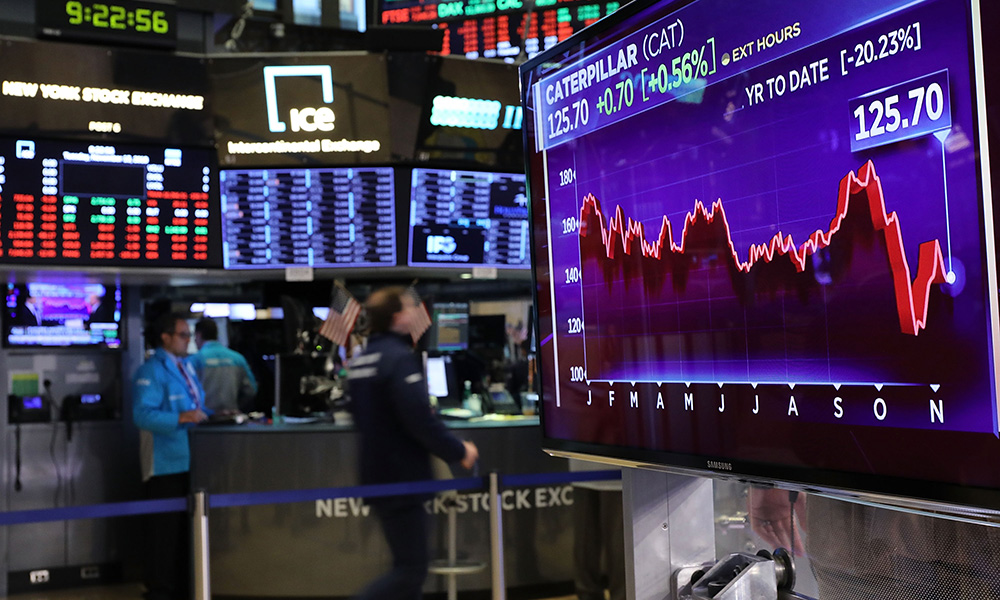
    It is a puzzlement why the stock market can go up while the economy is in a virus-caused depression. Much of the economy is in lockdown or closed because of decreased consumer demand. As many of one-third of workers and many small businesses are on federal life-support programs. Profits have disappeared. Large numbers of bankruptcies loom. Given the uncertainty, including recent record numbers of new virus cases, the usual stock evaluation metrics are worthless.

    With the economy tanking, how come the stock market has gone up dramatically?

    And continues to go up.

    THE STOCK MARKET

    Let’s decompose the stock market. When people talk about the stock market going up or down, they usually refer to an index such as the S&P 500 as the measurement. The S&P 500 is a market-value (cap, short for capitalization) weighted index. The ten most valuable companies account for over 20% of the total value of the index.

    There are over 3,000 actively traded stocks. But the 500 companies account for over 80% of the total value of all stocks. They also account for a minuscule percent of the 10-20 million companies in the United States.

    Public companies account for about one-fifth of U.S. employment. Small companies account for about half of private sector employment. Government accounts for about 10% of total employment.

    So, the dominant public companies are not representative of the economy. They are not even a representative sample. They are publicly owned. Even the smallest is much larger than almost all other U.S. companies. They are usually multinationals. And the largest, most dominant companies in market value are technology companies. The six companies with the highest market value are Facebook, Apple, Amazon, and Alphabet (the parent company of Google. Counted twice. Don’t ask.), collectively known as the FANG companies, joined by Microsoft.

    Technology companies account for over 30% of the total value of the S&P 500. Digital or online companies are 13 of the 20 most valuable corporations in America. Nine of them did not exist or were small companies 25 years ago.

    THE VIRUS ECONOMY

    The economy has gone into a depression, the worse since the Great Depression of the 1930s. Damage has been limited because of massive federal income maintenance programs for workers and small business owners.

    The severe downturn, caused by the virus and attempts to control the spread of the virus, has made visible that the economy is divided into two parts. (Yes, I know this is a huge simplification but not as simple-minded as most economic theory.) There is the service sector, the largest employer. Most of the companies are small. Many of the employees are low wage. They work in buildings and meet customers. Services and their employees have been very hard hit by the virus and the depression. At the other end are the technology companies that dominate the digital economy. As a group, they have done well during the depression as consumers and business have used their digital platforms and services as substitutes for physical interaction (aka store shopping, visiting doctors’ offices, online entertainment and commuting to work).

    This split is reflected in the stock market and the indexes. Of the 500 largest companies, 44, mostly tech companies, are up 20 percent or more since the market low of March 23. The big six are up over 60% since the bottom of the market, accounting for more than 40% of the increase in the value of the S&P 500. Tech companies like Nvidia and biotech companies account for much of the rest of the increase.

    Less known is that approximately 160 companies of the 500 are down more than 20%. Although the market average is almost the same as at the beginning of the year, the stock prices of about 350 of the 500 companies are down. They are large and important parts of the older economy.

    TIMING

    The timing of the market moves is surprising. The market hit its high on February 19, a month before the president admitted there might be a problem and weeks before the more aggressive governors announced lockdown rules. While the president was telling the country there wasn’t a problem, investors began unloading stocks.

    In the last week of March, as the president began hinting there might be a problem, the stock market hit bottom. As the number of new virus cases and deaths rapidly increased, and lockdown and quarantine rules were extended, the economy tanked. But the stock market began a rapid recovery, one of the strongest and quickest in history. Even as the virus situation worsened in most of the country, the stock market continued to go up.

    During the strong advance no one, not even corporate management, had any firm idea what corporate sales and profits would be in the future. No one could do the usual financial analysis. Every wealth fund manager, financial analyst and investor I’ve talked to said the market was crazy, irrational, unpredictable (usually preceding by a colorful adjective).

    But the main reason is obvious. The dominant companies in the stock market were part of the digital sector of the economy. Besides the monster tech companies, they were into telemedicine, video conferencing for fun, family and business, video streaming and other online entertainment, e-commerce, cybersecurity, and many other online services. Behind them was a large increase in cloud computing services.  

    The accelerated shift to these companies’ services and products indicated accelerated increases in sales and profits. The macroeconomic averages and totals for the economy looked dismal. But not for these companies.

    The stock market looks ahead. Investors forecast. They anticipate. Today’s news and events have little influence, even short run influence, on stock price movements. Investors have placed bets on their best estimate (known among statisticians as SWAG – statistical wild-ass guesses) of what will happen to corporate sales and profits in the future. As my old econ prof used to say, “You puts down yer money and takes yer chances.” Transitory and political events, no matter how dramatic and urgent, usually have very short run or no influence on stock market prices.

    But not the virus. By mid-March, it was obvious it would have a large and lasting impact on the economy. It was the powerful “exogenous shock” of economics (also known as the “black-swan” or “fat-tail” or “big tsunami” event). 

    The unknown was how big and especially how long. Politicians, especially the president and some Republican governors, argued the virus’ effect would be short-lived and not too deadly or disruptive. They dismissed the proposed attempts to limit economic activity to slow down the spread of the virus. The famous “V-shaped” recovery. It seemed that many investors agreed. As the market rose rapidly, new investors flocked to the market. Average daily volume so far this year is up over 60% compared to average daily volume in 2019. Much of the internet chatter sounded awfully familiar to me – it was the same as in histories of the 1929 stock market crash.

    But the market hasn’t collapse (yet). The big difference is the massive income maintenance federal aid programs, along with the Fed’s massive money creation and its underwriting of virtually the entire debt market. Already about 40 million  American workers (25% of the labor force) have received some form of federal aid. The main program has been unemployment benefits. The maximum benefit has been raised by $600/per week and eligibility standards have been loosened. About two-thirds of the workers who have been on unemployment received benefits as high or higher than their pre-virus income.

    Investors are betting that worsening virus news will have little effect on the economic recovery, that federal income maintenance programs will go on as long as needed (or at least to the November elections), that the Fed will keep the Fed funds rate near zero and finance the massive government deficits, and that demand for online and digital services will continue to increase.

    Result? Sometime in late 2020 or early 2021, total earnings would be expected to return to 2019 levels. The S&P 500’s price/earnings ratio (P/E ratio) of this forecast has already returned to the high 2019 levels. 

    New medical protocols are reducing the death rate. Sometime in the near future an effective vaccine will be announced. All of the stock market will go up. Given how crazy this market has been, I suggest waiting a week and then start cashing in some of your winnings.

    THE STOCK MARKET IN 1933

    Something similar happened in 1933. At the depths of the Great Depression, with the entire banking system near total collapse, the stock market started to recover. The main reason seems to have been that investors were encouraged by the optimism and vigorous pursuit of new laws and policies by the incoming president, Franklin Roosevelt. In that year, the stock market went up an amazing 66.7%.

    SUMMARY

    Investors, as investors, are not directly concerned about Covid-19. They are concerned about the economic consequences of the virus, both short term and long term, especially to public companies. 

    The dominant dynamic is that most of the economy’s industries and companies are experiencing accelerated movement to the digital economy. Face-to-face transactions are expensive. Check-out personnel and cashiers are disappearing in supermarkets, Target and McDonald’s. Retail stores will function more like local distribution warehouses. Think about classrooms and doctors’ offices. And, in the future, a shrinking labor force will probably push up the low wage part of the labor market. Digital interaction will continue to be less expensive and more effective.

    The stock market – don’t look at the averages. Look at the winners and the losers. The stock market is up because it is dominated by digital and technology companies. Changes in relative stock prices indicate which economic sectors and companies will innovate and and grow their sales and profits faster than the overall economy.

    One way to think about the stock market (big public companies) is that it is made up of past winners (past innovators), current innovators, and potentially successful (profitable and growing) future innovators. The market mostly invests in future growth based on innovation. It punishes “legacy” companies, in old industries with growth determined by the growth in total income, that stop innovating.

    In short, investors are buying companies that are benefiting from the economic consequences of the virus and attempts to limit its spread. These same companies will continue to benefit after the virus is contained. Since these companies dominate the market and the averages, the market is going up. And, increasingly, these are the companies that will drive economic growth and will dominate the economy in the future.

    For a discussion of some of the economic and governmental budgetary changes caused by the virus, see my After the Virus.   

  • After the Virus: Economic Consequences

    There are a number of forecasts of what the world will be like after the virus. Let’s take a look at some of them.

    Many long-term trends have been accelerated by the virus. Probably the most cited example has been the accelerated move to digital-based transactions and behavior. This has occurred among both consumers and businesses.

    I think we have hit an inflection point. Before, there was a great deal of discussion about how one industry or market was becoming more dependent on digital platforms and automation based on artificial intelligence. The Internet of Things, online shopping and ordering, business conferencing, telemedicine. Or how a particular company was transforming an industry (Amazon, Uber). But now we see that the entire economy – all industries and markets – rely on digital. The technology and rapid adaptation are accelerating the shifts.

    Income inequality is bad and probably getting worse. The usual reasons given are outsourcing in the global economy and the effects of automation. The two reasons are related. Advances in telecommunications, including global digital networks, and management software have made the management of multinational companies possible. 

    There now appears to be another reason. We talk about the growth of the service economy. What this means specifically is that most of the new jobs created over the last few decades have been relatively low-paying service jobs. About 15% of the entire labor force (about 25 million people) works in restaurants and bars. Much of the service industry consists of services that relatively low-paid workers provide to relatively high-paid and wealthy customers. A recent study indicated that unemployment among service workers in the affluent parts of New York City was higher than in the rest of the city. On the other end of the income scale, the upper-middle class, dominated by the technological and professional elite, have seen their average incomes rise much faster than low-paid service workers. As digital replaces service workers, including office workers, income inequality and its political consequences will probably get worse.

    The move to the digital economy will also threaten many owner-managed small businesses. Because of economies of scale and scope, large digital-based corporations will lead the trend towards more concentrated industries and markets. 

    Another consequence of the accelerating use of digital platforms is the demand for technological workers will probably also accelerate. Salaries will go higher. Automation and AI software will “deskilled” (lower salaries) professions based on specific knowledge and eliminate many manufacturing and office positions. Online business collaboration will become more common. Video conferences may not be as effective as face-to-face conferences and interaction but they are a lot cheaper than leasing office space in Manhattan.

    We don’t have to worry about the huge increase in government debt. Well, maybe. Almost all of the government “stimulus” programs are income maintenance programs. They are paid for through government borrowing, a large part of which is directly or indirectly selling debt to the Fed. The Fed pays for the debt by creating money. All this does is transfer federal debt from one part of the government balance sheet to another part. 

    As long as the Fed keeps interest rates extremely low, the cost of debt service (federal interest expense) as a percent of nominal income will be low.

    A few comments. Large yearly deficits and the total national debt will continue to increase for years after the virus comes under control. None of this debt will disappear. Total debt service costs will rise, even at extremely low interest rates. If for some reason, such as inflation, interest rates rise, the cost of interest expense could rise dramatically. By fiscal 2022, a one percent increase in federal borrowing costs could add at least $250 billion to the yearly deficit. The federal government could avoid most of any potential future interest expense increases by financing the national debt at the current rate of 0.6% for 10 year bonds.

    The Fed might want to sell off some of the government debt they have accumulated. They basically have to sell it to someone else who wants to hold U.S. government debt. This increases the supply of U. S. government debt offered to be sold. It might raise interest rates on all of the national debt. 

    Even if tax revenue increases, which will happen if there is an increase in taxable nominal income without tax cuts, the continuing large deficits will put pressure to reduce outlays on “discretionary” spending. That is, all spending after Social Security, Medicare, defense, federal pensions and interest on the national debt. Unless taxes are raised substantially, it is likely that in a few years all “discretionary” spending will be funded by new debt.

    There will be little, if any, distinction between monetary and fiscal policy. The pretense that the Fed makes monetary policy independent of the rest of the government will not be credible.

    The amount of lost income should go down as the economy expands and employees go back to work. The fiscal stimulus programs basically replace the lost income of workers and small business owners. Lost income may be about $400 billion per month, including PPP subsidies of salaries. $3 trillion in income maintenance programs won’t last long. The programs are expected to end or be reduced between August and October. 

    To avoid a worse recession, income maintenance programs will probably be renewed. With the number of virus cases rising rapidly, the recovery of the service economy may be slower than forecasted. If the number of virus cases do not go down soon, service businesses either cannot open, are restricted, or customers will be afraid to patronize service establishments or entertainment venues. Many small businesses will go bankrupt. Income maintenance programs may have to be greater than assumed and continue for a longer time. Or both. We could see high unemployment levels, a surge in bankruptcies, and even higher future government debt levels.

    State and local finances are even worse. State and local governments cannot create money to cover deficits. Inadequately funded public pensions were already killing some state and local budgets before the virus hit as more public employees were retiring. These governments, which provide most of the public goods and services, will have to cut services. Already large numbers of employees, including health care workers, have been laid off. Public office workers will be laid off as more interaction with citizens will be done online. Possibly more public education will also be done online, especially at the college level. Many of these employees qualify for pensions. The federal government would have to borrow trillions of additional dollars to support state and local governments.

    Longer term. Health care is now the largest industry in the United States and growing faster than the rest of the economy. It is also a major and growing part of the federal budget. But there is no way health care benefits paid by Medicare programs are going to be cut. The number of senior citizens is expected to double in the next 20 years. Senior citizens make up a large percent of voters. Over 30% of the Florida voters in this year’s presidential election will be senior citizens. In a close election, the winner must take Florida. I doubt if a candidate campaigning on a platform of cutting health care services to slow down the growth in Medicare costs would do well in Florida and elsewhere.

    All of this indicates that government money to tackle societal problems – large increases in investment in infrastructure, funding the huge costs of climate change, programs to increase the low rates of economic growth and productivity, new income maintenance programs, and many others – will not be available in adequate amounts. What this means is that the costs of mitigating the damage from climate change will be higher than expected. 

    One partial answer to these problems is accelerated innovation in new technology, especially in health care. This is likely to happen. Senior citizens, technology companies, and their employees and stockholders will benefit. But unlike the past, the new technology may be highly disruptive by increasing long-term unemployment and income inequality. Whether or not new public programs and policies will be created is uncertain in the current political climate and the future reality of government budgets. If not, the types of social, economic and political conflicts we are currently experiencing could get worse.

    For background on understanding government finance, budget deficits, trade deficits, and how they are related, see my Government Finance 101. This post also discusses the fiscal effects of Covid-19.

    You might also be interested in my extended explanation of The Stock Market Crash of 1929 and the Beginning of the Great Depression. Some of the analysis and conclusions may surprise you.