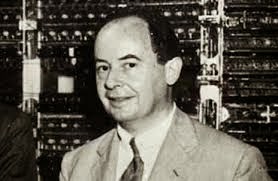
Tag: game theory

  • John von Neumann Sees the Future

    John von Neumann Sees the Future

    John von Neumann

    JOHN VON NEUMANN CREATES
    THE FUTURE

    If you want to understand the world we live in, you
    have to know about the thinking of three men – Alan Turing, Claude Shannon and
    John von Neumann. I’ve talked a little
    about Alan Turing in an earlier essay. 
    All three men knew each other, discussed their thinking with each other, and
    promoted each other’s ideas.

    John von Neumann has been called the smartest
    individual of the 20th Century (by his brother-in-law, who won a Nobel Prize in Physics).  An outline of von Neumann’s accomplishments, which you can read about in 
    Wikipedia, is hard to believe. He invented game theory, which I discussed in
    two earlier posts. He belonged to a group
    of mathematicians who invented new statistical techniques at Los Alamos that
    made the atomic bomb possible. He invented game theory. In 1944,
    he wrote a memo that outlined the structure of the modern computer. He then managed the design and building of a
    modern general computer (to sped up solving partial differential equations his friend Edward Teller had to solve to produce hydrogen bombs) and consulted on the building of virtually all the
    early computers.

    JOHN VON NEUMANN SEES THE
    FUTURE

    In the early 1950s, von Neumann, like Alan Turing, became interested in
    the similarities and differences between computers and the human brain. The study of both was in its infancy. But von Neumann already saw that comparisons
    between computers and human brains could benefit both computer science and
    neuroscience. In the far future, he
    believed they might even converge.

    In 1956, von Neumann was asked to give a series of
    guest lectures at Yale, summarizing his thinking.  Unfortunately, he was dying of cancer and
    couldn’t personally deliver the lectures. In 1957, they were published in a short book, The Computer and the
    Brain.

    Although it was not certain at the time, von Neumann assumed
    (correctly) that the output of neurons was digital. Either a neuron fired or it didn’t.  From this, he argued that a computer could
    simulate the processes of the brain but that the converse wasn’t true.

    Von Neumann calculated that the processing speed of
    the brain was very slow but the brain overcame this through massive parallel
    processing. All of the neurons, about 100 billion, are
    processing at the same time; through synapses between neurons, they are all
    computing simultaneously.  This is how
    supercomputers work – parallel processing through the interaction of many
    computers or servers. Only at vastly faster speeds
    than the brain. The total processing,
    measured in operations per second, is approaching that of the brain.

    But von Neumann saw even further into the
    future. He believed that we were at the
    beginning of a turning point in human history. He foresaw that the exponential increase in knowledge of computer
    technology and how the brain worked would have profound effects on humanity’s
    future. In the early 1950s, he told Stan
    Ulam, a brilliant mathematician, that

    the ever-accelerating progress of
    technology and changes in the mode of human life give the appearance of
    approaching some essential singularity in the history of the race beyond which
    human affairs, as we know them, could not continue.

    The possible implications of this statement,
    especially the use of the word “singularity,” are scary.
     T
    he entrepreneur and inventor Ray Kurzweil, who is now an intellectual in residence at Google, has been the biggest champion of the Singularity. Mr. Kurzweil wrote The Age of Intelligent Machines in 1990, The Singularity Is Near in 2005, and has now written The Singularity Is Nearer. By the end of the decade, he expects computers to pass the Turing Test and be indistinguishable from humans. Fifteen years after that, he calculates, the true transcendence will come: the moment when “computation will be part of ourselves, and we will increase our intelligence a millionfold.” This is also one description of artifice general intelligence, or AGI. At Meta, it is known as “super intelligence.”

    Geoffrey Hinton developed the ideas behind neural networks decades ago. He educated many of the scientists who developed the AI statistical methods that “trained” some of the first AI foundational models. Professor Hinton, the “godfather of AI,’ recently said on Ian Bremer’s show GZERO World that within at most 10 years computers would be “smarter” than humans. He didn’t sound too happy about it.


    If you would like to know just how scary all this could be, read Ray Kurzweil, The Singularity is Near:  When Humans Transcend Biology. I would not recommend reading this just
    before you try to go to sleep.

    A LITTLE HISTORY:  WATSON PLAYS JEOPARDY

    In 2011, IBM’s supercomputer Watson played against
    the two best Jeopardy players.  Watson’s
    predecessor, Big Blue, had defeated the world’s best chess player, Gary
    Kasparov.  Chess is a highly structured
    game where Big Blue’s ability to evaluate millions of combinations of future
    moves gave it an advantage over the more limited memory of Kasparov. But Jeopardy was different. Besides knowing a vast and varied amount of
    information, the supercomputer had to understand natural language and come up
    with the most probably answers. Jeopardy
    clues included puns, metaphors, double entendres, humor and worse, word
    combination and rhymes not found in normal speech. Rather surprising, Watson beat the two of the most successful human Jeopardy competitors. For some computer
    scientists, this meant that Watson had passed the Turing Test. For a few others, Watson had gone beyond it.

    We now know what came next. It took magnitudes of increase in computer processing capacity and speed, partly based on massive parallel processing. This led to the large learning models of artificial intelligence. Von Neumann would not be surprised.

    THE FUTURE STARTS TO ARRIVE

    The following is a summary of an article in The New
    York Times, “Brainlike Computers, Learning From Experience,” December 29, 2013.

    “Computers have entered the age when they are able to
    learn from their own mistakes.”  They can
    automate programming, like how to move a robot’s arm, and tolerate errors.  The new computer chips are based on
    neuroscience, “how neurons react to stimuli and connect with other neurons to
    interpret information.”  The new approach
    to artificial intelligence will allow computers to do many things humans do
    with ease – “see, speak, listen, navigate, manipulate and control.”  Some of this, such as SIRI voice recognition,
    is already here.

    The big difference is that computers will no longer
    be limited to what they have been specifically programmed to do. Computers use statistical algorithms to
    learn. Last year, Google researchers
    used a type of algorithm called a neural network into a computer, which was
    able to learn without detailed instructions or human supervision.  The computer was fed 10 million images and
    taught itself how to recognize cats.

    The new processors are not programmed in the usual
    sense.

    Rather, the connections between the
    circuits are “weighted” according to correlations in tagged data and images that the processor
    has already “learned.”  Those weights are
    then altered as data flows in to the chip, causing them to change their values
    and to “spike.”  That generates a signal
    that travels to other components and, in reaction, changes the neural network,
    in essence programming the net actions much the same way that information
    alters human thoughts and actions.

    This is how the brain works.  A neuron (nerve cell in the brain) receives
    information from hundreds or thousands of other neurons.  If a critical level of cumulative inputs is
    reached, the cell “spikes” and sends an electrical impulse down a filament
    called an axon.  This releases chemicals
    called neurotransmitters that are picked up by other neurons and may contribute
    to their “spiking,” possibly changing other neurons.  These changes lead to changes in human
    thoughts and actions.

    An advantage of the new approach is that the
    algorithms can adapt and continue working even when there are failures to
    complete prior tasks.

    Computers are combining biological and statistical
    techniques to overcome the limitations of traditional programming.

    It seems to me that the logic of this approach is
    similar to Bayesian statistics. The
    general nature of the algorithms, neural networks and genetic algorithms, has
    already been developed.

    This is another step away from the rigid programming (deterministic algorithms), and error-free hardware of computers. There will be feedback effects as scientists learn more about how the
    brain works and how computers are programmed to simulate the brain.  Already, there is a field of research called
    computational neuroscience.

    The largest class at Stanford last fall was a
    graduate course on applying biological and statistical techniques to computer
    learning.

    All of this returns us to the early speculations in
    the 1940s and 1950s on how information theory and computers were going to
    influence other disciplines, particularly the biology of the mind
    (neuroscience).  The difference is the
    incredible advances in our knowledge of the brain and the equally incredible
    increases in the processing capacity and speed of computers.  A “thinking computer’” is no longer a
    metaphor or an impossibility.  The
    convergence and feedback of the two areas are leading us into a future even
    beyond the wildest dreams of the early thinkers.

    Except John von Neumann. I imagine he would not be surprised by artificial intelligence.

    ====================================================================

    Related Earlier Posts:


    Alan Turing and Strategic Management

    Limits to Strategic Planning


    The Limits of Negotiation:  A Little Applied Game Theory


    President Obama Learns Some Game Theory

    Go back to the Guide for Posts.

    Many of the posts are about how information influences markets and market behavior. The next step is to conjecture on how AI will affect economic development through innovation, the structure of markets, and the management of corporations. We will all be waiting to see what ChatGPT has to say about all this.




  • President Obama Learns Some Game Theory

    President Obama Learns Some Game Theory


    INTRODUCTION


    For background, see prior post
    on The Limits of Negotiation.


    ECONOMIC NEGOTIATIONS


    Basic game theory works best
    in economic negotiations.  The players
    have the same assumptions (act rationally, make money), enter into the negotiations
    voluntarily and negotiate which positive payoff matrix they will agree on.  Economists usually assume that people are
    playing a positive sum (win – win) game. 
    That is, how to divide up the monetary or utility gains.


    Game theory indicates there
    is a better chance at cooperation or reaching good faith agreements if the
    players know they will be playing the game repeatedly or if both players see an
    advantage to a long-term agreement.


    Economic rationality implies
    that an agent will not agree to an outcome if the individual will be worse off
    than not negotiating. The alternatives
    are not to negotiate or find another party with whom to reach a positive or
    better agreement. A competitive economy,
    however imperfect, provides alternatives.


    ECONOMIC GAMES AND
    INFORMATION


    In simple games, the players
    know what the payoff matrix looks like when the two players try to decide which
    strategy to use and what their opponents’ strategy is.  Economists know that even a simple, deterministic
    outcome is unlikely.  One reason is
    asymmetric information.


    Economic theory usually
    assumes that all parties (agents in econspeak) have total information.  This is especially true in finance
    theory.  But in the real world, this is
    often not true.  The agent with superior
    information has a negotiating advantage. 
    It is likely that the outcome will be different than the full
    information outcome.  The more informed
    agent will probably end up with a larger share of the profits.  The increased profits may be a function of
    the difference in the relative information known by the players.  But it is still a positive sum game.


    POLITICAL NEGOTIATIONS


    Political negotiations are
    different.  Other factors are important –
    ideology, moral beliefs, coercion, threat of violence, and a sense of fairness, in
    addition to not negotiating.  Zero and
    negative sum games are more likely, especially if an alternative strategy is
    violence. History is full of  such examples, where politics is seen as a
    kill or be killed zero-sum game. Since the end of World War Two, there have been over 150 civil wars. 


    The payoff matrix of
    political games is often measured in power, not money. The value of the payoffs is more difficult
    to quantify and more uncertain.  Often,
    negotiations are delaying tactics and agreements are broken. 


    In American politics, there
    are political incentives not to agree. 
    An example occurs when there are term limits, especially in the second
    term of the president.  The opposition
    has no incentive to agree to a reasonable policy if they believe the
    president’s party will benefit politically. 
    They have every incentive to attack the president’s policies, even if
    they agree with the objective.  Even
    members of the president’s own party may not support him as they maneuver to
    become future presidential candidates.


    CREDIBLE THREATS

    An important aspect of political conflict is the concept of “credible threats.”  If a country or group wants another country or group to change its behavior or negotiate, one means is to threaten it with some action.  A threat is like a bluff. If an opponent calls a country’s bluff, the country must be willing to carrying out the threat. If if doesn’t, it loses credibility and is more likely to be ignored when it makes future threats. It is more likely that other countries or groups will continue or increase their behavior. Power and influence declines.


    PRESIDENT OBAMA LEARNS GAME
    THEORY


    President Obama became
    president with a belief that he could negotiate rationally, that he could use
    logic and persuasion to convince
    political opponents and special interests to compromise for the general good.  He played an economic game. His opponents here and abroad played political
    games. President Obama has finally
    realized that.


    He has had to deal with an
    increasingly conservative Republican party, many of whose most active members
    personally detest him. 10% of Americans, presumably Republicans and
    conservatives, believe Obama is the Anti-Christ.  Internationally, he has had to deal with
    Islamic fundamentalist groups, Iran, Syria, Iraq, Afghanistan, North Korea, armed militias
    of ethnic groups, the chaos of the aftermath of the overthrow of Quadaffi in
    Libya, Hugo Chavez in Venezuela and Vladimir Putin in Russia.  None of these groups and their leaders fit
    the rationalist profile of a game theory player.

    President Obama inherited a number of immediate and
    long-term problems.
     He believed that
    there were rational solutions to the problems, which could be reached through
    logical arguments based on facts and reason, leading to negotiations and
    mutually beneficial compromises.
      His
    political opponents didn’t share this assumption.
     Again and again, President Obama appeared
    exasperated by the irrationality of his political opponents, both at home and abroad.
     He shouldn’t be surprised any more. 

    ========================================================

    Please see related post, American Foreign Policy Since 1991.


    Also, The Limits of Negotiations:  A Little Applied Game Theory


  • The Limits of Negotiation:  A Little Applied Game Theory

    The Limits of Negotiation: A Little Applied Game Theory

    INTRODUCTION

    Much of the political news
    is about negotiations.  American
    politicians, in both domestic and foreign disputes, don’t seem to know much
    about negotiation strategy.  Maybe a
    little applied game theory would help.

    IS NEGOTIATION POSSIBLE? 

    The first question is
    whether or not negotiation is possible or just a waste of time and effort.

    Negotiations will be
    fruitless if at least one party believes there are no possible outcomes that are
    better than not negotiating.  Compromise
    is impossible.  Fanatics, true believers,
    proponents of “Victory at any cost” or “Give me victory or give me death” or
    parties who believe their opponents are evil are not likely to negotiate.

    Sometimes leaders act to
    limit their options or those of their followers.  The famous historical example is when Cortes
    burned his boats that brought him and his men to Mexico.  Returning to Cuba was no longer an
    option.  Cortes forced his men to make
    the “credible” commitment to conquer the Aztecs.  By their past actions, Israel’s policy of
    never negotiating with airplane hijackers is credible.

    Bashar al-Assad of Syria has
    put himself and his regime in this situation through the brutality of their
    past actions.  He has eliminated any
    option for himself except being dictator or being killed.  At this point, there is nothing to be gained
    by negotiating a political settlement.

    In business and other types of negotiations, there are two stages. Both sides of a potential agreement must believe that they will benefit from an agreement – increased sales, reduced costs, increased profit. This is the “win-win” or “positive sum” stage. The second stage is how the increased benefits are to be split. This is a “zero-sum” negotiation.

    THE LIMITS OF NEGOTIATION

    There are limits to what a
    party to a negotiation will accept. 
    These limits are set mostly by a party’s perception of the consequences
    if no agreement is reached.   When
    President Obama negotiated budget reductions in 2011 under House Republicans’
    threats to shut down the Federal government, he was facing reelection and felt
    pressure to compromise.  In 2013, after
    winning reelection, he felt he was in a stronger position to resist Republican
    demands.  The consequence of losing an
    election had disappeared.

    Knowing this, why did the
    Republicans again threaten to close down the government?  Because they perceived that the consequences
    of not challenging the president were greater than challenging the president
    and losing.   The Republican Party was
    becoming increasingly conservative.  The
    vast majority of House Republicans knew they came from safe districts.  The major threat to reelection in 2014 was
    losing to a more conservative Republican in the primary.  By again threatening the extreme action of
    shutting down the government they eliminated the main argument of a potential
    Republican primary rival.

    In addition, although
    circumstances had changed, President Obama’s compromises in 2011, seen as a
    victory by many Republicans, cast doubt on the credibility of his threat not to
    negotiate. 

    INCREASING THE CHANCES TO
    NEGOTIATE

    One way to increase the
    chances the other party will negotiate is to change the “payoff matrix” or
    cost/benefit of analysis of the other party, preferably before negotiations
    begin.  The idea is to raise the cost of
    not negotiating or increasing the options of the other party in negotiations.

    Iran is a recent
    example.  For years, Iran went through
    the motions of negotiating a moratorium on enriching uranium to develop an
    atomic bomb.  As long as the rest of the
    world thought there might be a chance of Iran slowing or stopping its atomic
    bomb project, there were no consequences to Iran of continuing the program.  They were even able to buy thousands of
    centrifuges from a West German company. 
    It was only after the United States and Western Europe finally imposed
    economic and financial sanctions that Iran was willing to seriously
    negotiate.  The sanctions had wrecked the
    economy and threatened the ayatollahs’ rule.

    THE ULTIMATUM GAME 

    This has become one of the
    most famous games in game theory.  It has
    been played many times by different groups in different countries.

    There are two players.   One player is given an amount of money.  He has to offer part of the amount to a
    second player.  If the second player
    accepts, they split the gain.  If the
    second player refuses, neither player gets any money.  This puts a limit on the number of possible
    outcomes.  One party maybe be better off
    accepting a proposal than refusing to negotiate but may decline the proposal
    because it is not “fair.” 

    To an economist, the offer
    is obvious.  If the amount is $1, the
    first player offers the second player the minimum, one cent.  The second player is better off accepting
    than refusing, so he accepts.  But that’s
    not what happens when the game is actually played.  For almost all groups and across different
    cultures, the second player typically rejects offers below 25-30% of the
    total.  There is an almost universal
    sense of “fairness.”  Even worse, the
    second party may feel insulted by the offer, making future and better offers
    more likely to be refused.

    MORE THAN TWO PLAYERS 

    In general, the more players
    there are in a game, the more difficult it is to reach an agreement.  Even a relatively weak or unimportant player
    can threaten to “hold up” an agreement at the last minute unless they get a
    better payoff.  This is true of global
    trade agreements and close votes in Congress.

    This is also one reason that
    the Assad regime in Syria has a good chance of surviving.  There are at least 20 anti-government
    organizations fighting the regime.  They
    have different sponsors and different visions of what a post-Assad Syria should
    be like.  Recently, they have been
    fighting among themselves.  In addition,
    the Syrian regime can count on financial and military support from Iran and
    military assistance from Hezbollah.  The
    regime also has some military support and diplomatic cover from Russia.

    CONCLUSION 

    While much of the discussion
    about negotiation is about how to negotiate, assumptions about the players are
    important.  Negotiations have a greater
    chance of succeeding if all the players share some basic assumptions, see a
    noticeable advantage of negotiating versus not negotiating, see the game as
    fair, and intend to actually abide by the agreement.  Even when negotiations lead to a treaty or
    agreement, they are often only a ploy by one side to buy time, to temporarily
    ward off sanctions or conflict.

    ==================================================================

    Related Post:

    President Obama Learns Some Game Theory