 |
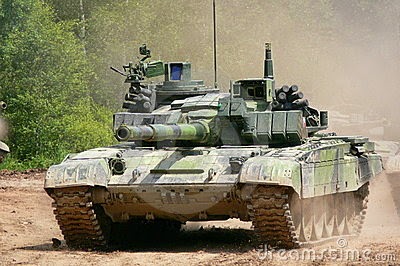
| Russian T-72 Tank Seen in Ukraine |
HISTORICAL BACKGROUND
Most of what is now Ukraine
came under Russian control in the 1700s, due to the expansionist policies of
Catherine the Great. Part of western
Ukraine (Galicia) was a province of the Austro-Hungarian Empire.
With the collapse of the
Romanov regime in 1917 and Austria-Hungary in 1918, Ukrainians attempted to
establish an independent republic.
During the Russian Civil War, Ukrainian nationalist groups fought on the
side of the Communist Red Army because they knew that if the monarchy were
reestablished, Ukraine would be forced back into the Russian Empire. Their hopes for independence were crushed as
the triumphant Communist regime absorbed Ukraine into the Soviet Union.
Ukrainians suffered under the
Stalinist regime. Because the Ukraine
was the “bread basket” of the Soviet Union, grain and other crops were
systematically confiscated by the Communist government to feed industrial
workers at subsidized cost and exported to earn foreign currency. Bad weather plus confiscations in 1932-33 led
to millions of Ukrainians starving to death.
During World War II, some
Ukrainians fought with the Nazis, hoping to be free of Russian rule. After the war, Ukraine was treated harshly as
punishment. All Tatars in the Crimea were
deported to the interior of Russia; over half died.
RECENT CONFLICT BETWEEN UKRAINE AND RUSSIA
From 1991 until 2004, Ukraine
was ruled by former Communist bosses and their protégés. Little changed politically or economically. Some state assets were privatized, creating a
small group of oligarchs with ties to government officials. Corruption was rampant. Old industries were not modernized. Production and exports were still mostly
oriented to supplying Russia with food, industrial materials like pipe and
weapons. There was little economic growth or development.
Fed up with the lack of
progress, corruption, and economic stagnation, Ukrainians took to the streets in
2004 to protest the regime of President Viktor Yanukovych. The “Orange Revolution” was one of a number
of popular protest movements against authoritarian regimes on the Russian
periphery. President Yanukovych was
replaced by a democratic government.
Unfortunately, the President and the Prime Minister became bitter
enemies. The pro-Russian party of former
President Yanukovych had a strong position in parliament. The government appeared paralyzed and didn’t
institute the reforms demanded by the “Orange Revolution” protesters. Aided by Putin’s campaign managers and Russian money, Viktor Yanukovych was elected President again
in 2010.
Unlike the peaceful “Orange
Revolution” of 2004, the 2013-2014 demonstrations protesting the pro-Russian
policies of President Yanukovych led to the use of violence against the
demonstrators. This time the removal of
Yanukovych led to an armed rebellion against the new government by Russian separatists in the eastern
provinces (Yanuokovych’s political base), a Russian takeover of the Crimea and
a shooting war with Russia over control of Ukraine’s eastern provinces.
NATURAL GAS AS A GEOPOLITICAL WEAPON: UKRAINIAN DEMAND FOR RUSSIAN NATURAL GAS
Before the conflicts began,
Ukraine depended on Russia for about two-thirds of its natural gas, about 30
billion cubic meters a year. The cost
was around $10 billion minus transit fees, a major cost for a small economy of around $200-$250 billion. Demand has
decreased because of the loss of territory and a severe recession, down to probably
around 20-25 billion cubic meters. But
Russia has increased the price and threatened to continue the current shut-off
of gas through the winter. Ukraine agreed to pay arrears for past purchases and pay COD for future purchases. Russia agreed to supply gas for six
months.
The money for these purchases
and other debts will come from a $17 billion loan from the IMF. In addition to paying for Russian gas and
oil, a $3 billion Russian loan will come due in 2015.
Ukraine is trying a number of
strategies to reduce its dependence on Russian natural gas. One is conservation. Ukraine, despite being poor, has one of the
highest natural gas per capita usage rate in the world. A major reason is that the cost to consumers
and industry is heavily subsidized; the retail cost is about 25% of the
wholesale cost Ukraine pays to Russia.
Raising the internal price under current conditions will be politically
unpopular and maybe impossible.
Ukraine has tried to receive
natural gas from neighboring countries by “reverse flow” of Russian gas
delivered through Ukrainian pipelines.
Russia has successfully pressured at least two of the four countries
(Slovakia and Hungary) not to do this.
In the future, Ukraine may be
able to develop large shale gas fields which may be an extension of shale gas fields in adjoining eastern Poland.
Ukraine also intends to build a short pipeline to Poland. Gas will come from an LNG plant Poland is
building and other non-Russian sources through interconnect pipelines.
RUSSIAN GAS PIPELINES THROUGH UKRAINE
Worried that Ukraine could
shut off deliveries to Europe, Russia’s strategy has been to bypass the Ukraine
pipeline network. The Nord Stream
pipeline in the North Sea reduced the percent of Russian natural gas exported
to Europe through Ukraine from 80 percent to 50 percent. It brings gas directly to Germany, its
largest EU customer.
The proposed South Stream
pipeline through the Black Sea to Bulgaria would have enough capacity to
eliminate Ukraine as a transit point for Russian gas. As a political reaction to Russia’s military
actions, the European Union pressured Bulgaria to suspend participation in
building the pipeline and terminal. The
South Stream pipeline currently is on hold.
The interim Bulgarian government before the recent elections signed an
agreement to be part of a competing pipeline consortium that brings Azerbaijan
natural gas overland through Turkey and Greece to Bulgaria. A European Union committee is discussing building interconnect pipelines through Central Europe (heavily dependent on Russian gas coming through Ukraine) to Austria.
UKRAINE’S ECONOMY
Even before the conflict with
Russia, the Ukrainian economy had not progressed. In 1991, the economies of Poland and Ukraine
were about the same size. Since then,
Poland’s economy has tripled in size while Ukraine’s economy before the current
conflict was about the same size as in 1991.
The differences may be somewhat smaller since much of the Ukraine
economy, maybe as much as 40%, is underground.
The continuing war in the
east and the loss of the Crimea has devastated Ukraine’s already weak
economy. The eastern provinces contain
the bulk of the Ukraine’s manufacturing capacity and coal mines. Russian has imposed sanctions on some
Ukrainian exports. Ukraine’s economy is
expected to shrink by 8% this year and again next year. If fighting continues, this is probably too low an estimated.
Ukraine’s foreign-exchange
reserves are falling rapidly. International
loans from the IMF and aid from the European Union have only bought time for
Ukraine. It seems impossible that
Ukraine can meet its debt obligations without new loans and aid. Two months ago, the IMF said that Ukraine
will need an additional $19 billion if the fighting continues. Even with new loans, it is likely that
Ukraine will have to default or renegotiate its external debt. Part of its external debt is owned by Russia.
POLITICAL CONSEQUENCES TO UKRAINE AND RUSSIA
Ukraine
is the most important application of the Russian foreign policy doctrine of
recovering lost territories and forming the old Soviet Union (actually, the old
Russian Empire since Communism is no longer the official ideology). Putin’s power and domestic support crucially depends
on this strategy succeeding. After a massive and emotional propaganda campaign, there is no
way the current Russian government of Vladimir Putin can allow Ukraine to
retake its lost eastern territory or the Crimea. When it appeared that the Ukrainian army
might defeat the separatist rebels, Russia sent in Russian special forces and
heavy weapons.
What has
Russia gained and lost by seizing Crimea, supporting the eastern rebels and
sending Russian military forces and weapons into Ukraine? Russia has
gained direct Influence or control over 15-20% of Ukraine’s population, which
was Russian or pro-Russian before the invasions. There is little economic advantage; the
eastern provinces the separatists control are a depressed area with old
industries and uncompetitive coal mines. Many of the companies have shut down because of the fighting or management fleeing the area.
Both Ukrainian and Russian
refugees will continue to leave the area controlled by the separatists. As of the end of October, the United Nations estimates that about one million people have left, out of a pre-war population of 4.5 million. Other estimates are higher. About half have gone to Russia and half to other parts of Ukraine. Refugees tend to be the young and better educated. Russia will need to heavily
subsidize the region just to restore devastation and basic services. Already eight large convoys from Russia have carried food (and probably military goods) to the separatist-controlled areas of Ukraine.
This will
leave a Ukraine of about 35 million people that just voted 92% to be
anti-Russian and pro-Europe. Russia has given Ukraine nationalists a
permanent issue. It also eliminates part of the economic and political
power base of the pro-Russian oligarchs.
Most of the oligarchs, including the President, are now firmly
pro-Europe.
In the
long run, Russian intervention may eliminate a 300 mile buffer zone from NATO
forces and puts a large anti-Russian country right on its borders. But without internal reforms and with Russian
troops on its eastern and southern (Black Sea) territory, Ukraine will continue
to be weak economically and militarily.
In retaliation to economic sanctions, Russia has banned about $9 billion of imports, mostly food. Foreign food products are disappearing from Russian stores. Russian substitutes either don’t exist or are of poorer quality. This is the first sign that the Russian people, at least the urban middle class, are beginning to pay a price for Russia’s intervention in Ukraine. Greater economic pain will follow.
====================================================================
For background, see an earlier blog:
https://politicaleconomicsprof.com/2014/06/ukraine-background-to-current-crisis.html
For earlier analysis, see:
https://politicaleconomicsprof.com/2014/03/the-crimea-russia-and-us-options.html