Tag: Global Power

  • The Roman Republic Commits Suicide:  A Cautionary Tale for America

    The Roman Republic Commits Suicide: A Cautionary Tale for America


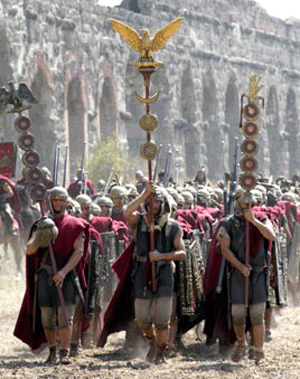
    Roman Legion


    Why Study Rome?


    Americans have focused on comparisons between Rome and America twice in American history.  The first time was during the period from before the Revolution to after the ratification of the Constitution and Bill of Rights, when the founding fathers and others looked to the Roman Republic for ideas and inspiration on how to structure the new government. After the American Revolution, the founding fathers, having read the Roman authors detailing the collapse of the Roman republic, worried about internal threats to the survival of their new republic.  


    The second time was when the United States became a superpower, especially after WWII, and then again after the collapse of the Soviet Union in 1991. Commentators compared America to the Roman Empire at the height of its power. There was some discussion about how America became a permanent warfare state and how it affected domestic democracy and civil society.


    And now a third time. Have Americans and their leaders concluded that the costs of maintain global leadership and power are too high? That the creation of the global economy under American rules and protection is responsible for domestic economic problems including stagnant and declining incomes of many Americans while a small elite controlling and managing global corporations are becoming very rich? Will the resulting domestic political conflicts lead to fewer resources and lessened commitment to the global order America created? In short, can America, like Rome, be both a republic and a global power?


    It is difficult to appreciate today how extraordinary was the Roman Republic. The city was governed for 500 years without a king or conqueror. Power was not concentrated in one person; leaders were elected. Nowhere else in the world, except in parts of Greece and overseas Greek cities, was there the idea of citizenship. Nowhere else could power be shared and transferred peaceably through elections. Nowhere else were conflicts resolved through compromise and according to rules of law. Nowhere, not even Athens, was more democratic, in terms of the percent of the male adult population who voted and enjoyed the rights of citizenship.


    Many of the American founding fathers read Roman historians. Roman historians generally praised Rome’s republic, its political structure, and its underlying civic and individual virtues. They condemned Rome’s subsequent emperors as tyrants and their society as corrupt. This learning had a profound effect on American political thinking and governmental institutions.


    Historians like to write about the “decline and fall of the Roman Empire.” But of more historical relevance for the United States now is the last 100 years of the Roman Republic (146-49 BC). It was during this period that Roman legions, after the final destruction of Carthage, conquered western Europe and the Mediterranean world. The Republic created the Empire. But the consequences of these military victories undermined and then destroyed the Republic. 


    How did this happen?  Could it have been avoided?  What does this say about the relationship between becoming an imperial power, military power, internal security and liberty? How does being a global superpower impact domestic society and politics? Can a republic become a global superpower and survive as a republic? Are there any possible lessons to be learned from Rome’s experience?


    The Suicide of the Roman Republic:  The Building of Empire and the Projection of Military and Political Power

    The Roman Republic did not “fall” or “collapse.” It did not fail because of one dramatic event such as Julius Caesar and his legions crossing the Rubicon River in 49 B.C., invading Rome and later declaring himself Dictator. The Roman Republic weakened and then committed suicide, or was killed, over a long period of time.


    Rome, like America, began its modern history by overthrowing a foreign king and declaring a republic. But even before, America had a long history of local self-government; the American Revolution was partly caused by England’s attempt to impose more control on its American colonies. The subsequent republican government was partly modeled on Rome’ republic. This is not surprising. Both countries were suspicious of concentrating power in one man and wanted to diffuse power. But not too far; both believed that political power and government offices should rest in the hands of a political elite with “civic virtue.” The center power was the Senate, whose members were part of “patrician” clans. This political elite, for a long time, believed in “civic virtue,” which included ideas about contributing to the common good, focusing on national interests, and gaining personal status (gravitas) by contributing to the welfare of the state. In America, the man who embodied this ideal was George Washington. There is a statue of him wearing a Roman toga.


    The Roman Republic lasted approximately 500 years, If America’s experience with self-government begins in the early 1600s, America has had some form of representative government for about 400 years.


    One way Rome grew, as did America, was taking in immigrants, no questions asked. In the long run, immigrants were a source population and economic growth, new citizens, and soldiers. In America, immigrants played a similar role.


    Both republics were founded – their basic constitution and laws were written, representative institutions established – when both countries were agrarian societies based on independent landowning farmers. All were citizens. Citizens had rights under Roman law similar to the rights of American citizens. While candidates for political offices usually came from the patrician clans, they were elected by the citizens. 


    Citizens also had obligations. The most important was that all citizens were required to serve as soldiers. For centuries, the Roman army was a part-time militia. Citizens were called up after planting, fought against other Italian towns or tribes during the summer or if a military emergency, and were then sent home for harvesting. There was no standing (permanent) army but all male citizens were a permanent military reserve, an obligation that could last a lifetime. Armies were led by one or two elected consuls (the highest political office, somewhat similar to the American president) who served for one year.


    The American version was local militas. In colonial times, all white males beween the ages of 16 and 60 were required to be members of local militas. Required time of active service was usually 30-60 days and militas only fought locally. They chose their officers. They could be activated if there was a local threat such as fighting Indians on the frontier or the British in the Revolutionary War. After the Revolution, Americans opposed the idea of a permanent standing army. Until December 7, 1941. 


    For hundreds of years, republican Rome expanded by fighting local enemies on the Italian peninsula. The American equivalent was expanding across the American continent and avoiding overseas conflicts. Any fighting that occurred before the Civil War, usually against native Americans, was done by locally-raised militias. Jefferson, who approved the Louisiana Purchase, said that America was creating “an empire of liberty.”


    As Rome conquered surrounding towns and territories, some of them were given the choice of becoming subordinated allies. In exchange for some privileges, including local rule and citizenship rights for local elites, allies were expected to provide “auxillary” military forces to the Roman army. Rome drew on this expanding manpower pool. Often, in both the Republic and Empire, the number of auxillary troops were more or about the same as the number of soldiers who were Roman citizens in legions.


    Similarly, America did not treat purchased or conquered territory as colonies. Most of the existing population and new America settlers enjoyed the same rights as Americans in the original states. New states were formed with the same government structure and political rights as the older states.


    After WWII, the United States, like Rome, was able to turn former enemies into allies. American and allied military forces were combined into military structures like NATO, dominated by the United States.


    Rome and Carthage:  The Beginning of a Superpower


    As Rome became the dominant power in Italy, Carthage became the dominant economic and trading power in the western Mediterranean. Rome had an army but no navy; Carthage had a strong navy to protect its merchant ships and Mediterranean trade. Rome and Carthage had a long history of treaties and alliances with each other. They had different sphere of influence with no important geopolitical areas of conflict.


    Rome and Carthage finally came into contact in Sicily after Rome conquered southern Italy. Sicily was close to both Rome and Carthage, sat astride important shipping lanes in the Mediterranean, and was a source of grain for Rome. Both Rome and Carthage had city-state allies in Sicily, although most of Sicily was dominated by Carthage and the independent city-state of Syracuse. As allied troops demonstrated in World War II, Sicily was a convenient staging area for invading southern Italy. Carthage in Sicily and Rome in southern Italy were now only a few miles apart.


    The Punic Wars between Rome and Carthage lasted off and on from 264 BC until 146 BC. The First Punic War was during 264-241 BC, the Second between 218-202 BC, and the Third between 149 and 146 BC. The greatest danger to Rome was the Second Punic War, when Hannibal invaded Italy, defeated one Roman army after another, and threatened Rome and its Italian allies.


    Carthage could only defeat Rome if they built an army, invaded Italy and threatened Rome. Rome could only defeat Carthage if they could build a navy and defeat the Carthaginian navy, thus clearing the way for Roman legions to invade North Africa and conquer Carthage.  


    Rome fought a life or death struggle against Carthage for the dominance of the western Mediterranean. Rome eventually triumphed over Hannibal and Carthage because of its ability to mobilize all of its citizen manpower supplemented by troops from Italian allies, appoint long-term commanders and officers, create a navy, and send its full-time legions overseas. By the end of the Third Punic War, Rome was a strong military force in the Mediterranean world and could project its military over long distances. 


    In the period before the Punic Wars, Rome typically conscripted yearly enough men to fill two legions, about 10,000 men. The size of this force was sometimes doubled by military quotas Rome imposed on its Italian allies. During the Second Punic War, large Roman armies were annihilated again and again by Hannibal and had to be rebuilt. At the battle of Cannae, it is estimated that the Roman army had 80,000 men (and over 60,000 of them were killed by Hannibal’s forces). By the end of the Second Punic War, the Roman army had an estimated 100,000 men. From then on, Roman legions would fight and be stationed throughout the Roman Empire. Throughout the period of the Roman Empire, Rome tried to maintain a permanent standing army of over 200,000 men. This put economic and administrative strains on Rome that Rome’s tax system and republican institutions found it difficult to manage.


    A rough analogy might be America just before its entrance into World War I in 1917 (very small and unprepared standing army), World War II, and the Cold War with the Soviet Union until the collapse of the Soviet Union in 1991. Carthage was Rome’s equivalent of the combination Germany and Japan in World War II and then the Soviet Union during the Cold War. Because of the threat of the Soviet Union, America could not demobilize its armed forces and return to isolationism. Also, for the first time, America had to station large forces overseas, especially in Europe. 


    Rome as a Superpower


    Again, almost all of the Roman Empire was conquered while Rome was still a republic. The “Roman Empire” as a form of government substituted monarchical rule for a combination of oligarchy and representative democracy. 


    In the last 100 years of the Roman Republic, from the end of the long war with Carthage to Julius Caesar establishing a dictatorship in 49 BC, Roman legions and auxillaries conquered Spain, France, the Lowlands, North Africa, the Balkans, Greece and Macedonia, Turkey and Asia Minor to the Black Sea, and most of the eastern Mediterranean as far as Syria. In the middle of these conquests, Rome stopped a major invasion of Italy by Germanic tribes, fought a major civil war with its Italian allies and defeated Mithridates, a formidable opponent in Asia Minor. These conquests brought great wealth to Rome, with serious domestic political consequences. 


    Roman legions often fought more than one war at the same time. Conquests and pacification often took many years, sometimes decades. Rome needed a much larger army able to campaign for long periods of time and permanently occupy distant territories. Short-term conscripted citizens were replaced by long-term professionals, who signed up for as long as 25 years. The Roman army transitioned from a conscripted militia of short-term citizen soldiers to a well-trained, well-equipped permanent force of professional soldiers and officers. As did the American army after Vietnam.


    Rome’s antiquated tax system had difficulty paying for the greatly expanded costs of the army. New legions were sometimes financed by private individuals, usually from generals of the patrician class (Sulla, Pompey, Caesar), to further their ambitions and power. 


    Legionaries were often loyal to their general, not Rome, and expected to be rewarded with booty, bonuses, and land. Conquered territories were often considered power bases for the general and his legions that conquered them.


    In the last decades of the republic, Roman generals and their legions fought other Roman generals and their legions for control of the republic. Marius vs. Sulla. Pompeii vs. Caesar. 


    Later in the Empire, Roman legions were increasingly used to patrol and defend frontiers. The most important frontiers were far from Rome – the Rhine River, the Danube River, and roughly the Tigris-Euphrates Rivers in Syria and Iraq. Two thousand years later, American troops fought and stood guard along some of the same frontiers.


    Domestic Consequences of the Empire


    The new wealth and the military needs of the Empire weakened the foundations of the republic. The patrician class of senators and their clients seized much of the increased wealth, first as military commanders receiving much of the immense booty. After a province was established, the Senate appointed provincial governors and staff from their own ranks. This was another opportunity to get rich quickly. Some of this private wealth was spent back in Rome to buy power and influence. Some of it was used to buy large tracts of land in Italy to create large plantations usually worked by slaves. Senators and ambitious politician/generals used bribery, gangs, assassination and patronage to control and manipulate the Roman population and their popular assembles and elections.


    As earlier in the Republic, private influence was also gained by sponsoring public buildings, lavish games, spectacles, and entertainment for the increasing population of Rome; this was a common way to gain influence with the volatile mobs and plebs in the streets. But now the elites also enjoyed “conspicuous consumption,” a higher level of luxury.


    During this transition period, there was an explosion of population of Rome, going from about 200,000 to one million in about 50 years. Many of the new residents were citizen-farmers and their families who had lost their land to creditors, unemployed ex-legionaries, refugees, and slaves, the poor and dispossessed, first from Italy and then from all parts of the Empire. But the Roman government did not create new institutions to govern or manage the larger city and its unemployed. Instead, generals and politicians attempted to curry favor with the mobs with free bread and spectacular entertainments. 


    At the beginning of the final century of the republic, wealthy elites were seen as venal, corrupt and refusing to share power with the people. Demagogues arose to articulate plebeian anger and frustration. The Senate was challenged by more aggressive tribunes, who were elected by the people and represented their interests. The Senators tried to reduce the power of the tribunes through coopting them, corrupting them, or paying to have tribunes sympathetic to the Senate elected in the first place. Political tactics included mob violence and assassination; the most famous of the tribunes were killed by a mob of senators.


    Rome was able to provide security along trade routes and sea lanes. More long-distance trade was made possible by the increased security of the Mediterranean world. Rome increased its imports of grain and other products to feed its growing urban population. Rome’s wealthy upper-classes imported luxury goods. 


    Local citizen farmers found it increasingly difficult to compete with the cheaper imported grain and other agricultural products. Many went into debt and lost their farms. Wealthy patricians were able to seize much of this land. Dispossessed farmers drifted into Rome and other cities, became part of the unemployed poor, joined the army as professional soldiers, or became tenant-farmers or laborers on the landed estates of the wealthy. Patricians increasingly used slaves to work their large plantations. It is likely that this new wealth and income was concentrated in the hands of a small group, mostly patrician clans. The Republic base of citizen-farmers was fatally weakened.


    The Empire and the new Roman “global economy” created new opportunities for a class called publicani. The Roman government “outsourced” much of the economic and financial management of the Empire to the publicani. This group of imperial merchants and moneylenders grew rich handling long-distance trade, collecting taxes in the provinces, supplying the army, and managing the Empire’s finances. Government contracts were given to influential senators, who subcontracted to their publicani clients. Primitive limited liability corporations were created to spread risk.


    As this concentration of power and wealth played out, the hard-won political privileges and power the plebeian classes gained earlier were eroded. Successful generals dominated the Senate and had themselves elected consuls for long periods of time or dictators (rulers with extra-legal authority).


    The link between Rome’s citizens and citizen army was broken. Generals pursued personal glory and power through military conquest. Ambitious patricians and newly-wealthy generals financed the creation of new legions. Professional soldiers were recruited from the lower classes and the provinces. Politician/generals such as Marius, Sulla, Pompey, and Julius Caesar used wealth and booty captured in military campaigns to reward their legions and buy political power and influence when they returned to Rome. Legions, far from Rome, shifted their allegiance from Rome to their commanders. Roman legions loyal to one general fought wars against Roman legions loyal to another general. Successful generals became consuls or dictators with emergency powers. This dynamic reached its climax when ambitious generals like Sulla and Julius Caesar committed the ultimate treason to the Republic by marching their legions into Rome and seizing power. After decades of fighting among legion armies, Julius Caesar became undisputed leader (Dictator) of Rome. He appointed new senators, men to fill all political, religious and legal posts in Rome, and provincial governors and their staff. His assassination by republican Senators cut his dictatorship short. But Caesar’s adopted successor, Octavian (Julius Caesar’s great-nephew, later named Caesar Augustus) became the first emperor in all but name. In an act of historical symbolism, part of his campaign to kill anyone with republican sympathies, Augustus ordered his thugs to kill Cicero, the great republican orator. The Republic was dead.


    The Last Act. Octavian and Marc Antony


    Octavian was a poor military commander but fortunately for him, a childhood friend named Agrippa turned out to be an excellent general. Agrippa won the wars.


    Octavian was a genius at political propaganda. He convinced many Romans he was saving the republic while he was “hollowing out” its republican institutions.  His final conflict was with Marc Antony, Julius Caesar’s top commander.  What was the usual Roman conflict for control, Octavian cleverly created support against Antony.


    Antony lived in Egypt with Cleopatra (queen of Egypt) and controlled the eastern half of the Roman Empire. It was the wealthier half. Octavian started a propaganda campaign portraying Antony as under the influence of a foreign queen and no longer a true Roman. Octavian spread rumors that Antony wanted to move the capital of the Roman Empire to Alexandria in Egypt. In the end, Octavian’s forces under Agrippa defeated Antony. Antony and Cleopatra committed suicide. Octavian was the undisputed ruler of the new Roman Empire.


    The End of the Roman Republic


    Octavian (Caesar Augustus) did not destroy the institutions of the Roman Republic.  He finished “hollowing” them out, completing the process began by his uncle Julius Caesar and Caesar’s predecessors (Marius and Sulla, Caesar’s former commander). 


    Augustus was able to do this with a minimum use of violence but only after 13 years of warfare and the elimination of political rivals and defenders of the Republic. Augustus ruthlessly hunted down his uncle’s assassins and anyone else suspected of republican sympathies. Many senators were killed and Augustus appointed replacements. The Senate and elected magistrates continued to exist but were totally subservient to Augustus. He wrote the laws. Like his uncle, he appointed the Senators and the administers of Rome. Caesar Augustus, not the Senate, appointed the generals and provincial governors who ruled the empire. He named his successor. The Senate lost all domestic political power. 


    Augustus curtailed citizen rights, especially the right to free speech and dissent. He punished anyone who had the courage to criticize him. He was above the law and any legal constraint.


    In summary, during the last decades of the Roman Republic there was a breakdown of a sense of community, political compromise and sharing power and responsibilities, and “civic virtue.” Rome’s republican institutions were not strong enough to stand up to the new opportunities for personal power and wealth presented by military success and the creation of conquered territories.


    The Roman people were tired of decades of internal violence and political chaos. Augustus promised a return to the “domestic tranquility” destroyed by the creation of the Roman Empire. He attempted to legislate traditional morality and republican virtues to a society dominated by a wealthy elite, a society that was no longer republican. He failed.


    ======================================================

    For a related post, see The Roman Republic and America

    List of Posts by Topic


    There are essays on American History and American Economic History. Other essays on:

    Information, innovation, and how markets work. 

    Business, finance and economics. 

    Also a series of essays on demographics, population projections, and speculations on how decreasing and aging populations will interact with the economies of individual countries and the global economy. 


  • American Foreign Policy Since 1991

    American Foreign Policy Since 1991


    Introduction


    The United States
    has been the world’s only superpower since the collapse of the Soviet
    Union in 1991.  In some ways
    it is more difficult to manage foreign policy without concentrating on one big
    rival.


    The United States
    is vastly stronger in military strength than any possible coalition of enemy
    forces.  But since 9/11 we are feeling
    less secure despite huge military and domestic security expenditures.  Our military and national security
    expenditures of around $1.1 trillion are greater than the military expenditures
    of next ten countries combined (and most are allies).  This is a consequence of a professional
    military, a result of eliminating conscription after the Vietnam War, and the
    highly technical (capital intensive) nature of American military forces and strategy. 


    There is almost no national debate on U.S.
    military interventions in other countries. 
    One reason is that most Americans have no direct involvement; they see
    the professional military differently than if we still had the draft and a conscript army.


    There has been little public debate on national security
    strategy since 1991.  Congress has all
    but abdicated its role in foreign policy to the president. We should be asking:


    Is it the wrong strategy for a rapidly changing world?


    Do we rely on military force at the expense of using other
    means? 


    Did America
    change its political and military strategy enough after disintegration of Soviet
    Union? 


    We focused on terrorism after 9/11.  But are we fighting global terrorism with the
    same strategy we used during the Cold War? 


    There have been a number of successes from the U.S.
    point of view.  But they are not directly
    due to America’s
    military might or even an active American foreign policy.


    Eastern European countries join
    NATO and the European Union after the collapse of the Soviet empire.  This is a historical moment – a chance to
    peacefully unite Western and Central Europe.


    The spread of democracy to
    countries without a democratic tradition or experience, especially in Latin
    America and East Asia.  In some cases, democratic groups were able to
    overthrow authoritarian or military regimes that enjoyed American support.


    The shift in control of most economic
    resources from public to private control. 
    Except for some raw materials, almost all of global economic resources are
    now in private hands, especially those of large multinational corporations.  Private companies develop new technology.  A globally integrated economy, I would argue,
    is in America’s
    national interests.


    I would like to discuss four aspects of American foreign
    policy:


    Reliance on massive firepower and technological solutions.


    Lack of knowledgeable leadership in the United
    States.


    Lack of support for democratic, liberal groups in
    authoritarian states.


    Lack of awareness that domestic and foreign policies are
    intertwined.


    Reliance on massive
    firepower and technological solutions.


    It is difficult for American leaders not to think first of a
    military solution to a foreign political problem when we have such a
    magnificent tool as the U.S.
    military. But military interventions have not been politically successful in Vietnam, Lebanon, Somalia, Afghanistan or Iraq.  American presidents have
    learned that it is easy to invade and conquer but hard to occupy.  Also, as in Iraq
    and Afghanistan,
    lengthy occupations tend to create and strengthen the very political groups we
    seek to destroy. The Taliban is the strongest political group in Afghanistan; the inept occupation of Iraq led to Iran now dominating Iraqi politics and officers of the disbanded Iraqi army joining ISIS.   


    The use of military force without thinking through the
    long-run consequences and how it fits into 


    America’s
    strategic objectives can be futile and expensive.


    Lack of awareness that
    domestic and foreign policies are intertwined.


    For a superpower there is no distinction between domestic
    and foreign policy. Since 9/11, the United States has become a domestic security state; new surveillance powers and technology threaten civil liberties and individual rights to privacy. 

    Domestic economic and social policies have
    consequences for foreign policy and American power.  A few examples:


    Fiscal Policy. 
    After eliminating the self-funding parts of Social Security and
    Medicare, about 40% of the federal budget is currently financed through
    borrowing.  The current deficit is about
    $1 trillion a year.  This is
    approximately equal to total national security costs.  So the high costs of being a superpower is
    being financed through debt. Higher tax revenue because of economic growth will reduce but not eliminate the yearly
    deficit and increase the national debt. The recent combination of a tax cut and increased military spending makes the fiscal situation worse. At some point, American leaders may have to look at the cost of
    national defense and seriously consider major cutbacks.  This will impact America’s
    ability to project force and influence anywhere in the world.


    If large fiscal deficits continue they will eventually
    jeopardize the dollar as the international currency.  Much of international trade is denominated in
    dollars.  This is a source of America’s
    global influence.


    Energy policy. 
    Importing crude oil and natural gas finances, directly and indirectly, America’s
    actual and potential enemies.  In the
    past, oil exports supported corrupt, authoritarian regimes in Libya
    and Iraq.  Oil exports benefit Russia,
    Iran and Venezuela.  Oil revenues help finance Muslim terrorist
    groups. Because of the dramatic increase in domestic production of oil, the U.S. now imports virtual no oil from the Middle East. It is ironic that the United States became militarily engaged in the Middle East just as we no longer needed oil from that region.


    Trade Deficit. 
    The U.S.
    continues to run a large trade and current account deficit.  The reasons are complicated although net
    energy imports are a part of it. 
    We can run this trade deficit as long as foreign holders of dollars are
    willing to invest in and lend to the United
    States. In the long run, this could have
    serious economic consequences.  Changes
    in domestic energy and economic policies could reduce the trade deficit and
    finance more of it from domestic savings. 


    Drug policy.  Current
    domestic drug policy creates huge profits for drug gangs around the world.  Profits from the drug trade help to finance
    terrorist groups and the states that support them.  Drug gangs destabilize Latin American and
    Asian governments and divert resources needed for economic development.


    An important part of American influence in the world is foreign
    perception of America
    as an example to be emulated.  America
    represents both a set of political and social ideals, and a related model to
    achieve economic growth and opportunity.  American influence is jeopardized if the rest
    of the world sees a society with increasing concentration of wealth and income,
    less social mobility, low economic growth, and a political system that appears
    to be intolerant, lacks compassion for the poor, and seems incapable of solving
    domestic problems.


    Lack of support for
    democratic, liberal groups in authoritarian states.


    The United States
    continued to support authoritarian regimes even after the fall of the Soviet
    Union.  There was no
    long-run policy to support democratic groups in authoritarian states after 1991
    or even after 2001.  Potential democratic
    opposition in these states continued to be outlawed, weakened or
    destroyed.  In many countries, the only
    organized opposition was religious fundamentalist groups. Egypt
    is the latest example.


    The United States
    should concentrate on supporting organizations and individuals who organize and
    expand the civil society of countries. 
    The point is that a democratic state can only survive and prosper if it
    has a social, economic and ideological foundation.


    The U.S.
    should support democratic groups in the same way we supported Solidarity in Poland.
    The American people have a role to play by contributing to NGOs that can affect
    change through supporting and advising civic organizations in other countries.


    One area of opportunity where the U.S.
    and Americans should support democratic groups and civil organizations is sub-Saharan
    Africa. This is important since after 2050 all of the world’s population growth will occur in sub-Saharan Africa.


    Part of any strategy is to play for the long run.  It was naïve to expect that Russia
    would overnight transform from a Communist to an American-style democratic
    society, or that long term Russian strategic interests would somehow disappear.  It is possible that Islamic
    fundamentalist political parties will dominate politics in many Islamic states
    in the foreseeable future.  But, as in Iran,
    they will create an internal opposition. 
    They can not keep out information, ideas and images from other
    societies.  For the U.S.,
    giving the opposition moral and material support should be a vital part of a
    long-run strategy.


    Lack of knowledgeable
    leadership in the
    United States.


    The quality of leadership counts.  For a superpower, the ignorance and lack of
    foreign policy experience of every president and presidential candidate after George
    Bush is appalling.  It is ironic that
    almost all of the domestic and foreign policies of George Bush were reversed or
    ignored by his son when he became president.  


    The American people should think about electing national
    leaders who know something about the rest of the world.  The recent presidential debates were
    embarrassing.  Congressional leaders are
    even worse. 


    Questions


    What are America’s
    strategic objectives?


    How are they being met by using overwhelming military force?


    What are
    the limits to our military superiority in a world of “asymmetric warfare,” non-state terrorist groups, and Internet-based propaganda?

                What are
    the tactical alternatives?


    Can we continue to spend $1 trillion a year on national
    security while running large budget and trade deficits?


    Cautionary Tales


    Historical
    analogies must be used with extreme care but they can be suggestive cautionary examples.  I wish that America’s
    political leaders had read Thucydides, especially his detailed analysis of Athens’
    large expedition to subdue Syracuse,
    before committing substantial American military forces to Vietnam. Or how come the most powerful military country of its day could not defeat American rebels. 


    The examples of the imperial democracy of Athens
    and the Roman republic might be relevant to the U.S.
    after the collapse of the Soviet empire. After defeating serious threats from rival powers (Persia
    and Carthage, respectively), both
    city-states rapidly expanded power and influence.  Both became the dominant powers in their main theaters of operation (Greece for Athens and the Mediterranean for Rome). Athenian and Roman political institutions could not adjust to remaining democratic and managing an empire.  Thucydides gives Pericles,
    the architect of imperial Athens, a
    speech justifying Athens’ foreign
    policies that sounds eerily like the “American exceptionalism” speeches of the
    last 20 years. In both cases, foreign power and imperial policies put severe strains on
    domestic politics and society. Athenian democracy was destroyed by a war of attrition with Sparta and then both were conquered first by the Macedonians and then the Romans. The Roman republic expanded rapidly in the last 100 years of the republic but collapsed from internal pressure to become the Roman empire.


    Conclusion


    All of this suggests that there are less expensive
    alternatives than relying primarily on military superiority – U.S.
    image, different domestic policies, changing security and economic alliances, support for foreign civil society
    organizations, becoming more economically
    competitive in the global economy, strategic vision and better leadership.  Since it is possible that military and national
    security spending will decrease sometime in the future because of fiscal constraints, it is time to
    concentrate on alternatives.


  • Arab Spring, Arab Autumn

    The post-war rule of autocratic, secular strongmen backed by
    their military and secret police is coming to an end.  Last year saw the fall of regimes in Egypt,
    Tunisia, Libya
    and Yemen.  There is open revolt in Syria.  Demonstrations continue in Bahrain,
    even after earlier demonstrations were suppressed by Saudi Arabian troops.  The kings of Morocco
    and Jordan have
    made concessions towards democracy.  A
    democratic election that went against the ayatollah-supported regime in Iran
    was disqualified and leaders were arrested; despite this, anti-government
    demonstrations continue.  Then there is
    the special case of the overthrow of Hussein in Iraq.


    The immediate issue is the lack of economic growth and
    development, the inability to provide jobs for its young population.  The demographic clock is ticking.  Within a generation or two, the Middle
    East will have a smaller, older population, with the possibility
    of far fewer resources to support it.


    THE ROLE OF DEMOGRAPHICS


    The most surprising fact about the Middle East
    is the low birthrate in the populous countries of Egypt,
    Iran and Turkey
    (also Tunisia
    and Algeria).  The Arab world, Turkey
    and Iran are
    facing a demographic decline.  The region
    is far along one of the fastest declines in birthrates in history.  From 1950 to 2010, it went from some of the
    highest birthrates in the world to some of the lowest.  Birthrates in Iran,
    Turkey, Algeria
    and Tunisia are
    below replacement.  Egypt’s
    birthrate is rapidly approaching replacement.


    One-third of the current population in Arab countries is
    between 15 and 29 years old.  We are looking
    at the last Arab and Iranian “baby boomer” generation.  The population profile of these countries will
    go from a young to a rapidly aging population distribution over the next 30-50
    years.  The tragedy is that this could
    happen without rapid economic development. 


    The presidents of Turkey
    and Iran have
    talked about their countries’ low birthrates. 
    They are fully aware of the social stresses and political consequences.  In Turkey,
    the higher birth rate among the minority Kurds than among Turks is shifting the
    demographic balance.  Kurdish demands for
    more autonomy, or even a separate state, will become harder to resist,
    especially now that there is forming a de
    facto
    Kurdish state in neighboring Iraq. 


    EGYPT


    Egypt’s
    population 35 years ago was around 40 million; today it is 82 million.  Economic development has not kept up and the
    recent political turmoil has had a negative impact of the Egyptian economy.  Egypt
    is experiencing serious environmental degradation, according to a World Bank
    study.  Part of the problem is that poor
    agricultural practices are creating soil erosion and the spread of deserts.  Even current levels of food production may
    not be sustainable without drastic changes in agricultural practices, which
    would have destabilizing political consequences.


    The pictures of Egyptian protesters are somewhat
    misleading.  The protesters appeared to
    be overwhelming young, reflecting the population in the Middle East
    and North Africa. 
    But Egypt
    also has a large rural population and high rates of illiteracy, especially
    among females.  The quality of education
    is poor and, as in most less-developed countries, there are very high rates of
    unemployment among the young. 


    The tech-savvy, often bilingual young people who appeared on
    U.S. news
    channels are a very small percent of Egyptian society.  Egypt
    has about 500,000 Internet connections in a country of 82 million people.  The democratic coalition did very poorly in
    the first round of elections.  The
    Islamic parties drew their strength from the rural and urban poor. 


    Egypt’s
    economic situation is becoming critical. 
    Despite a large rural population, Egypt
    cannot feed its population.  Egypt
    is the world’s largest importer of wheat. 
    It runs a large trade deficit, which has been covered by tourism (Egypt’s
    largest source of foreign capital), remittances from Egyptians working outside
    the country, the Suez Canal and foreign aid.  Tourism has
    temporarily ceased and Egyptians working in neighboring Libya
    have come home.  Foreign reserves are
    decreasing rapidly, partly because of capital flight.  


    In addition, political turmoil in Egypt has apparently revived Israeli plans to build a high-speed railroad to carry containers from its port on the Red Sea to a Mediterranean port.  Some cargo ships then be able to bypass the Suez Canal and transport time between Asia and Europe will be reduced.


    IRAN


    Iran’s
    ability to deal with its economic problems is more difficult today than in 1979
    when the Islamic Revolution began.  In
    1979, Iran’s
    population was 37 million; it is now 75 million.  Iran,
    like other Muslim countries, is going through a “demographic transition” from
    high birthrates and high population growth to low birthrates and an aging
    population at a time when the country is experiencing severe economic stress
    and probably declining economic output.


    Iran’s
    birthrate is very low.  Even if it
    doesn’t continue to decline, sometime after 2050 there will be more Iranians
    aged 55-75 than 20-40.  Iran’s
    age distribution will look like Europe but probably
    without the economic resources to support an aging population.


    The Iranian economy may be on borrowed time.  Oil production is declining although oil
    revenues would be up, because of high world prices, if it were not for the economic
    sanctions.  Reflecting the lack of
    internal economic development, Iran
    is a large importer of refined oil products. 
    The price of gasoline is heavily subsidized with the revenue from
    selling crude oil.  Iran
    may not be a net oil exporter in about 15 years without massive new investment
    in its oil infrastructure.  But decreasing
    the massive subsidies for gasoline and other basic products runs the political
    risk of decreasing support for the Islamic rulers.


    Iranian efforts to build nuclear weapons have taken a heavy
    economic toll.  American and European
    boycotts and sanctions have damaged the Iranian economy.  Oil revenue has been cut in half, from $100
    billion a year to $50 billion a year. 
    There are shortages of virtually all products.  Inflation rates are very high.  Despite the “charm offensive” of Iran’s
    new president, it is unlikely that Iran
    will abandon its program of producing nuclear weapons.  The leaders of the powerful Revolutionary
    Guard, which manages the weapons program, have publicly told the new president
    that they will not support any suspension or abandonment of building nuclear
    weapons.


    In addition, Iran
    is threatened by climate change and environmental challenges.  The immediate problem is water.  According to the former Iranian agricultural
    minister (an adviser to the new president), groundwater is decreasing and all
    bodies of natural water are drying up. 
    Deserts in Iran
    are spreading.  He fears that large parts
    of Iran will be
    uninhabitable in 30 years. 


    GENERAL COMMENTS


    With the exception of Turkey,
    Muslim countries in the Middle East have failed to
    compete in the global economy.  They have
    not attracted foreign capital investment, except in the areas of oil and
    tourism.


    Arab countries and Iran
    do not produce goods and services they can sell in global markets.  Even with proximity to Europe,
    literacy and low wages, they cannot compete with East Asia.  All of the countries have an undereducated
    young population with very high unemployment rates (an estimated 30% in Egypt).  Many educated Arabs look for opportunities
    elsewhere.  Except for oil, the Arab
    countries and Iran
    have total exports that are less than those of Israel.  A rough equivalent would be if New
    Jersey, with less than 3% of the U.S.
    population, exported more goods and services to the rest of the world than the
    other 49 states combined.


    Even the oil-rich countries have not fared well over the
    last 40 years.  The “oil curse” was discussed
    in an earlier post.  Much of the oil
    revenue has been spent fighting wars, on high military and “internal security”
    spending, supporting a small political and economic elite and, in Dubai,
    insanely expensive building (see Mission Impossible III) that has bankrupted the country.


    Given the future demographics, it may be too late.  Egypt,
    like other countries, had 60 years of military and autocratic rule.  Its rulers failed to provide universal,
    quality education, and economic growth and development.  It has enriched a small,
    politically-connected elite and a privileged military.  We are looking at the political consequences
    of this failure.  But providing economic
    growth and development, or world-class secular education, may not be too high
    on the agenda of new governments. 


    It is wide open what will come next.  It may not be democracy in some countries.  Recent actions by the military in Egypt
    indicate that they are not ready to tolerate an open, democratic society.  The military has used violence against
    demonstrations of Coptic Christians and raided the offices of foreign NGOs
    promoting democracy.  The democratic
    coalition fared poorly in the recent election, with Islamic parties receiving
    about two-thirds of the vote. 


    IN THE LONG RUN


    However, I am “cautiously optimistic” about the long
    run.  For decades, I’ve heard how there
    would never be democracy in “Confucian” cultures in East Asia or in “caudillo”
    cultures in Latin America.  Who would
    have thought that democratic governments would be the norm in central Europe?  Multi-party democracy has returned to Indonesia
    (another Muslim country with a low birthrate) with the end of the Sukarno
    regime.  Besides South
    Africa, at least five other African
    countries have held multi-party elections in the last few years.  Even the oppressive military regime of Burma
    (Myanmar)
    appears ready to tolerate at least some democracy.


    Arab countries are riven by ethnic, clan and sectarian
    conflicts.  Traditional society is still
    strong.  Whether power can be shared and
    conflicts compromised through elections remains to be seen.  For Islamic parties, there is the negative
    example of Iran.  Not only has the regime turned most of its
    young people against it, but also against religious participation.  There is some polling evidence that Iran
    (or at least Tehran) has the lowest
    religious attendance in the Middle East.


    There will still be brutal regimes in the world.  But opposition to such regimes will be fed
    by, among other factors, their inability to provide economic growth, good mass
    education, jobs (outside of those for people with political influence) and
    economic opportunity to their young populations.  Once again, a “baby boomer” generation is
    driving political change.

  • Russia and China – Contrasts


    Why has the political and economic development of Russia since 1991 been so different than that of China? 


    Russia – political collapse of Communism and the Communist Party.


    China – Communist Party keeps political control after brutally suppressing

                  demonstrations in Tiananmen Square.


    Russia – loses Eastern Europe and much of old Russian Empire, creating

                    economic disruption and political enemies on borders.


    China – keeps territorial boundaries.


    Russia – slow to reform agriculture.


    China – starts reforming agriculture in 1970s.  Increases food production and

                  income of farmers.


    Russia – tries to move quickly to democracy.  Ends up with disappointment

                   and authoritarian government.  Does not tolerate internal dissent. 


    China – no free elections.  Does not tolerate internal dissent.


    Russia – attempts quick transition to capitalism.  Ends up with corrupt

                   combination of government bureaucrats and oligarchs.


    China – phased transition to state-directed capitalism.  Creates large new

                   entrepreneurial and professional middle class.  Widespread

                   government corruption.


    Russia – attempts to attract foreign capital. Fails.


    China – attempts to attract foreign capital. Succeeds.


    Russia – invades Georgia and alienates foreign countries and foreign investors.


    China – does not invade other countries.


    Russia – defaults on most of external debt, further alienating foreign investors.


    China – increases foreign debt.


    Russia – uses exports of natural gas as a political weapon against Ukraine

                   and Western Europe.  Alienates potential European investors.


    China – does not rely on exports as political weapon.


    Russia – little help from Russians in other countries.


    China – massive amounts of investment, technology transfer and managerial

                  expertise from overseas Chinese, including Taiwan and Hong Kong.


    Russia – backward banking system and underdeveloped financial markets.


    China – modernizing banking system and financial markets, although much of it

                  still under state control.


    Russia – economy relies heavily on exporting raw materials and processed

                   metals.  “Oil curse.”


    China – large net raw material importer.  Relies on exporting manufactured

                 goods and development of domestic market.


    Russia – allows ruble to float with negative results.


    China – fixes value of yuan.  Slight appreciation because of foreign pressure.


    Russia – very little importing of foreign technology.


    China – large amount of foreign technology imported and diffused throughout

                 economy.


    Russia – little use of joint ventures to import foreign technology.


    China – extensive use of joint ventures to import foreign technology.


    Russia – some investment in infrastructure.


    China – massive investment in infrastructure.


    Russia – emigration to Israel and other industrialized societies.  (One of the two

                   founders of Google from Russia.)


    China – immigration of overseas Chinese with capital and skills.


    PROBLEMS


    Russia – serious pollution and environmental degradation problems.


    China – serious pollution and environmental degradation problems.


    Russia – collapse of social welfare programs.


    China – collapse of social welfare programs.


    Russia – declining, unhealthy population.  Declining life expectancy.


    China – slowly increasing population.  Far below replacement birthrate.

                   Rapidly aging population.


    Russia – moving away from dependence on raw material exports.


    China – possible contradiction between economy and government.