Tag: Immigration

  • Demographics and Economic Growth

    Demographics and Economic Growth

    The Future Manufacturing Labor Force


    SUMMARY

    This post is a summary of some of the themes of previous posts on demographic and population projections, with an emphasis on how demographics impact economic growth. See bibliography at the end of this post. For a list of all blog posts on a wide variety of topics, see List of Posts by Topic on my blog.


    Almost all countries outside of Africa are already facing or will soon face below replacement birth rates. Without immigration, this could lead first to smaller labor forces with greater numbers of retired citizens. Eventually, however, both the number of workers and retired citizens will decrease. During both stages of the transition, there will be issues of how to increase total output, maintain standards of living, and allocate income between the two major age groups. For background, see Global Demographics and Population Projections.


    Population and economies can growth even if birth rates are below replacement. But eventually both economic output and real income per capita fall unless countered by migrations, new technology that increase productivity, or organizational, political and societal change. Societies will have to manage these transitions to avoid economic and political crises.


    The first country that has started on the demographic declining path for wealthy nations is Japan. The depopulation curve starts with a slow descent, then accelerating. Japan has until 2030 to prepare for the rapid decrease in total population and the labor force age group. For details, see Demographics and Population Projections of Japan.

    Other countries – China, countries in Southeast Asia, and countries in Central Europe – will soon face the same demographic trends as Japan.


    The countries outside of Africa will have a collective labor shortage; the countries inside Africa will have a collective labor surplus. Wealthy industrialized or industrializing countries with declining populations will have different problems and strategic alternatives than poorer countries that have above replacement birth rates and increasing populations. For details about global population projections and the demographics of these two types of countries, see Global Demographics and Population Projections.


    Immigrants into the wealthier countries will be one way to counter a dwindling labor force. Some of the immigrant will come from countries with declining labor forces. Immigrants will be especially in demand in the “service” sector with rising numbers of older citizens needing medical care and other services. In the United States, immigrants, both legal and undocumented, are also crucial for new construction, farm labor, restaurants, and various service and maintenance industries. But until the labor shortage becomes critical, there will be continuing political opposition to immigration.


    An aging population plus increased immigration of different ethnic and religious groups may be necessary for economic growth but also a recipe for political conflict. Aging populations tend to become more conservative, less likely to support change, but more in need of immigrant service employees.


    Changing demographics will influence the national and global allocation of labor. Decisions about allocation of labor – outsourcing, immigration – will sharpen the conflict between national policies and the global economy. Corporations have different strategies and objectives then national governments.


    Changing demographics will influence the mix of supply and demand. In wealthier countries, more of the economic and political decisions will be driven by the increasing population of the elderly, including public support for health care services and biotechnology research. In poor countries, the economic objective will be how to grow rapidly to employ a quickly growing labor force.


    There are three substitutes for a country’s shrinking labor force – immigration, investment in innovation and new technology, and organizational innovation and more productive employees. Better educated and trained employees and researchers are crucial for innovation and economic development. The new technologies of robotics and AI may reduce the long-run demand for the human labor force, especially in areas of white collar data processing and analysis jobs, although both will create new jobs demanding a high skill level.


    How will governments and societies cope with the triple problems of declining populations, supporting an aging population and the cost of mitigating global warming?


    THE ACCOUNTING IDENTITY OF ECONOMIC GROWTH


    The accounting identity here is a framework to explore implications of a shrinking labor force for economic growth and development.


    An accounting identity says nothing about causality, assumptions or feedback. But it introduces some general issues.


    The following accounting identity shows the sources of economic growth:


    The economic growth rate (growth rate of total output) roughly equals the growth rate of the labor force plus the increase in labor productivity (output per member of the labor force).


    If the labor force numbers are stable, all of the increase in output depends on the increase in productivity. The pressure on productivity is even greater if the labor force numbers are decreasing.  So, for example, if a labor force is increasing at about 1% per year and productivity is increasing at about 1% per year, output will increase about 2% per year. If the workforce stops growing, productivity will have to double to 2% to yield the same economic growth. If the workforce were to decrease at 1% a year, as it is in some countries already, productivity would have to increase 3% a year to achieve 2% economic growth. This is a high productivity growth rate for a developed economy.

    Declining population, declining labor force and some increase in productivity could lead to higher standards of living (real income and consumption per person). But the demographic trends, without other changes, might lead to less innovation and lower or negative rates of productivity growth.


    Low rates of productivity growth with accelerating rates of labor force and population decline could also lead to less output (negative growth rates) and declining standards of living.


    LABOR SUBSTITUTES


    A member of the industrial/information labor force today is better educated, with new skills, working with better capital equipment and IT inputs, compared to a member of the labor force a generation or two ago. The difference should show up as an increase in labor productivity. Increase in total factor productivity is due to innovation in capital equipment – including information technology – combined with employees with new skills and knowledge. Other factors included economies of scale, network effects, public investment and organizational innovation.


    Capital investment, technological innovation, and organizational change are substitutes for labor. The composition of the declining labor force will change.


    2-3% sustained productivity growth is unlikely without a dramatic impact from AI-augmented robots, AI-augmented business software, advances in new energy and production processes, and, possibly, quantum computing. Unit costs and prices are falling for a wide range of new outputs – EVs, solar panels and systems, energy from other renewables, hydrogen, large batteries and carbon capture.


    Changing demographics will help direct the actual products and services of the new technology.


    Some white-collar, middle-class jobs will be eliminated and replaced by software like AI, which will become more sophisticated in the future. AI programs are already able to analyze large quantities of specialized data and quickly reach conclusions and devise strategies. While AI and other new technologies will create technology jobs there is a fear that for the first time in the history of the Industrial Revolution, more jobs may be eliminated than created by new technology. Labor-intensive manufacturing and white collar data processing may be hit the hardest. One possibility is that high-wage, advanced technology systems may replace labor-intensive economic processes in low-wage countries. The economic disruption may be less if matched by a decreasing number of workers.


    The new information technologies may primarily affect white-collar jobs, unlike past industrial technologies that mostly affected blue-collar jobs.


    There will possibly be a greater importance of a globally connected and managed economy. Multinational companies will develop and control technology and globally allocate labor and other inputs. This might increase conflicts between the objectives of multinational companies and national governments.


    DEMOGRAPHICS AND DEMAND


    Demographics also influence the demand side of economies. Americans spend more money on pet products and services than on childcare. In South Korea, which has the lowest birth rate in the world, consumers spend more money on “baby carriages” for pets than for human babies.


    Companies use demographic information when planning marketing and advertising strategies. Changing demographics are analyzed when developing new products, changing product mix, and segmenting markets. The explosion of detailed demographic information about smaller and smaller segments, down to individuals, combined with online marketing technology and almost real-time data analysis algorithms, is revolutionizing marketing and advertising.


    Companies are using this data and analysis to fine tune pricing strategies such as price discrimination and dynamic pricing.


    Autonomous driving vehicles and robotaxis should find a huge demand from older Americans, the number of whom are expected to double in the next 20 years.


     IMPLICATIONS FOR ECONOMIC POLICY


    In the past, there was a correlation between industrialization and secular increases in population. There were also national and international allocation of labor. A large number of people left Europe between 1815 and 1914, especially at the start of the second stage of the Industrial Revolution around 1870. An estimated 60 million people emigrated from Europe. They opened up new agricultural lands in other countries and provided some of the labor force for the new factories, mines, and railroads. The United States also experienced a large immigration of Latin American and Asian groups, starting in the 1960s. There was also large internal migration within countries. At the same time, the Industrial Revolution created new economic groups including industrial entrepreneurs, industrial work force, investment bankers, and a new technical and managerial middle class. This led to political conflict between traditional elites and the new groups, fights for political power and status. This also led to a call for economic and political reforms – the Populist and Progressive movements around 1900.


    The standard economic models demonstrate that the demographic changes we saw over the last 200 years are a function of economic growth and development. Industrializing, urbanizing populations have declining birth rates. The experience of the poorer regions of the world tends to indicate that these demographic changes can occur even without economic growth and development because of imported modern health and the spread of primary education. The challenge for low and middle-income countries now is the danger of “getting gray before getting rich.”

    Although wealthier countries concentrate on the costs of their rapidly growing retired population, for most of the world the critical question over the next two generations will be how to accelerate economic growth to provide jobs and opportunity for the growing working age population.  The related challenge is how to improve education, training and economic opportunity to raise standards of living now to provide the resources for the aging population in the future. 


    For the entire world, these objectives are complicated by how to pay for the social costs of past industrialization and environmental degradation, and the future costs of climate change.


    Over the next 40 years, the global population is expected to increase by 1.7 to 2.0 billion people, despite below replacement birth rates in most of the world. Although wealthier countries will concentrate on the costs of their rapidly growing retired population, for much of the world the critical question over the next two generations will be how to accelerate economic growth to provide jobs and opportunity for the growing working age population. Part of the challenge is how to improve education, training, and economic opportunity to raise standards of living now to provide the resources for the aging population in the future. 


    For the entire world, these objectives are complicated by how to pay for the social costs of past industrialization and environmental degradation, and the future costs of climate change. This will be a major part of future investment and a possible source of income and employment, especially for the technically educated.


    In the long run, the positive side of declining global population may probably be less demand for resources. It depends on fewer people versus higher standards of living and changing preferences. Combined with substitute technology, global warming might slow down or stop. Climate change might not have quite the devastating effects trend projections indicate.


    The advanced and industrialized countries with stable or declining populations and labor forces will have to consider the following:


    Economic growth will have to come from large increases in productivity (output per member of the workforce). To achieve this, and also meet social welfare costs, most countries and regions such as the European Union will have to make changes in economic policies. Particularly disruptive and contentious will be the adoption of automated factories and offices. On the positive side they will increase labor and total productivity; on the negative side they will probably eliminate a large number of existing and future jobs. Retirement ages and requirements might change, depending on political resistance. Tax laws will have to change.


    Even in the United States, a large increase in retirement age populations is leading to potential underfunding of public and private pension funds. Taxes to fund public pension funds are rising, both in amount and as percent of federal, state and local budgets. Despite this, unfunded liabilities – promised future benefits not covered by projected future revenue – are also rising. The $300 billion/year deficit in social security funding after the trust fund runs out in 2034 will probably be paid for by an increase in general government expenditures. 

    The United States is already experiencing large yearly fiscal deficits and a very large and rapidly-rising national debt. For the present and future impact of these trends on federal government budgets, see

    Government Finance 101:  Fiscal Policy. Can’t Anyone Add?


    Multinational corporations will develop and adopt the new technology. Countries that do not have quality education, invest in public infrastructure, fund scientific research, encourage innovation and change economic incentives will not be able to attract foreign and domestic investment and compete in the global economy. And their best educated and most motivated people may emigrate.


    On the other hand, poor countries with decent transportation, energy and communication infrastructure will probably attract foreign investment. Real wages of at least part of the labor force will rise.


    Attitudes towards immigration might change from the current restrictive policies of some countries. Attracting “human capital” will be just as important as attracting investment capital. Trans-border movement of people will increase. New national, regional and international agreements will have to be negotiated.  Remittances back to the home country will be a more important part of the economy of many countries and global capital flows. 


    Attitudes about work, labor laws, retirement and retirement ages will change. The benchmark age of 65 was arbitrarily set by Bismarck almost 150 years ago when a very small percent of the German population lived that long. When the United States adopted Social Security, life expectancy was 56 years. The life expectancy of America’s younger workers is already around 80 years.


    The Japanese government and elites seem to have accepted declining population, slow (if any) economic growth, social stability and rising per capita income. They are increasing immigrant labor but there is a limit. They will export capital, earning income from overseas investments. They will outsource production of Japanese companies and export manufacturing technology, including robots. Whether all industrialized, wealthy countries can adopt the same policies at the same time seems unlikely.


    What is uncertain is whether or not the Japanese government can continue to fund domestic expenditures by running large deficits. Global interest rates were low until 2022. This assumes that Japanese are willing to lend their savings to the government. Maybe part of an implicit social contract that the money will be spend on services for the elderly.


    Other countries facing a “Japanese future” do not have the resources (per capita income and tax base) that Japan has. Many other countries do not have the political and cultural stability that Japan has. Hardly any country realizes this is soon going to be their number one domestic problem.


    Countries are already facing the domestic problem of needing more immigrants to augment the declining labor force in the face of rising opposition against immigration. Without immigration, some countries will be facing declining output and lower standards of living. This will probably increase domestic anger and stresses. Rather than Japanese stability, there will be further instability fueled by increasingly shrill populist, nativist politicians.


    More people will see they are living in a “zero-sum” country where more domestic resources will have to be allocated to a rapidly increasing older population It could be that political battles will be fought over age-based “income inequality.” 


    If taxes on the working population go up, this might further discourage economic development (innovation and risk-taking) and growth. The exception may be for products and services aimed at senior citizens. 


    Demographics are heavily influencing the areas of investment in wealthy countries; these sectors will drive future economic growth. Three current active areas of research and net investment are robots and AI (reaction to declining workforce), autonomous driving and robotaxis (aging population) and biotechnology (aging population).


    How will governments and societies cope with the triple problems of declining populations, the cost of mitigating global warming, and supporting an aging population? With dysfunctional societies and governments, large and growing budget deficits and national debts, opposition to immigration, on top of existing political, ideological and economic problems?


    The solutions may have to be global. This suggests increasing conflict between national governments (and their power elites) protecting privileges, national identity and sovereingty. This appears to be happening in the European Union. Maybe national governments can by replaced by international organizations whose members are not national governments. Some possible alternatives might be multinational corporations and privately-funded NGOs.


    Fighting global warming, especially reducing the burning of fossil fuels, may pose an economic threat to poor countries dependent on “extractive” industries. Developing and poor countries whose economies depend on exporting raw materials – fossil fuels, minerals, agricultural goods – may have a particularly difficult time. 


    Increasing population and rising real income in emerging economies, especially in Asia, are increasing the demand for energy. A dramatic increase in the number of cars in Asia is the main reason for the continuing increase in global demand for oil.  Increased demand for electricity is being partly met with new power plants burning fossil fuels. For at least another generation, these trends will make it difficult to meet global goals to drastically slow down or stop global warming.


    DEMOGRAPHICS AND DEMAND


    Demographics also influence the demand side of economies. Americans spend more money on pet products and services than on childcare. In South Korea, which has the lowest birth rate in the world, consumers spend more money on “baby carriages” for pets than for human babies.


    The large increase in the Hispanic population in the United States has created a demand for new types of food and restaurants, new source of popular music, Spanish language TV and radio, bi-lingual teachers, imported beer, shifts in airline travel, and higher income remittance services. Chili is the go-to food at many Super Bowl parties.


    Companies use demographic information when planning marketing and advertising strategies. Changing demographics are analyzed when developing new products, changing product mix, and segmenting markets. The explosion of detailed demographic information about smaller and smaller segments, down to individuals, combined with online marketing technology and almost real-time data analysis algorithms, is revolutionizing marketing and advertising.


    Companies are using this data and analysis to fine tune pricing strategies such as price discrimination and dynamic pricing.


    An aging population has increased demand for health care, retirement communities, RVs, leisure activities such as cruises, robot companions (in Japan), and reverse mortgages. Autonomous driving vehicles and robotaxis should find a huge demand from older Americans, the number of whom are expected to double in the next 20 years.


    South Korea has the lowest birth rate in the world. Sales of “baby carriages” for pets is greater than sales for human babies.


    DEMOGRAPHICS AND SUPPLY


    If there are labor shortages, the result may be larger salary increases. Corporations may then step-up investment in labor-saving technologies, especially if immigration in the wealthier regions is limited by the political backlash.


    The shortage of workers may accelerate the development of robotics and AI to substitute for workers. Economic growth will depend more than in the past 250 years on economic development, innovation, new technology and productivity increases than on population and labor force growth. The quality of workers – their education, skills and knowledge – will be more important than their numbers.


    Demographics will change attitudes about retirement, immigration, employment and unemployment, automation, work and leisure, and economic growth. Retirement programs may be especially strained as the ratio of retired people to working people goes up.


    DEMOGRAPHICS AND FOOD PRODUCTION


    Demographics is interacting with climate change in another important area – food production. Many scientists believe the most serious effect of climate change will be its impact on food production. 


    Global warming and more extreme weather events will make it more difficult to expand food production using current technology. As in other areas, trend projections can be changed by the development of new technology such as drought-resistant strains of grains.


    The global population will include about 1.7 to 2.0 billion more people between now and the 2060s. The challenge here is how to feed them, on top of rising food consumption per capita in emerging economies and possible negative effects of rising temperatures on food production, especially in tropical areas.


    Technology is a substitute for using more land. Yields per acre have gone up dramatically in the last 75 years. In the U.S in the last 100 years, tractors eventually replaced about 23 million horses and mules. About 60 million acres of cropland planted to feed the horses and mules were freed up. Farms became larger and reduced the number of workers needed to produce food. (The Economist, “A Short History of Tractors in English,” December 23, 2023, 20-21.)


    Expanding agriculture, and highly productive modern agriculture, are now a threat to the environment and a cause of climate change and environmental degradation. Examples are the burning of tropical forests, depletion of aquifers, and heavy use of fossil fuels to run machinery and produce nitrogen fertilizer and farm chemicals.


    Food producers in industrialized areas may find that declining populations mean lower sales. But exports to poorer regions with increasing populations may rise.


    SPECULATIONS AND SUMMARY


    Static or declining labor forces outside of Africa mean economic growth will mostly depend on increases in productivity. To counter demographic trends, technological innovation leading to high rates of productivity growth will be necessary to increase standards of living (real income per person).


    Rising population in poor countries make high rates of economic growth both pressing and difficult. Emigration pressure from poor regions of the world will probably increase unless there are high rates of economic growth in poor countries.


    Most of the world’s population increase will take place in cities and surrounding metropolitan areas, creating even larger massive urban areas. Large urban areas are increasing rapidly in poorer countries.


    It is nearly impossible to predict technological and organizational change over the next 25 or 50 years. This will help determine if increases in productivity will counter the decrease in the size of the working population.


    Demographics interact with global economic and environmental trends. More people mean more food and more consumption products and services, which means more energy and technological inputs. At the same time, new technology must reduce carbon-emitting energy and production processes. 


    BIBLIOGRAPHY


    DEMOGRAPHICS AND ECONOMICS


    I believe that projections and related analysis of demographics should be the starting point of any long-range planning. There is time to implement strategies that mitigate the probable negative impact of these trends. For the data, see


    Global Demographics and Population Projections


    The United States may be one country that avoids experiencing declining population and labor force. For details on how this may be possible, see


    Demographics, Immigration and Future Economic Growth of the United States


    Japan is already on the declining labor force and population curve. It also has the world’s oldest population. For details, see


    Demographics and Population Projections of Japan


    For a case study of the difficulties of an African country trying to develop, see


    Nigeria

    For a discussion on why England and America had the prerequisites to start the Industrial Revolution and continued to economically develop, see 

    THE INDUSTRIAL REVOLUTION IN ENGLAND


    The Beginning of the Industrial Revolution in England

    Adam Smith’s Pin Factory


    Josiah Wedgwood, the Wedgwood Pottery Company, and the Beginning of the Industrial Revolution


    A Cautionary Tale – England and the Industrial Revolution

    AMERICAN ECONOMIC HISTORY


    The Beginning of the Industrial Revolution in America


    How America Industrialized and Became Wealthy


    Alice in Wonderland and the Origins of Silicon Valley


    AMERICAN HISTORY


    The classic book on colonial immigration is David Hackett Fischer, Albion’s Seed. For a much shorter study of colonial American immigration, and an introduction to some long-term consequences, see


    American Colonial History, 1607-1775


    For a case study of a country (multi-national empire) undergoing industrialization, internal migration, the rise of new classes, and heightened social and political tensions, see

    The Austro-Hungarian Empire Before World War I
     

  • American Colonial History, 1607-1775

    American Colonial History, 1607-1775


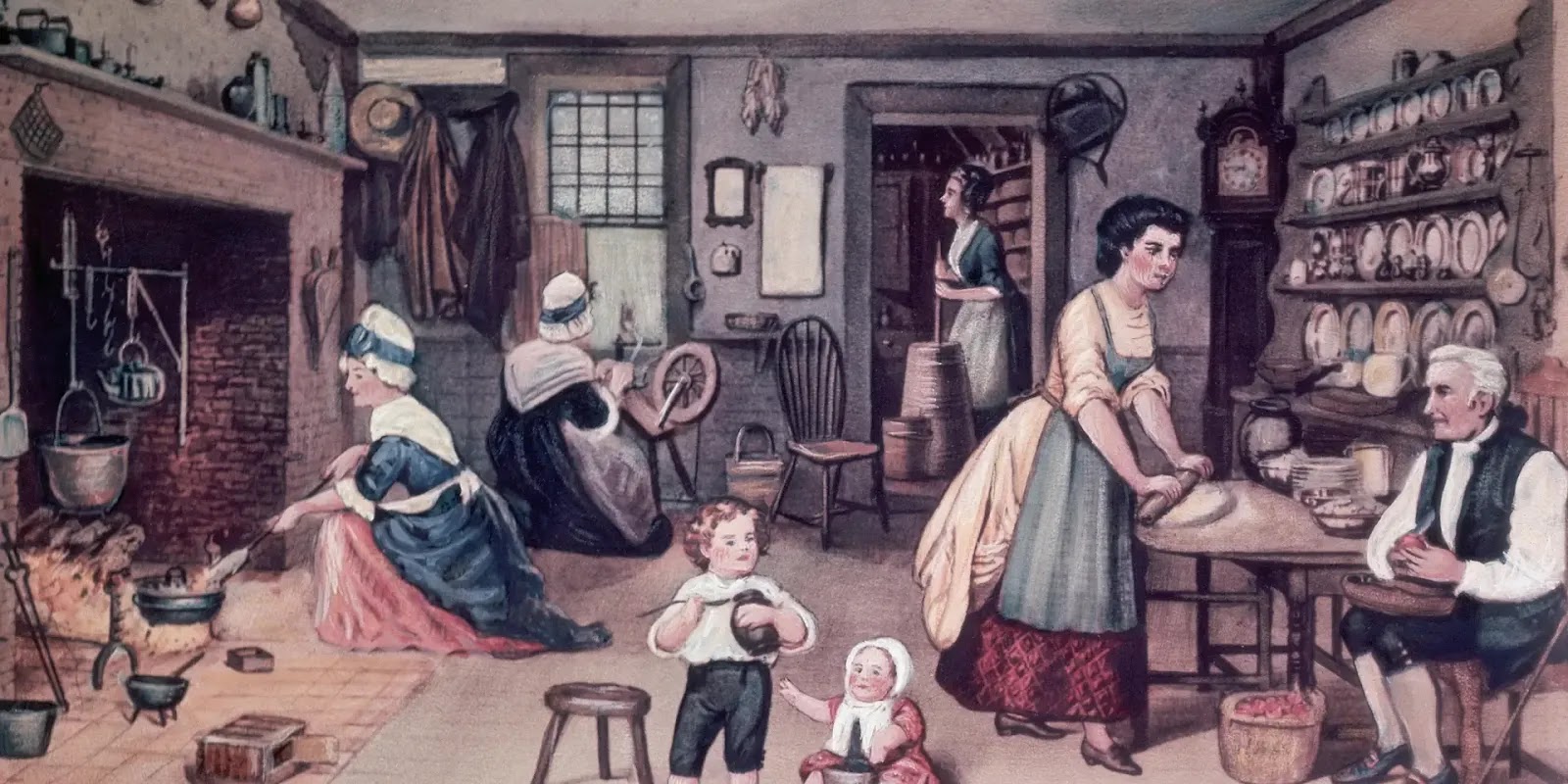
    Colonial Farm Kitchen. Notice clock in the corner.


    THE 1600s


    Preliminary Comments


    About 350,000 Europeans emigrated to the American colonies in the 1600s. They were risk-takers. They left long-settled communities and societies to get on small, crowded sailing ships to make the dangerous 3,000 voyage to a new land that was mostly wilderness. About 5% died. They had to adapt to a new, frontier environment of forests and swamps. They had to “tame the howling wilderness.” 


    A high percent of the European immigrants in this period were from England. Almost all were Protestants.


    Emigrants from England came over in three “waves.”  Then a fourth ‘wave” came to the North American colonies in the 1700s. They were four distinctly different groups of people from different areas of the English isles.


    To understand why these four groups left England and Scotland, at different times and for different reasons, it is necessary to know a little bit of English history during this period.


    The Failure of the First Settlements


    The earliest settlements of Pilgrims coming to Plymouth (1620) and immigrants coming to Jamestown (1607) were failures. About half of the Pilgrims died on the voyage or in the first year. Very few new immigrants came to Plymouth. The English Pilgrims actually came from Holland; they were worried that they were being assimilated into Dutch society.


    The company that settled Jamestown continued to send over thousands of new immigrants and many supply ships. The first settlers were mostly single men looking for gold; only later did the Virginia Company send over families. In the first 15 years, about 75% of the settlers died. There were many reasons, including that Jamestown was built on a malarial swamp. Neither group was prepared to deal with the harsh “wilderness” of America.


    But there was one success. Some of the Jamestown settlers began growing tobacco.


    The First Wave – Puritans coming to the Boston area. (1629-1642)


    English background. In the early 1600s, there was political tension and conflict in England. The English kings thought they could rule without consulting Parliament; Charles I suspended Parliament for eleven years. But many people in England thought the King and Parliament should rule together. They opposed the king’s right to rule without Parliament. 


    At the same time, there was a bitter conflict over who would control the Church of England. The Church of England was the official, government-supported church. It was Protestant (it was illegal to be a Catholic in England at this time). Most English were members. Some members wanted a church controlled by its bishops, who were appointed by the king. Top-down, hierarchical control. Others wanted to “reform” or “purify” the Church, move it further away from traditional practices and beliefs. Some even thought individual congregations should be able to appoint their ministers without interference from the bishops. These people were called Puritans.


    The fights over who should control the government and who should control the Church of England were connected. Supporters of the king also supported a Church controlled by its leaders, the bishops. Many supporters of Parliament were also Puritans.


    By the late 1620s, it was obvious that the king and the bishops had won the fight over power and control. Puritan ministers were being removed from their pulpits. Many Puritans recognized they had lost and wanted to leave England. They came to the American colonies.


    From 1629 to 1642, 15,000-20,000 Puritans came to the Boston area and quickly spread out. Few new immigrants arrived in the rest of the 1600s, only about 7,000. This area was known as the Massachusetts Bay Colony. They were highly organized and well-prepared to set up towns and farms. They came in families, brought farm equipment and supplies, and their own Puritan ministers. They laid out towns and distributed land for family farms. They quickly set up a seminary to train new Puritan ministers; we now call this school Harvard. They prospered and their numbers increased rapidly. They spread out into much of New England and beyond.


    They wanted to set up a Puritan society that they controlled. They discouraged anyone who wasn’t a Puritan from settling in New England. Non-Puritans were forced to deport and not return on threat of death. Four Quakers who came back were hung.


    The Second Wave – Royalists coming to Virginia (1649-1660)


    In 1642, civil war broke out in England – the Puritans and Parliament supporters against the king and his supporters. Supporters of the king were called royalists (also called cavaliers). Many were members of landowning aristocratic and gentry families.


    The king and his supporters lost. The king was executed. Many royalists didn’t want to live under a government and church controlled by Parliament and Puritans. Some emigrated to the British West Indies and some to Virginia, where a pro-royalist governor created a stratified society dominated by royalists. He gave them large tracts of land, the basis of the spread of tobacco plantations. 


    They tried to recreate the kind of society and government they ruled before the civil war. Fortunately, there was hundreds of miles of wilderness between Virginia and Massachusetts.


    About half of the European immigrants in the 1600s were poor people who couldn’t afford the ship passage to America. To get to America, they became “indenture servants.” Most came to Virginia and Maryland.


    The tobacco growers owned great amounts of land but very few people to work it and process the tobacco. They encouraged “indentured servants” to come to Virginia. When the ships landed in America, the immigrants were auctioned off to pay the shipowners for passage. Typically, an indentured servant “agreed” to work for their owners for four to seven years. They had almost no rights. After their indenture was complete, they were free; some received some compensation. They were offered free or cheap land, so they had little reason to continue working on plantations. But since most of the good land along the rivers of Virginia was owned by earlier immigrants and their descendants, the new immigrants had to move west to the unsettled frontier, much of which were the foothills and valleys of the Appalachian Mountains. Tobacco growing spread rapidly and was by far the American colonies largest export in the 1600s and 1700s. 


    The Third Wave – Quakers coming to Pennsylvania (1680s and early 1700s)


    Not everyone in England belonged to the official Church of England. They were called “dissenting sects.” One of the most prominent was the Quakers.


    The Quakers were persecuted by government and church officials. In the 1680s, William Penn worked out a deal with the king, who granted Penn, who had converted to Quakerism, ownership and control over a large area in America in exchange for cancelling loans the king owed to the Penn family. Pennsylvania. It became a haven for Quakers. Many of the Quakers in England, over 20,000, emigrated to Pennsylvania and nearby areas. They established a society based on radical Quaker ideals. They were later joined by German sects with similar beliefs. 


    By the end of the 1600s, there were about 250,000 European immigrants and their descendants along the Atlantic coast. A very high percent, maybe 90% or more, were from England and Wales. Their numbers increased rapidly because of immigration and the high birth rates in New England.


    FROM 1700 TO 1775 (THE FIRST YEAR OF THE AMERICAN REVOLUTION)


    Immigration was different in the 1700s than in the 1600s. There were four main groups:


    English – less than 100,000

    Scots and Scots-Irish – about 150,00

    German speaking – about 100,000

    African slaves – about 250,000

    Small numbers of other groups, including French Huguenots (Protestants) and Irish Catholics.


    Total immigration in the 1700s was around 600,000 people. English immigrants were a minority of the European immigrants and a small minority of total immigrants. By 1775, the American colonies were made up of a diverse population; English immigrants and their descendants may have been a minority of the total population.


    English Immigrants

    The composition of English immigrants in the 1700s were somewhat different than that of English immigrants in the 1600s. They were not part of distinct religious or political groups. They were generally poor. They came from different parts of England, including the borderlands with Scotland. Many, maybe as many as 50,000, or over 50%, were criminals or convicts (in England, you could be sent to prison for not paying a debt). England emptied its jails and sent the inmates to America. Most ended up in Virginia and Maryland because that was where the ships were going, to pick up tobacco. The convicts were indentured for up to 14 years and did not get any land or compensation. They were treated no better than slaves. Most became part of the landless poor after their indenture was up. If they survived.

    People from the borderlands between northern England and Scotland (1700s) and Highland Scotland

    The Scots and Scots-Irish

    Fighting between northern English and lowland Scots, and among Scottish clans, had been going on for hundreds of years. This was a frontier, lawless area – little organized government or military control. There was much violence, including raids to cause destruction, pillage, and steal cattle. In addition, there was family and clan feuds on the Scottish side of the border.


    In the 1600s and 1700s, England completed its campaign of clearing out Irish Catholics from Northern Ireland. Favored English were given large land grants. Many of the farm workers came from Scotland. They were Protestant. They were called Scots-Irish.


    In the 1700s, a stronger English government successfully established control over northern England. Through battles and brutal military campaigns, England subdued the lowland (borderland) Scots. Many didn’t like the new order. At the same time, highland Scot landowners began clearing out their tenant farmers, who became landless. Many Scots went to Northern Ireland to work. But conditions were not much better than in Scotland. In the 1700s, about 100,000 Scots and Scots-Irish emigrated to the American colonies.


    Many of the settled colonies weren’t happy about the less “civilized” new immigrants. But the expanding plantation colonies of Virginia (tobacco) and South Carolina (rice) needed their labor.


    Many of the borderland people and Highland Scots settled into a frontier environment in the foothills, valleys, and mountains of the Appalachian Mountains (the western geographical border of the colonies). Some Highland Scots settled in parts of North Carolina, a borderland region between Virginia and South Carolina. For a long time, there was little government or legal presence. Few churches and little organized religion. Disputes were often settled by violence. Many raised cattle as in the borderlands. In America, they were called the “backcountry” people.


    German-Speaking Immigrants

    Many of the German-speaking immigrants came to America to avoid religious persecution. They held similar religious beliefs as the Quakers. They also were persecuted by German governments and their official (state-supported) religions. When the Quakers established Pennsylvania, it was a safe haven for the German sects, including the German-speaking Amish, Mennonites, Moravians and Schwenkfelders. About three-quarters of the Germans landed in Philadelphia.


    The German sects, like the Puritans and the Quakers, tended to come over as families and often with their ministers. They moved to the new lands west of the Quaker-dominated region around Philadelphia. Even today, part of their settlement is called the “Pennsylvania Dutch” country. The word “Dutch” is derived from the German word for Germans.


    Because of the waves of Scot and German immigration, Pennsylvania’s population exploded from about 18,000 in 1700 to about 120,000 in 1750. The Quakers had become a minority in their own colony.


    African Slaves


    The largest colonial immigrant group was African slaves. About 250,000 African slaves were brought to the American colonies up to 1775. The number started to go up in the late 1600s and then accelerated after 1725. The total black population of colonial North America in 1775 was probably over 500,000, mostly slave but a small percent were free. Most of the slaves in the South worked on plantations, especially in Virginia, Maryland, South Carolina, and North Carolina.


    Why were there African slavery in colonial America but not in England? There are demand side and supply reasons. 


    The short answer is: the rapid expansion of the production of plantation crops. The limiting growth factor, as always in colonial America, was labor. Expansion originally depended on indentured servants. But many immigrants, including indentured servants, didn’t want to work on plantations. German-speaking immigrants went to Pennsylvania, not Virginia, Maryland, or South Carolina. Many Scottish immigrants avoided indenture. Then there were the long-run costs. Indentured servants only worked for four to seven years. Plantation owners had to buy new servants to replace the freed servants. For complicated reasons, the number of  immigrant indentured servants fell and the cost of  rose in the late 1600s. African slaves cost more but they were slaves for life. In addition, children of slaves belonged to the slaveowner, a cheap source of future labor.


    South Carolina was a special case. Plantation agriculture started when a few slaveowners and their slaves migrated from Barbados. Rice, not sugar, was the most profitable crop. Rice was exported to Europe and to Caribbean islands. By the late 1700s the rice growers in South Carolina were some of the richest families in America.


    Slaves were available. The American continent was importing large number of slaves in the 1700s, mostly for the sugar-producing Caribbean islands and Brazil. Much of the trade to the Caribbean was controlled by English slavers. It was a short step to expand to the North American colonies. New England merchants and shipowners also entered the slave trade.


    Native Americans


    I have not mentioned Native Americans. There is currently much writing and discussion about Native Americans. It is a complicated topic. For the early relations  between Native Americans and European immigrants, see Ken Burns’ documentary The American Revolution.


    There were attempts to enslave Native Americans. The attempts failed.


    In the end, unlike Spanish or Portuguese America, the rapid increase in the European population, combined with the pressure to expand farming into Native American lands with relatively small Native American populations, doomed Native American independence in parts of colonial and early Federalist America. Some tribes adapted. Some moved west. The Iroquois Confederation avoided most of the pressure and remained independent up to the American Revolution. But the long, tragic history of land-hungry white Americans taking Native American lands had begun.


    CONSEQUENCES


    Many of the European immigrants came to America to avoid religious and political persecution. Almost all early English immigrants had grievances against the English government when they emigrated. German-speaking immigrants had no ties with England. Many Scots hated the English. Equally important was the lure of unlimited new farmland. Rather than being tenant farmers (paying rent to a landowner) or landless farm laborers in Europe, immigrants had a chance to own large farms (by European standards) and be independent. For many, religious freedom and economic independence went together. For Africans, the exact opposite happened.


    All groups had different ideas about how government, religion, and society should be organized. Or not organized. After the American Revolution, as the separate colonies became the United States, the clash of their different ideas would become the basis of many of America’s future political conflicts.


    The rapid increase in the population of these groups and their westward expansion looking for new farmland would have a profound influence on American history. The first consequence was that the western movement to new lands was a contributing factor in causing the American Revolution.


    AMERICA IN 1775


    America in 1775 was a much different colony than the America of 100 years earlier. Population near the end of the 1600s of around 250,000 – almost all of English descent and few slaves – had become a society of about 2 million people in 1775 – about 1.5 million European immigrants and their descendants and about 500,000 African slaves. The white population had become more diverse and less English. The African slave population was around 25% of the total population. 

    With high birth rates, plentiful and diverse food, and open immigration, Americans could expect their population to double by 1800.


    Why the change? 


    ·      Access to “unlimited” free and cheap land for farming. 

    ·      Geographic mobility – individuals, families and groups leaving settled communities to move west. 

    ·      Fortunes to be made producing plantation crops and exporting into protected English markets (similar to the sugar islands in the Caribbean). 

    ·      Expanding merchant and shipping class to handle rapidly expanding domestic and foreign trade.

    ·      Development of craft production to fill rapidly rising standards of living. 

    ·      Overall opportunity – fewer obstacles to personal and family advancement than in England and Europe. Individual and political freedom and democratic government compared to Europe and even England.


    The Economy


    Almost all Americans, about 90%, engaged in agriculture. By 1775, about half of the white population owned their farms. 

    Agriculture by 1775 was very different than the subsistence (producing food just for the farm family) agriculture in most of the rest of the world. Americans with large family-owned farms and plantations, produced enough food to make Americans well-fed, plus a surplus of grain and commercial crops for sale to local markets, towns, and for export.


    Americans produced a surprising variety of food and crops. For example, many farms and plantations had apple orchards. The apples were mostly used to produce cider. I was also astonished to learn that bananas were grown in South Carolina. 


    Americans had begun to experiment with growing mulberry trees throughout the colonies. Mulberry trees were the food for silkworms. Americans were trying to develop a silk industry. This venture would eventually fail. But many towns and rural areas even today have a Mulberry Street. Including Boston.  


    America’s largest exports in colonial times were the plantation crops of tobacco and rice, followed by indigo (a blue dye from the indigo plant for England’s growing textile industry). The colonies also exported grain and other products like lumber and horses to the sugar-producing islands in the Caribbean. 


    The American colonists imported most of their manufactured products from England. Everything from cloth, clothes, shoes, guns, swords, clocks, furniture, dinnerware, china (including Wedgwood), silverware and silver products, and all sorts of manufactured metal products including pots and shoe buckles. Wealthy planters imported luxury goods from England and Europe, imitating the wealthy landowning class of England. And tea.


    The American colonies were England’s largest trading partner by 1775. While sugar from the West Indies was a more valuable English import than American tobacco, America with its large and growing population of prosperous farmers, planters, and merchants was a major market for English exports.  


    In the 1600s, almost all this trade was carried on English ships and controlled by English merchants. But by 1775, the American colonies had become major ship builders, about one-fourth of the total merchant ships of England and America. More of the trade with England was carried in American ships. And more of the trade was organized by a growing merchant class in American ports. 


    And by 1775, Americans were producing some of their own manufactured goods. Most farm families made cloth. American craftsmen were producing furniture, dinnerware, and silver products. The most famous silversmith was Paul Revere.


    The colonial image above shows a farm family with metal pots and other metal goods, a gun over the mantel, metal buckles on man’s shoes, a butter churn (owned cows?), and a spinning wheel to make yarn. They also owned a grandfather clock. These products were of a simple style; other than the metal products, some of them were probably made in America. England would regret exporting rifles to America.


    With seemingly unlimited land and a rapidly-growing population, rising exports, and new types of economic activity, the American economy was also rapidly growing and developing. On average, white Americans enjoyed a high average standard of living by 1775. Possibly the highest in the world. 


    Politics and Government


    America was more democratic than England. No king, no aristocracy who dominated land-holding and political power. Much higher literacy rates. A much higher percent of white males voted and were active in local government than in England. America was almost entirely self-governing for almost 150 years before England attempted to tighten control in 1763.


    Americans were highly literate; about 70% of white males and 50% of white females could read and write. The percents in Puritan New England were very high – about 90% for men and 80% for women. New England had its first printing press by 1640. 


    The literacy rates in England were much lower.


    The American colonies had more newspapers than England, which had a larger population. Foreign observers often remarked that Americans seemed to love to read and talk about politics (often in taverns).


    By 1775, over 50% of free adult males were qualified to vote. And Americans were very active voters, with high turn-outs at election times (free food and alcohol from the candidates helped raise turn-out rates). In England, by contrast, fewer then 5% of adult males were qualified to vote. In over half of parliamentary elections, there was only one candidate. 


    American colonies were self-governing. At both the local and provincial (colony) level, most of the government officials were democratically elected. The exception was that most of the provincial governors were appointed by London. But their salaries had to be approved by provincial assemblies, which gave them control over the governors.


    One example of America’s independence from English control was that Americans found it easy to evade the Navigation Acts. The Navigation Acts basically said that most of American exports and imports had to be with England or English colonies. But Americans routinely ignored the Navigation Acts by trading with other countries and their colonies. Although illegal, Americans and American ships imported goods from other countries. England had too few officials and ships in America to stop this smuggling (sneaking in illegal imports). Probably the best-known smuggler was John Hancock.


    England began to crack down on smuggling in 1763, after the end of the French and Indian War.


    OVERVIEW 

    By 1775, the American colonies had become a rather unique society. It was very different than most of the rest of the world, even England. Large, family-owned farms. New land on the frontier. Commercially active. Literate. Democratic and politically engaged. Economic opportunity – few barriers to start new businesses or develop new skills (no guilds). Physical (move west) and economic mobility. King far away and no aristocratic landowning class. No long-settled rural class society.  No large standing army. Low taxes approved by local governments.


    One partial exception. By 1720, five colonies, and Westchester County in New York, had “established” religions, that is, religions supported by taxes. They were Congregational  (Puritan) in Massachusetts and Connecticut, and Church of England (Anglican) in Virginia, North Carolina, and South Carolina. By 1775, other Protestant denominations, besides Quakerism, were flourishing, including Presbyterians (Scots), Baptists, Methodists, and German pietist sects. After 1740, America was swept by waves of evangelical enthusiasm.


    By 1775, Europeans had become or were becoming Americans. England’s North American colony was less “English” and more diverse than a century earlier. Puritans were becoming Yankees; many were challenging their Puritan roots and moving away from the Boston area.  By the early 1700s, many New Englanders thought Harvard (established to train Puritan ministers and teachers), had become too “liberal.” Virginia royalists had become plantation owners, with African slaves replacing European indentured servants. England had virtually outlawed slavery in 1772 and was moving to stop the African slave trade. Many had gone from being Tories (supporters of king and aristocrats) to becoming Whigs (critics of king and his royal governors of Virginia) as they engaged in bitter political battles with appointed English governors and resented high tariffs imposed on their tobacco exports to England. 


    The Virginia planter class, somewhat unexpectedly given their backgrounds, would contribute many of the leaders, supporters and military officers in the coming American Revolution, including George Washington, Thomas Jefferson, James Madison and James Monroe. And the father of Robert E. Lee.


    Quakers came to America as a small persecuted religious group and had become the dominant merchant and political group in the greater Philadelphia regions. Maybe the Scots and Scots-Irish, relatively late arrivers, probably changed the least by 1775, but many hated the English for the brutal conquest of Scotland and already had a strong sense of personal independence.


    The German-speaking farmers in Pennsylvania challenged the political monopoly of the Quakers and forced them to share political power.


    There was individual mobility. The most famous example was Benjamin Franklin, who went from being a penniless “immigrant” from Boston to the richest man in Philadelphia. He was an urban entrepreneur and a major investor in urban real estate. An anglophile (lover of the English), he also went from a man who retired to England and expected to die there to be one of the leaders of American independence from England.


    The Manigault family went from penniless religious refugees (French Huguenots) to the richest family in South Carolina in three generations. (They would be followed after the Revolution by the du Pont family, French political refugees.)


    This was not a settled or stagnant society. By the standards of the time, colonial America was a “modern” society. The main threat to dynamic change and growth was that America was still an English colony. That would change.

      ==========================================================

    See the next post in this series, 

    The American Revolution and the New Country: American History, 1755-1790

    followed by

    A New Nation, America from 1789 to 1860

    The classic book on colonial America is Albion’s Seed: Four British Folkways in America, a 1989 book by David Hackett Fischer. Long, incredibly detailed about all aspects of colonial American life. If you get through the entire book (last section optional), you should consider becoming an American History major.


    For an excellent survey of colonial America and the other colonies in North America, see Alan Taylor, American Colonies:  The Settling of North America, 2001. 


    For a discussion of how the North American and West Indies colonies fit into the wider English imperial empire that began in the 1600s, see


    England in the 1600s: The Beginning of England’s Rise to Global Power and Wealth


    This essay includes a discussion about how the American colonies fit into the English imperial system, especially the Navigation Acts.


  • Wealth and Power in Pre-World War I Europe

    Wealth and Power in Pre-World War I Europe

    Krupp Steel Works, Gun Shop #1, 1917
    Library of Congress

    New Nations in Europe and Global Political Change (1860s – 1914) 


    New nation-states were formed in Europe at the beginning of this period – Italy in 1867, Germany in 1870, Austria-Hungary in 1867, and new nation-states carved out of Ottoman empire in the Balkans in the 1870s. 


    Other countries pursued new policies. France and England expanded their colony empires and fought a number of wars against native resistance (this was the first time machine guns were used). Russia attempted to expand its influence and control into Central Asia and the Far East (Siberia and Manchuria). Under pressure from the outside, Japan ended its isolation and started rapid industrialization in the 1860s and 1870s. By the 1890s, Japan began imperialist expansion by defeating China in a war and establishing control of Korea, Taiwan and part of Manchuria. The Chinese dynastic system came to an end in 1911, starting a period of internal chaos and violence. The United States also began to pursue an imperialist policy, defeating Spain in a short war to expand into the Caribbean and the Philippines. Combined with building the Panama Canal and control of Hawaii, America was becoming a Pacific power.


    These geopolitical changes would have serious consequences in the period leading up to World War I and later. They led to increased national rivalry in Europe and national confrontations in Africa, Central Asia and East Asia. Russia, China and the United States would all come up against Japanese imperial expansion in the 20th century.


    Nation-states in Europe were bigger, with access to more resources, including new, deadlier weapons (for one example, see the post The Maxim Machine Gun and Smokeless Powder).


    1870 – 1914:  New Political and Economic Dynamics in Europe


    Most of history has been the story of the struggle for power. Conflicts, wars, conquests, and civil wars among the political and warrior elites. Peasants who worked the fields for the landowning elites and paid taxes to the political elite, did not count for very much in this story.


    This narrative began to change with the coming of the American Revolution, the French Revolution, and the Industrial Revolution. Economic competition was added to political competition. New sources of wealth and power were created. The spread of literacy, the expansion of the franchise (right to vote), and the formation of political parties, representing the new middle class and industrial workers in the late 1800s and early 1900s, began to challenge the political dominance of king, the governments they appointed, and the landowning aristocracy that supported the status quo. This happened in Russia, Germany, and Austria-Hungary. In England, royalty and the nobility lost most of its political power. The House of Lords, a bastion of the old order, was stripped of its veto power, and new tax laws were undermining the economic base of the landowning aristocracy. Both political parties were headed by politicians with middle-class backgrounds. In France, unresolved ideological tensions were heightened during this period, culminating in the Dreyfus Affair of 1894-1906 that bitterly divided society between conservative and liberal groups. As a result, the Catholic Church, an important part of conservative power, was stripped of much of its political power and influence by new laws passed by a liberal government in the early 1900s.


    It was a period of tremendous economic development, economic growth, and social change. Some economic historians call this period the Second Industrial Revolution.  Much of the technology of the modern world was created during this period – electricity, steel, skyscrapers, autos, oil refining, chemicals, telephones, radio, movies, record players, and airplanes. There was a large expansion of railroads and steamships. A global telegraph network was built (called the “Victorian Internet” by Tom Savage’s delightful book of the same name). Everywhere there was the rapid expansion of mass production of industrial products, food and clothing, new consumer products, in factories, industrial centers and modern corporations. To finance this was a parallel expansion of banking and financial institutions. An increase in the international trade in food products threatened established national economic groups with political power, especially European landowners and peasants (except in Austria-Hungary). New industrial centers arose and the population of cities exploded.


    As the Industrial and Transportation Revolutions accelerated after 1870, new socioeconomic groups were formed and expanded, collectively creating new economic structures and great wealth. A small group of industrialists and financiers who owned or financed the new corporations became immensely wealthy. The spread of large and complex economic organizations created a demand for a new type of manager; a new industrial and organizational management class was formed. The new industrial and information technology also created a new social group based on scientific, engineering, intellectual and professional knowledge. Professional societies were formed, helping to raise the status of the new technological elite. 


    The new economic class of industrialists and capitalists were legitimatized by the political philosophies of free-market capitalism and liberal democracy. They lived in an intellectual post-Enlightenment and post-French Revolution atmosphere. These groups often came from poor backgrounds or religious and ethnic minorities.  


    The new economic order did not go unchallenged. It threatened the wealth, power and status of the traditional elite groups, especially the landed aristocracy and gentry. This elite from pre-industrial society often led the opposition to liberal democracy and bitterly opposed the disruptive changes of the Industrial Revolution. They upheld and defended the traditional values of the pre-Industrial Revolution world. They destroyed or tried to limit attempts by liberal or social democratic political parties to share power.


    This was a period of great technological and organizational change. These changes created rapid urban growth and disrupted the traditional agrarian social order. It caused great social stress and anxiety, especially among groups who felt they were socially or racially superior. (see Philipp Blom, The Vertigo Years:  Europe, 1900-1914, for an insightful analysis)


    Trade among the nations of Europe greatly increased. One consequence of the spread of international trade was it directly threatened the landed aristocracy who lived off rents. Their incomes declined as the price of agricultural output fell due to regional and international trade in agriculture products (watch the later episodes of Downton Abbey).  Lower tariffs, less protection, lower prices. The aristocracy relied more on service in government, especially in the foreign affairs offices and as ambassadors, and in the military, to retain power, income and status. Examples include Junkers (landed Prussian aristocracy and gentry) in Germany and the landed aristocrats in Russia and Austria-Hungary.


    The landed aristocracy controlled the top positions in government and military. Over 80% of top German military officers at the beginning of World War I were of Junker (Prussian titled nobility) background. They allied with other conservative, reactionary, and anti-modern groups – kings, churches, dispossessed artisans, peasants, and political and intellectual conservatives and reactionaries – who formed conservative political parties and influenced public opinion. Ideology and mythology romanticizing pre-industrial societies were used to denounce the effects of liberalism and capitalism. Related arguments demonized groups that benefited from these trends, especially Jews. Political anti-Semitism was effective in Austria-Hungary, especially in Vienna (see the post Austria-Hungary Before WWI). It was a potent weapon during the Dreyfus Affair in France. The tsarist regime in Russia promoted deadly pogroms (race riots against Jews) to divert national anger heightened by the disastrous Russo-Japanese War (1904-1905) and the violent suppression of the 1905 Revolution.


    Conservatives everywhere tried to divert opposition by appealing to nationalism, racism and imperialism. Bismarck and successor Prussian leaders successfully co-opted large industrial and banking companies, tying them to reactionary Prussian-dominated Germany, partly with government military contracts.  


    World War I


    World War I shattered the political power of pre-capitalist, reactionary groups in Russia, Austria-Hungary and partly in Germany. It seemed possible that liberal democracy, national self-determination and free market capitalism would triumph in Europe. The war broke up the empires of Russia and Austria-Hungary, creating new states in Central Europe. The Treaty of Versailles reduced the size of Germany and greatly limited the size of its military. But WWI led to chaos and violence in Central Europe, Communism in Russia, fascism in Italy and bitter, and violent opposition to the Weimar Republic in Germany. The Versailles Treaty in Germany was the target of German nationalist rallying cries. 


    HISTORICAL ANALOGIES (AND LESSONS?)


    We may be returning to the political world of the early 1900s. After World War I, appeals to nationalism and prejudice by anti-democratic demagogues were used against the “failure” of liberal democracy and capitalism. Now, “populist” national parties and their political leaders rally opposition to the new “liberal” economic and social order, angry at the growing wealth and power of new elites. International organizations and global trade are denounced. National “populists” expand power by demonizing ethnic and religious “enemies.” 

    —————————————————————————————————-

    BIBLIOGRAPHY

    GENERAL HISTORY OF THE 19TH CENTURY


    Richard J. Evans, The Pursuit of Power:  Europe 1815 – 1914. 2016.


    Good, general history of Europe.


    Jurgen Osterhammel, The Transformation of the World:  A Global History of the Nineteenth Century. First published in German, 2009. English translation, 2014.


    Large, dense book that discusses the 19th century by topics and themes rather than chronology. Covers an incredible range of topics. Pick and choose.


    BEFORE THE STORM


    Charles Emmerson, 1913:  In Search of the World Before the Great War. 2014.


    Attempts to describe what the world was like just before the war. A world tour of 21 cities. Some interesting material and commentary. Reenforces the idea that almost no one in Europe or elsewhere thought about the conflicts in the Balkans or the prospect of war.


    Philipp Blom, The Vertigo Years:  Europe, 1900-1914. 2008.
     

    Despite the book’s structure of picking one theme in each year, surprisingly insightful look at the years before WWI. Attempts at parallels to current (or continuing) society. Emphasizes psychological stress and social disruption caused by economic change, and their political and cultural consequences.  


    AUSTRIA-HUNGARY AND VIENNA.


    For a more detailed look at Austria-Hungary before WWI, see the related post

    Austria-Hungary Before WWI)


    Carl Schorske, Fin-De-Siecle Vienna:  Politics and Culture. 1980.


    Brilliant, seminal book on how the liberal, capitalist, upper middle classes lost political and cultural dominance in Vienna. Their newly-found influence and power were symbolized by the Ringstrasse and the buildings on it.  Rise of mass movements to challenge existing political order, including the use of anti-Semitism as a reactionary political weapon. (Observed by a young Adolf Hitler.)  Cultural (and psychoanalytic) attack on rationalist and ordered culture of Vienna. In the background, the gradual disintegration of Austro-Hungarian Empire.  Tie-in with Morton’s book.


    Geoffrey Wawro, A Mad Catastrophe:  The Outbreak of World War I and the Collapse of the Habsburg Empire.


    Excellent history of the combination of unreality, arrogance and stupidity of the military and political leaders of the Austro-Hungarian Empire that led to World War I.  Mostly a military history of the performance of the Austro-Hungarian army during the first year of the war.  Incredible incompetence leading to defeats against Serbia and Russia, resulting in horrific casualties.


    Stefan Zweig, The World of Yesterday.


    A literary and moral autobiography.  The tragedy of Europe as seen in the life of a literary intellectual who believed in a European community of intellectuals.  Dreamed of a peaceful, united Europe. Committed suicide in exile.
    ================================================

    For related posts, which could be read in order, see


    Bismarck and the Origins of World War I

    The Beginning of the Twentieth Century:  The Start of World War I


    The Austro-Hungarian Empire Before World War I


    Europe on the Brink of World War I


    The Immediate and Long-Run Historical Consequences of World War I


    The Maxim machine gun, which fired 600 rounds per minute, was one of the new weapons that made the WWI battlefield so deadly.


    The Maxim Machine Gun and Smokeless Powder


    For a list of all posts, with links, see List of Posts by Topic.


  • Global Demographics and Economic Growth

    Global Demographics and Economic Growth

    1. Jakarta – 30 million people and sinking

    GLOBAL DEMOGRAPHICS

    Demographics, the study of the size and composition of population, will shape national and global economic growth and economic policy.  

    The period from 1950 to 2000 was highly unusual. The American “baby boom” started, temporarily reversing the long-term decline in birth rates.  Not just the United States but the global population experienced high birthrates and high population growth rates. In the middle of this period, partly due to more effective and more available birth control, birth rates began a rapid decline. The growth rate in world population began to fall. At the same time, much of the world’s population experienced rising standards of living. One consequence was longer life expectancies and rising average ages in industialized countries.  

    Countries with over a third of the world’s population and most of the world’s output now have birth rates below replacement. They are mostly the wealthy, industrialized countries, including the United States, Canada, Brazil, Western and Eastern Europe, Turkey, parts of Southeast Asia, Japan, Russia and China. Collectively, the size of their labor forces have stopped growing. All countries face the same challenges: Will they be able to invest in economic growth and development (innovation and structural change), deal with environmental costs and climate change effects, and support aging populations?  

    There are falling birthrates for most of the rest of the world’s population, coming down from very high levels. Mexico is at replacement and India is close to the replacement birthrate. But total population continues to grow, partly because of lower infant and child mortality rates, public health programs, better medicine, and subsequently longer lives in most of the world.  

    We are now in a period of a slowdown in total population growth rates. Global population is growing at about one percent per year and the rate continues to fall. But the increase in the number of people is large. In the most recent United Nations projection, the increase in global population from 2020 to 2050 is about 2 billion people, from 7.8 billion to 9.7 billion. The projected population increase over the following 50 years is lower, abour 1.2 billion. 

    Changes in total population may be points on an exponential decay curve. The UN projects that zero population growth will be achieved sometime shortly before 2100. The rate of decline could change with changes in the availability and cost of birth control, education of women, anti-aging medical technologies and more available health care for an aging population. (Estimates of future population are from June 17, 2019 UN projections. UN projections are revised about every two years.)

    The biggest unknown is future medical technology that will prolong life expectancies. Regardless of projection, the fastest growing age cohort is 65 years and over; within that cohort, the fastest growing age group is 80 years and older.

    Countries with birthrates well below replacement and aging populations may experience accelerating decreases in population. Family planning, combined with urbanization and more education of females, could lead to birth rates declining faster than projected in high birth-rate countries. In Africa, Ethiopia, Malawi and Rwanda promoted family planning and have seen large decreases in their birth rates. Kenya, after investing in family planning clinics and information, has seen its fertility rate fall from 6.5 in the late 1980s to 2.4, marginally above replacement and half the rate of most African countries.

    POOR COUNTRIES AND RICH COUNTRIES

    Wealthy countries have below replacement birth rates, no growth or declining populations and labor forces, low real economic growth, and aging populations and labor forces. Population will continue to concentrate in cities; the population of a small number of cities will be responsible for technological innovation and economic development. Rural areas will continue to lose population.

    Poor countries today have high but declining birth rates, young and increasing populations, and populations that want to emigrate (see case study below).

    Most of the largest and fastest growing urban areas in the world are in poor countries, China and India. Over half of the world’s population live in cities and the percent is rising. Almost all of the increased population in poor countries will live in or move to cities, which are already ecological disasters – traffic gridlock, poor air quality, lack of infrasturcture, sinking, raw sewage, and power outages. Many are coastal cities that are already experiencing periodic flooding and storm surges; rising sea levels and the increased number and severity of hurricanes will intensify urban problems. 

    Starting sometime in the 2050s, the world’s population outside of sub-Saharan Africa will stop growing and then slowly decline. All of the world’s net population growth will then be in Africa. How soon the world reaches zero population growth will depend critically on how fast birthrates decline in Africa.

    By 2100, Africa could have about as many people as Asia, about 4-5 billion. Together, Africa and Asia in 2100 could have about 80% of the world’s population.

    Throughout large parts of the Middle East, Africa and Latin America, governments have not been able to provide effective management of economic development for their young, growing population, which have high rates of unemployment and underemployment. Many of the governments are corrupt and/or repressive without free elections or civil liberties. Political activism, partly caused by stagnant or declining standards of living and lack of economic opportunity for young workers, commonly takes the form of mass protests and street demonstrations, aided by Internet social media. Governments typically react with riot police and the military, arrests, torture and prisons, rather than economic and political reform.

    THE DEMOGRAPHICS OF SPECIFIC REGIONS AND COUNTRIES

    A recent survey concludes that 46 countries have declining population or will have declining population in the near future. Declining population is already true in Japan (see below) and Russia and is about to be true in central and eastern Europe. South Korea, also with an extremely low birth rate, is looking at a demographic future similar to Japan’s (see below). South Korea’s current population of 51 million is expected to decline to about 30 million in 2100.

    Russia’s population is declining. Male life expectancies in Russia have been going down for decades but might have recently stabilized. While birthrates are below replacement, the decline of the national population has been offset in recent years by immigration. But lower rates of immigration in 2018 and 2019 have led to large decreases in population. The UN projection is that Russia’s current population of around 146 million will fall to about 85 million by the end of the century. 

    Because of very low birthrates and out-migration, central and eastern Europe is looking at population declines in this generation.  Some UN projections show that most countries in central and eastern Europe might have even larger total percent declines than Japan by the end of the century (over 50%).

    Western Europe is further along the population aging curve but because of immigration of younger people, the decline will not be as precipitous. And western Europe, like Japan, currently starts with more resources to support an aging population.  But high structural unemployment rates, low economic growth, restrictive labor laws and generous early retirement benefits will strain western Europe’s ability to grow and maintain current social welfare levels. A few European countries realize that current levels of social welfare are not sustainable and have begun reviews of retirement and health care programs. This problem is exacerbated by the currently high unemployment and underemployment rates among younger employees.

    China, which has enforced a “one-child” program since the 1970s until 2016, has a very low birthrate of about 1.6. Although this program has been relaxed in recent years, the national birthrate remains far below replacement. China currently has a young average-age population but the average age is rising very rapidly. 

    China’s working-age population began shrinking in 2012.  By around 2050, the decrease will be about the size of the current U.S. total labor force. Next year, the median (half above, half below) age in China will pass that of the United States. By around 2045, the percent of China’s population over the age of 65 will be about equal that of the United States. 

    A mature, experienced workforce should help maintain high but falling economic growth rates for another generation. After about 2050, demographics will begin working against Chinese economic growth. 

    China will grow old before it becomes rich (high per capita income). Even after decades of spectacular growth, per capita income is still about one-third to one-fourth that of South Korea and Japan. Even worse off are the economies of Southeast Asia, with per capita incomes below China, similar birthrates and rapidly aging populations.  

    Given current political strains and a large Chinese population outside of China, it is possible that China will have larger net outmigration in the future.

    DEMOGRAPHICS AND ECONOMIC GROWTH

    The following accounting identity shows the sources of economic growth. An accounting identity says nothing about causality, assumptions or feedbacks. But it introduces some general issues.

    The economic growth rate of a country roughly equals the growth rate of the labor force plus the increase in productivity (output per member of the labor force).

    If the labor force numbers are stable, all of the increase in output depends on the increase in productivity. The pressure on productivity is even greater if the labor force numbers are decreasing. So, for example, if a labor force is increasing at about 1% per year and productivity is increasing at about 1% per year, output will increase about 2% per year. If the workforce stops growing, productivity would have to double to 2% to yield the same economic growth. If the workforce were to decrease at 1% year, as it is in a number of countries already, productivity would have to increase 3% a year to achieve 2% economic growth. This is a high productivity growth rate for a developed economy.

    There is a small amount of research that suggests that an aging labor force is one cause of slowing productivity growth.

    Low rates of productivity growth with accelerating rates of labor force and population decline could lead to less output (negative growth rates) and declining standards of living.

    A member of the industrial/information workforce today is better educated, with new skills, compared to a member of the labor force a generation or two ago. The difference should show up in an increase in labor productivity. Increase in total factor productivity will be due to innovation in capital equipment – including information technology, robotics and artificial intelligence algorithms – and demand for employees with new skills and knowledge. Other factors are public investment and organizational innovation. But these changes have not shown up in productivity measurements. Productivity growth rates are low, although I suspect that the methodology used to compute these figures underestimates the gains.

    Demographics are heavily influencing the areas of investment in wealthy countries; these sectors will drive future economic growth. The three most active areas of research and net investment are robots and AI (reaction to declining workforce), driverless vehicles (same), and biotechnology (health care for an aging population).

    Demographics also influence the demand side of economies. The changing age structure of the economy influences the “market basket” of consumer spending. Certainly the large increase in the number of senior citizens (and their income) is having a major impact on health care spending. To say nothing about the increase in demand for tourism, gambling and south Florida real estate. (I once predicted that marijuana would be legalized when a large number of baby boomers became 65 and older.)

    An aging population is not necessarily bad for economic growth. A healthy population beyond retirement age is leading in the United States to an increasing percent of senior citizens remaining in the work force. With a rising percent of the population over 65 and living longer, health care is a growing percent of output. The health care sector is very innovative, which is a source of economic development and thus economic growth. 

    Companies use demographic information when planning marketing and advertising strategies. Changing demographics are analyzed when developing new products, changing product mix, and segmenting markets. The explosion of detailed demographic information about smaller and smaller segments, including individuals, combined with online marketing technology, is revolutionizing marketing and advertising.

    Areas of the world like Africa face the opposite problem. Working-age population will increase rapidly for a generation or two. But unemployment rates may be high and marginal productivity may be close to zero, or negative in rural areas. With high growth rates of population, economic growth rates will have to be high – over 6% per year – for a sustained period to raise real per capita income (standard of living) and reduce unemployment.  

    IMPLICATIONS FOR ECONOMIC POLICY

    The standard economic models demonstrate that the demographic changes we are seeing are a function of economic growth and development. Industrializing, better educated, urbanizing populations have declining birth rates. But the experience of the poorer regions of the world tends to indicate that these demographic changes are occurring even without economic growth and development.

    Although wealthier countries concentrate on the costs of their rapidly growing retired population, for most of the world the critical question over the next two generations will be how to accelerate economic growth to provide jobs and opportunity for the growing working age population.  The related challenge is how to improve education, training, and economic opportunity to raise standards of living now to provide the resources for the aging population in the future. 

    For the entire world, these objectives are complicated by how to pay for the social costs of past industrialization and environmental degradation, and the future costs of climate change.

    Increasing population and rising real income in emerging economies, especially in Asia, are increasing the demand for energy. China, which had no privately owned cars in 1979, is now the world’s largest automobile market. A dramatic increase in the number of cars is the main reason for the continuing increase in the global demand for oil.  Increased demand for electricity is being met largely with new power plants burning fossil fuels. For at least another generation, these trends will make it difficult to meet global goals to drastically slow down or stop global warming.

    Demographics is interacting with climate change in another important area – food production. Many scientists believe the most serious effect of climate change will be its impact on food production. Global warming and more extreme weather events will make it more difficult to expand food production using current technology. As in other areas, trend projections can be changed by the development of new techology.

    In the long run, the positive side of declining global population will probably be less demand for resources. Combined with substitute technology, global warming might slow down or stop. Climate change might not have quite the devastating effects trend projections indicate.

    The advanced and industrialized countries with stable or declining populations and workforces will have to consider the following:

    Economic growth will have to come from large increases in productivity (output per member of the workforce). To achieve this, and also meet social welfare costs, most countries and regions such as the European Union will have to make radical changes in economic policies. Particularly disruptive and contentious will be the adoption of automated factories and offices. On the positive side they will increase labor and total productivity; on the negative side they will probably eliminate or “deskill” a large number of existing and future jobs.

    Large increases in retirement age populations is leading to serious underfunding of public and private pension funds. Taxes to fund public pension funds are rising rapidly, both in amount and as percent of government budgets. Despite this, unfunded liabilities – promised future benefits not covered by projected future revenue from taxes – are also rising rapidly.

    Multinational corporations will develop and adopt the new technology. Countries that do not have quality education, encourage innovation and change economic incentives will not be able to attract investment and compete in the global economy. And their best educated and most motivated people may go somewhere else, as is happening in eastern Europe and many developing countries.

    On the other hand, poor countries with decent transportation, energy and communication infrastructure will probably attract foreign investment. Real wages of at least part of the labor force will rise.

    Attitudes towards immigration might change from the current restrictive policies of some countries. Attracting “human capital” will be just as important as attracting investment capital. Trans-border movement of people will increase. New national, regional and international agreements will have to be negotiated.  Remittances back to the home country will be a more important part of the economy of many countries and global capital flows. 

    Attitudes about work, labor laws, retirement and retirement ages will change. The benchmark age of 65 was arbitrarily set by Bismarck almost 150 years ago when less than one percent of the German population lived that long. When the United States adopted Social Security, life expectancy was 56 years. The life expectancy of America’s younger workers is already over 80 years.

    DEMOGRAPHICS AND PUBLIC ECONOMIC POLICIES

    If the labor force is not growing or actually shrinking, as it is in most industrialized economies, and the non-working population is growing, one consequence is likely to be growing government budget deficits. Growing government deficits as a percent of GDP may be a function of no economic growth or slow economic growth, not the other way around as suggested by economic research.

    It is how a government spends its income, more than the size of the deficit, that matters. Public investment substitutes for stagnant private consumption spending. Investment, both public and private, substitutes demand for innovation for demand for existing goods. This could increase productivity and result in new products and services. Economic growth then will depend on high levels of new technology and increased productivity (output per employee).

    JAPAN AS A POSSIBLE MODEL (OR WARNING) FOR INDUSTRIAL COUNTRIES

    Figures are from The Economist, “Japan’s economic troubles offer a glimpse of a sobering future,” December 5, 2019.

    Japan is a possible model for the future of other wealthy countries. Japan has a shrinking population and workforce. This will continue. It is not surprising Japan leads the world in developing and installing robots. Robots and AI are also alternatives to immigrants. Japanese companies export capital and technology. Facing falling population, Japan is slowly increasing the number of foreigners allowed into Japan on temporary work permits. But the number remains small, below 1%.

    Japan’s real GDP has been basically stagnant (about one percent per year) over the last 30 years. Without immigration and structural changes to Japan’s political and economic system, Japan’s real GDP in the future will grow slowly at best and eventually decline along with its population. In the long run, Japan will continue on its path to demographic and economic self-destruction.

    CONCLUSIONS

    Demographic trends have important consequences for economic growth and public policies. They cannot be seen in isolation. Neither can any of the other major trends. They are interrelated. 

    ·      Rising global population but at lower rates, mostly in poor countries, for the remainder of the century. After the 2050s, all of the world’s net population increase will occur in Africa. Global population may stop growing by the end of the century. 

    ·      Rising population in poor countries makes high rates of economic growth both pressing and difficult. Emigration pressure from poor regions of the world will probably increase unless there are high rates of economic growth.

    ·      Most of the world’s population increase will take place in cities and surrounding metropolitan areas, creating even larger massive urban areas. Large urban areas are increasing rapidly in poorer countries. 

    ·      Static, falling and aging populations in the wealthier, industrialized countries. Static or declining labor forces mean all economic growth will depend on increases in productivity. To counter demographic trends, technological innovation (robotics and software) leading to high rates of productivity growth will be necessary to increase standards of living (real income per person).

    ·      Problems with unemployment and underemployment, stagnant and declining real incomes and income inequality will probably get worse as artificial intelligence and robotics accelerates the substitution of capital for labor.

    Economic development and growth since the beginning of the Industrial Revolution has been aided by large increases in populations and especially the working age population. But in the future, economic development and growth in most of the world will have to occur with stagnant or declining labor forces and aging populations.

    =====================================================

  • How America Industrialized and Became Wealthy

    How America Industrialized and Became Wealthy


    INTRODUCTION


    This post and the next is on
    the topic of economic development and its contribution to economic growth.  Since the beginning of the Industrial
    Revolution more than 200 years ago, this is the central economic dynamic.  


    The following are factors that led to American economic
    development, many in place before the beginning of the Industrial
    Revolution.  The United
    States, more than any other country, was
    positioned to take advantage of the new technology and ideas that were the
    basis of the Industrial Revolution.  The
    following is an outline of those factors. 
    For the full story of the early decades of America’s Industrial Revolution, see Engines of
    Change
    and some of the excellent histories written about America
    after the Revolution.


    FACTORS IN AMERICAN ECONOMIC DEVELOPMENT AND
    GROWTH


    The usual narrative centers on the inventors and entrepreneurs
    who developed and commercialized new production and transportation technology and technological
    improvements.  They also invented new
    organizational structures to exploit the new technology, both on the supply and
    demand side.


    This post looks at contributing factors that made the
    American experience exceptional.  The United States
    began innovation after England, the country that started the Industrial Revolution, but quickly caught up. By the mid-1800s, America has surpassed England in key technologies.  Innovation has continued up to the
    present.  Why?


    RADICAL POLITICAL, CULTURAL AND
    SOCIAL CONDITIONS CONDUCIVE TO SUPPORTING THE INDUSTRIAL REVOLUTION


    The United States
    had developed social, political and cultural institutions that were supportive
    of the market capitalism version of the Industrial Revolution before it began.  Because of the American Revolution, there was
    an aversion to a strong central government, which at the time was dominated and supported favored
    pre-industrial classes or groups.


    • No
      rent-seeking (parasitic) royalty or nobility.
    • No
      state-supported church.
    • Limits
      on government-supported monopolies. (By rulings of the Marshall Supreme Court)
    • No
      guilds to retard innovation, factories and new forms of labor relations.
    • A
      Constitution giving the Federal government wide powers to support a
      national economy and limiting states’ ability to “restrain” trade among states.
    • A
      culture emphasizing individual responsibility and individual opportunity.
    • A
      radical political system, a democracy based on universal white male suffrage.
    • Wide dissemination of information among a literate public.
    • A
      mobile social system and open society that encouraged risk-taking.

    ENGLISH LEGAL INSTITUTIONS, ESPECIALLY PROTECTION OF
    PRIVATE PORPERTY, PATENTS, 
    AND
    ENFORCEMENT OF CONTRACTS


    Strong English tradition of protecting private property
    and enforcing contracts.


    Underlying law and custom protecting the rights of
    individuals.

    Patent law to protect innovations.


    ACCESS TO ENGLISH INDUSTRIAL TECHNOLOGY AND
    APPLIED SCIENCE


    England
    was the first country to industrialize.  Some
    important aspects:


    • Innovative
      methods to smelt iron, increasing quantity and lowering unit cost. 
    • The application
      of more efficient steam engines and water power to drive machinery.  Beginning of factories.  Large increases in quantity and reduction in unit cost. 
    • Steam engine power-driven
      textile mills and then railroads. 
    • More
      accurate machine tools to produce machinery and metal products.
    • Tradition of entrepreneurs and innovative mechanics, machine tool makers and engineers
    • Continuous invention and improvement; cumulative large increases in productivity.  


    Most of this technology, and the ideas behind them, were transferred
    quickly to America,
    changed to fit American conditions, and improved.  Some transmission channels:


    English immigrants.

    An English immigrant named Samuel
    Slater built the first            water-powered cotton spinning mills.


    Welsh ironmasters who knew how to
    use anthracite coal to smelt iron.


    Contacts with England,
    both personal and scientific.      


    Imitating or
    stealing English technology.


    Francis Cabot Lowell and the
    integrated, power-driven textile mill.


    Steam engines and locomotives.  Americans went to England
    to study the English development of locomotives and railroad technology even
    before the English built the first general-purpose railroad.


    Within two years of the first
    English railroad, Americans were importing English locomotives, adapting them
    to American conditions, and manufacturing them.

    Robert Fulton first learned about steamboats in England.


    Access to English scientific and
    technical publications.


    Establishment of American
    scientific societies to discuss new ideas and technologies, and disseminate the
    knowledge.


    HUGE NATURAL RESOURCES


    In early decades, vast quantities of wood, iron ore, anthracite
    coal, fast-flowing streams and rivers for water power.


    The United States
    would continue to be the world’s leading producer of almost all key minerals
    and fossil fuels (coal, oil, natural gas) until after WWII.


    Huge potential agriculture. 


    Development of commercial
    agriculture, starting in colonial     period.

                            Commercial production for market.

                            Surplus
    food for industrial workforce.

                            Main
    source of exports until 20th Century.


    CONTINUING IMMIGRATION


    In the colonial period and until 1860, slaves and indentured
    servants produced most of America’s
    exports that helped pay for the importation of European capital goods and
    technology.


    Over the last 200 years, there have been as many as 75
    million immigrants.  Immigrants have been
    an important factor in American economic development from the very beginning.


    Free human capital.


    Mostly young adults. Much of the
    cost of raising them to adults, their education and acquisition of knowledge
    and skills paid before they came to America.  Crucial “free lunch.”


    Like Sam Slater,
    many brought specialized skills and knowledge.


                Disproportionate number of innovators and entrepreneurs.

                            Created
    vast and growing internal market.


    Early on, America’s
    democratic ethos and the existence of an open society created opportunity for
    advancement for lower-class mechanics and millwrights unavailable in England.  They could become part-owners of new business
    establishments based on their technical knowledge.  This was the beginning of what I call the
    “hustler and the nerd” model of economic innovation.  From Samuel Slater and Amos Brown (cotton spinning) to William
    Clark and Isaac Singer (Singer Sewing Machine) to Silicon Valley
    (scientific and computer nerds and venture capitalists).


    For the first 100 years of the Second Industrial Revolution (1870 – 1970), all industrializing societies, including America, ignored the “negative externalities.” As had all societies before then. This meant the producers, distributors, and consumers did not have to pay the full cost of their activity. Some examples of negative externalities are destroying the natural environment (clear-cutting forests, water pollution, air pollution, dangerous and deadly work places, noise pollution, accidents and death (auto fatalities and injuries), terrible unhealthy slum living conditions). It was only with the exponentially cumulative effect of all negative externalities that governments began to deal with them.


    CONCLUSIONS


    In economics, Milton Friedman popularized the phrase “There
    ain’t no such thing as a free lunch.”  This
    may be true in a closed economy but not in an open society like the United
    States that allowed immigration, imported (stole) ideas and technology, and provided
    the resources and opportunity to develop new technologies and economic
    institutions.


    A more formal phrase for a free lunch is “positive
    externalities.”   A positive externality
    occurs when someone benefits from someone else’s actions without paying for
    it.  For the American private sector as a
    whole over the last 200 years, there has been lots of free lunches.

                Tens of
    millions of young adult immigrants.

                            Brought
    labor, skills, education and knowledge.

                Access to
    knowledge of foreign technology.


    This combination reduced the cost and increased the speed of industrial innovation.


    Immigrants, shut out of traditional and high-status careers,
    look for or created new opportunities. They had to
    be innovative but had opportunities for advancement not available elsewhere.  A recent study concluded that immigrants are twice as likely to start new businesses than native-born Americans.

    The point is that continual economic development depends on a country’s political, cultural, and social institutions, not just on its economic institutions.

    ==================================================

    A related post:


    The Beginning of the Industrial Revolution in America


    These posts on early American history give some detail on the factors discussed in this post:


    American Colonial History, 1607-1775


    Revolution and the New Country;  American History, 1775-1790


    A New Nation, America from 1789 to 1860


    For an excellent example of an entrepreneur at the beginning of the Industrial Revolution in England, see


    Josiah Wedgwood, the Wedgwood Pottery Company, and the Beginning of the Industrial Revolution.

    See related posts:

    After reading this post, you might want to see the related post on the first case study of a source of economic development, Adam Smith’s Pin Factory. 

    For the story of how England lost its economic leadership, see A Cautionary Tale:  England and the Industrial Revolution

    For the economic dynamics within this wider environment, see A Stylized Model of Innovation:  The Dynamics of Capitalism.