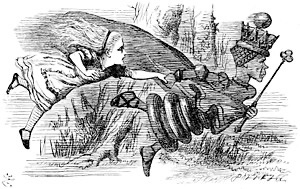

The Red Queen’s Race
TWO DEFINITIONS
Fed funds rate.
The Fed funds rate is the interest rate banks charge other banks that borrow their excess reserves. It is a very short-term (overnight) rate. An increase in the Fed funds rate increases the cost of capital of large banks (net borrowers) and puts pressure on these banks to raise their lending rates. A change in the rate also changes the rate charged by other sources of short-term funds.
The Fed funds rate is the most watched interest rate in the United States and probably the world. It is not set by supply and demand in financial markets. It is set (fixed) by the Federal Reserve Bank (the Fed), America’s central bank.
The Fed funds rate determines or heavily influences almost all other short-term interest rates in financial markets. It also indirectly influences many other longer term interest rates. It summarizes how the Fed views the economy and near-term changes. It is at the heart of monetary policy.
Nominal vs. real interest rates.
Nominal interest rates are the reported interest rates, also called current interest rates. Real interest rates are nominal rates minus some measure of inflation. Both nominal and real rates can be negative. For many years recently, nominal interest rates on many countries’ national debt have been negative. No longer. Although almost all countries have raised central bank rates, the inflation rate in the United States and many other countries was above almost all nominal interest rates, making real rates negative. This is no longer true in the U.S., as inflation has come down below the Fed funds rate but the Fed has not started to lower rates. (As of 7/24)
MONETARY POLICY
The Fed’s mandate is to make monetary policy. The objectives of monetary policy and the tools the Fed uses to implement policy have changed from the past.
In the past, the Fed’s main functions were to fight inflation by raising interest rates and slow down the growth rate of the money supply, and to fight recessions by lowering interest rates. The Fed could also be the “lender of last resort” to banks if the banking system got into serious trouble. Most of the time, however, the economy grew and the Fed had little to do. In the last few years, especially during Covid and after, the Fed has bought huge quantities of federal debt (Treasuries) to keep interest rates low. It is currently slowly selling off its inventory. It is uncertain if the Fed will continue to sell off Treasury inventory when it starts to lower interest rates.
Although never publicly stated, the Fed seems sensitive to supporting asset prices, particularly stock prices. Bond prices move inversely to interest rates. Rising interest rates lowers prices of existing bonds and raises the interest expense of new debt. The largest single borrower is the U.S. government.
With the deregulation and globalization of the banking system and the explosion of nonbank financing, the Fed has less direct control of the finance sector than in the past. But as long as the dollar is the international currency and non-bank financial institutions fund their operations by borrowing from banks, the Fed will have indirect influence on the rest of the financial markets.
The Fed funds rate is in the range of 5.25-5.50% while the inflation rate is under 3.0%. This has been the Fed funds rate since May, 2022. The Fed started reducing the Fed funds rate to 4.75-5.00% in September. If the inflation rate stays low, this will decrease both nominal and real rates of interest.
The recent history of Fed policy has been unusual. The Fed under Ben Bernanke and Tim Geithner and the Treasury under Henry Paulson were extremely aggressive during the 2008-09 financial crisis in containing the real threat of a total meltdown of the national and global financial system. They extended loans to and guaranteed debt of banks and non-bank corporations. They promoted shotgun marriages between banks, creating megabanks and accelerating the consolidation of the banking system. But their policies of historically low interest rates and purchasing of public debt continued long after the economy resumed growing. From 2008 to early 2022, the Fed funds rate has been below 1% in 12 out of the 14 years. This is extraordinary; the last time the Fed funds rate was below 1% was for a short time in 1958. And, during this recent past period, real interest rates were negative. The Fed obviously believed that a massive interest rate subsidy was necessary to get the U.S. economy out of the Covid-caused recession and for continue economic growth.
A major beneficiary of low interest rates has been the federal government. The government has been able to greatly increase the national debt with little increase in interest expense. Interest rates on government debt before the 2022 inflation, less than 1% on ten-year government bonds, were the lowest they’ve been since the end of World War II. But since 2022, interest expense on the national debt has been rising rapidly and will continue to rise unless there is a large decrease in government borrowing costs. This is unlikely.
Extremely low interest rates by themselves did not seem to have much of an impact on economic growth rates. But a combination of low interest rates and the corporate tax cuts of President Trump have helped to increase after-tax corporate profits. They have grown much faster than the economy and total income, reaching a record high as a percent of GDP. Over the last 40 years, stock prices have increased faster than wage income. No wonder families with financial assets have seen their incomes grow faster than families without financial assets.
While the Fed has increased the number of tools it is willing to use, it usually cannot prevent accelerating inflation or a recession. These are often caused by exogenous (outside) events the Fed has no control over. OPEC raising oil prices, Asian and Russian debt crises, Covid, Chinese lockdown policies, global supply-chain problems, war in Ukraine, Russia shutting off oil and gas supply to Europe, disruptions caused by effects of global warming. The Fed is judged on how quickly and effectively it reacts.
THE CORONAVIRUS AND MONETARY POLICY
The Federal government spent trillions of dollars to maintain total income, keep companies and state and local governments from going bankrupt, paying for emergency services and once again backstopping the entire financial system.
The government’s financial response to the coronavirus was unprecedented in peacetime. Starting with the 2008-10 playbook, the Fed and the Treasury, working together, came up with massive new programs to keep the economy from falling into a prolonged depression, buy time until the virus abated, and guaranteed virtually all debt in the country. In the first round, over $3 trillion will be spent on income maintenance. Congress added another $1.9 trillion in the first months of President Biden’s administration, which will be spent over the next decade.
All of the government income maintenance programs cost at least $300 billion a month, about equal to the fall in total income. This was extraordinary – a deep recession (fall in total output and rise in unemployment) without a decrease in total income. The economy recovered quickly. There were falling levels of unemployment already in 2021 and near record lows by the first half of 2022. Since then, the unemployment rate has remained low despite a continuous increase in the size of the labor force.
The lagged effect of earlier income maintenance programs plus the 2021 “stimulus” expenditures pushed total income above the long-term trend line, resulting in increases in total spending and falling unemployment rates. The inflation rate rose through 2021, reaching levels far above 2% before the Russian invasion of Ukraine and the resulting increases in energy prices. The Fed did not start increasing interest rates until the middle of 2022. But, to make up for a tardy start, it raised rates rapidly.
The Covid stimulus programs had another effect. Total household liquid financial savings went up by about $3 trillion, about equal to the cost of the programs. Add-on savings from higher income and a stock market boom has kept total liquid savings from declining very much, if at all. In other words, the net financial effect of Covid stimulus programs has been to increase public (federal government) debt offset by increased private (household) savings.
Assuming a 3% interest rate on the national debt, much of the increase in tax revenue since 2022 will go towards paying the increased interest expense on the national debt. Much of this has already occurred. Interest expense was around $450 billion a year in 2022; it is currently (2024) around $890 billion because of the increase in interest rates. By 2034, interest expense is projected by the CBO to be $1.7 trillion, about double the 2024 expense. By 2034, the increase in interest expense will be abut 60% of the increase in total expenditures minus the self-funding Social Security and Medicare programs. (BTW, the CBO projects that both Social Security and Medicare expenditures will increase about 5-6% a year. I find this hard to believe.)
For the details behind these projections, see The Congressional Budget Office. (Update as of June, 2024.), especially their Executive Summary.
How is the government paying for all this? Borrowing. Selling new debt to cover yearly deficits and rolling over existing debt at higher interest rates.
2020-2022
Much of the new debt created for the Covid programs was financed indirectly by the Fed, that is, the Fed created money to buy the same amount of debt. The Fed also underwrote the risks of virtually the entire debt market, even announcing it was willing to buy junk bonds. Much of the junk bond market consists of bonds issued by frackers who were in danger of going bankrupt because of low oil prices. The government would loan money and provide assistance (guarantee corporate debt) to companies in danger of going bankrupt.
2022 and 2023: FIGHTING INFLATION
All U.S. government fiscal and monetary programs in 2020 and 2021 were aimed at countering the sudden recession and economic dislocations caused by the Covid epidemic. But throughout 2021, the Fed was ignoring the financial effects of the stimulus programs financed by Fed’s buying of the rising national debt and massive expansion of the money supply.
The Fed has stated for a long time that it will tolerate an inflation rate of 2% but will be concerned if the inflation rate goes above 2%. The inflation rate started to go above 2% in March, 2021. It rose steadily to 7-9% by the end of 2021 (depending on which measurement was used). The unemployment rate fell rapidly, reaching 4% by the end of the year. The unemployment rate has been below 4% since 2022. This is close to what economists consider full employment. Until March, 2022, the Fed continued to purchase large amounts of U.S. government debt.
The $1.9 trillion stimulus program of March, 2021 was “a bridge too far.” A smaller program was probably needed to continue the recovery. The problem was the size. If you (or Fed economists) added the creation of new income to the trend in total income due to the rapid increase in employment and wage income, the total was greater than the amount of total income leading to full employment. That suggested that sometime in the foreseeable future (the Fed’s planning horizon), the inflation rate would go up, well past 2%.
Even with the inflation rate around 7% at the end of 2021, the Fed didn’t react. The Fed funds rate was still around zero. The inflation situation was made marginally worse by Russia’s invasion of Ukraine in March and the rise in energy prices (since reversed, at least the U.S. price of crude oil). Not until May, 2022, did the Fed start getting serious about raising the Fed funds rate and stop increasing its holdings of government debt. The Fed raised rates rapidly to make up for its delayed reaction to high inflation. They raised rates even while the inflation rate was coming down.
MONETARY POLICY AND MACROECONOMICS
The Fed made it clear they would keep the Fed funds rate high until the inflation rate would show a substantial downward trend towards 2%. Back to the old-time religion – fight inflation come hell or high water! Don’t support any aggressive fiscal policy to fight a possible recession that might result from rising interest rates. In fact, the Fed, to support higher Fed funds rates, has been selling its holdings of government securities to reduce the money supply. This risks the possibility of a recession before the inflation rate falls below 2%.
The Fed could get lucky. Many commodity prices are falling, which might counter some of the increased wage and salary costs. Shortages due to global supply chain dislocations started to clear up. Almost all large corporations are saying they are “increasing free cash flow,” a nice way of saying they are slashing costs. A recession might lead to a moderate increase in measured unemployment because the labor force is growing at a much slower rate than in the past. Fewer than expected new entrants. So small increases in the unemployment rate, as are now happening, do not seem to influence the Fed to lower the Fed funds rate.
If the price index as measured by some version of the CPI stops going up but stabilizes at the current high levels, the year over year inflation rate will go down. Why? Because the price level – the inflation rate – rose rapidly in the second half of 2021. The same current price level will be divided by increasingly higher past price levels, resulting in a lower yearly inflation rate.
Leads and lags again. Don’t “follow the data,” which is past news. Since there are lags in reporting economic data and the Fed has to look at trends and averages in the data, it will usually be behind the current and near future data. If there is large and rapid increase in the data, as recently, the Fed has to make up its delays in policy changes by large and rapid changes in instruments like the Fed funds rate. Anticipate the future and build in lags in the impact of policy changes. Like everyone else making financial decisions, the Fed should forecast the future and place its bets. As my old econ prof used to say – you puts down your money and you takes your chances.
The Fed should have anticipated that an aggressive monetary policy supporting massive fiscal stimulus to fight the disruptive recession caused by Covid could led to higher inflation rates if taken too far. As it did, the Fed should have started fighting the resulting inflation earlier, before it accelerated and raised inflation expectations. Large, delayed increases in the Fed funds rate chasing higher inflation rates now runs the risk of impacting the future economy as it enters a recession. To continue with cliches – the Fed gets the devil and the deep blue sea at the same time.
CONCLUDING REMARKS
There are indirect effects of the Fed’s monetary policies. Very low interest rates, money creation, bailouts to avoid company bankruptcies, and massive bond buying to avoid debt defaults all directly or indirectly helped stock prices. Asset prices increase while the real economy has falling inflation. But the 2021-22 inflation and rise in interest rates temporarily reversed asset price increases, especially stock prices. Since then, the stock market has had a strong boom, fueled by AI stocks (especially Nvidia) in addition to general rising corporate profits and speculation in crytocurrencies. The increased return on bonds does not seem to have diverted demand for stocks.
In short, the Fed bought massive amounts of private and public debt and paid for it by creating money. The federal yearly deficit is structural; unless there are radical changes in government spending and/or tax rates, the yearly deficit will continue and the national debt will increase.
This is short-run Keynesian economic policy on meth. Massive income maintenance through deficit spending. This is unlike government spending in the Great Depression, when some of the government spending led to public investment and new jobs – WPA, PWA, CCC, TVA, dams, rural electrification. The recent infrastructure bill provides potential tax subsidies to private investment in designated industries, particularly public investment, domestic chip production and renewable energy. Even before passage of the bill, large, global chip designers and manufacturers announced investment in new plants in the United States.
This is also Modern Monetary Theory on steroids – run large fiscal deficits and have the central bank (the Fed) create electronic money to buy the government debt. Keep interest rates low, preferably near zero, so the federal government can continue to run larger and larger deficits with small increases in the total interest expense on the national debt. The government has been doing this for years; only the high inflation rates forced the Fed (and financial markets) to increase interest rates.
There is research done by Carmen Reinhart, Vincent Reinhart, and Kenneth Rogoff that when government debt rises above 90% of GDP, economic growth slows down. Government debt held by the public is already above this ratio. The CBO projects the ratio will be 122% in 2034.
What if the causality is the other way? Or there are feedback effects? What if slowing economic growth and low rates of inflation mean a slowing growth rate in taxable income? In the “everybody wins” fantasy of democratic politics, it is difficult to control total spending or to refuse tax cuts or tax breaks. Rapidly rises expenditures for Social Security and Medicare because of an aging society is increasingly paid for out of general tax revenue. Payroll tax rates for Social Security and Medicare might not rise. When the Social Security Trust Fund goes to zero in the mid-2030s, about 20-25% of Social Security expenditures will come out of the general budget. This could add about $300 billion to yearly deficits.
Total tax revenue for the rest of the decade will only cover Social Security, Medicare, interest expense, government pensions and social welfare programs like Medicaid and food stamps. The rest of the budget – defense and discretionary spending – will be paid for out of borrowing. Borrowing more money is politically easier than “fiscal discipline.” Surprisingly, the CBO is projecting that short-term government borrowing rates on national debt will go down, but longer rates will stay about the same. This implies that average rates will decrease and the inverted yield curve will disappear.
All of these fiscal and monetary trends can go on for a long time but not forever. Japan has been doing this since the early 1990s, soaking up most of the country’s past savings to fight off a stagnant economy, deflationary pressures, an aging population, and lack of any structural reform. Japan has had very low rates of economic growth over the last 30 years; I doubt if the U.S. economy and society could tolerate very low growth rates over a long period of time.
The U.S. can continue running large budget deficits as long as the dollar is the international reserve currency, interest rates decline from current levels, and U.S. government debt is considered risk-free. Or if the growth rate of national debt is lower than the growth rate of nominal GDP. Currently, interest rates on the national debt are trending higher as the government rolls over the existing debt and attempts to attract buyers of the large amount of new debt.
In the past, conventional wisdom said that fiscal policy and monetary policy had contradictory goals. Fiscal policy was supposed to encourage and support economic growth and job creation. Deficits would increase if there were a recession or low economic growth. This was in the personal interest of elected officials. But too much stimulus or for too long could lead to higher rates of inflation. The Fed would then raise interest rates until inflation rates eventually came down. This would slow down spending and risk a recession. But over the last 30 years or so, the two institutions seem to be coordinating their policies. The government now has structural deficits rather than a counter business cycle (Keynesian) strategy. The Fed has a bias towards low (below market) interest rates, which also encourages borrowing and increased aggregate demand. Only if the inflation rate rises to a level that threatens growth will the Fed be aggressive in raising rates. So the CBO can project real growth, rising national debt, and falling government borrowing rates from the current levels. Even as the national debt/GDP ratio rises. Again, this might go on for a long time, but not forever.
===============================================
See companion post Government Finance 101: Fiscal Policy. Alice in Wonderland.
For a list of all posts on this blog, see List of Posts by Topic with links to all other posts.