|
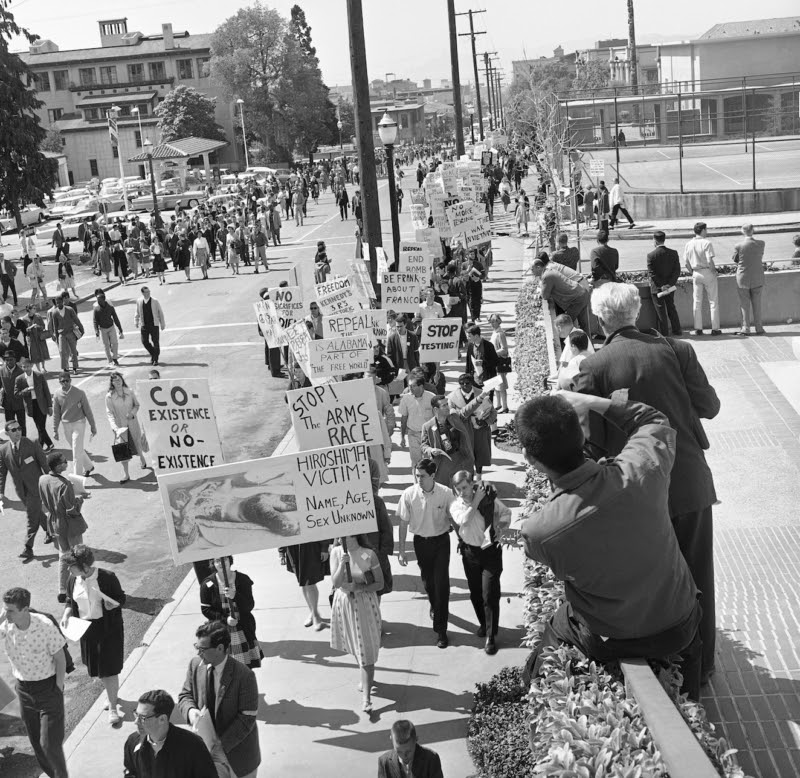
| Berkeley 1962 – 30 students against racial discrimination |
I was mildly political in high school. In 1960, I picketed the Democratic Convention that was in L.A. with a small group of radical Quakers protesting atmospheric testing of atomic weapons. The protest was in front of the Biltmore Hotel, where the candidates were staying. We were outnumbered by federal agents with cameras. After our little protest, I wandered into the Biltmore. While loitering in the main corridor, John Kennedy walked by. He was a few feet away. I didn’t think much about it until his brother was assassinated eight years later in a different Los Angeles hotel. Looking back, I was amazed at the lack of security. A kid in a protest just walks into the hotel – no security at the door, no identity checks, very little security (if any) around Kennedy. I guess all the government agents were too busy developing the film they took of our protest and writing detailed reports on how Quakers were threatening America’s security.
In high school, I planned to go to Berkeley, as did my liberal friends. I had my life planned. Undergrad major in Poli Sci/International Relations, law school (probably Boalt, Berkeley’s law school), and lawyer in SF (back to LA, if desperate). The Fates laughed.
I graduated high school in Los Angeles a semester early in 1962 and started Berkeley the next week. I was at Berkeley for one semester as an undergrad in Spring 1962 and one semester as a grad student in Spring 1966. I visited friends at Berkeley in the intervening years.
My parents drove me up to Berkeley and dropped me off. I decided to see the campus. It was getting dark and the campus was deserted because of the semester break. A little spooky. All the buildings were dark. But at the top of the hill Berkeley was built on was a large building fully lit up. Everyone working on a Saturday night between semesters? I later asked a friend about it and he laughed. Sort of. He told me that was where Edward Teller and associates designed bigger and better hydrogen bombs.
(A little history for everyone who saw the recent movie about Oppenheimer. Teller helped to design the first atomic bomb at Los Alamos. He was part of a brilliant group of European refugees that came to the United States mostly in the 1930s. When designing the first hydrogen bomb later, he got his fellow Hungarian refugee, John von Neumann, to design and supervise the construction of the first modern computer to solve partial differential equations and thus speed up the development of the bomb.)
In 1962, Berkeley was more an extension of the post-war 1950s than its later image. Rather quiet, laid-back (hey, we’re talking California here), students hanging out. Folk and folk-rock music, early rock and roll. Peter, Paul and Mary gave a free concert. Students optimistic and career-oriented. We recognized the new opportunity that college provided; almost all my high school friends and I were the first in our families to go to college.
There was little political activity on campus. Some interest in hippie culture. The dominant political cause was the civil rights movement but not much active interest. There wasn’t any civil rights group on campus. A friend and I decided to start one.
In those days, you had to get permission from the university to set up a table and distribute literature. So these two nebbishes climbed the stairs of a huge admin building called Sproul Hall (Woody Allen stole this scene for one of his movies). We finally found the office. The admin flack-catcher wasn’t in but his secretary was; it was obvious she ran the office. She was a middle-aged white woman who spoke with a southern accent. I figured as soon as we left, she would drop our application into her wastepaper basket. While my friend filled out the form, I talked with her. I mentioned that the group we represented (Southern Christian Leadership Conference) was run by Baptist ministers. I forgot to mention they were black. She immediately approved our application.
Two years later, the campus exploded in a student protest called the Free Speech Movement against the administration’s right to ban political activity on campus it didn’t like, including setting up tables and distributing political information. Thousands of students protested, including a massive sit-in in Sproul Hall. Mass arrests. Eventually, restrictions on student political activity were lifted.
The Free Speech Movement had some unintended consequences. Ronald Reagan was unexpectedly elected governor of California on a platform that he would “clean up the mess in Berkeley.” The local DA who had the students arrested became Reagan’s Attorney General after Reagan became president. The head of the California university system, Clark Kerr, whose office was in Sproul Hall, was fired for being soft on student radicals. The steps leading up to Sproul Hall were later named after one of leaders of the movement.
Back to 1962. It was the last semester of compulsory ROTC, with weekly drill in uniform. Drill was canceled if it was raining hard or the fields were too wet. The university announced cancellation by ringing the campanile bell. So, at 1 PM on the day of drill, the male student body stopped what they were doing and stared up at the campanile. Campus-wide silence. Sort of like a cargo cult or waiting for divine intervention. I learned a new skill – how to spit-shine shoes.
This was the last semester of NO TUITION in the Cal university system. The administration announced that the next academic year would have a yearly tuition of $100! The announcement triggered the biggest student protest and demonstration of the semester. (Actually, this was a bigger deal than it seems today. Students had part-time and summer jobs that paid $1/hour. So 2 ½ weeks of summer employment now went to pay for tuition rather than room and board.)
There was little interest in Vietnam.
Even in this tranquil setting, it was impossible to avoid politics. Richard Nixon, having lost to Kennedy in 1960, was getting ready to run for governor of California. He was giving “non-political” speeches around the state, including Berkeley. Before he came out of a building to give his outdoor speech, the Cal Prep Band, engaged to whip up enthusiasm for Nixon, played “It Ain’t Necessary So.” The audience went wild. Nixon walked out and thought all the “enthusiasm” was for him. He learned differently as soon as he started to speak.
President Kennedy came to campus and gave a speech to a large audience in the football stadium. I don’t remember what he said except something about his wife riding an elephant in India. Afterwards, a prof in the Poli Sci department, an expert on China, had organized a debate on whether or not the U.S. should be in Vietnam. His opponent was a member of Kennedy’s cabinet. Oxford debating rules – quiet audience, no clapping, no shouting or any other interruptions. After the debate was finished, the audience voted for who they thought made the better argument. Since it was right after Kennedy’s speech, I guessed a majority would vote for Kennedy’s man. I was wrong. Over 90% voted for the critic. I thought that if the Kennedy administration couldn’t sell the policy to a sympathetic group of liberal students right after a Kennedy speech, there might be trouble for Kennedy’s government if involvement lasted a long time or was expanded.
By coincidence, I read Thucydides’ Peloponnesian War later that year. I only wish that America’s political leaders over the last 60 years had read it.
1966. Back to Berkeley. I had a new plan. Ph.D. in Economics from Berkeley and then teach or work in the SF area. The Fates laughed again.
Some hippie, counter-culture, feel good vibes but, overall, the atmosphere was different than in 1962. Vietnam changed it. Big draft calls began in 1965. Anti-war protests, rallies and demonstrations on campus and at the army induction center in Oakland. Elected student radicals dominated student government. Darker mood. Angrier, more radical rhetoric, much more critical of all aspects of American life. Usual weed but now more LSD and other psychedelic drugs. Ken Kesey and the Grateful Dead in nearby Santa Clara county, now known as Silicon Valley. Dominant music was psychedelic rock. Beatles still popular but they were moving from teeny-bopper (I Want to Hold Your Hand) to psychedelic/political (Sgt. Pepper in 1967). Jefferson Airplane at the Fillmore and The Doors at Whiskey a Go Go, where I celebrated my 21th birthday. I went to the Fillmore twice; i didn’t see Jefferson Airplane but I did see Quicksilver Messenger Service. I think. Memory a little hazy. Saw Grateful Dead earlier.
Berkeley had one of the first large anti-war street demonstrations. Thousands of students. It was broken up by the Alameda County cops. I was in another anti-war street demonstration that summer in Los Angeles. This one was broken up by L.A. cops even though ground rules for the demonstration had been worked out with the city. The protest march took place in Century City, a new development of high-rise corporate buildings next door to Beverly Hills. A very west L.A. young adults crowd. Workers of Beverly Hills, unite!
The war in Vietnam changed everything. Changed the political mood on college campuses and in the country. Even worse was to come after 1966.
Out of all this did not come hippie counter-culture and communes. Or radical politics or a new political party. Or any swerve from America’s technocratic future. The Chancellor of the California university system, Clark Kerr again, was explicit on what his goals were for higher education – to provide college-educated personnel for the growing industries and corporations of California, especially the defense industry. And, I assume, for Dr. Teller’s operation on the hill. He was just too soft on free speech and students’ rights.
His program succeeded, just not quite according to plan. The drug-influenced counter-culture of the Bay area produced a disproportionate percent of America’s top entrepreneurs who developed the new digital technology. Out of all this came Silicon Valley, PARC (the digital office of the future), the Homebrew Computer Club and Steve Jobs. Apple in its early years ran a brilliant commercial equating IBM with Big Brother of 1984. Aired, ironically, during a Super Bowl game. Then Apple became the new IBM. The “permanent revolution” of corporate technological change continued. The vision of PCs for the people, a technological counter-culture, became Microsoft, Intel and later, the advertising behemoths Google and Facebook. The Fates laughed. (For a little more detail on how the SF counter-culture ended up creating America’s technocratic and corporate future, see my Alice in Wonderland and the Origins of Silicon Valley.)
I am not very nostalgic about the 60s. They ended badly. Robert Kennedy and Martin Luther King were assassinated. Richard Nixon was elected president and extended the Vietnam War for four more years. It was possible to see the beginnings of the reactionary “counter-revolution” in the 1970s. It has never stopped.
And yet. It was the beginning of a long period of positive change – end of legal segregation and most discrimination. The changing role of women, maybe the most widespread change in America over the last 60 years. Beginning of the environmental, organic farms and food movement (America’s national commune? Mass-produced organic foods?). Expansion of legal and civil rights to new groups. More opportunity and alternatives. More tolerance. But there were limits – fierce opposition to gay rights, abortion, and celebration of “diversity.” A new economic elite not entirely made up of white males. Part of the group who thought they were still running America were left behind because of the digital technology revolution and the resulting global economy. They were not happy.
This complicated, contradictory future was not obvious to me at Berkeley in the 60s.
——————————————————————————–
For a list of all the posts on this blog, see List of Posts by Topic
with links to all other posts.
Again, a loosely related bit of California history:
Alice in Wonderland and the Origins of Silicon Valley