Tag: Slavery

  • American Colonial History, 1607-1775

    American Colonial History, 1607-1775


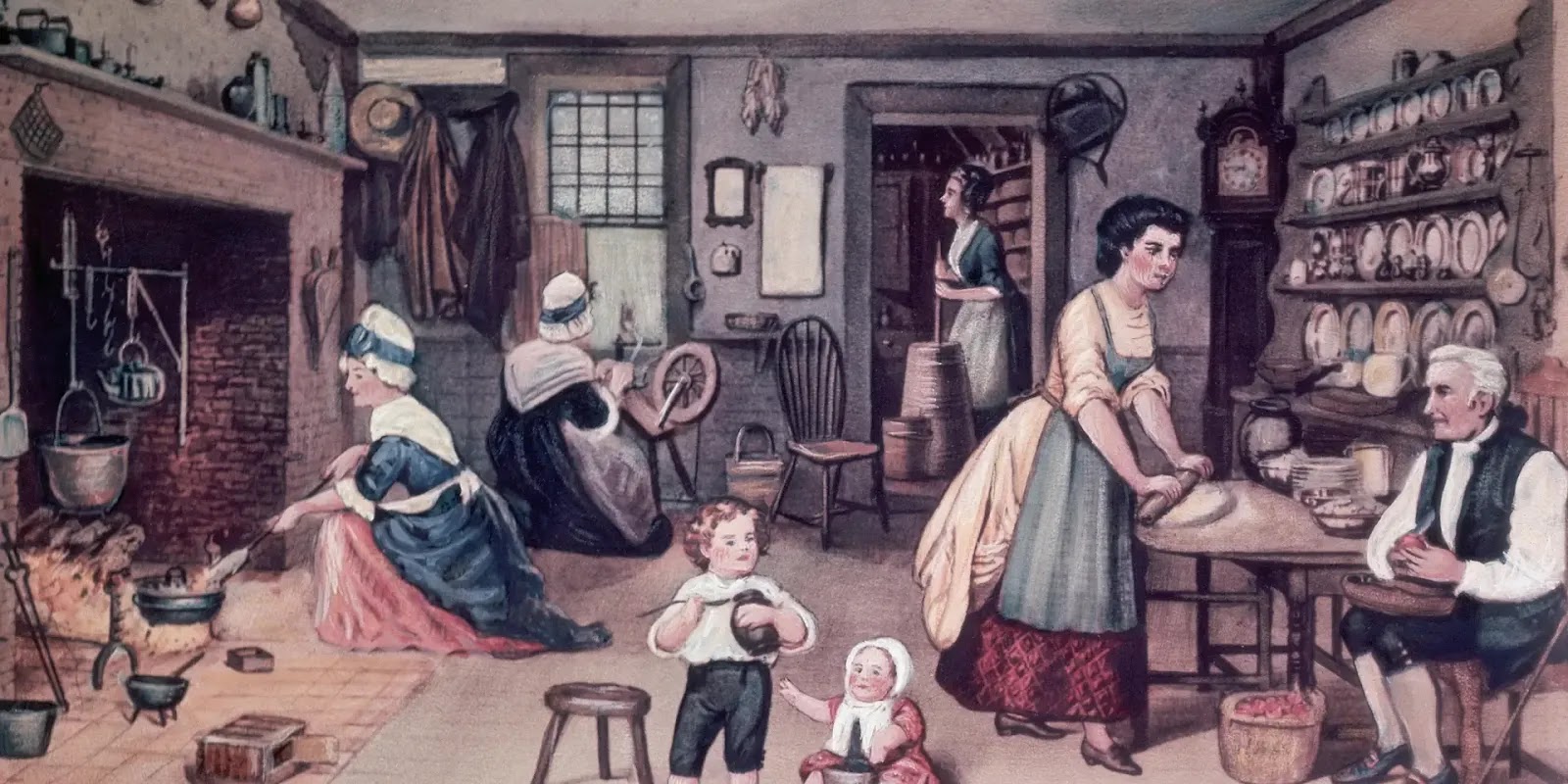
    Colonial Farm Kitchen. Notice clock in the corner.


    THE 1600s


    Preliminary Comments


    About 350,000 Europeans emigrated to the American colonies in the 1600s. They were risk-takers. They left long-settled communities and societies to get on small, crowded sailing ships to make the dangerous 3,000 voyage to a new land that was mostly wilderness. About 5% died. They had to adapt to a new, frontier environment of forests and swamps. They had to “tame the howling wilderness.” 


    A high percent of the European immigrants in this period were from England. Almost all were Protestants.


    Emigrants from England came over in three “waves.”  Then a fourth ‘wave” came to the North American colonies in the 1700s. They were four distinctly different groups of people from different areas of the English isles.


    To understand why these four groups left England and Scotland, at different times and for different reasons, it is necessary to know a little bit of English history during this period.


    The Failure of the First Settlements


    The earliest settlements of Pilgrims coming to Plymouth (1620) and immigrants coming to Jamestown (1607) were failures. About half of the Pilgrims died on the voyage or in the first year. Very few new immigrants came to Plymouth. The English Pilgrims actually came from Holland; they were worried that they were being assimilated into Dutch society.


    The company that settled Jamestown continued to send over thousands of new immigrants and many supply ships. The first settlers were mostly single men looking for gold; only later did the Virginia Company send over families. In the first 15 years, about 75% of the settlers died. There were many reasons, including that Jamestown was built on a malarial swamp. Neither group was prepared to deal with the harsh “wilderness” of America.


    But there was one success. Some of the Jamestown settlers began growing tobacco.


    The First Wave – Puritans coming to the Boston area. (1629-1642)


    English background. In the early 1600s, there was political tension and conflict in England. The English kings thought they could rule without consulting Parliament; Charles I suspended Parliament for eleven years. But many people in England thought the King and Parliament should rule together. They opposed the king’s right to rule without Parliament. 


    At the same time, there was a bitter conflict over who would control the Church of England. The Church of England was the official, government-supported church. It was Protestant (it was illegal to be a Catholic in England at this time). Most English were members. Some members wanted a church controlled by its bishops, who were appointed by the king. Top-down, hierarchical control. Others wanted to “reform” or “purify” the Church, move it further away from traditional practices and beliefs. Some even thought individual congregations should be able to appoint their ministers without interference from the bishops. These people were called Puritans.


    The fights over who should control the government and who should control the Church of England were connected. Supporters of the king also supported a Church controlled by its leaders, the bishops. Many supporters of Parliament were also Puritans.


    By the late 1620s, it was obvious that the king and the bishops had won the fight over power and control. Puritan ministers were being removed from their pulpits. Many Puritans recognized they had lost and wanted to leave England. They came to the American colonies.


    From 1629 to 1642, 15,000-20,000 Puritans came to the Boston area and quickly spread out. Few new immigrants arrived in the rest of the 1600s, only about 7,000. This area was known as the Massachusetts Bay Colony. They were highly organized and well-prepared to set up towns and farms. They came in families, brought farm equipment and supplies, and their own Puritan ministers. They laid out towns and distributed land for family farms. They quickly set up a seminary to train new Puritan ministers; we now call this school Harvard. They prospered and their numbers increased rapidly. They spread out into much of New England and beyond.


    They wanted to set up a Puritan society that they controlled. They discouraged anyone who wasn’t a Puritan from settling in New England. Non-Puritans were forced to deport and not return on threat of death. Four Quakers who came back were hung.


    The Second Wave – Royalists coming to Virginia (1649-1660)


    In 1642, civil war broke out in England – the Puritans and Parliament supporters against the king and his supporters. Supporters of the king were called royalists (also called cavaliers). Many were members of landowning aristocratic and gentry families.


    The king and his supporters lost. The king was executed. Many royalists didn’t want to live under a government and church controlled by Parliament and Puritans. Some emigrated to the British West Indies and some to Virginia, where a pro-royalist governor created a stratified society dominated by royalists. He gave them large tracts of land, the basis of the spread of tobacco plantations. 


    They tried to recreate the kind of society and government they ruled before the civil war. Fortunately, there was hundreds of miles of wilderness between Virginia and Massachusetts.


    About half of the European immigrants in the 1600s were poor people who couldn’t afford the ship passage to America. To get to America, they became “indenture servants.” Most came to Virginia and Maryland.


    The tobacco growers owned great amounts of land but very few people to work it and process the tobacco. They encouraged “indentured servants” to come to Virginia. When the ships landed in America, the immigrants were auctioned off to pay the shipowners for passage. Typically, an indentured servant “agreed” to work for their owners for four to seven years. They had almost no rights. After their indenture was complete, they were free; some received some compensation. They were offered free or cheap land, so they had little reason to continue working on plantations. But since most of the good land along the rivers of Virginia was owned by earlier immigrants and their descendants, the new immigrants had to move west to the unsettled frontier, much of which were the foothills and valleys of the Appalachian Mountains. Tobacco growing spread rapidly and was by far the American colonies largest export in the 1600s and 1700s. 


    The Third Wave – Quakers coming to Pennsylvania (1680s and early 1700s)


    Not everyone in England belonged to the official Church of England. They were called “dissenting sects.” One of the most prominent was the Quakers.


    The Quakers were persecuted by government and church officials. In the 1680s, William Penn worked out a deal with the king, who granted Penn, who had converted to Quakerism, ownership and control over a large area in America in exchange for cancelling loans the king owed to the Penn family. Pennsylvania. It became a haven for Quakers. Many of the Quakers in England, over 20,000, emigrated to Pennsylvania and nearby areas. They established a society based on radical Quaker ideals. They were later joined by German sects with similar beliefs. 


    By the end of the 1600s, there were about 250,000 European immigrants and their descendants along the Atlantic coast. A very high percent, maybe 90% or more, were from England and Wales. Their numbers increased rapidly because of immigration and the high birth rates in New England.


    FROM 1700 TO 1775 (THE FIRST YEAR OF THE AMERICAN REVOLUTION)


    Immigration was different in the 1700s than in the 1600s. There were four main groups:


    English – less than 100,000

    Scots and Scots-Irish – about 150,00

    German speaking – about 100,000

    African slaves – about 250,000

    Small numbers of other groups, including French Huguenots (Protestants) and Irish Catholics.


    Total immigration in the 1700s was around 600,000 people. English immigrants were a minority of the European immigrants and a small minority of total immigrants. By 1775, the American colonies were made up of a diverse population; English immigrants and their descendants may have been a minority of the total population.


    English Immigrants

    The composition of English immigrants in the 1700s were somewhat different than that of English immigrants in the 1600s. They were not part of distinct religious or political groups. They were generally poor. They came from different parts of England, including the borderlands with Scotland. Many, maybe as many as 50,000, or over 50%, were criminals or convicts (in England, you could be sent to prison for not paying a debt). England emptied its jails and sent the inmates to America. Most ended up in Virginia and Maryland because that was where the ships were going, to pick up tobacco. The convicts were indentured for up to 14 years and did not get any land or compensation. They were treated no better than slaves. Most became part of the landless poor after their indenture was up. If they survived.

    People from the borderlands between northern England and Scotland (1700s) and Highland Scotland

    The Scots and Scots-Irish

    Fighting between northern English and lowland Scots, and among Scottish clans, had been going on for hundreds of years. This was a frontier, lawless area – little organized government or military control. There was much violence, including raids to cause destruction, pillage, and steal cattle. In addition, there was family and clan feuds on the Scottish side of the border.


    In the 1600s and 1700s, England completed its campaign of clearing out Irish Catholics from Northern Ireland. Favored English were given large land grants. Many of the farm workers came from Scotland. They were Protestant. They were called Scots-Irish.


    In the 1700s, a stronger English government successfully established control over northern England. Through battles and brutal military campaigns, England subdued the lowland (borderland) Scots. Many didn’t like the new order. At the same time, highland Scot landowners began clearing out their tenant farmers, who became landless. Many Scots went to Northern Ireland to work. But conditions were not much better than in Scotland. In the 1700s, about 100,000 Scots and Scots-Irish emigrated to the American colonies.


    Many of the settled colonies weren’t happy about the less “civilized” new immigrants. But the expanding plantation colonies of Virginia (tobacco) and South Carolina (rice) needed their labor.


    Many of the borderland people and Highland Scots settled into a frontier environment in the foothills, valleys, and mountains of the Appalachian Mountains (the western geographical border of the colonies). Some Highland Scots settled in parts of North Carolina, a borderland region between Virginia and South Carolina. For a long time, there was little government or legal presence. Few churches and little organized religion. Disputes were often settled by violence. Many raised cattle as in the borderlands. In America, they were called the “backcountry” people.


    German-Speaking Immigrants

    Many of the German-speaking immigrants came to America to avoid religious persecution. They held similar religious beliefs as the Quakers. They also were persecuted by German governments and their official (state-supported) religions. When the Quakers established Pennsylvania, it was a safe haven for the German sects, including the German-speaking Amish, Mennonites, Moravians and Schwenkfelders. About three-quarters of the Germans landed in Philadelphia.


    The German sects, like the Puritans and the Quakers, tended to come over as families and often with their ministers. They moved to the new lands west of the Quaker-dominated region around Philadelphia. Even today, part of their settlement is called the “Pennsylvania Dutch” country. The word “Dutch” is derived from the German word for Germans.


    Because of the waves of Scot and German immigration, Pennsylvania’s population exploded from about 18,000 in 1700 to about 120,000 in 1750. The Quakers had become a minority in their own colony.


    African Slaves


    The largest colonial immigrant group was African slaves. About 250,000 African slaves were brought to the American colonies up to 1775. The number started to go up in the late 1600s and then accelerated after 1725. The total black population of colonial North America in 1775 was probably over 500,000, mostly slave but a small percent were free. Most of the slaves in the South worked on plantations, especially in Virginia, Maryland, South Carolina, and North Carolina.


    Why were there African slavery in colonial America but not in England? There are demand side and supply reasons. 


    The short answer is: the rapid expansion of the production of plantation crops. The limiting growth factor, as always in colonial America, was labor. Expansion originally depended on indentured servants. But many immigrants, including indentured servants, didn’t want to work on plantations. German-speaking immigrants went to Pennsylvania, not Virginia, Maryland, or South Carolina. Many Scottish immigrants avoided indenture. Then there were the long-run costs. Indentured servants only worked for four to seven years. Plantation owners had to buy new servants to replace the freed servants. For complicated reasons, the number of  immigrant indentured servants fell and the cost of  rose in the late 1600s. African slaves cost more but they were slaves for life. In addition, children of slaves belonged to the slaveowner, a cheap source of future labor.


    South Carolina was a special case. Plantation agriculture started when a few slaveowners and their slaves migrated from Barbados. Rice, not sugar, was the most profitable crop. Rice was exported to Europe and to Caribbean islands. By the late 1700s the rice growers in South Carolina were some of the richest families in America.


    Slaves were available. The American continent was importing large number of slaves in the 1700s, mostly for the sugar-producing Caribbean islands and Brazil. Much of the trade to the Caribbean was controlled by English slavers. It was a short step to expand to the North American colonies. New England merchants and shipowners also entered the slave trade.


    Native Americans


    I have not mentioned Native Americans. There is currently much writing and discussion about Native Americans. It is a complicated topic. For the early relations  between Native Americans and European immigrants, see Ken Burns’ documentary The American Revolution.


    There were attempts to enslave Native Americans. The attempts failed.


    In the end, unlike Spanish or Portuguese America, the rapid increase in the European population, combined with the pressure to expand farming into Native American lands with relatively small Native American populations, doomed Native American independence in parts of colonial and early Federalist America. Some tribes adapted. Some moved west. The Iroquois Confederation avoided most of the pressure and remained independent up to the American Revolution. But the long, tragic history of land-hungry white Americans taking Native American lands had begun.


    CONSEQUENCES


    Many of the European immigrants came to America to avoid religious and political persecution. Almost all early English immigrants had grievances against the English government when they emigrated. German-speaking immigrants had no ties with England. Many Scots hated the English. Equally important was the lure of unlimited new farmland. Rather than being tenant farmers (paying rent to a landowner) or landless farm laborers in Europe, immigrants had a chance to own large farms (by European standards) and be independent. For many, religious freedom and economic independence went together. For Africans, the exact opposite happened.


    All groups had different ideas about how government, religion, and society should be organized. Or not organized. After the American Revolution, as the separate colonies became the United States, the clash of their different ideas would become the basis of many of America’s future political conflicts.


    The rapid increase in the population of these groups and their westward expansion looking for new farmland would have a profound influence on American history. The first consequence was that the western movement to new lands was a contributing factor in causing the American Revolution.


    AMERICA IN 1775


    America in 1775 was a much different colony than the America of 100 years earlier. Population near the end of the 1600s of around 250,000 – almost all of English descent and few slaves – had become a society of about 2 million people in 1775 – about 1.5 million European immigrants and their descendants and about 500,000 African slaves. The white population had become more diverse and less English. The African slave population was around 25% of the total population. 

    With high birth rates, plentiful and diverse food, and open immigration, Americans could expect their population to double by 1800.


    Why the change? 


    ·      Access to “unlimited” free and cheap land for farming. 

    ·      Geographic mobility – individuals, families and groups leaving settled communities to move west. 

    ·      Fortunes to be made producing plantation crops and exporting into protected English markets (similar to the sugar islands in the Caribbean). 

    ·      Expanding merchant and shipping class to handle rapidly expanding domestic and foreign trade.

    ·      Development of craft production to fill rapidly rising standards of living. 

    ·      Overall opportunity – fewer obstacles to personal and family advancement than in England and Europe. Individual and political freedom and democratic government compared to Europe and even England.


    The Economy


    Almost all Americans, about 90%, engaged in agriculture. By 1775, about half of the white population owned their farms. 

    Agriculture by 1775 was very different than the subsistence (producing food just for the farm family) agriculture in most of the rest of the world. Americans with large family-owned farms and plantations, produced enough food to make Americans well-fed, plus a surplus of grain and commercial crops for sale to local markets, towns, and for export.


    Americans produced a surprising variety of food and crops. For example, many farms and plantations had apple orchards. The apples were mostly used to produce cider. I was also astonished to learn that bananas were grown in South Carolina. 


    Americans had begun to experiment with growing mulberry trees throughout the colonies. Mulberry trees were the food for silkworms. Americans were trying to develop a silk industry. This venture would eventually fail. But many towns and rural areas even today have a Mulberry Street. Including Boston.  


    America’s largest exports in colonial times were the plantation crops of tobacco and rice, followed by indigo (a blue dye from the indigo plant for England’s growing textile industry). The colonies also exported grain and other products like lumber and horses to the sugar-producing islands in the Caribbean. 


    The American colonists imported most of their manufactured products from England. Everything from cloth, clothes, shoes, guns, swords, clocks, furniture, dinnerware, china (including Wedgwood), silverware and silver products, and all sorts of manufactured metal products including pots and shoe buckles. Wealthy planters imported luxury goods from England and Europe, imitating the wealthy landowning class of England. And tea.


    The American colonies were England’s largest trading partner by 1775. While sugar from the West Indies was a more valuable English import than American tobacco, America with its large and growing population of prosperous farmers, planters, and merchants was a major market for English exports.  


    In the 1600s, almost all this trade was carried on English ships and controlled by English merchants. But by 1775, the American colonies had become major ship builders, about one-fourth of the total merchant ships of England and America. More of the trade with England was carried in American ships. And more of the trade was organized by a growing merchant class in American ports. 


    And by 1775, Americans were producing some of their own manufactured goods. Most farm families made cloth. American craftsmen were producing furniture, dinnerware, and silver products. The most famous silversmith was Paul Revere.


    The colonial image above shows a farm family with metal pots and other metal goods, a gun over the mantel, metal buckles on man’s shoes, a butter churn (owned cows?), and a spinning wheel to make yarn. They also owned a grandfather clock. These products were of a simple style; other than the metal products, some of them were probably made in America. England would regret exporting rifles to America.


    With seemingly unlimited land and a rapidly-growing population, rising exports, and new types of economic activity, the American economy was also rapidly growing and developing. On average, white Americans enjoyed a high average standard of living by 1775. Possibly the highest in the world. 


    Politics and Government


    America was more democratic than England. No king, no aristocracy who dominated land-holding and political power. Much higher literacy rates. A much higher percent of white males voted and were active in local government than in England. America was almost entirely self-governing for almost 150 years before England attempted to tighten control in 1763.


    Americans were highly literate; about 70% of white males and 50% of white females could read and write. The percents in Puritan New England were very high – about 90% for men and 80% for women. New England had its first printing press by 1640. 


    The literacy rates in England were much lower.


    The American colonies had more newspapers than England, which had a larger population. Foreign observers often remarked that Americans seemed to love to read and talk about politics (often in taverns).


    By 1775, over 50% of free adult males were qualified to vote. And Americans were very active voters, with high turn-outs at election times (free food and alcohol from the candidates helped raise turn-out rates). In England, by contrast, fewer then 5% of adult males were qualified to vote. In over half of parliamentary elections, there was only one candidate. 


    American colonies were self-governing. At both the local and provincial (colony) level, most of the government officials were democratically elected. The exception was that most of the provincial governors were appointed by London. But their salaries had to be approved by provincial assemblies, which gave them control over the governors.


    One example of America’s independence from English control was that Americans found it easy to evade the Navigation Acts. The Navigation Acts basically said that most of American exports and imports had to be with England or English colonies. But Americans routinely ignored the Navigation Acts by trading with other countries and their colonies. Although illegal, Americans and American ships imported goods from other countries. England had too few officials and ships in America to stop this smuggling (sneaking in illegal imports). Probably the best-known smuggler was John Hancock.


    England began to crack down on smuggling in 1763, after the end of the French and Indian War.


    OVERVIEW 

    By 1775, the American colonies had become a rather unique society. It was very different than most of the rest of the world, even England. Large, family-owned farms. New land on the frontier. Commercially active. Literate. Democratic and politically engaged. Economic opportunity – few barriers to start new businesses or develop new skills (no guilds). Physical (move west) and economic mobility. King far away and no aristocratic landowning class. No long-settled rural class society.  No large standing army. Low taxes approved by local governments.


    One partial exception. By 1720, five colonies, and Westchester County in New York, had “established” religions, that is, religions supported by taxes. They were Congregational  (Puritan) in Massachusetts and Connecticut, and Church of England (Anglican) in Virginia, North Carolina, and South Carolina. By 1775, other Protestant denominations, besides Quakerism, were flourishing, including Presbyterians (Scots), Baptists, Methodists, and German pietist sects. After 1740, America was swept by waves of evangelical enthusiasm.


    By 1775, Europeans had become or were becoming Americans. England’s North American colony was less “English” and more diverse than a century earlier. Puritans were becoming Yankees; many were challenging their Puritan roots and moving away from the Boston area.  By the early 1700s, many New Englanders thought Harvard (established to train Puritan ministers and teachers), had become too “liberal.” Virginia royalists had become plantation owners, with African slaves replacing European indentured servants. England had virtually outlawed slavery in 1772 and was moving to stop the African slave trade. Many had gone from being Tories (supporters of king and aristocrats) to becoming Whigs (critics of king and his royal governors of Virginia) as they engaged in bitter political battles with appointed English governors and resented high tariffs imposed on their tobacco exports to England. 


    The Virginia planter class, somewhat unexpectedly given their backgrounds, would contribute many of the leaders, supporters and military officers in the coming American Revolution, including George Washington, Thomas Jefferson, James Madison and James Monroe. And the father of Robert E. Lee.


    Quakers came to America as a small persecuted religious group and had become the dominant merchant and political group in the greater Philadelphia regions. Maybe the Scots and Scots-Irish, relatively late arrivers, probably changed the least by 1775, but many hated the English for the brutal conquest of Scotland and already had a strong sense of personal independence.


    The German-speaking farmers in Pennsylvania challenged the political monopoly of the Quakers and forced them to share political power.


    There was individual mobility. The most famous example was Benjamin Franklin, who went from being a penniless “immigrant” from Boston to the richest man in Philadelphia. He was an urban entrepreneur and a major investor in urban real estate. An anglophile (lover of the English), he also went from a man who retired to England and expected to die there to be one of the leaders of American independence from England.


    The Manigault family went from penniless religious refugees (French Huguenots) to the richest family in South Carolina in three generations. (They would be followed after the Revolution by the du Pont family, French political refugees.)


    This was not a settled or stagnant society. By the standards of the time, colonial America was a “modern” society. The main threat to dynamic change and growth was that America was still an English colony. That would change.

      ==========================================================

    See the next post in this series, 

    The American Revolution and the New Country: American History, 1755-1790

    followed by

    A New Nation, America from 1789 to 1860

    The classic book on colonial America is Albion’s Seed: Four British Folkways in America, a 1989 book by David Hackett Fischer. Long, incredibly detailed about all aspects of colonial American life. If you get through the entire book (last section optional), you should consider becoming an American History major.


    For an excellent survey of colonial America and the other colonies in North America, see Alan Taylor, American Colonies:  The Settling of North America, 2001. 


    For a discussion of how the North American and West Indies colonies fit into the wider English imperial empire that began in the 1600s, see


    England in the 1600s: The Beginning of England’s Rise to Global Power and Wealth


    This essay includes a discussion about how the American colonies fit into the English imperial system, especially the Navigation Acts.


  • A New Nation:  America from 1789 to 1860

    A New Nation: America from 1789 to 1860


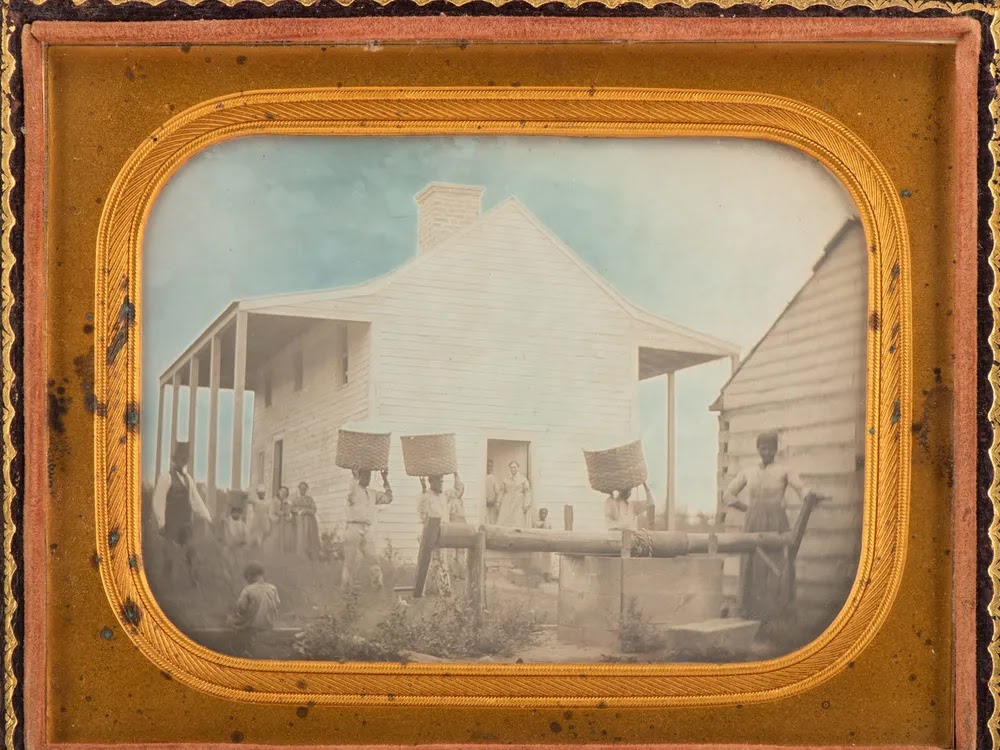
    Earliest known photograph of slaves and cotton, around 1850
    Brigit Katz, Smithsonian Magazine, December 6, 2019

    A New Nation, America from 1789 to 1860

    If you study American history from 1789 to 1860 (just before the start of the Civil War), the political history is very complicated. But remember what caused most of these political conflicts and uneasy compromises – the dynamic changes in the underlying economy. Two in particular – the spectacular increase in slave-produced cotton and the beginning of the Industrial Revolution. They were related.


    What is the Industrial Revolution? At its heart it is power-driven metal machinery producing huge quantities of goods. At first, the power was supplied by steam engines and water wheels. Later, in the 20th century, electricity. All of this used huge amounts of fossil fuels – first coal, later oil and natural gas were added. America had huge quantities of all three.


    A trend that continued from colonial times was the rapid population growth of America. This is part of demographics, the study of populations. America has had spectacular population growth throughout its history, from 4 million people in 1790 to 30 million in 1860 to over 330 million today. Two reasons for this growth were high birth rates, and open immigration until 1924. Also, Americans tended to be healthier than the people in other countries, mostly because of plentiful food. This is an important part of the American story, as discussed in the essay on colonial history. 


    There are lots of numbers when you talk about demographics, economic growth, and the Industrial Revolution. I’ll try to keep them to a minimum, hopefully just the more important ones. I also round up numbers to make them easier to read.


    The New Government, 1789-1798 

    After the Constitution was ratified and the structure of the new government was established, Americans voted in their first elected representatives in 1789. George Washington was elected president. He appointed Thomas Jefferson as Secretary of State (in charge of foreign affairs) and Alexander Hamilton as Secretary of the Treasury (financial affairs). James Madison, who wrote the first draft of the Constitution, became Speaker of the House of Representatives and established the structure and procedures in the House that are still used today.


    The government faced many of the problems left over from the Revolution. Because of the fight with the British army, Americans did not want a large standing (permanent) army.  They saw a permanent army as a threat to their liberties. America could do this because there was no serious threat on the American continent. Also, they didn’t want to get involved in European wars and political conflicts. “No entangling alliances” as Washington said. This foreign policy was possible because America was separated from Europe by the 3,000 miles of the Atlantic Ocean. 


    This was not to be. What happened in Europe during this period would have a profound impact on American history.


    The same year the U.S. government began, the French Revolution broke out. The French revolutionaries used similar ideas as the Americans. They wanted to destroy the power of the French king and the aristocracy. In 1793, they beheaded the king and queen of France and thousands of others. The other countries of Europe – all with kings or queens – were appalled. They declared war on France. One of the countries was England. England would fight France, off and on, until 1815.


    France was taken over by Napoleon. He would fight until he eventually lost in 1815. Wars are expensive and Napoleon needed money. France had laid claim to part of America. But Napoleon, fighting large wars in Europe, knew he could not defend the land from west-moving Americans. In 1803, he offered the land to America. President Jefferson bought it for $11 million. It was called the Louisiana Purchase. It was the land between the Mississippi River and the Rockies. It doubled the size of the United States. 


    After Jefferson bought the Louisiana Purchase, he established the Corps of Discovery to find out the geography of what he bought. The Corps first leaders were Meriwether Lewis (Jefferson’s secretary) and William Clark. Their famous expedition of 1804-06 traveled through the northern part of the new territory, including exploring the Missouri River. This was important for the future. America had more miles of navigable rivers than any other country. With the invention of the steamship, America had a vast internal transportation system that would help join the regional economies of the country together. Unfortunately, one of the region’s economy was based on slavery.


    Hamilton and Financing the Government 

    All governments must raise money to pay for government activities. But the U.S. government was limited in how it could raise money. The Constitution said the government could not tax American exports. No income taxes. The attempt to put a tax on goods, especially whiskey, led to riots and demonstrations that threatened the new government. What was left? Some revenue came in from land sales but not enough. Hamilton was given the task to solve this problem.


    He was ready. He started life as a teenager working for a merchant in the Caribbean. After the Revolution, he spent years studying the history and workings of government finance. His options were limited but he came up with a brilliant (and controversial) plan. He would tax imports.


    There was a larger problem. The currency issued during the Revolution (called Continentals) was worthless. The new government had to establish creditability which included faith in any new currency. Hamilton’s idea was to buy back the Continentals at face value. In exchange, the government would issue government bonds that paid interest and could be redeemed (sold back to the government) in the future. The bonds could also be traded like money. How to pay for them? From the revenue that came from taxing imports. Hamilton figured that tariffs on imports would cover government expenses and the cost of redeeming the bonds. He was right.


    I believe this was part of a larger plan he had. Hamilton saw the beginnings of the Industrial Revolution. He believed that manufacturing would be part of an economically strong country, as was beginning to happen in England.


    In 1791, Hamilton helped found the Society for Establishing Useful Manufactures (S.U.M.), to harness the waterfall energy of the the Great Falls of the Passaic RiverThe society founded Paterson, New Jersey, which became an early site of the industrial revolution in America. The Great Falls would provide tremendous energy to drive many large water wheels that powered machinery. Paterson was America’s first industrial city and would be a major manufacturing center for over 150 years.


    Hamilton’s grand plan:

    ·      Tax imports to raise revenue for the American government.

    ·      Develop domestic manufacturing to produce substitutes for English manufactured goods exported to America.

    ·      Use manufacturing to drive American economic development and growth in addition to agriculture.

    ·      Develop a class of manufacturers, bankers, and merchants.


    Hamilton’s vision was bitterly opposed by Jefferson and most Americans who thought about America’s future. Jefferson, when he was ambassador to France, saw the negative side of the beginnings of the Industrial Revolution in France and England. Dirty, crowded cities. Pollution. A degraded industrial labor force. Banking and finance. He saw all of this as a threat to a democracy based on independent, land-owning farmers.


    These two different visions of the future would be the basis of later bitter political conflicts.


    Slavery and Cotton

    The issue of slavery was mostly ignored at the national level in the early years. It was left to the individual states.


    Some people like Jefferson hoped that slavery would be unprofitable and wither away. This was not entirely wishful thinking.


    Importing slaves became illegal at the end of 1807. The Virginia and Maryland tobacco industry, the largest user of slaves, was in permanent decline after the American Revolution. Planters turned to diversified agriculture, including grain crops like wheat and fruit orchards. It was not obvious that the same number of slaves were needed or that owning and supporting slaves was profitable in the new environment. All this changed with the English demand for cotton. The deep south had a huge area of some of the best cotton land in the world. Many Virginia and Maryland tobacco planters, who owned half the slaves in America in 1790, moved to the deep south, bringing their slaves with them. Other slave owners sold some of their slaves, who were transported down the Mississippi River and sold to the cotton growers. This is where the phrase “sold down the river” came from. 


    It is one of the great ironies of history that the beginning of the Industrial Revolution in England was responsible for the survival and expansion of slavery in America. The first large industry in England was the power-driven mechanical production of cotton cloth. This created a huge and growing demand for cotton. Production of cotton cloth exploded after the war with French ended in 1815. It turned out that the largest and best growing area for the type of cotton that was best for machine production was in the American South.


    Cotton Production, 1790-1860

    Small amounts of cotton had been planted and cultivated in the United States since before the American Revolution, mostly in the islands off the coast of South Carolina and Georgia. But there was a bottleneck to the rapid expansion of cotton growing. After the cotton was picked, the fibers had to be separated from the seeds. This was done by hand. Only about one pound of clean cotton could be produced per day. But, in 1793, a Connecticut mechanic name Eli Whitney was invited by a Yale classmate to visit his mother, Nathanael Greene’s widow in Georgia. He listened to the complaints of the local cotton growers. After tinkering for a few weeks, he invented an improved cotton gin. This was a fairly simple, hand-operated machine that could produce about seven pounds of cotton per day. Further improvements increased output to about 50 pounds per day. By 1860, there were large power-driven cotton ginning factories.


    Cotton planting expanded to the west very dramatically after 1815—all the way to Texas. Planters, growers, and slaves moved from the Eastern Seaboard throughout the South and then to the Mississippi River region. Planters who owned slaves took them with them, thus avoiding the largest cost of starting a large cotton plantation. 


    The growth in cotton production was spectacular. Only about 1.5 million pounds were produced in 1790. Then, after the invention of Whitney’s cotton gin, output increased to 85 million pounds in 1810. By 1840, output rose to 830 million pounds, 10 times that of 1810. In 1860, the South produced the largest crop ever – over 2 billion pounds. 


    It was by far the nation’s main export, accounting for about 60% of the value of total American exports. Cotton exports helped pay for the imports of machinery and iron rails. 


    The South was producing about 2/3 of the world’s supply of cotton. 


    What led to an expansion of slavery was the unexpected huge increase in demand for cotton, first in England and then in the cotton mills of New England. Cotton was grown elsewhere but nowhere could a growing region produce the large and rapidly increasing amount of the type of cotton that manufactures demanded. This was made possible by the large increase in the slave population through natural increase, even after importing slaves was banned. By 1860, a very high percent of the slave population was growing, processing, and distributing cotton.


    Railroads, 1830-1860

    Starting in the 1830s, America built a large railroad network.


    America began building railroads in the 1830s, right after England built the first general-purpose railroad in 1830. By 1850, there was 8,600 miles of track. Then came a railroad-building boom. By 1860, there was 30,800 miles of track. America had by far more miles of track than any other country. New York had the most miles of track, followed by Ohio, Illinois, Pennsylvania, and Indiana. The southern states had about 1/3 of the total trackage.


    Railroad locomotives and tracks were a huge spur to iron production and manufacturing. Railroads were able to move large quantities of output (and people) from one region to another. 


    The Key to America’s Early Industrial Success

    America had abundant natural resources and aggressive “go-ahead” entrepreneurs. America also had poor immigrants who would form part of the new industrial work force. But what really drove industrialization was a new way to manufacture output.

    Thomas Jefferson was ambassador to France where he learned about an experiment to manufacture interchangeable parts to produce guns. He brought this idea to America and it was developed in America’s two armories at Springfield, Mass and Harper’s Ferry, Virginia.  It took thirty years to perfect the system.

    Interchangeable parts means that all produced units of a part are almost exactly alike. If a part of the firing mechanism of a gun had to be replaced, any substitute part would fit in without the former necessity of filing it down, fitting it, and repeating the process until it fit. This also meant that a factory could produce large numbers of all the parts and assemble the final product from any one of the parts. This system was be used to revolutionize the production of sewing machines, clocks, other metal products, and later bicycles and autos.


    The Economic Integration of the Three Regions

    The three regions of the American economy were becoming economically integrated but politically divided over the issue of slavery. America’s first large industry was also cotton cloth production in New England, with its own demand for Southern cotton. About 75% of Southern cotton was exported and 25% went to New England mills. Much of the cotton cloth output was used to make cheap clothing for slaves. The shoe factories of New England made most of the shoes worn by slaves. Southern families bought home furnishings from Northern factories. In addition, much of the cotton trade was financed by Northern bankers. Most exports went through New York. Southern planters borrowed large amounts of money from Northern bankers to expand production by buying more land and more slaves.


    Politicians and commentators debated the future of America. What no one foresaw was that these three parts of the economy of America were going to be connected.


    What would tie the three regions together was the transportation revolution, based on high pressure steam engines that drove railroad locomotives and steamboats. Steamboats exploited the largest system of navigable rivers in the world.


    Southern railroads and steamships brought cotton to Southern ports. By 1860, there were about 800 steamboats on the Mississippi River. Ships, first sailing ships, later supplemented by steam ships, carried the cotton to New York. Transatlantic ships carried the cotton to England, mostly to Liverpool.


    Northern farm families streamed into Ohio, Indiana, and Illinois in search of new farmland. These states had the biggest increase in population between 1850 and 1860. These farmers produced food for the increased population of Eastern cities and for exports. Produce went to market first through canals and then mostly by rail. Beside moving cotton to market, the greatly increase speed and capacity of railroad brought Western grain east and manufactured goods west. The new Western farms also supplied corn and pork to the Southern plantations, much of it sent south on Mississippi steamboats.


    By 1860, America had three sources of economic growth:


    Expansion of agriculture based on population growth, unlimited land for independent farmers, and westward expansion. 


    Expansion of slave-based cotton production. By 1860, Mississippi produced the most cotton, followed by Alabama and Louisiana.


    By 1860, the Industrial Revolution in Americas was well on its way. More money was invested in cotton mills than in any other industry. The second largest manufacturing industry was the iron industry.


    To the Civil War 

    The issue of slavery was the main cause of most of the political battles during this period, including the annexation of Texas and the war with Mexico to make Texas a slave state. There was a rise of anti-slavery sentiment in the North and West. Arguments were increasingly made for the abolition of slavery. There was effective propaganda, like Harriet Beecher Stowe’s book Uncle Tom’s Cabin. In response, the Southern defense of slavery became fierce – no compromises. Slave ownership and cotton production became the basis of the economy, political power, society, and culture of the South. 


    There was a danger to the expansion of cotton production and slavery as more new states in the future would be “free soil” (no slavery) states than new slave states. The South would lose political power in the national government and might be threatened with the abolition of slavery. Arguments on both sides became very emotional. When Abraham Lincoln was elected president in 1860, the South saw him as a threat to the survival of slavery. Although he hated slavery, he did not advocate its elimination. He wanted to stop it spreading to new states. Southern planters believed they needed new land as old cotton lands wore out and produced less cotton per acre. The Civil War – the South’s attempt to leave the union – started even before Lincoln was inaugurated. 


    The 1860 Census – the United States on the Eve of the Civil War 

    Total population – 31.4 million

    White population – just under 27 million (86%)

    Slave population – just under 4 million (13%)

    Free blacks – just under 500,000 (1.6%)

           Does not exactly equal 100% because of rounding


    Number of whites in the South – 5,800,000. This is the number of whites in the South in states that left the United States in the Civil War.


    Number of whites in the North – 21,200,000. This includes slave states that did not leave the Union in the Civil War.


    By 1860, despite continuing immigration, most Americans were native-born. Of the 27 million whites, about 4 million were foreign-born. Just under 75% of the immigrants during this period came from Ireland (because of the famine) and the German States (Germany did not become a unified country until 1871). Of the black Americans, almost all were native-born since the Constitution prohibited importing slaves after 1807. 


    Remember there were about 700,000 slaves in 1790. Most of the increase came from the high birth rates in the number of slaves.


    There were more slaves than whites in Mississippi and South Carolina. Slaves made up at least 40% of the total population in Alabama, Georgia, and Louisiana (almost 50%).


    Almost 400,000 white families owned slaves. But most of them were owned by a small percent of the slave-owners. About 280,000 whites owned fewer than 10 slaves. At the other end, about 11,000 whites owned 50 slaves or more; 14 of them owned 500 slaves or more.


    At the beginning of this period, slavery was legal in all 13 colonies. But the ideals of the American Revolution motivated some Americans to think about abolishing slavery. By the end of this period, all northern and western states had outlawed slavery. The arguments for and against slavery became more shrill. Some attempts at compromise, as advocated by Abraham Lincoln, were rejected by the south. The essay cited below argues that the Civil War, unlike the American Revolution, was inevitable. 

    =========================================================

    For two essays on earlier periods of American history, see


    American Colonial History, 1607-1775


    Revolution and the New Country:  American History, 1775-1790

    For an analysis of:  Was the Civil War inevitable?, see 

    The American Civil War

    For an example of the transition from using hand tools to power-driven machinery for production, see

    Adam Smith’s Pin Factory

    For an essay focused on the industrialization of America in the same period, see

    The Beginning of the Industrial Revolution in America

    For an analysis of:  Was the Civil War inevitable?, see The American Civil War


    For a list of all essays on this blog, with links, see 


    List of Posts by Topic


    There are more posts on American History and American Economic History. Also essays on Rome and the period surrounding World War I.

    Essays on information, innovation, and how markets work. 

    Essays on business, finance and economics. 

    A series of essays on demographics, population projections, and speculations on how decreasing and aging populations will interact with the economics of individual countries and the global economy.


  • The American Civil War

    The American Civil War


    INTRODUCTION


    This is not a military history of the American Civil War. Instead, it tries to answer three related questions:

    Was the war inevitable in 1861?

    Could it have been avoided?

    What were the alternatives to war? 


    BACKGROUND


    America has a peculiar political structure. Major decisions such as abortion, gun laws and legalizing drugs are often made by states, not the national government. The Constitution does not say anything about whether slavery should be abolished or remain legal. So slavery would be legal and protected in the major cotton-producing states. Congress could pass a law outlawing slavery but it couldn’t be enforced in the slave states.


    In 1861, southern cotton production was important to the northern economy. Cotton textile production was the largest industry in the north. New York City handled most of the distribution of the cotton crop and much of the financing of exports to Europe. Cotton was also by far America’s largest export. (For more on the economic integration of the three regional economies of the United States, see my post American History, 1790-1860.


    So, in the foreseeable future, slavery was probably safe from legal abolition. But not from criticism and political pressure. There was increased agitation to abolish slavery.


    THE SOUTH’S ECONOMIC POSITION IN 1860


    The South didn’t need new land in new states to produce more cotton, although many southerners didn’t believe it. There was much unused and underutilized land in the existing cotton states. Southern agricultural publications advocated better farming techniques to increase output per acre and use the land more productively.


    It was very likely that the high growth rate in the southern production and sale of cotton would slow down. Global demand was already high. One reason the South had spectacular growth rates in the past was that the South could fill the increased demand nationally and globally. Besides more land and the natural increase in the number of slaves, much of the slave population was moved from the upper south, tobacco-growing regions, such as Virginia and Maryland, and the cities and towns in the South to the cotton-growing regions. This internal migration was almost over; there were fewer slaves left in urban areas.


    From an economic point of view, the South would continue to benefit from its dominant position of supplying the type of cotton needed by cotton textile mills. There was room for expansion, but not at the spectacular growth rates in the past. Both supply and demand would probably grow slower. Growing cotton in the South would probably remain profitable. In summary, the South would continue to prosper even with the status quo. 


    Growing cotton was still an expanding and profitable business (see the definitive economic analysis, Robert Fogel’s Time on the Cross).


    1859 saw a record-size cotton crop. The crop in 1860 was even bigger. It was profitable to use slaves to produce more cotton. The South could reasonably expect a continuation of the trend of the natural increase in the number of slaves and growing demand for its cotton, even if future growth rates would be slower than in the past.


    THE SOUTH’S POLITICAL FUTURE


    Slavery could only be abolished by a constitutional amendment. This could not happen in 1861 because there were enough slave states to block approval.


    When the South seceded in 1861, there were 34 states. To pass a constitutional amendment abolishing slavery, ¾ of the states, or 26 states, would have to approve the amendment. There were only 19 states without slavery and 15 with, more than the nine states needed to defeat the amendment. Slavery was safe. So why did some of the slave states secede from the union?


    Between 1820 and 1850, politicians crafted compromises to preserve southern political power. The basic tool was that there would be an equal number of slave states and free states, meaning equal representation in the Senate. But continuing western migration of Americans into the Louisiana Territory indicated that most if not all of the new states carved out of the territories would be non-slave states.


    Some southern politicians worried that there would be more “free soil” (no slavery) states in the future. As many as ten new states might be admitted to the Union over the next 20 or 30 years. None of these states would have the natural environment needed to grow cotton. All of them would probably be “free soil” states. Then there would be enough states to pass an anti-slavery amendment.


    Even if this didn’t happen, the slave states would have diminishing power at the national level. A southerner would probably not be elected president and the South would have a declining minority of members in Congress in the future. Non-slave states would dictate domestic economic policies and critical tariff policies. They would favor industrialization and the expansion of western agriculture. 


    Slavery might be threatened with legal abolition in 20 or 30 years as more non-slavery states were admitted to the union. Southern states could try to secede in the future but ratio of resources would be even worse. The wide gap between the white population of the North and the South would become even wider. It could not be filled with immigrants. European immigrants were reluctant to go to southern states because good land wasn’t available; large numbers of white southerners, including Abraham Lincoln’s family, were moving out of the South looking for better farmland. Unskilled immigrants would find few jobs because of a lack of industrial jobs and competition from slaves.


    The North would continue to increase industrial and food production, and the railroad network, widening the gap in total output and material needed to fight a war.    


    The South would be at a worse disadvantage in terms of relative resources to fight the war. The South would be more likely to lose a war in 1881 than in 1861.


    IF SLAVERY WAS SAFE FROM ABOLITION IN 1861, WHY DID THE SOUTH GO TO WAR?


    If slavery was constitutionally abolished, it was likely that most former slaves would remain in the South as free workers. Cotton production would continue, with former slaves as farm workers or sharecroppers. But this was not certain. In addition, slaves were the largest source of wealth in the South. The total value of slaves was greater than the total value of the land. Slave owners would be much poorer in terms of wealth. Debts incurred in buying and maintaining slaves remained. Equally important, owning slaves provided status and power, particularly to the large slave owners who dominated local politics. Owning slaves and growing cotton were the foundations of the southern society.


    Even if southern slaveowners weren’t looking at longer-run trends, there were immediate reasons to be worried. 


    Political pressure from the North to abolish slavery was getting stronger. Anti-slavery sentiment rose in the 1850s because of the Fugitive Slave Act, the Dred Scott case, publication of Uncle Tom’s Cabin in 1852 (an abolitionist, anti-slavery novel focused on the horrors of slavery and the treatment of human beings as property), the violence in “bleeding” Kansas, and John Brown’s raid on Harpers Ferry to seize guns and presumably start a slave rebellion. In reaction, anger and fear ran high in the South. 


    The trigger of the secession and the war was the election of Abraham Lincoln, representing the new Republican party. Many leaders of the party were abolitionists. 


    Lincoln was personally opposed to slavery. But his political position was that he would leave slavery alone in the existing slave states but that no new states would be admitted as slave states. This was a more moderate position than that of many Republican politicians. Even so, the South saw this as a threat to their expansion, their political power, and possibly their long-run survival as slave states. Southern states began to secede even before Lincoln took office.


    WHY DID THE NORTH GO TO WAR?

    More people in the North saw the conflict, and later the war, as a moral crusade, as indicated by the words of the Battle Hymn of the Republic. The conflict between liberty and slavery could no longer be ignored. There would be less chance of negotiations or political compromises than in the past.  


    According to Abraham Lincoln, the North went to war to preserve the Union. In other words, when a state was admitted into the Union, it could not leave. But why not just let the Southern states go? It would greatly weaken the Union. Other states might secede for other reasons. New England states talked about seceding during the War of 1812. There was the danger of the dissolution of the Union. Like during the years right after the Revolution, there would be a very weak national government. It was also feared that the separate states might be at the mercy of European countries. 


    Or each other. There were many disputes among the states before and after the Revolution. They continued. There would be no national mechanism to resolve disputes. States might go to war with each other.


    The United States would now have a powerful new potential enemy along its borders in continental America. The whole point of fighting the Revolution and buying the lands in the Louisiana Purchase was to eliminate threats to the new republic. England, heavily dependent on Southern cotton for its most important industry, might form an alliance with the South. (During the Civil War, many powerful political and economic groups advocated recognizing the Confederacy.)


    The economic integration of the three regional economies of the United States might be weakened or shattered. A Southern government would control the Mississippi River and many of its tributaries. Both countries could put up tariff and other trade barriers against the other. The South might ban the sale of cotton to northern cotton mills. The North could retaliate. 

    Another economic option for an independent South might have been building cotton mills in the South to capture more of the value-added from growing cotton and competing with the northern mills. This began to happen in the 1890s.


    ALTERNATIVES

    • ·      Increased national and international pressure.
    • ·      Industrialize.
    • ·      Have the federal government buy out the slaveholders.
    • ·      Free the slaves.


    After the 1880s, the U.S. would have been the only country in the Americas with slavery. Brazil was the other country. But slavery was unprofitable in Brazil as the country moved away from plantation crops. Slavery slowly faded away. This was not possible in South – the whole economy and society depended on one plantation crop produced by slaves. 


    Maybe international pressure could be brought to bear if alternative sources of cotton expanded. But this was unlikely.  The South filled almost of the global demand for their type of cotton, which was the kind used by most cotton mills. Southerners knew the world (and the North) needed their cotton. They were the one-source OPEC of the 19th century.


    Slave owners didn’t even consider any alternative use of slaves. This was outside of their mental framework. South did not consider industrializing or any alternative investment to slaves. Putting up factories was what Yankees did. The whole culture was against it. 


    Another alternative was for the federal government to buy out the slave owners. When England outlawed slavery in all its possessions, it compensated the slave owners in the Caribbean with long-term bonds. The U.S. could have done the same thing except the cost would have been higher. Voters in non-slave states would probably have to pay most of the cost (higher taxes, tariffs, and fees) and might not have been happy about it.


    What would it have cost? There were about 4 million slaves in 1860. The average market value might have been as high as $500/slave. So, the cost was about $2 billion. The market value of the total output of the U.S. in 1860 was about $4 billion. If the government issued bonds, at say 3%, the total yearly interest cost would have been about $60 million. This was higher than the government’s total yearly revenue. And over a long period of time, the government would also have to pay out the $2 billion.  Maybe some of it would come out of higher future tax revenue. But most of it probably from the sale of new bonds. But the United States had a long history of reducing federal debt.


    The South did not consider another alternative. Free their slaves. It was illegal in the South to talk about it or even to possess anti-slavery publications. Both the Methodist and Baptist churches split over the issue of slavery; there was little moral or religious condemnation of slavery in the South. And it was illegal to free slaves in most slave states.


    As it turned out, this is what happened after the Civil War. Ten years later, the South was producing as much cotton without slaves as before the war. But the white landowners could still exploit black labor. How? Many of the former slaves stayed on the plantations and worked for wages. Or sharecropping. There were no local stores. The planters established stores and charged their workers high prices. Most workers went into debt and couldn’t leave the plantations. 


    ADDENDUM:  FIGHTING THE WAR TO SAVE SLAVERY


    The South should have learned the main lesson of the American Revolution. The longer the war went on, the better the chance the North would have given up. The South fought mostly a defensive war. But the South’s main general Robert E. Lee was aggressive. He invaded the North in 1863 and lost the battle of Gettysburg. Combined with the loss of Vicksburg, (the North now controlled the Mississippi River and New Orleans, and was in a position to invade the deep South), the war was lost as long as Lincoln was president. But many in the North were appalled at the human cost of the war or were tired of it. Lincoln almost lost the election of 1864 to an opponent willing to discuss the end to the war. The South fought on. Why? Because by then there was little chance for negotiations. More people in the North saw the war as a moral crusade to end slavery. There would be no negotiations or political compromises as in the past. The attitudes hardened on both sides as the war produced huge casualties. Like World War I, it was a war of attrition. It was a fight to the end.  


    The South knew it had two choices – independence (keeping slaves) or being dictated to by the North (abolishing slavery).


    No one thought of the cost of the war. Southerners thought they were going to win the war quickly and preserve slavery. But 200,000 Southerners lost their lives; many more were seriously wounded. Much property was destroyed. (See the movie Gone with the Wind and the burning of Atlanta. In the movie, they burned down the set for King Kong.) The South couldn’t sell cotton to raise money because of the Northern naval blockade during the war. It took over 10 years to recover.

    ===========================================================

    For the background on the contentions in this post, see A New Nation:  America from 1789-1860


    For posts on American colonial and early national history, see

    American Colonial History, 1607-1775


    Revolution and the New Country;  American History, 1775-1790

    For posts on American economic history, see 

    The Beginning of the Industrial Revolution in America

    How America Industrialized and Became Wealthy

    The Stock Market Crash of 1929 and the Great Depression


    Alice in Wonderland and the Origins of Silicon Valley


    For a list of all posts on this blog, see List of Posts by Topic with links to all other posts.