 |
|
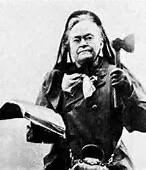
| Carrie Nation – Prohibitionist |
RELIGION IN AMERICA
There is an interesting dynamic in
the history of Protestantism in America. As different
Protestant churches became the “established” or mainstream churches, many Americans turn away to form and join more evangelical or Pentecostal churches and
sects. This began in colonial America. Following the spectacular success of itinerant evangelical preacher George Whitefield in 1740 (the first Great Awakening), the evangelical New Light movement and independent itinerant preachers swept America. They challenged the established (tax supported) churches with emotional appeals for salvation. Although the fervor died down in the 1750s, it never disappeared.
The large and sudden popularity
of Baptists and Methodists in the first half of the 19th century was a revival of the reaction to the less fervent Puritan (Congregational) and Episcopal
churches. As Methodist and some Baptists
groups became less evangelical and more “mainstream,” there were numerous
breakaways to found evangelical, enthusiastic and Pentecostal churches.
America has a long history of itinerant preachers and camp meetings. Enthusiastic preaching, as opposed to fixed
liturgies and long, rational sermons, can now reach national and international audiences
through mass media.
Competition in the religious
marketplace, the lack of one dominant religious group or “established” church after the Revolution, is one reason for the enduring important role that religion
plays in American life. America is the exception to the general tendency that as Christian
countries experience rising income, religious participation and influence declines. It is only recently, as many evangelical groups ally themselves with far-right political positions and politicians, that religious participation may be declining.
RELIGION AND
POLITICS
Religion, and religious-based
morality, has played an important role in American politics. Bernard Bailyn, in his classic Ideological
Origins of the American Revolution, documents the increasingly radical
anti-British sermons of Puritan ministers.
Revivals, “Great Awakenings,” and evangelical Protestantism have been
part of the American landscape as far back as the wildly popular colonial
preaching of the itinerant George Whitefield.
The “Great Awakening” revivalist crusades of Charles Grandison Finney in
the 1820s and 1830s along the Erie
Canal, whose book on how to
organize a religious crusade influenced Billy Graham, led to the belief that
the second part of being “reborn” was to fight to reform society. He supported many of the reform movements of the 19th century. Many believed a reformed Christian society would hasten the Second
Coming.
Finney’s followers and Protestant
ministers became key figures in many of the reform movements of the 19th
Century, including suffrage (women’s right to vote), abolitionism (abolishing
slavery), temperance (volunteer not drinking of alcohol), and a whole host of
religious-based groups to fight immorality and reform society. More recently, one thinks of the Civil Rights
Movement led by black ministers.
But religion can also be used to
justify racism, prejudice, and reactionary political movements. Colonial established churches believed that women should be silent on religious matters.
Defenders of slavery, including Southern
ministers, often quoted the Bible to justify slavery. Prohibitionists in the 19th Century were
not above blaming much of the “immorality” of the times on Catholic immigrants,
especially the Irish. The same
religious-influenced populist movement has been used against the teaching of
evolution in public schools.
By historic standards, the United States has been a radical society. All areas of life are always changing,
including movement, social mobility and immigration. In an earlier post, I summarized this
dynamism as “permanent revolution.” It is not surprising then that at any given time, many people feel threatened or
morally repulsed by some aspects of social and cultural change. The long-held belief that power and status in America belonged to white, native-born Protestants continues into a more diversified society.
Times of heightened social or cultural change, such as the forces
unleashed in the 1920s or 1960s, and recently, seem to lead to a political backlash to slow
down or criminalize new types of behavior. There is often a moral or religious basis to this backlash.
Sometimes it is difficult to tell if religion’s influence is progressive
or reactionary.
Social change has political
consequences. Civil rights for blacks
led to the political issue of affirmative action. The changing role of women in American
society led to political issues like birth control and abortion. Legal tolerance of homosexuality led to the issue of gay marriage.
Religious-based moral reform
groups are single issue groups that are outside the political structure but attempt
to influence public policy and law. They
are willing to use the coercive powers of the state to impose their moral and
religious beliefs. They become political
pressure groups.
Like today, reform movements first
had success at the local and state levels before their reforms were adopted at
the national level.
In the 19th Century,
there was a widespread belief that Christian-based social reform would hasten
the Second Coming. Some conservatives today
believe that American society has become so evil that it will lead to the
Second Coming. Michele Bachmann all but
called President Obama the Anti-Christ and predicted his policies were leading
to the “end of days.” This
type of rhetoric is not new. Puritan
ministers like Cotton Mather were constantly berating New Englanders for the
“declension” (decline) of Puritan orthodoxy and looking for signs of the Second
Coming. He supported the Salem Witch
Trials as a tool to stop the spread of the devil’s influence, and only changed
his mind after dozens of witches (and one Puritan minister) were burned at the
stake. (In a typical New England coincidence, the interrogator at the Salem Witch Trials was the
grandfather of Nathaniel Hawthorne.)
Many people in America see moral decline as the most important issue in American
politics.
With the increased influence of
fundamentalism in American religion and culture, maybe the idea of Armageddon
has become a mental reality for more Americans. There seems to be a
lot of Armageddon movies in the last few years. Just as Martin Luther
called Rome “the whore of Babylon,” many Americans seem to think the same way about Washington. They see presidents and other elected politicians who support laws and programs they believe are evil. Not wrong, but evil. There can be no
compromise with evil. Arguments about reasonableness, tolerance, fairness, rule of
law, democratic process, fall on closed ears and minds. Opponents are demonized.
Americans have had a strong tendency to see social problems as moral
issues. Social issues usually have a
strong component of religion-based morality. Drugs is a current
example. Punishment for illegal
behavior, not reduction of usage or social costs, is the preferred policy. Until recently, only libertarians and most
economists, two notoriously materialistic and overlapping groups, disagreed. While some marijuana use is now legal, America has been racked by waves of illegal drugs use over the last six decades. Not even the wave of opioid and fentanyl drug deaths among young, male, white Americans has changed national opinion.
Over the last 60 years, we have
become a much more tolerant society. This has angered a lot of people,
especially older white, native-born Americans, the predominant constituency of
the social conservative and the tea party movements. It has also contributed to politicizing organized religion.
Great preachers in the past – Whitefield, Finney, Moody, Sunday, Billy Graham – were institution outsiders. They were not members of a particular Protestant denomination. If they founded a physical church, it was independent. They understood how to use the mass media of the day. Aimee Semple McPherson, who founded the widely popular “Foursquare” megachurch in 1923 after a long career as an itinerant preacher in America and Asia, had her own radio license and had applied for a TV license just before she died.
They did not identify or support any organized political group or party. They did not endorse political candidates. But for the last 40 years, the Republican Party has made conservative Christians and their organizations an important part of their political base. Republican elected officials and candidates appear at religious conferences. Religious leaders and denominations take political positions aligned with the right wing of the Republican party.
What will happen after Trump? The cooperation between some organized religious groups and religious leaders and the Republican party will probably continue. The legal barrier between the separation of church and state will continue to be challenged. Far-right politicians will continue to be speakers at national religious conventions.
INTERNATIONAL IMPLICATIONS
There are international implications to the political role of evangelical Protestantism. There are more Protestants in sub-Sahara Africa than in the United States. A large and rising minority of people in countries like Brazil, Guatemala and South Korea have become Protestants. Pentecostal groups have been particularly successful in Brazil and Guatemala, and among Latino immigrants to America. Protestants, predominately Pentacostals, make up over 25% of the population of Brazil. Jair Bolsonaro, the right-wing former president of Brazil, made Protestant evangelical groups an important part of his political base.
The number of Protestants is also rising among the ethnic Chinese throughout East Asia, including China. Evangelical religion is also an important influence in Korean politics. In the future, there may be a religious overlay to the interaction of internal politics and American foreign policy in Asia and in Africa.
CONCLUSION
Political observers who assume
that American politics is about rationality, economic interests, and compromise have
underestimated the role of religious-based moral beliefs in politics. Economic analysts, with their libertarian bias and cost/benefit rationality, are tone deaf to the moral aspects of political conflicts. Voters will ignore their economic interests
if they strongly believe that government is supporting or protecting immoral
behavior.
In American history,
religious-based moral movements have strong staying power. They are sustained by deeply-held religious
beliefs that determine political reactions to continuous economic and social
change. The current ones are not going
away.