 |
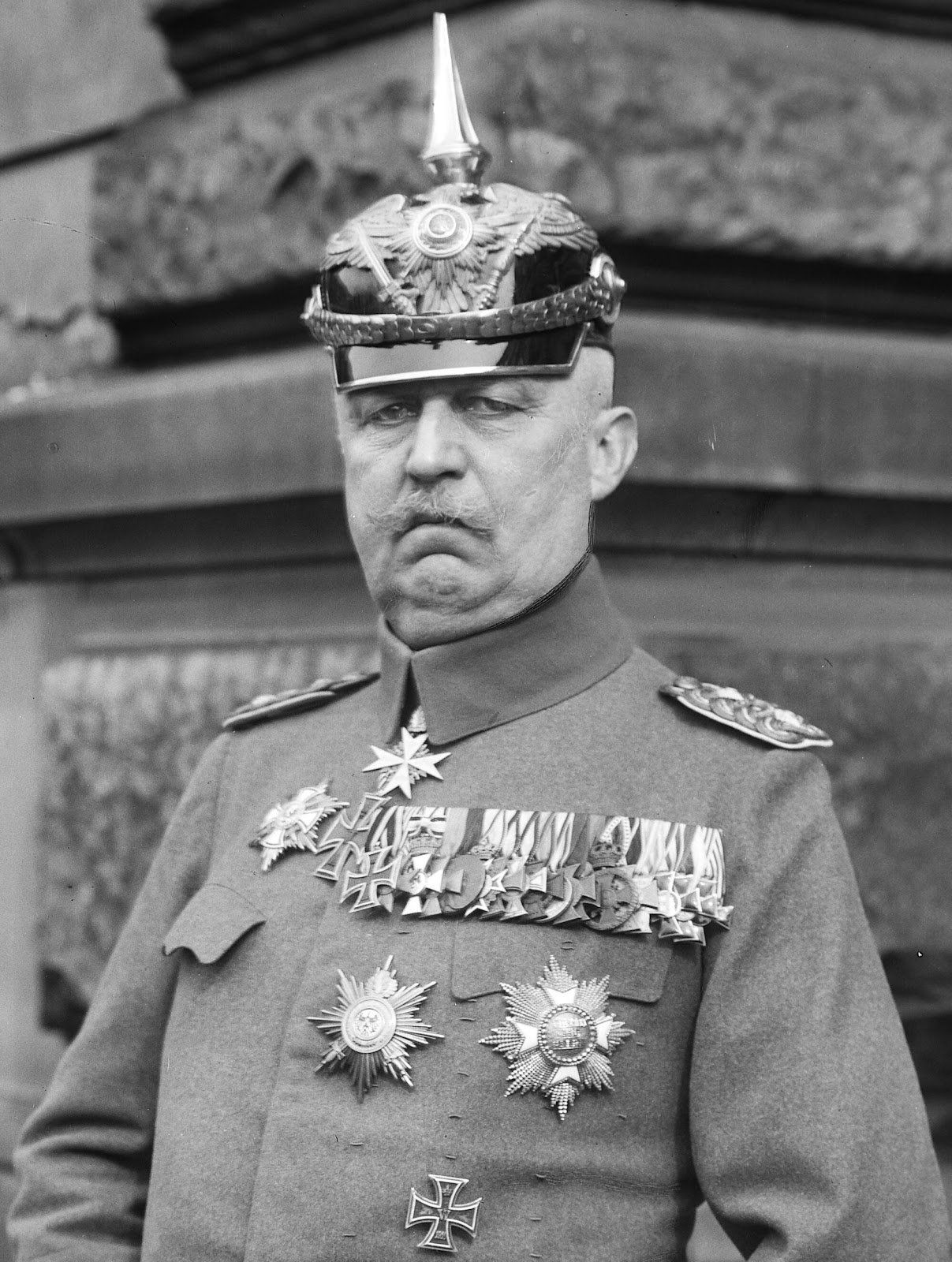
| Erich Ludendorff |
This is a summary of the reasons Germany lost World War I.
The Entente was the alliance of France, Russia, and England, later including the United States. Sometimes called the Allies.
German Planning (Schlieffen Plan)
Germany’s strategy was based on the Schlieffen Plan, first developed by the head of the German General Staff in the 1890s. The essence was that most of the German Army would quickly attack France and defeat France in six weeks, before Russia could fully mobilize. Then much of the army could be quickly transported on Germany’s superb railroad system to the east to defeat Russia. The Plan was reviewed and updated by the German General Staff every year up to 1914, first under Schlieffen and then under his successor, von Moltke. Helmut von Moltke was the nephew (and namesake) of the general that led German forces to victory over France in the Franco-Prussian War of 1870-71.
The German General Staff never seriously considered any alternative scenarios.
The elder von Moltke, thinking about Germany’s future after his famous victory, believed that Germany, and its army, should fight the next war in the East. Block France’s expected offensive, concentrate on defeating Russia, and occupy Central and Eastern European territory. Then, if necessary, turn to defeating France. Schlieffen and the younger von Moltke changed the focus, expecting to defeat France quickly with a massive offensive before turning on Russia. In their private diaries, both expressed doubts about the success of their plan.
When World War I started, von Moltke led the German Army and was responsible for the success of the Plan. In six weeks, when Germany had failed to conquer France, von Moltke had a nervous breakdown and was relieved of command.
- · Germany did not win a quick victory over France as planned and expected.
- · Underestimated how fast Russia mobilized and moved its army to attack Germany. German General Staff panicked and transferred a substantial number of soldiers from its armies in the West to the East.
- · Believed (hope?) Britain would stay neutral. Then underestimated how fast the British army deployed in France. Although small, the British army was crucial in slowing down the German advance and later counter-attacking along the Marne.
- · Hoped that Belgians would not fight. When they did, slowed down the advance into France.
- · Underestimated logistical problems of a huge army moving by foot and horse in enemy territory.
Could Germany have won the war in the West in 1914? Despite miscalculations, they came close (how close is still a matter of debate). The original attack almost succeeded. The two massive German armies that led the attack were commanded by generals who did not like each other and did not communicate with each other. At a critical moment when victory was possible along the Marne, one of the generals changed the direction of his army without telling the other general or von Moltke’s command center. This opened up a gap between the two armies which French and British units exploited, mauled one of the armies, and forced the Germans to retreat. When they stopped retreating, they took out their shovels and began to dig. The series of trenches they created became their front line for almost four years.
Trench Warfare and Artillery
Despite huge offensives on both sides, there was static trench warfare in the west for almost four years. Until the summer of 1918, all offensives failed with huge causalities.
Both sides realized the quick offensive war had become a war of attrition after stalemates in France and in the East. Despite this, the Germans launched a huge offensive in 1916 against Verdun; to relieve pressure, the British launched its Somme offensive. Both offensives failed: there were massive causalities on both sides.
World War I became primarily an artillery war. Artillery was the largest cause of death.
Huge artillery barrages preceded attacks on lines of fortified trenches. The other side launched counter barrages against advancing infantry.
At the beginning of the war, Germany had advantages in deployed artillery and artillery production. In the long run, though, Germany could not keep up with British and French production of artillery shells and explosives.
By 1917, England alone was producing more artillery shells and explosives than Germany.
1917
Again, World War I was a war of attrition. Germany had a chance to win the war in 1917. In 1917, the Russian Army collapsed and Russia was out of the war, the British Army’s size and effectiveness was diminished after the very heavy losses from the Somme offensive, and part of the French Army mutinied. Germany had to attack before large numbers of American troops began arriving and prepared for combat. But Germany had suffered huge losses in its attack on Verdun.
In 1917, Germany’s submarine warfare in the Atlantic threatened to put England out of the war before American could enter in force. Britain depended on imports, especially for food. About 80% of grain for bread (and beer) was imported. By April, 1917, when America entered the war, Britain and France had only a few weeks inventory of wheat. But Germany’s U-Boot campaign to deny England food from Canada and American was never fully successful.
Americans began to consider joining the war in 1917 as a result of the German navy’s renewed unlimited submarine warfare. Germany’s navy assured the kaiser they would starve out England before America could send over troops. Americans were also incensed on learning in March that the German government secretly offered German assistance to Mexico if it would attack the United States (the Zimmerman telegram). That was the final straw; America declare war less than a month later.
The American army was not ready for European warfare in 1917. The American army was very small and ill-equipped. Although America sent over a total of 2 million troops in 1917 and 1918, they were poorly-trained and lacked weapons like machine guns and artillery. France and England had to arm the American soldiers and teach them how to use the weapons to fight a new kind of war. But by the spring of 1918 about one million Americans were ready for combat.
1918
By 1918, German civilians were starving. This was mostly due to the English Navy’s blockade of Germany.
Ludendorff had to delay the massive offensive until the spring of 1918. The German Army in France was increased by 500,000 troops transferred from the Eastern Front after Russia collapsed.
Again, the outcome was in doubt. Reasons for his failure were that the French Army had partly recovered from mutinies, draftees replaced volunteers in the decimated English Army, which was also fortified by Canadian and Australian corps. Both the French and English armies now contained large American divisions (an American division was twice the size of depleted French and English divisions). In addition, Americans helped stop the last German offensive and a large American army took part in the counter-attack (the Meuse-Argonne offensive). The Entente also now had an advantage in artillery and began to effectively deploy tanks and airplanes. After being hammered by the Germans for months, the Entente had sufficient troops to mount a counter-attack all along the German lines. The German army no longer had reserves to plug gaps in their lines. The Entente armies breached the Hindenburg Line, Germany’s last line of defense. The German army collapsed. Ludendorff fled to Holland, but only after advising Kaiser Wilhelm to surrender. Instead, Wilhelm also fled to Holland. The war was over.
Other Factors
Germany did not develop the new war technology of airplanes and tanks as fast as the Entente, although this was not a decisive factor in Entente victory. Germany produced very few tanks. Germany also produced fewer airplanes than England and France combined. By the end of the war, the Entente controlled the skies.
Poison gas warfare gave Germany some advantage early in the war but Entente counter-measures and poison gas production partly neutralized the effect.
The Entente had resources beyond the national resources of men and weapons. Germany had to rely mostly on its national resources.
o France had military manpower from its colonies, mostly from North Africa.
o England had manpower and resources from Dominion countries (Canada, Australia, New Zealand, and South Africa), India and its other colonies, and the United States, even before America entered the war. After the United States entered the war, America sent over approximately 1.4 million troops who fought or supported fighting in 1918.
§ Food, horses, mules, steel, and artillery shells and high explosives from Canada and the United States, even before the United States entered the war. By 1916, the United States was providing England with 30% of its food.
§ In 1914-1915, the soldiers provided by England’s India Army were critical in stopping German offensives after trench warfare began.
o The Entente imported approximately 300,000 Asians, Indians and Africans into labor brigades – to man supply depots and move supplies, and help build and repair railroads. Released manpower for the armies.
As war continued, Germany’s ally Austria-Hungary became more of a burden than a help. German and Austro-Hungarian objectives were at odds. In the beginning of the war, Austria-Hungary wanted to use most of its army to attack Serbia. Germany wanted Austria-Hungary to use most of its army against Russia to help limit Russian attacks on Germany. Germany only had 1/8 of its army in the east to stop the Russian offensive. It depended on a large Austria-Hungary force to engage much of the Russian army. Austria-Hungary’s redeployment of troops did little to help German in the crucial first month of the war.
Austria-Hungary failed to defeat Serbia and suffered huge casualties in the four months of 1914 fighting on the eastern front. Later in the war, Germany had to divert troops at the western front to rescue Austria-Hungary in its war against Italy. By 1918, the new Austrian-Hungarian emperor began secret negotiations to take Austria-Hungary out of the war.
Saul David, BBC, “How Germany lost the WWI arms race,” February 16, 2012.
Niall Ferguson, The Pity of War: Explaining WWI, 1998.
Two essays on this blog by Professor Andrea Dragon documents the vital assistance America gave England and Russia even before entering World War I.
New Jersey Artillery Explosives in World War I
KELP IS ON THE WAY: How American Kelp Helped Save the English Explosives Industry in World War I
Hal Brand, The Eurasian Century: Hot Wars, Cold Wars, and the Making of the Modern World, Chapter 2.
For a discussion of the weaknesses and problems of Austria-Hungary in the period leading up to World War I, see
The Austro-Hungarian Empire Before World War I
There are other posts on this blog that explore the period before World War I and what led up to the outbreak of the war:
Bismarck and the Origins of World War I
The Beginning of the Twentieth Century: The Path to World War I
Wealth and Power in Pre-World War I Europe
Europe on the Brink of World War I
World War I had long-term consequences. Some are discussed in:
The Immediate and Long-Run Historical Consequences of World War I
The effect of WWI on the Stock Market Crash of 1929 and the Great Depression is discussed in:
The Stock Market Crash of 1929 and the Beginning of the Great Depression