Category: Uncategorized

  • Demographics, Immigration and Future Economic Growth of the United States

    Demographics, Immigration and Future Economic Growth of the United States


    Americans


    SUMMARY


    Population projections and demographic changes, especially in the different age cohorts, should be seen along with large annual fiscal

    deficits and the large and increasing national debt. The connection is the forecasts of large increases in the over-65 age group and the shrinking working age (and tax-paying) age group. 

    This essay should be read along with Government Finance 101. Fiscal Policy:  Welcome to Alice in Wonderland. 


    UPDATE (November 2025)


    Combining the recent changes in the birth rate and net

    immigration, plus the “baked-in” projection that Americans over the age of 65 will increase by about 50 million by 2060 (see below), it seems likely that the number of Americans in the working ages  cohort (15-64) will decrease at least 40 million by 2060. From about 230 million in 2025 to 190 million in 2060. Well before then, it seems likely that America, like other wealthy countries, will have extensive temporary worker permit programs to augment the native-born work force. This will probably be combined with much more extensive use of generative AI algorithms to handle much of the information analysis in organizations combined with greatly increased use of industrial robots.


    UPDATE (October 2025)


    Projections are changing rapidly because of the dramatic change in net immigration and a slight but continuous fall in the birth rate. Past long run projections, assuming historic levels of immigration, now seem high.


    In January, the CBO’s projections  showed “without immigration the population would shrink beginning in 2033” if birth rates stayed at current low levels. Without immigration, the CBO now expects the US population to start shrinking in 2031. If there is net negative immigration – more deportations and immigrants leaving the US – CBO projections indicate that the population may reach zero growth as early as around 2028. 


    At least half of immigrants, about 6 million, have entered the country in the last four years with some protection from immediate deportation, especially under asylum status. This protection is being withdrawn, even from immigrants who have been granted asylum status in the past.


    There are some estimates that the total immigration population of the US is falling, about 1.5 million over the last year. This may indicate net negative immigration.


    Since immigrants tend to be young adults and have a higher birth rate than the US-born population, lower levels of immigration, mass deportations, and voluntary leaving of immigrants could lower the projected birth rates.


    UPDATE (September 2025)


    The Congressional Budget Office (CBO) has updated its population projections based on a lower birth rate and lower net immigration. “The CBO projects that the U.S. population will increase from 350 million in 2025 to 367 million in 2055. Deaths will be greater than births starting around 2031; the gap gets larger over time. So all population growth after 2031 will be from net immigration. If net immigration falls to zero, the U.S. population will stop growing in 2031 and start a slow decrease after then.


    UPDATE (August 2025)


    Recent data from the Center for Disease Control and Prevention show the U.S. birth rate has fallen below 1.6, the lowest rate on record. With a falling birth rate, far fewer legal and illegal immigrants and increasing deportations, the United States is now on the same demographic falling population path as most other industrialized and industrializing countries. 


         Reported in The Economist, “America’s fertility crash reaches                                                                                               a new low,” August 5, 2025.

    OVERVIEW OF POPULATION PROJECTIONS AND DEMOGRAPHIC CHANGES 

    The longer-run projection is a population of about 335 million people in 2100 (Lancet), about the same number as today. This projection was made with data up to 2017. There is a very wide range of uncertainty around this projection, partly depending on future birth rates and levels of immigration.


    The U.S. birth rate is a little over 1.6, below the replacement level of 2.1. This is in line with some industrialized countries but higher than Japan, China, South Korea, and most European countries. If the birth rate stays about the same and there is little or no net immigration, the Lancet projection is too high. The U.S. maximum population may occur much sooner.


    According to the Census Bureau, by 2030, one in five Americans will be 65 or older, which is up from less than one in 10 in 1960.


    By 2060, the Population Reference Bureau expects the number of Americans 65 and older to more than double from 46 million today to over 98 million.


    In less than two decades, older adults are set to outnumber kids for the first time in US history.


    Because of demographics, the United States could have a relatively better economic future than almost any other industrial or industrializing country. Almost all these countries will experience declining populations (if levels of immigration do not substantially increase), many with population decreases of 30-50%. Also, most of these countries will have higher dependency ratios (a higher percent of old people) than the U.S. That is, the U.S. will have a relatively younger population. This is partly due to higher birth rates and high rates of immigration into the U.S. since the 1960s. With the current birth rate, the United States will reach maximum population later than the other industrial or developing countries.


    DEMOGRAPHICS OF AMERICA:  POPULATION PROJECTIONS


    For generations, demographers considered America exceptional. High levels of immigration and relatively high fertility rates increased its population faster, and kept it more youthful, then its rich country peers in Europe. Americans within their borders were also exceptionally mobile.


    America has had high population growth rates since the first immigrants. (For a detailed look at immigration in colonial times, see American Colonial History, 1607-1775) Since becoming a country, America’s population has gone from 4 million in 1790 (the first census) to 30 million in 1860 to the current (7/24) population of 343 million. The main reasons for America’s high population growth rates in the past have been high birth rates, immigration, relatively healthy and well-fed population, and industrialization (economic development and growth).


    The period from 1950 to 2000 was unusual. 


    Population during this period was:


    Year

    Population

    Millions

    Decade

    Increase

    Millions

    Decade

    % Increase


    1950

    152


    1960

    176

    24

    16%


    1970

    200

    24

    12


    1980

    223

    23

    12


    1990

    248

    25

    11


    2000

    282

    34

    14


    2010

    311

    29

    10


    2020

    339

    28

      9


    United Nations, Department of Economic and Social Affairs, Population Division,

    World Population Prospects, The 2024 Revisions


    Between 1950 and 2000, the U.S. population almost doubled. The American “baby boom” started after World War II, temporarily reversing the long-term decline in birth rates. In the middle of this period, partly due to more effective and more available birth control, starting around 1970, birth rates began a rapid decline. That was partly offset by an increase in immigration.


    Since 2000, population growth rates have slowed. The 2020-2030 population growth rates will probably be lower, maybe around 6% for the decade, because of Covid, lower birth rates, and lower net migration rates (fewer immigrants and more past migrants leaving the United States).


    The U.S. population at the beginning of 2024 was 343 million.


    The UN projection continues:


    2040 – 370 million

    2050 – 381 million

    2070s – 400 million

    2100 –  421 million


    The projected population in 2050 is only 11 million higher than 2040, a decade increase of only 3%. It is also 38 million people higher than 2024, an average increase of about 4-5% per decade.

    After the 2070, the U.S. population will increase by less than one million per year. (United Nations, World Population Prospects, 2024 Revision.) These projections are high and like past United Nations projections will probably be lower in the future.


    The alternative projection from Lancet expects the U.S. population to peak at 365 million in 2062 and then decline to 335 million in 2100, about the same number as today.


    There is a very wide range of uncertainty around this projection, depending on future birth rates and levels of immigration. These projections were made from a starting point of higher birth rates and higher immigration numbers before Covid and current immigration and deportation policies. Birth rates have not returned to pre-Covid levels.


    The U.S. birth rate has been around or slightly below replacement since 1975. The current (2024) U.S. birth rate at 1.62 is the lowest since records began in 1909. The population growth rate is 0.5% a year is low and falling. The 2025 population growth rate is expected to be around 0.2%.


    About half of the decline in the birth rate since 1990 has been due to fewer teenage pregnancies.


    Without past immigration and the children of immigrants, the U.S. population and labor force growth rate would have been lower in the past 40 years. And more of the total growth would have been in the over-65 age group. Immigrants tend to be young adults. If net immigration is zero or below, America’s birth rate will continue to fall.


    The over-65 population is expected to double in the next 35 years, from 46 million now to over 98 million in 2060. (Population Reference Bureau) All of the total population increase will be in the over-65 group; the number of people under 65 will decline. This will increase the ratio of the over-65 age group to the prime labor force age group of 18-64. Again, depending on immigration, since immigrants tend to be younger than the native population.


    Like other industrialized countries, older adults are expected to outnumber children (under 18) in less than two decades. (Population Reference Bureau) 


    The current birth rate is now about the same or slightly higher than that of many industrial countries. This might be partly due to the effects of Covid, although the current birth rate is the same as the birth rate during the Covid years of 2020-2022. But because of past immigration and its demographic effects, the long run decline in America’s population and the labor force should be less than most other industrialized countries.


    The partial abortion ban will have little effect on future population growth. The number of abortions was going down even before the ban. Abortions are still legal in many states. Abortion pills accounted for over half of abortions before the ban. In Europe, pills account for about 70% of abortions.


    The United States has a special problem. Because of the opioid/fentanyl epidemic and suicide, America’s adult mortality rate is increasing, mostly among white men under 55. A 15-year-old white male’s probability of dying before the age of 50 is now higher in America than in Bangladesh. The good news is that while still high, deaths from opioids and fentanyl are going down. The bad news is that a new, more powerful drug than fentanyl has begun to show up.


    ECONOMIC GROWTH AND THE FUTURE SIZE OF THE LABOR FORCE


    With birth rates below replacement, the future size of the labor force will depend critically on immigration. Future productivity increases will partly depend on immigrants’ young age composition, birth rate, and education and training.


    The current (2024/25) unemployment rate is near a post-World War II low. The labor crunch is likely to persist for some time. The Pew Research Center projects no or very little growth in the working-age population over the next two decades. If the United States were to cut off the flow of new immigrants, Pew noted, the American working-age population would shrink.


    The U.S. economy is growing at about 2-2½ percent a year. Employment is growing at about 1.0-1.5% a year; productivity is growing at about one percent a year. The size of the labor force (employed plus unemployed) is growing at about 0.3% per year; the growth rate is in long-term decline and may accelerate with a possible decrease of immigrant workers. This indicates that the growth in employment will probably be lower in the future than in the past.


    The US youth (16-24 years old) labor force participation rate is dropping. Bureau of Labor Statistics data show that only 53.1% of young people (ages 16-24) were employed during the summer of 2025, about 15 percentage points less than in 2000. This might also lead to delayed marriages and family formation. This could affect the demand for housing.


    This is puzzling. The minimum wage is much higher. College graduates have large amounts of student loan debt. Both of these should indicate higher labor force participation rates. But currently (second half of 2025), companies, based with uncertainty due to randomly changing tariffs, higher interest rates, and uncertainty about future consumption expenditures, are not hiring new entrants to the labor force.


    One possibility is that traditional employers of young people, such as restaurants, are cutting back on total employment and also substituting automation. 


    Periods of high youth dropping out and unemployment are historically correlated with increases in social instability, drug use, crime, and political extremism. 


        Ed D’Agostino, “Unemployment’s Slow Burn,” October 10, 2025.

    There’s another variable, one highlighted in The Wall Street Journal. Suzy Welch wrote an important commentary based on her research on Gen Z at NYU Stern School of Business. This group was born between 1997 and 2012, making them 13 to 28 years old today. Welch, former editor of the Harvard Business Review, took a look at Gen Z’s values. She found a stark disconnect between their values and those sought by today’s businesses.


    Welch reports that only about 2% of Gen Z prioritize the values most employers seek—achievement, learning, and a strong drive to work. Instead, Gen Z places higher value on selfcare, authenticity, and helping others—commendable values on their own, but when they are your top priorities, you might find it hard to thrive at work.

    Another possible source of disconnect of the young is the addictive attraction of the internet, especially video games, for males. Some researchers believe this is also the reason that male academic achievement is below female achievement and the gap is widening.


    Combined with the high use of illegal drugs, these factors might help explain the dropout rate and lack of traditional values.  


    Most of the recent increase in the size of the labor force has been in the over-55 age group. This is the fastest growing age group and more older Americans are living longer, healthier, and working past retirement age. Also, millions of Americans own small businesses and apparently do not automatically retire just because they turn 65. Others have technical skills (tax accountants, dentists, various types of data analysts) that allow them to continuing working, often part-time or online.


    There has been little increase in total employment in the under-55 age group. There are studies that suggest an aging labor force causes slower productivity growth. Also, possibly, less innovation. This may be a factor in the decline of new business formation.


    Like other wealthy countries, economic growth will depend on productivity increases. Productivity growth in the ten years of this economic expansion (since 2009, before Covid) was the lowest for any ten-year period since the end of World War II. It is possible, however, that government statistics are not picking up the productivity increases from innovations in information technology.


    DEMOGRAPHICS AND IMMIGRATION


    The following report from 2015 shows how important immigration has been from the 1960s to the date of the report. This is in contrast to the situation since Covid and the Trump campaign against immigration.


    According to a 2015 Pew Research Center report, “Immigrants and their children will represent 36 percent of the U.S. population in 2065, which equals or surpasses the peak levels last seen around the turn of the 20th century. That share will represent a doubling since 1965 (18 percent) and a notable rise from today’s 26 percent.” Pew estimates that as of March 2025, immigrants and their U.S.-born children comprise about 28% of the U.S. population, totaling over 93 million people. These projections are now in doubt because of the drastic reduction of immigrants seeking permanent residence.


    The report states that “the arrival of new immigrants and the births of their children and grandchildren accounted for 55 percent of the U.S. population increase since 1964…The projections also show that 88 percent of the increase in population until 2065 is linked to future immigrants and their descendants.”


    Over the last two decades, immigrants and their children accounted for more than half the growth of the population of 25- to 64-year-olds, according to the Pew analysis. Over the next 20 years, immigrants and their children will have to make up for the net deficit in the labor force left by the retirement of the baby boom generation. If immigration were to continue at recent levels, around 2050 the United States would have the lowest percent of retirement-age population of any developed country. Even lower than China. This means more tax-paying workers per retired person than any other industrialized country.


    Immigration over the last 50 years has impacted American demographics. The American population continues to grow despite below replacement birthrates of native-born inhabitants. Immigrants tend to be young, increasing the size of the workforce and slowing the increase of the average age of the population. The education and skills they bring is a “free lunch” for the American economy. A high percent of Americans who have won Nobel prizes were immigrants or the children of immigrants.


    Immigrants and their children have traditionally provided a disproportionate share of entrepreneurs. “Immigrants start companies at twice the rate of native Americans. Almost half the companies in the Fortune 500 were started by immigrants or their children.” (Austan Goolsbee, “Sharp Cuts in Immigration Threaten U.S. Economy,” New York Times Sunday Business, October 13, 2019, 4). One of the founders of Google was from Russia. The current CEOs of Microsoft and Google are from India and the CEOs of Nvidia and AMD are from Taiwan. 


    IMMIGRATION POLICY AND STATISTICS


    Currently, there are 9 million people in the United States with green cards, which means they are on a path to citizenship. During the Biden administration, about 3.5 million people became naturalized citizens, almost one million a year. (New York Times, “Immigrants are Becoming U.S. Citizens at Fastest Clip in Years,” August 12, 2024, From the photos in the article, it appears a high percent are young people.) 


    America has an estimated 11-14 million illegal immigrants. But this is more complicated than the political rhetoric and sensationalist journalism indicates. Many would have eventually attain some type of legal status leading to permanent residence; less now because of deportations and blocking the part to residence and citizenship.


    The United States does not have a coherent immigration policy. The last immigration law was passed in 1990. Attempts to modernize immigration policy has been stymied because of difference between Democrats and Republicans.


    The Trump administration reduced legal immigration and plans to make it difficult for foreign, especially Chinese, students to attend American colleges. In the past, foreign students who remained in the United States were a major source of scientists, technology workers and entrepreneurs. Over half of the science, math and engineering graduate students in the U.S. are from foreign countries.


    Discouraging immigration, limiting foreign work visas, and foreign graduate students will reduce major sources of American innovation, technology entrepreneurs, and productivity growth in the future. It will also eliminate the major source of the overall growth in the labor force. 


    DEMOGRAPHICS AND ECONOMIC GROWTH


    Immigration over the last 50 years has impacted American demographics. The American population continues to grow despite below replacement birth rates of native-born inhabitants. Immigrants tend to be young, increasing the size of the workforce. The education and skills they bring is a “free lunch” for the American economy. On the other hand, the increasing number of older Americans will make it difficult to reduce yearly deficits and fund programs for economic growth.


    The changing demographics of the United States may be influencing other variables besides economic growth. Changing demographics might interact in the future with changing social

    attitudes, global warming and how to combat it, and America’s foreign policy.


    POLITICAL CONSEQUENCES OF DEMOGRAPHIC TRENDS


    Immigration since 1960 has changed the ethnic and racial composition of America. Latinos make up about 20% of American population; Asians about 10%. There are about twice as many Latinos than blacks; there are almost as many Asians as blacks. This will change the influence of minority groups. (New York Times, February 22, 2021).


    The continuing change in the age distribution of the population will have political and economic consequences. For example, when the Social Security trust fund runs out around 2034 (maybe earlier), benefits will drop by at least 20%. With seniors on Social Security making up a large minority of voters, the government will probably make up the shortfall out of general tax revenue. This could increase federal yearly deficits or there would be less money for other programs.


    Fewer taxpayers in the future will have to support the greatly increased public health care costs of an aging population living longer.


    It could be that the United States will have a better economic future than almost any other country because of demographics. That partly depends on future immigration policies. And there probably will be internal political conflict over the distribution of income by age group.

    SUMMARY


    With labor force growth rates falling and productivity not increasing, the labor force aging, and legal immigration restricted, long-term U.S. economic growth rates may be lower in the future – below 2% – than currently. Increases in per capita income will depend on productivity increases from new technology, including the widespread application of robotics, new business software, artificial intelligence, and technology developed in the future. It is too early to predict what the long-run impact of artificial intelligence will be on economic growth and employment.


    SOURCES:


    S.E. Vollcet et. al., “Fertility, mortality, migration, and population scenarios for 195 countries and territories from 2017 to 2100: a forecasting analysis for the Global Burden of Disease Study,” Lancet, July 14, 2020, 1285-1306. https://doi.org/10.1016/ S0140-6736(20)30677-2.


    Probably the best estimates of long-run population projections. Also includes “uncertainty internals” (two standard deviations from mean estimate). They become wider the further out the projection.


    United Nations, Department of Economic and Social Affairs, Population Division,

    World Population Prospects, The 2024 Revisions

    The United Nations population projections used here are the most recent “medium,” most likely projections. They are lower than the UN projections made two years earlier. It is likely that future UN projections will revise population numbers downward.


    Pew Research Center


    Particularly strong on immigration data and analysis


    United States Census Bureau (census.gov)

    Statistica

    Population Reference Bureau

    Worldometer (for current figures)

    Numerous articles in The Economist


    Again, population projection and demographic changes should be thought of in connection with government deficits:


    Government Finance 101. Fiscal Policy:  Welcome to Alice in Wonderland.


    For population projections and analysis for Japan and the world, see

    Demographics and Population Projections of Japan


    In contrast to the United States and other countries, Japan is further along the declining population and labor force curve than almost any other country and may be a preview of the future of many countries outside of Africa. Japan has the world’s oldest population. There is limited but rising immigration, which has triggered a political backlash.


    For an analysis of global demographics and long-run population projections, see


    Global Demographics and Population Projections


    Demographics and Economic Growth


    For a look at current global and American use of industrial and humanoid robots, see


    Robots. “It’s Alive.”

    Includes some (hopefully) satirical comments about the future use of robots.


  • Nigeria

    Nigeria


    Lagos – Over 30 Million People 


    POPULATION

    This case study of Nigeria, building on


    Global Demographics and Population Projections

    illustrates the problems that recently-independent countries, especially in Africa, have had. Rapid population growth has made it difficult to deal with these problems in the past; continued large population growth in the future will be even more burdensome. 

    Nigeria became independent in 1960. Its population was 45 million people. In 2024 its population was 233 million people. Nigeria’s capital, Lagos, is already one of the largest cities in the world. In 2050 its projected population will be in the range of 375-400 million people, depending on how fast its birth rate continues to come down. Around that year Nigeria will replace the United States as the third most populous country in the world. 


    By 2100, Nigeria is projected to have at least 750 million people, which will be about equal to the projected population of China.


    Nigeria’s birth rate in 2023 was 4.5, substantially higher than the replacement rate of 2.1 children per woman. Although the birth rate is down from the high of 6.9 in 1979, it is still one of the highest in the world. Government programs to reduce the birth rate are part of health care programs, which are being cut back because the stopping of U.S. aid for health care, which includes birth control programs.


    ECONOMY

    This forms the backdrop for discussing Nigeria’s current problems and prospects for economic growth and development. One conclusion is obvious: Nigeria will need very high and sustained economic growth rates to overcome the rapid increase in population and increase the country’s real per capita income. 


    Nigeria’s economy still depends on oil; Nigeria is a major oil exporter. Real per capita income goes up and down with the price of oil. Economic statistics tend to indicate that real per capita income has not increased in decades.


    One of the successful areas of economic growth is telecommunications. About 90% of the population has mobile phones and about 25% have internet access. Data center capacity is expanding.

    Nigeria is forming economic ties with China. In June-August 2025, Chinese exports rose almost 60%. The increase was tied to Chinese Belt and Road infrastructure projects in the country, led by demand for equipment to build Chinese-financed railroads and power generation.

    ELECTRICITY


    A crucial reason for the lack of economic growth has been the government’s failure to provide enough dependable electricity.


    The electricity power grid is owned and operated by the government. Of Nigeria’s 233 million people, over 90 million do not have access to electricity. Nigeria’s electricity production per person is one of the lowest in the world. Long term underinvestment results in frequent blackouts and shortages. Many users, including the government, do not pay their electricity bills; revenue accounts for about 65% of operating costs.


    Private gas-powered generators generate more than twice as much electricity as the power grid. Nigerians’ spending on off-grid power is equal to 60% of the government’s entire budget. Cities suffer from noise and air pollution.

    Over half of the country’s manufacturing sector is not connected. New data centers have to provide their own power.


    There are plans to build off-grid solar and other renewable energy projects. Even if successful, they will not close Nigeria’s massive electricity shortage. And if successful, there will probably be fewer customers on the grid, making it even harder to expand and modernize it. 


    Government energy policy seems inconsistent; it would like to have solar projects connected to the grid, but it is also thinking about banning solar panel imports.


         This discussion of electricity is based on The                                     Economist, “A nation in the dark,” May 10, 2025,         38.

    Unless banned, roof-top solar panel installations will probably increase rapidly. The price of Chinese exported solar panels has fallen over 50% in the last three years because of overcapacity and price wars.

    China has built a high-speed rail line between two suburbs.


    POLITICAL


    Nigeria’s borders were established by England, Nigeria’s colonial master, in 1898. England combined several kingdoms into an arbritary

    administrative area.


    The largest ethnic group – Hausa – makes up about 30% of the population. But there are about 275 distinct ethnic groups and about 500 languages and dialects. The population is about evenly divided between Christians and Muslims. Muslims predominate in the north, Christians in the south. There is resentment in the north that the south has benefited more from the oil wealth. The Muslim population, with a higher birth rate, is increasing its share of the total population.  


    Nigeria has had a tumultuous political history since independence. National politics has been dominated by military coups, fighting among top military officers for power, and brutal military governments. Civilian governments have tended to be corrupt. 2023 was the first national election in Nigeria’s history where no “civilian” candidate was not a former military ruler.  


    There was a brutal civil war shortly after independence. The predominantly Muslim region in the north is experiencing jihadist terrorism.


    Politics has suffered from widespread corruption and the inability to support economic development beyond oil extraction. The country suffers from high inflation and large government fiscal deficits.

    OTHER TOPICS


    The oil producing region of Nigeria is one of the most polluted areas in the world.


    As farmers attempt to expand food production, the result has been massive deforestation as bad as in the Amazon. Even with this, food production has not kept up with population growth. Nigeria has gone from being a net food exporter to a net food importer.

    According to Doctors Without Borders, there is widespread malnutrition in northern Nigeria.


    Global warming has made producing food more difficult. It is one reason for the large rural migration to the cities.

    ===================================== 

    For a discussion of Africa’s demographics and future population, see the essay cited above.

    Global Demographics and Population Projections


    There are other essays on demographics and population projections for the global economy and individual countries.


    Demographics, Immigration and Future Economic Growth of the United States


    Demographics and Population Projections of Japan


    For a variety of essays, with links, on this blog, see

    List of Post by Topics


  • The Prince in a Democracy

    The Prince in a Democracy


    Niccolo Machiavelli
     

    It is customary for those who wish to gain the favor of a prince to endeavor to do so by offering him gifts of those things which they hold most precious.

        Niccolò Machiavelli

    THE MIND OF THE PRINCE


    The only goal of a Prince is to get and keep power.

    Others may lust after wealth or prestige but all that matters to the Prince is power.

    Power is the only reality. Information is just a tool to support and increase power.

    Power is personal. The Prince’s interests are the country’s interests.

    The Prince sees society divided in three groups – supporters, enemies, and the silent, fearful politically passive. 


    Politics is a zero-sum game. You win, your enemies lose. There are no democratic negotiations or compromises. Only temporary alliances that can be broken.


    BUILDING YOUR POLITICAL BASE


    You share with your supporters a deeply negative view of the future of society. Your supporters see a bright past compared to a dark future. You share this vision. You tell them that only you can fight against or reverse this trend.  


    You share their belief that the present is corrupt, there are “corrupt elites,” and the future is bleak because of conspiracies. An important part of your appeal is to find or invent conspiracies. You find scapegoats to blame for what your supporters believe is wrong with society.


    You find political allies who will support you. Established churches or conservative religious groups are an obvious choice. Many believe in the presence of hidden evil forces. 


    You do not have to share their beliefs; it is probable you are not religious and do not share their moral teachings. All you have to do is to articulate their moral outrage and support their moral programs. You politicize their beliefs. Like the cynical Richard III of Shakespeare, carry a Bible in public or some other religious photo op. Appear with religious leaders. Speak at their national conventions. Appear on the TV programs of televangelists.


    Your political enemies are not the “loyal opposition” of a democracy. They are the enemy. They are the enemy of your supporters. The only legitimate citizens are your supporters. They are “the people.” Your enemies are “enemies of the people.” Your enemies are not just wrong but immoral and evil, a threat to your supporters’ vision of the desired order of society. You denounce your enemies as criminals, traitors, subversives, radicals, elitists, “scum.” You demonize and dehumanize them.


    Ignore opinion polls and approval rating polls. The only opinions that count are the opinions of the segment of the population that supports you.


    You probably have contempt for people. You only see their negative side – their weaknesses – that you exploit. You feel superior. But you must hide this and transform this feeling into an image of infallibility that will give your supporters strength and purpose.


    GETTING ELECTED


    The Prince, to be secure, must corrupt the government. You must subvert democratic institutions so you have nothing to fear from defenders of democracy. 


    To get power, a Prince has to convince about half of the voting citizens to support him. All of his energy and tactics are to increase the number of his supporters. Ignore debate with those who will never support you. Don’t argue with your opponents. Use irrational, emotional appeals against logical, rational arguments. You can ignore, or ridicule, opponents who believe in the rules of debate or fair play.

    You can deal with them after you are elected.


    Who are your potential supporters?


    A democratic society is probably also capitalist. That means permanent disruption, both economic and social. A disproportionate share of the innovators, entrepreneurs and disruptors will come from ethnic, racial, and religious minorities, often immigrants. The dominant racial or ethnic or religious group will feel threatened with an absolute or relative loss of income, status, influence, and power. They will feel insecure, threatened, angry, and hateful. They may use the rhetoric of moral outrage, which you adopt. They see the traditional order of things threatened or slipping away. They start talking about “real citizens.” They are your potential supporters.


    Your supporters do not want to hear about tolerance, accommodation to other views or behavior, protection of minorities, human rights, free speech, or individual liberties that protect what is to them abhorrent behavior. Social issues are seen through a traditional moral lens. 


    It is not necessary that you share their beliefs. It is only necessary that you recognize their beliefs about what they think is wrong and who is to blame. If you gain power, you must articulate their discontent and focus it.


    You create a narrative of a past “Golden Age” or a historical mythology. You appeal to their ethnic or racial pride.


    KEEPING AND EXPANDING POWER


    Princes in a democracy depend on and represent the reactionary forces that cannot or do not wish to face the future. You do not have to have any positive programs to deal with society’s problems. Reward your supporters with grants and subsidies. Place blame. Deny the problems exist. Your power and influence do not depend on constructive or “progressive” programs to deal with your country’s future.


    It is necessary that attacks on opponents, liberals, and potential rivals be continuous and incessant. In a world of social media, it is necessary to control the narrative. To do this, all statements, no matter how outrageous, should demonize, dehumanize, and demoralize the opposition. They should always be kept on the defensive.


    You can tell the truth or you can lie. You can change your story without explanation. It doesn’t matter. All that matters is that you constantly talk about the themes important to your supporters.


    You must dominate the discussion. Overwhelm opponents with a constant barrage of propaganda and misinformation. Don’t stop to debate. Your supporters will accept whatever you say on faith.


    Many of the opposition politicians and their supporters are the “new classes” prospering because of economic opportunity and disruption. Your supporters probably felt superior to them in the past but now feel threatened by them. You play upon those fears. You appeal to their sense of nostalgia, how they imagine things were in the past. At the same time, extort money from corporations and the wealthy by threatening them with the powers of your government. Attack and weaken other institutions you believe are actual or potential threats to your power or influence.


    It is not necessary to build a new political base. You will find that many politicians will support you if you have gained power. You will probably view them with contempt because of their weakness and flattery but it doesn’t matter if they do your bidding. If they question some of your actions or begin to appear to be a threat to your power, they must be destroyed. They can always be replaced with new sycophants.


    CORRUPTING DEMOCRACY


    Keep democratic institutions but “hollow” them out. Subvert the election process so your supporters are almost guaranteed to win. Discredit, indict, or prosecute leading opposition politicians. 


    The large bureaucracy of government is a powerful tool you can use.  You use the powers of government to destroy or neutralize opponents. The economic and military resources of a country are used to support or increase your power. Gain control of the “judicial” parts of government. Use criminal charges, civil investigations, threatening government prosecutions, taking away grants and subsidizes, destroying reputations, tax audits, and intimidation to weaken your opponents.


    Democratic institutions and norms are established to protect the political system from demagogues like you. Ignore them or subvert them. Keep the institutions but change the content. Make sure the legislature is dominated by your supporters. Appoint the judges and federal law enforcers. All government departments, all government employees, must be loyal to you, not to some abstract belief in democracy or justice or the common good. There is no common good. They are there to carry out, to justify, whatever actions you decide to take. Everyone is replaceable; loyalty is the only criterion. If things go wrong, find scapegoats. Question motives and patriotism. Denounce and dismiss anyone in your government that doesn’t do your bidding. Everyone in government must feel insecure and only dependent on your goodwill.


    You probably have developed personal resentments and grievances. Some may coincide with those of supporters. This suggests targets for your retribution. Also attack real or imagined opponents at random. This will install fear in actual or potential critics. 


    Strike at targets randomly. No one will feel safe. Install fear in everyone. Everyone has something to lose. The populace will become politically passive to avoid your wrath.


    All political rhetoric and moves are tactical. You do not have to have any consistent or long run strategy. You will be in power for only a limited number of years.


    Some democracies have term limits. You may not want to give up power after your term of office is finished. Term limits can often be ignored or changed. You might challenge the legality of the term limit law. Or you might promote a flunky as your successor and dominate him. Get elected to another position of power to influence or dominate.


    Promote the wealth and power of relatives, especially children. Increase the chances that they may become Princes in the future.


    FOREIGN AFFAIRS


    The same thing in foreign affairs. You do not promote democratic values, human rights, individual liberties. Foreign politics is about power, realpolitik. But your power, not your country’s.


    Use patriotism and nationalism to gain support. Display your patriotism at every opportunity. Find real or imaged foreign scapegoats for your country’s problems. Divert blame to foreign governments for your country’s problems.


    Form alliances with other Princes. Criticize and subvert democracy in other countries. Portray democratic leaders of other countries as weak and indecisive.


    If you become the leader of a powerful country, conduct foreign policy like domestic policy. The goal of foreign policy is to increase your domestic power, whether or not it helps your country in foreign affairs. Foreigners don’t vote. And foreigners are a good source of scapegoats. It is easy to conjure up foreign conspiracies for your supporters. If you can link them, no matter how absurdly with domestic opponents, all’s the better.


    It is probably a good idea to avoid wars because of uncertain outcomes and consequences. But not always. Regardless, appeal to nationalism and use patriotic rhetoric. You go to war if you believe it will increase your country’s power and influence. Or territory. This implies going to war against weaker opponents.


    Beware of other Princes. They share your outlook about human nature and power. Beat up on foreign rulers who still believe in democracy, fairness, and reason.


    Many countries with democratic institutions are dominated by the military or corrupt politicians. Older democracies are under attack by “far-right” (autocratic) parties and leaders. They are your natural allies. Support them. Justify their behavior. If they are elected, they might become your ally. But be careful; they think like you.


    IF YOU RETIRE


    Remember that you will not be around to be criticized when the consequences of your actions come due. Not your problem. The future ends the day you leave office.


    Do not worry about your “historical legacy.” History doesn’t judge; historians do. Given enough time and distance, historians find virtues in the most despicable and destructive of leaders. They will accept your written propaganda. They are usually timid academics who worship power. Otherwise, they wouldn’t be spending their time writing about Princes.


    If you retire to write your autobiography, also become a gardener. Gardeners ruthlessly control their plantings. Gardening will put you in the proper mood to write your memoirs.


    HISTORICAL EXAMPLES


    Learn from successful examples.

    Study the tactics of other Princes who have subverted democracies.


    KARL LUEGER


    There is an irony surrounding the expansion of male suffrage in Austria-Hungary in 1882. It led to the rise of the Christian Social Party, a right-wing populist party led by Karl Lueger. 


    Economic growth and development generated economic, demographic, cultural, and political stresses in Austria, especially Vienna. Vienna experienced rapid population growth as Slavs, Jews, and other non-German-speaking groups from the provinces and neighboring countries moved to Vienna. Vienna’s population increased from 551,000 in 1850 to 2,083,000 in 1910.


    Lueger allied his party to existing conservative, reactionary and religious elements. The party appealed to clerical Catholicism, German nationalism, and traditional values. In Vienna, he appealed to a voting base of mostly German-speaking lower middle-class artisans and shopkeepers who were losing their economic security and status to immigrants and a rising liberal capitalist class. Mr. Lueger became very popular and was elected mayor of Vienna (1897-1910). As mayor, he initiated and managed new public works projects in Vienna that benefited his constituency. Eventually, he was accepted as an ally by the emperor and the aristocracy. 


    Mr. Lueger and the Christian Social Party used anti-Semitism as an effective political weapon. Karl Lueger did not create the populist anti-Semitism of Vienna but shrewdly exploited it for political gain. 


    The party advocated racist policies against non-German speaking minorities. It supported a bill to restrict immigration of Russian and Romanian Jews into Austria-Hungary. After World War I, the Christian Social Party morphed into a Fascist party that dominated Austrian politics until the Anschluss (union) with fascist Germany in 1938.


    One person living in Vienna who watched and learned from the success of the political rhetoric of the Christian Social Party and the mass organizing techniques of Social Democrats was Adolph Hitler.


    CAESAR AUGUSTUS


    Brilliant use of propaganda and power to “hollow out” Rome’s republican institutions and destroy potential opposition, including half of the senators. Controlled all aspects of the government even though he had no official title. Always protested he was just trying to save the republic. Turned the Roman Republic into the Roman Empire.Turned Rome into an imperial city of marble.


    MACHIAVELLI’S THE PRINCE


    Don’s waste your time reading this book. Another time, another place. Princes were either born to power or killed rivals to get it. Ignore the book’s “how to” advice. You already know everything about getting and keeping power.


    PLATO ON TYRANNY


    Plato says that tyrants project anger, resentment, and revenge. (Books 8 and 9 of Plato’s Republic)


    Tyrants exhibit hatred that springs from envy. They destroy good men (the just) because they have the virtues the tyrant lacks. Tyrants also go after the brave, the proud, the wise, the rich to boost their own stature and self-worth. All groups or organizations that contain people like this are potential enemies and must be corrupted.

  • American Colonial History, 1607-1775

    American Colonial History, 1607-1775


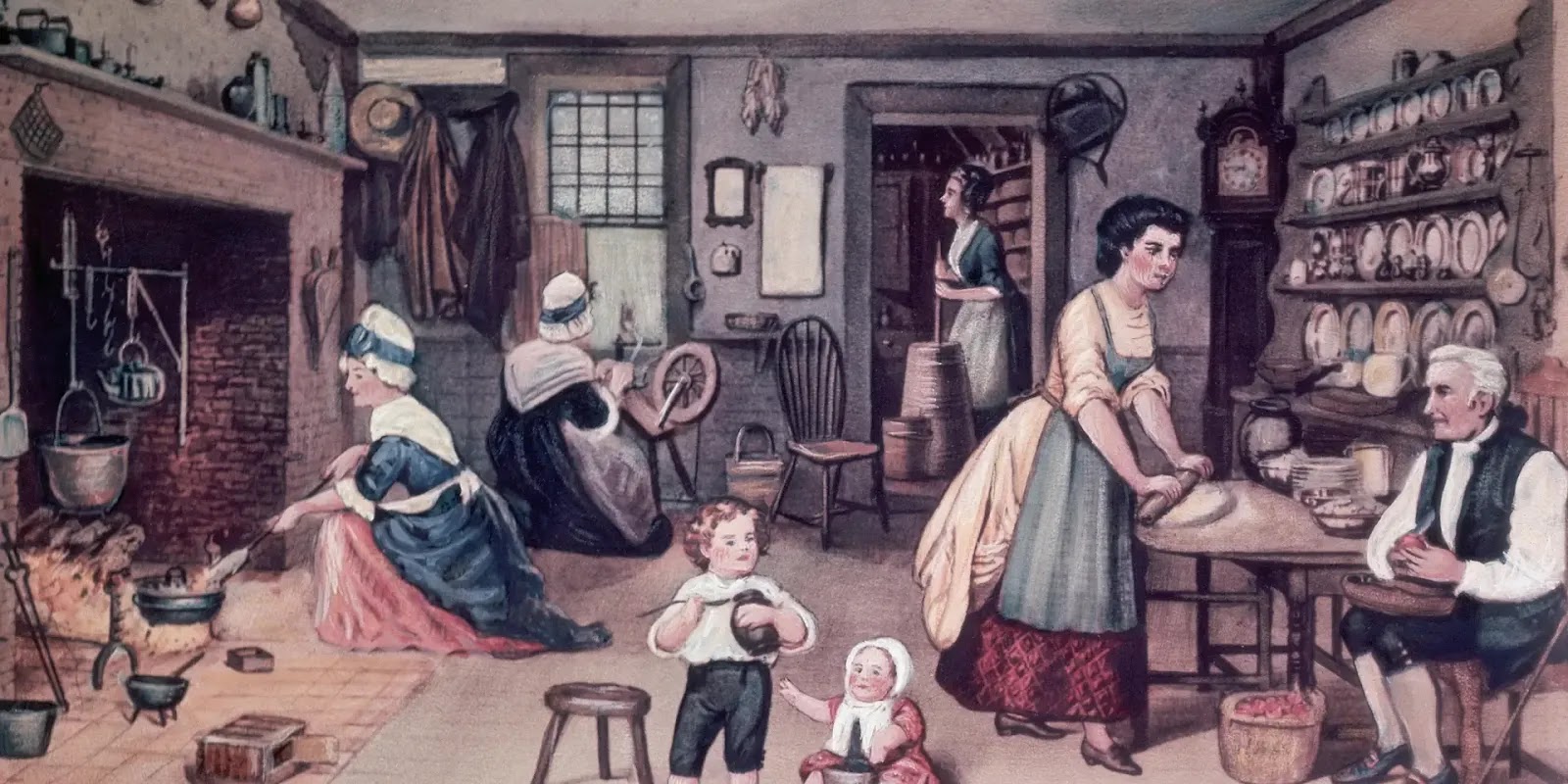
    Colonial Farm Kitchen. Notice clock in the corner.


    THE 1600s


    Preliminary Comments


    About 350,000 Europeans emigrated to the American colonies in the 1600s. They were risk-takers. They left long-settled communities and societies to get on small, crowded sailing ships to make the dangerous 3,000 voyage to a new land that was mostly wilderness. About 5% died. They had to adapt to a new, frontier environment of forests and swamps. They had to “tame the howling wilderness.” 


    A high percent of the European immigrants in this period were from England. Almost all were Protestants.


    Emigrants from England came over in three “waves.”  Then a fourth ‘wave” came to the North American colonies in the 1700s. They were four distinctly different groups of people from different areas of the English isles.


    To understand why these four groups left England and Scotland, at different times and for different reasons, it is necessary to know a little bit of English history during this period.


    The Failure of the First Settlements


    The earliest settlements of Pilgrims coming to Plymouth (1620) and immigrants coming to Jamestown (1607) were failures. About half of the Pilgrims died on the voyage or in the first year. Very few new immigrants came to Plymouth. The English Pilgrims actually came from Holland; they were worried that they were being assimilated into Dutch society.


    The company that settled Jamestown continued to send over thousands of new immigrants and many supply ships. The first settlers were mostly single men looking for gold; only later did the Virginia Company send over families. In the first 15 years, about 75% of the settlers died. There were many reasons, including that Jamestown was built on a malarial swamp. Neither group was prepared to deal with the harsh “wilderness” of America.


    But there was one success. Some of the Jamestown settlers began growing tobacco.


    The First Wave – Puritans coming to the Boston area. (1629-1642)


    English background. In the early 1600s, there was political tension and conflict in England. The English kings thought they could rule without consulting Parliament; Charles I suspended Parliament for eleven years. But many people in England thought the King and Parliament should rule together. They opposed the king’s right to rule without Parliament. 


    At the same time, there was a bitter conflict over who would control the Church of England. The Church of England was the official, government-supported church. It was Protestant (it was illegal to be a Catholic in England at this time). Most English were members. Some members wanted a church controlled by its bishops, who were appointed by the king. Top-down, hierarchical control. Others wanted to “reform” or “purify” the Church, move it further away from traditional practices and beliefs. Some even thought individual congregations should be able to appoint their ministers without interference from the bishops. These people were called Puritans.


    The fights over who should control the government and who should control the Church of England were connected. Supporters of the king also supported a Church controlled by its leaders, the bishops. Many supporters of Parliament were also Puritans.


    By the late 1620s, it was obvious that the king and the bishops had won the fight over power and control. Puritan ministers were being removed from their pulpits. Many Puritans recognized they had lost and wanted to leave England. They came to the American colonies.


    From 1629 to 1642, 15,000-20,000 Puritans came to the Boston area and quickly spread out. Few new immigrants arrived in the rest of the 1600s, only about 7,000. This area was known as the Massachusetts Bay Colony. They were highly organized and well-prepared to set up towns and farms. They came in families, brought farm equipment and supplies, and their own Puritan ministers. They laid out towns and distributed land for family farms. They quickly set up a seminary to train new Puritan ministers; we now call this school Harvard. They prospered and their numbers increased rapidly. They spread out into much of New England and beyond.


    They wanted to set up a Puritan society that they controlled. They discouraged anyone who wasn’t a Puritan from settling in New England. Non-Puritans were forced to deport and not return on threat of death. Four Quakers who came back were hung.


    The Second Wave – Royalists coming to Virginia (1649-1660)


    In 1642, civil war broke out in England – the Puritans and Parliament supporters against the king and his supporters. Supporters of the king were called royalists (also called cavaliers). Many were members of landowning aristocratic and gentry families.


    The king and his supporters lost. The king was executed. Many royalists didn’t want to live under a government and church controlled by Parliament and Puritans. Some emigrated to the British West Indies and some to Virginia, where a pro-royalist governor created a stratified society dominated by royalists. He gave them large tracts of land, the basis of the spread of tobacco plantations. 


    They tried to recreate the kind of society and government they ruled before the civil war. Fortunately, there was hundreds of miles of wilderness between Virginia and Massachusetts.


    About half of the European immigrants in the 1600s were poor people who couldn’t afford the ship passage to America. To get to America, they became “indenture servants.” Most came to Virginia and Maryland.


    The tobacco growers owned great amounts of land but very few people to work it and process the tobacco. They encouraged “indentured servants” to come to Virginia. When the ships landed in America, the immigrants were auctioned off to pay the shipowners for passage. Typically, an indentured servant “agreed” to work for their owners for four to seven years. They had almost no rights. After their indenture was complete, they were free; some received some compensation. They were offered free or cheap land, so they had little reason to continue working on plantations. But since most of the good land along the rivers of Virginia was owned by earlier immigrants and their descendants, the new immigrants had to move west to the unsettled frontier, much of which were the foothills and valleys of the Appalachian Mountains. Tobacco growing spread rapidly and was by far the American colonies largest export in the 1600s and 1700s. 


    The Third Wave – Quakers coming to Pennsylvania (1680s and early 1700s)


    Not everyone in England belonged to the official Church of England. They were called “dissenting sects.” One of the most prominent was the Quakers.


    The Quakers were persecuted by government and church officials. In the 1680s, William Penn worked out a deal with the king, who granted Penn, who had converted to Quakerism, ownership and control over a large area in America in exchange for cancelling loans the king owed to the Penn family. Pennsylvania. It became a haven for Quakers. Many of the Quakers in England, over 20,000, emigrated to Pennsylvania and nearby areas. They established a society based on radical Quaker ideals. They were later joined by German sects with similar beliefs. 


    By the end of the 1600s, there were about 250,000 European immigrants and their descendants along the Atlantic coast. A very high percent, maybe 90% or more, were from England and Wales. Their numbers increased rapidly because of immigration and the high birth rates in New England.


    FROM 1700 TO 1775 (THE FIRST YEAR OF THE AMERICAN REVOLUTION)


    Immigration was different in the 1700s than in the 1600s. There were four main groups:


    English – less than 100,000

    Scots and Scots-Irish – about 150,00

    German speaking – about 100,000

    African slaves – about 250,000

    Small numbers of other groups, including French Huguenots (Protestants) and Irish Catholics.


    Total immigration in the 1700s was around 600,000 people. English immigrants were a minority of the European immigrants and a small minority of total immigrants. By 1775, the American colonies were made up of a diverse population; English immigrants and their descendants may have been a minority of the total population.


    English Immigrants

    The composition of English immigrants in the 1700s were somewhat different than that of English immigrants in the 1600s. They were not part of distinct religious or political groups. They were generally poor. They came from different parts of England, including the borderlands with Scotland. Many, maybe as many as 50,000, or over 50%, were criminals or convicts (in England, you could be sent to prison for not paying a debt). England emptied its jails and sent the inmates to America. Most ended up in Virginia and Maryland because that was where the ships were going, to pick up tobacco. The convicts were indentured for up to 14 years and did not get any land or compensation. They were treated no better than slaves. Most became part of the landless poor after their indenture was up. If they survived.

    People from the borderlands between northern England and Scotland (1700s) and Highland Scotland

    The Scots and Scots-Irish

    Fighting between northern English and lowland Scots, and among Scottish clans, had been going on for hundreds of years. This was a frontier, lawless area – little organized government or military control. There was much violence, including raids to cause destruction, pillage, and steal cattle. In addition, there was family and clan feuds on the Scottish side of the border.


    In the 1600s and 1700s, England completed its campaign of clearing out Irish Catholics from Northern Ireland. Favored English were given large land grants. Many of the farm workers came from Scotland. They were Protestant. They were called Scots-Irish.


    In the 1700s, a stronger English government successfully established control over northern England. Through battles and brutal military campaigns, England subdued the lowland (borderland) Scots. Many didn’t like the new order. At the same time, highland Scot landowners began clearing out their tenant farmers, who became landless. Many Scots went to Northern Ireland to work. But conditions were not much better than in Scotland. In the 1700s, about 100,000 Scots and Scots-Irish emigrated to the American colonies.


    Many of the settled colonies weren’t happy about the less “civilized” new immigrants. But the expanding plantation colonies of Virginia (tobacco) and South Carolina (rice) needed their labor.


    Many of the borderland people and Highland Scots settled into a frontier environment in the foothills, valleys, and mountains of the Appalachian Mountains (the western geographical border of the colonies). Some Highland Scots settled in parts of North Carolina, a borderland region between Virginia and South Carolina. For a long time, there was little government or legal presence. Few churches and little organized religion. Disputes were often settled by violence. Many raised cattle as in the borderlands. In America, they were called the “backcountry” people.


    German-Speaking Immigrants

    Many of the German-speaking immigrants came to America to avoid religious persecution. They held similar religious beliefs as the Quakers. They also were persecuted by German governments and their official (state-supported) religions. When the Quakers established Pennsylvania, it was a safe haven for the German sects, including the German-speaking Amish, Mennonites, Moravians and Schwenkfelders. About three-quarters of the Germans landed in Philadelphia.


    The German sects, like the Puritans and the Quakers, tended to come over as families and often with their ministers. They moved to the new lands west of the Quaker-dominated region around Philadelphia. Even today, part of their settlement is called the “Pennsylvania Dutch” country. The word “Dutch” is derived from the German word for Germans.


    Because of the waves of Scot and German immigration, Pennsylvania’s population exploded from about 18,000 in 1700 to about 120,000 in 1750. The Quakers had become a minority in their own colony.


    African Slaves


    The largest colonial immigrant group was African slaves. About 250,000 African slaves were brought to the American colonies up to 1775. The number started to go up in the late 1600s and then accelerated after 1725. The total black population of colonial North America in 1775 was probably over 500,000, mostly slave but a small percent were free. Most of the slaves in the South worked on plantations, especially in Virginia, Maryland, South Carolina, and North Carolina.


    Why were there African slavery in colonial America but not in England? There are demand side and supply reasons. 


    The short answer is: the rapid expansion of the production of plantation crops. The limiting growth factor, as always in colonial America, was labor. Expansion originally depended on indentured servants. But many immigrants, including indentured servants, didn’t want to work on plantations. German-speaking immigrants went to Pennsylvania, not Virginia, Maryland, or South Carolina. Many Scottish immigrants avoided indenture. Then there were the long-run costs. Indentured servants only worked for four to seven years. Plantation owners had to buy new servants to replace the freed servants. For complicated reasons, the number of  immigrant indentured servants fell and the cost of  rose in the late 1600s. African slaves cost more but they were slaves for life. In addition, children of slaves belonged to the slaveowner, a cheap source of future labor.


    South Carolina was a special case. Plantation agriculture started when a few slaveowners and their slaves migrated from Barbados. Rice, not sugar, was the most profitable crop. Rice was exported to Europe and to Caribbean islands. By the late 1700s the rice growers in South Carolina were some of the richest families in America.


    Slaves were available. The American continent was importing large number of slaves in the 1700s, mostly for the sugar-producing Caribbean islands and Brazil. Much of the trade to the Caribbean was controlled by English slavers. It was a short step to expand to the North American colonies. New England merchants and shipowners also entered the slave trade.


    Native Americans


    I have not mentioned Native Americans. There is currently much writing and discussion about Native Americans. It is a complicated topic. For the early relations  between Native Americans and European immigrants, see Ken Burns’ documentary The American Revolution.


    There were attempts to enslave Native Americans. The attempts failed.


    In the end, unlike Spanish or Portuguese America, the rapid increase in the European population, combined with the pressure to expand farming into Native American lands with relatively small Native American populations, doomed Native American independence in parts of colonial and early Federalist America. Some tribes adapted. Some moved west. The Iroquois Confederation avoided most of the pressure and remained independent up to the American Revolution. But the long, tragic history of land-hungry white Americans taking Native American lands had begun.


    CONSEQUENCES


    Many of the European immigrants came to America to avoid religious and political persecution. Almost all early English immigrants had grievances against the English government when they emigrated. German-speaking immigrants had no ties with England. Many Scots hated the English. Equally important was the lure of unlimited new farmland. Rather than being tenant farmers (paying rent to a landowner) or landless farm laborers in Europe, immigrants had a chance to own large farms (by European standards) and be independent. For many, religious freedom and economic independence went together. For Africans, the exact opposite happened.


    All groups had different ideas about how government, religion, and society should be organized. Or not organized. After the American Revolution, as the separate colonies became the United States, the clash of their different ideas would become the basis of many of America’s future political conflicts.


    The rapid increase in the population of these groups and their westward expansion looking for new farmland would have a profound influence on American history. The first consequence was that the western movement to new lands was a contributing factor in causing the American Revolution.


    AMERICA IN 1775


    America in 1775 was a much different colony than the America of 100 years earlier. Population near the end of the 1600s of around 250,000 – almost all of English descent and few slaves – had become a society of about 2 million people in 1775 – about 1.5 million European immigrants and their descendants and about 500,000 African slaves. The white population had become more diverse and less English. The African slave population was around 25% of the total population. 

    With high birth rates, plentiful and diverse food, and open immigration, Americans could expect their population to double by 1800.


    Why the change? 


    ·      Access to “unlimited” free and cheap land for farming. 

    ·      Geographic mobility – individuals, families and groups leaving settled communities to move west. 

    ·      Fortunes to be made producing plantation crops and exporting into protected English markets (similar to the sugar islands in the Caribbean). 

    ·      Expanding merchant and shipping class to handle rapidly expanding domestic and foreign trade.

    ·      Development of craft production to fill rapidly rising standards of living. 

    ·      Overall opportunity – fewer obstacles to personal and family advancement than in England and Europe. Individual and political freedom and democratic government compared to Europe and even England.


    The Economy


    Almost all Americans, about 90%, engaged in agriculture. By 1775, about half of the white population owned their farms. 

    Agriculture by 1775 was very different than the subsistence (producing food just for the farm family) agriculture in most of the rest of the world. Americans with large family-owned farms and plantations, produced enough food to make Americans well-fed, plus a surplus of grain and commercial crops for sale to local markets, towns, and for export.


    Americans produced a surprising variety of food and crops. For example, many farms and plantations had apple orchards. The apples were mostly used to produce cider. I was also astonished to learn that bananas were grown in South Carolina. 


    Americans had begun to experiment with growing mulberry trees throughout the colonies. Mulberry trees were the food for silkworms. Americans were trying to develop a silk industry. This venture would eventually fail. But many towns and rural areas even today have a Mulberry Street. Including Boston.  


    America’s largest exports in colonial times were the plantation crops of tobacco and rice, followed by indigo (a blue dye from the indigo plant for England’s growing textile industry). The colonies also exported grain and other products like lumber and horses to the sugar-producing islands in the Caribbean. 


    The American colonists imported most of their manufactured products from England. Everything from cloth, clothes, shoes, guns, swords, clocks, furniture, dinnerware, china (including Wedgwood), silverware and silver products, and all sorts of manufactured metal products including pots and shoe buckles. Wealthy planters imported luxury goods from England and Europe, imitating the wealthy landowning class of England. And tea.


    The American colonies were England’s largest trading partner by 1775. While sugar from the West Indies was a more valuable English import than American tobacco, America with its large and growing population of prosperous farmers, planters, and merchants was a major market for English exports.  


    In the 1600s, almost all this trade was carried on English ships and controlled by English merchants. But by 1775, the American colonies had become major ship builders, about one-fourth of the total merchant ships of England and America. More of the trade with England was carried in American ships. And more of the trade was organized by a growing merchant class in American ports. 


    And by 1775, Americans were producing some of their own manufactured goods. Most farm families made cloth. American craftsmen were producing furniture, dinnerware, and silver products. The most famous silversmith was Paul Revere.


    The colonial image above shows a farm family with metal pots and other metal goods, a gun over the mantel, metal buckles on man’s shoes, a butter churn (owned cows?), and a spinning wheel to make yarn. They also owned a grandfather clock. These products were of a simple style; other than the metal products, some of them were probably made in America. England would regret exporting rifles to America.


    With seemingly unlimited land and a rapidly-growing population, rising exports, and new types of economic activity, the American economy was also rapidly growing and developing. On average, white Americans enjoyed a high average standard of living by 1775. Possibly the highest in the world. 


    Politics and Government


    America was more democratic than England. No king, no aristocracy who dominated land-holding and political power. Much higher literacy rates. A much higher percent of white males voted and were active in local government than in England. America was almost entirely self-governing for almost 150 years before England attempted to tighten control in 1763.


    Americans were highly literate; about 70% of white males and 50% of white females could read and write. The percents in Puritan New England were very high – about 90% for men and 80% for women. New England had its first printing press by 1640. 


    The literacy rates in England were much lower.


    The American colonies had more newspapers than England, which had a larger population. Foreign observers often remarked that Americans seemed to love to read and talk about politics (often in taverns).


    By 1775, over 50% of free adult males were qualified to vote. And Americans were very active voters, with high turn-outs at election times (free food and alcohol from the candidates helped raise turn-out rates). In England, by contrast, fewer then 5% of adult males were qualified to vote. In over half of parliamentary elections, there was only one candidate. 


    American colonies were self-governing. At both the local and provincial (colony) level, most of the government officials were democratically elected. The exception was that most of the provincial governors were appointed by London. But their salaries had to be approved by provincial assemblies, which gave them control over the governors.


    One example of America’s independence from English control was that Americans found it easy to evade the Navigation Acts. The Navigation Acts basically said that most of American exports and imports had to be with England or English colonies. But Americans routinely ignored the Navigation Acts by trading with other countries and their colonies. Although illegal, Americans and American ships imported goods from other countries. England had too few officials and ships in America to stop this smuggling (sneaking in illegal imports). Probably the best-known smuggler was John Hancock.


    England began to crack down on smuggling in 1763, after the end of the French and Indian War.


    OVERVIEW 

    By 1775, the American colonies had become a rather unique society. It was very different than most of the rest of the world, even England. Large, family-owned farms. New land on the frontier. Commercially active. Literate. Democratic and politically engaged. Economic opportunity – few barriers to start new businesses or develop new skills (no guilds). Physical (move west) and economic mobility. King far away and no aristocratic landowning class. No long-settled rural class society.  No large standing army. Low taxes approved by local governments.


    One partial exception. By 1720, five colonies, and Westchester County in New York, had “established” religions, that is, religions supported by taxes. They were Congregational  (Puritan) in Massachusetts and Connecticut, and Church of England (Anglican) in Virginia, North Carolina, and South Carolina. By 1775, other Protestant denominations, besides Quakerism, were flourishing, including Presbyterians (Scots), Baptists, Methodists, and German pietist sects. After 1740, America was swept by waves of evangelical enthusiasm.


    By 1775, Europeans had become or were becoming Americans. England’s North American colony was less “English” and more diverse than a century earlier. Puritans were becoming Yankees; many were challenging their Puritan roots and moving away from the Boston area.  By the early 1700s, many New Englanders thought Harvard (established to train Puritan ministers and teachers), had become too “liberal.” Virginia royalists had become plantation owners, with African slaves replacing European indentured servants. England had virtually outlawed slavery in 1772 and was moving to stop the African slave trade. Many had gone from being Tories (supporters of king and aristocrats) to becoming Whigs (critics of king and his royal governors of Virginia) as they engaged in bitter political battles with appointed English governors and resented high tariffs imposed on their tobacco exports to England. 


    The Virginia planter class, somewhat unexpectedly given their backgrounds, would contribute many of the leaders, supporters and military officers in the coming American Revolution, including George Washington, Thomas Jefferson, James Madison and James Monroe. And the father of Robert E. Lee.


    Quakers came to America as a small persecuted religious group and had become the dominant merchant and political group in the greater Philadelphia regions. Maybe the Scots and Scots-Irish, relatively late arrivers, probably changed the least by 1775, but many hated the English for the brutal conquest of Scotland and already had a strong sense of personal independence.


    The German-speaking farmers in Pennsylvania challenged the political monopoly of the Quakers and forced them to share political power.


    There was individual mobility. The most famous example was Benjamin Franklin, who went from being a penniless “immigrant” from Boston to the richest man in Philadelphia. He was an urban entrepreneur and a major investor in urban real estate. An anglophile (lover of the English), he also went from a man who retired to England and expected to die there to be one of the leaders of American independence from England.


    The Manigault family went from penniless religious refugees (French Huguenots) to the richest family in South Carolina in three generations. (They would be followed after the Revolution by the du Pont family, French political refugees.)


    This was not a settled or stagnant society. By the standards of the time, colonial America was a “modern” society. The main threat to dynamic change and growth was that America was still an English colony. That would change.

      ==========================================================

    See the next post in this series, 

    The American Revolution and the New Country: American History, 1755-1790

    followed by

    A New Nation, America from 1789 to 1860

    The classic book on colonial America is Albion’s Seed: Four British Folkways in America, a 1989 book by David Hackett Fischer. Long, incredibly detailed about all aspects of colonial American life. If you get through the entire book (last section optional), you should consider becoming an American History major.


    For an excellent survey of colonial America and the other colonies in North America, see Alan Taylor, American Colonies:  The Settling of North America, 2001. 


    For a discussion of how the North American and West Indies colonies fit into the wider English imperial empire that began in the 1600s, see


    England in the 1600s: The Beginning of England’s Rise to Global Power and Wealth


    This essay includes a discussion about how the American colonies fit into the English imperial system, especially the Navigation Acts.


  • The American Revolution and the New Country:  American History, 1755-1790

    The American Revolution and the New Country: American History, 1755-1790


    The Causes of the American Revolution

    How the Colonials Won

    Creating a New Nation


    Prologue:  America on the Brink of Revolution

    America in 1775 was a very different English colony than in 1700. In 1700, America was a poor “country” compared to England. By 1775, America’s total output was about 40% of England’s. About one-third of England’s total trade (imports plus exports) was with the American colonies. America’s total output and population were growing faster than England’s.

    Besides providing raw material imports that England taxed and exported to other countries, primarily tobacco, America was becoming an important market for English manufactured goods. America also provided ships, shipbuilding, and sailors augmented the British merchant marine in times of peace and the English navy in times of war. About one-fourth of England’s merchant marine was American.

    But England had to be careful. Again, America was a very different colony in 1775 than in 1700. Its population was greater and more diverse. In 1700, almost all the white population in the 1600s came from England. But in the 1700s, about half of immigrants from England were convicts forced to serve long indenture terms in the American colony. German immigrants had no personal or nostalgic ties to England. Many Scot immigrants had good reasons to hate the English. Descendants of Puritans would fight against the French-Canadian Catholics but many had no love-lost for English kings.

    North America was an English colony but it was not primarily a colony of Englishmen.

    American grievances did not just begin after the French and Indian War. There were periods of conflict throughout the colonial period that should have been a warning to England. Americans appreciated the economic advantages of being inside the British imperial system but objected to earlier English attempts to impose stricter political control.

    The French and Indian War, 1755-1761


    History is irony. Things turn out differently than expected or planned, there are unintended consequences, a short-run success can be the source of a long-run failure.


    The French and Indian War (1755-1761) is an example. England, with help from American militias, won the war. But, as a consequence of the war, England changed its policies towards its American colony. And lost America.


    The loss of the American colonies was more important than the gain of Canada.


    The French and Indian War was part of a global conflict between England and France. After England’s victory in North America, they made bad decisions affecting their American colonies. From being an ally, Americans became increasingly angry at English policies. The result was that only twelve years after the official end of the French and Indian War (1763), Americans rose up in revolt against English rule. The American Revolution was on.

    Fighting broke out between English soldiers and their American allies on the one side and French Canadians and their Native American allies on the other in 1755. Americans, especially from New England, fought with the British army against the French Canadians and their Native American allies. American colonists contributed many troops and much material support. Thousands of Americans died or were wounded. 


    The first shots of the war were probably fired by the Virginia militia on a recon mission scouting the French fort in what is now Pittsburgh. The commander of the Virginians was Colonel George Washington.


    This conflict then became part of the Seven Years War (1756-1763), a global conflict between England and France. This war was fought in Europe, India, the Caribbean, and North America. It ended in victory for the English; England took over French Canada and French territory in the upper Ohio Valley.

    A common enemy had been eliminated. Both England and Americans began to reassess their expectations and relationship.

    America and England After Victory

    By helping to defeat French Canada, Americans expected advantages. French forts west of the Appalachians were eliminated. French support of Native American raids on frontier farms and villages ceased. Americans expected that land between the Appalachians and the Mississippi River would now be open to American settlement. They expected protection from Native Americans from English forts and English troops.


    But England had a problem. England had been fighting a series of expensive wars against France since 1689. The English government was deeply in debt. England’s population was being heavily taxed. Americans set their own domestic taxation rates, which were typically less than 1/4 the average tax rate in England. In some colonies, far less. England was hesitant to spend money protecting their American colonists.


    On the contrary. An economically-growing, increasingly wealthy America looked like a good source of new tax revenue.


    England was now a global imperial power, ruling part of India, much of the West Indies, and much of North America. But England had a problem. The war, like the prior three, had been long and very expensive. Taxes were greatly increased at home and the government’s debt went way up. England’s government had to issue new bonds and pay interest to the bondholders. The government of George III looked around for new sources of revenue.


    England had another problem. It had to leave troops in North America to protect Americans along the frontier from Native American attacks, to occupy Canada, and to garrison the former French forts west of the Appalachian Mountains. The Native American tribes west of the Appalachians had fought with France. Conflicts with Native American tribes broke out right after the war ended. American farmers, plantation owners, and land speculators started to move west into former French territory. British commanders estimated it would take about 10,000 troops and £350,000 a year to man the forts and keep the colonists and Native Americans separated.


    To minimize English military expenditures and try to avoid warfare with the Native Americans, the English government decreed that Americans had to stay out of the new territory (all territory west of the Appalachian Mountains, which were effectively the western border of the colonies). Nothing could have dissolved American goodwill towards England faster. Pride in being part of England’s victory quickly turned to anger. Americans believed that access to free or cheap new lands was part of their birthright. Many Americans, especially in New England and along the frontier, saw the new lands west of the Appalachians as an opportunity to own farmland and be independent.


    As if this weren’t enough, England decided it was time to bring its American colonies under stricter English control. Their policy of “salutary neglect” of over 150 years was at an end. English warships patrolled American waters to capture American smugglers. English officials were sent to America to enforce the Navigation Acts and collect tariffs (taxes on imports) and taxes. All governors had to be appointed by London; before, some had been elected by provincial voters. They answered to English government directives. 


    England also felt that Americans benefited from the war and should help pay for it. So the English government passed a series of laws increasing already high tariffs on imported American tobacco and imposing new taxes on their American colonies. Americans were not accustomed to paying taxes, except the low local taxes they voted on themselves. Every time England imposed a new tax, howls of protest went up in America. Then Parliament would repeal (cancel) the tax and try a different one. That just made the Americans angrier. Protests became larger and better organized. Americans from the different colonies set up a correspondence network to share information and coordinate strategies. Local opposition groups called “Sons of Liberty” were formed. Some Americans began talking about their rights as Englishmen, shifting the opposition from new taxes to abstract rights. This is always dangerous. Shouts of “no taxation” became “no taxation without representation,” meaning Americans shouldn’t pay taxes unless they voted for the taxes themselves or were represented in Parliament. This was not going to happen since most Englishmen were not represented in Parliament.

    Tea 

    And then came tea. Americans imported tea from the English East India Company, which had a monopoly to buy and distribute Chinese and Indian tea throughout the British Empire. The East India Company sold tea to English and American distributors and exporters in England. But in the early 1770s, the company had warehouses full of tea in England they couldn’t sell. One reason they couldn’t sell enough tea in England was because there was a very high tariff (tax) on imported tea and some of it was smuggled in without paying the tariff. For English consumers, the smugglers’ tea was cheaper.


    So the East India Company decided to sell tea directly to the American colonies, bypassing the wholesalers and merchants. They would bring tea to America in their own ships and sell tea directly to Americans at a lower price. They believed that, even with the tariff on tea, this would reduce the price of tea to American consumers and American tea drinkers would buy more.


    Everyone focused on the tariff, not the lower price. Another colony-wide boycott was begun. As East India Company ships arrived at American ports, local mobs (or protest groups) blocked the unloading of the tea. In Boston, a mob boarded a ship and dumped the tea into the harbor. This was the final straw for the frustrated English. The damned colonists were destroying English private property! 


    Boston was singled out for harsh punishment. English soldiers were sent to seize Boston, close the port, suspend elected governments, and close the courts. In short, martial law was declared. The head of the English army in North America, General Gage, had total authority. This was probably unexpected. In the past, England always backed down in the face of organized protests and boycotts. Worse yet, English soldiers killed five Americans in the so-called “Boston Massacre.”


    New England Puritans, who had little patriotic feelings for English kings anyway (many supported the beheading of an English king by English Puritans during the English Civil War), increased organized protest and boycotts, and stepped up the size and training of local militias. Weapons and gunpower were stockpiled. Anti-British propaganda, most notably from Sam Adams, became more critical. Puritan ministers began denouncing English actions from their pulpits. Once more, New Englanders strengthened their ties with sympathetic groups throughout the colonies. 


    1775


    War was not inevitable.


    The Boston Tea Party happened in December 1773. The first shots of the Revolution were fired in April 1775. Still, the war could have been avoided. It was more than a year later before the Continental Congress declared independence from England. Until it happened, most Americans did not want a break with England. Many Americans had personal and families ties with England. Wealthy Americans sent their sons to schools in England. Until the very end, most members of the Continental Congress tried to avoid a break with England. But King George and his cabinet were in no mood to negotiate. As far as King George was concerned, the damned colonists were there to be milked like cows, not real or proper Englishmen.


    Until 1775, almost all Americans did not think of themselves as Americans (except Sam Adams). Many, especially the political and economic elite, thought of themselves as Englishmen with all the historic rights of Englishmen. Others identified with different religious, language, and ethnic groups. If anything, most of the white population identified with their own colony. Before 1775 (and after the Revolution), it was common for someone in a colony or state to refer to people from other colonies or states as “aliens.”


    How did the Americans win the Revolution? 


    Before the war began


    Most textbooks tell the story as a David vs. Goliath contest. On paper, the English should have won easily. They were a world power. They had a professional, well-trained, experienced army, considered one of the best in the world. England also had a large and powerful navy. It had proven during the last war that military forces in America could be supplied by the British navy and merchant marine from England. England was not at war with France, so it could concentrate its military might on America.


    Many of its officers and soldiers had fought in North America during the recent French and Indian War. They had fought alongside American militia units. General Gage had been the commander of British forces in America for 12 years. His wife was American. He owned property in America. America was not a foreign territory. 


    If this were a traditional war fought in the traditional European manner, England would have won. But it mostly wasn’t. It was something new. And something modern – grassroots political organization, a vigorous propaganda campaign emphasizing rights, guerrilla warfare, wearing down the will of the occupying country until they decided the cost of trying to stay was too high. I found it amazing in the 1960s that America’s strategic and military planners didn’t see the analogy between a massive American commitment in Vietnam and the massive English commitment at the start of the American Revolution. 


    Each colony was separate and different until years of colony-wide protests and boycotts promoted some cooperation. Political networks throughout the colonies had been established. Local protest leaders and organizers corresponded with similar leaders elsewhere (Americans, like the English, were prolific letter writers.)


    Public opinion shifted quickly in 1775 and 1776 as England cracked down on Boston. The rhetoric of the English government was belligerent and showed no signs of wanting to negotiate differences or grievances. In the colonies, the change in sentiment towards independence accelerated with the publication of Tom Paine’s Common Sense in early 1775. His short book was an instant best-seller. It was read aloud and debated throughout America (often in taverns). It was a brilliant and effective piece of political propaganda. It set out in plain language how England had a tyrannical government, oppressed Americans, and why America should be free of English rule.


    Organized protests and boycotts against tea and other English imports evolved into organization for independence. Local “patriotic” groups like the Committees of Safety, seized local (county) governments and local militias. They demanded that everyone sign a loyalty oath to support American independence. Local Tories (supporters of England) were harassed, humiliated, shunned, attacked, driven from their homes, and occasionally killed. The most politically-active rebels had seized the initiative and silenced active and potential opposition.


    The story of American farmers putting down their plows and taking up their guns to fight the British had some truth, especially in the first months of the war, but is not the whole story. Americans were not quite the untrained and unorganized military amateurs pictured here. Most were already members of local militias, whose training became more serious as the war approached. Many American officers and soldiers had fought in the French and Indian War. Since they fought as detachments of the regular British army, they knew how British officers thought and the strengths and weaknesses of British soldiers. Many future American generals saw combat in the earlier war, including George Washington, Israel Putnam, Philip Schuyler (future father-in-law of Alexander Hamilton), Benedict Arnold, and Daniel Morgan. Two other American generals, Charles Lee and Horatio Gates, had been officers in the English army. Ethen Allen was part of the joint force that captured Fort Ticonderoga from the French. He returned 16 years later, along with Continental Army troops under Benedict Arnold, to take it away from the English.


    Americans had “home court advantage.” They knew the geography. The American colonies were a large area of about 100,000 square miles, larger than the English isles. Much of it was wilderness or sparsely populated. Poor roads. A logistics nightmare. There was no way English forces could occupy this much territory.


    Besides the “home court advantage,” the Americans had a psychological advantage. After the fighting began and King George made it clear there would be no negotiations, the Americans knew their only choices were to lose the war and suffer under harsher English rule (and the leaders would be hung as traitors) or be independent. And Americans were motivated by a radical new ideology of liberty and equality. They knew the potential advantages of self-rule under their own national government. To paraphrase Tom Paine, England might be able to defeat an American army, but they could never conquer the country. And there were armed rebels everywhere.


    Winning the war


    In England, there were groups that supported American independence or favored negotiating differences. They included Adam Smith, political and philosophical liberals, Edmund Burke, manufacturers, merchants, and William Pitt, the former English prime minister who devised the brilliant strategy that won the Seven Years War. But these groups had little political power and were ignored by King George and his ministers. But they persisted and their opposition grew as the war dragged on.


    After the battle of Bunker Hill (June 1775),  fought by local militias, the Americans realized they needed a permanent standing army. They could not continue to fight the British with part-time militias. So they formed the Continental Army under the command of George Washington.

    General Washington, when he assumed command of the new Continental Army around Boston, proposed a toast at an officers’ dinner. He hoped for a short war. But Israel Putnam, one of his three generals, countered with “I expect nothing but a long war, and I would have it a moderate one, that we may hold out till the mother country becomes willing to cast us off forever.” Putnam seemed to understand that a long, indecisive war would ground down the will of the more powerful England and promote American nationalist feeling and cooperation.


    After being forced to evacuate Boston the following spring, because of the surrounding guns the Americans brought down from Fort Ticonderoga. the English government decided on a major commitment of English forces to occupy the colonies and punish the rebels. The obvious first target was New York City. Both sides believed that controlling the port of New York was key. In the spring of 1776, the British sent over about half of their regular army and over half of their navy. In the battle of New York, the Brits routed Washington’s Continental Army, drove the remnants across the Hudson River, and pursued the Americans as they retreated through New Jersey and Pennsylvania. Lord Cornwallis’ cavalry almost caught them. Later, in Washington’s most daring move of the war, his small army crossed the Delaware River, caught England’s Hessian mercenaries napping (drunk) in Trenton, drove north to capture Princeton, and once more eluded Cornwallis.


    In September/October 1777, the Americans won the most important victory of the war. They defeated a large English army at Saratoga, New York. The battlefield American commanders, who were most responsible for the victory, were Benedict Arnold and Daniel Morgan, under the overall command of Horatio Gates. The English strategy of controlling the Hudson River area and isolating New England failed. But just as important, the American victory (and Benjamin Franklin’s brilliant diplomacy in France) convinced the French to support the rebels. England was now at war with France again, not just with the American rebels.

    This was crucial for another reason besides French support of the Americans. England now had to commit forces to protect their valuable West Indies sugar islands and Gibraltar. Both were consider crucial; this lessened the necessity of conquering America. 


    Over the next three years, England won battlefield victories but didn’t annihilate the Continental Army or convince the rebels to give up. The Brits occupied Philadelphia after defeating Washington’s troops, but were overextended and evacuated its army later. George Washington, who started with the conventional belief that you won wars by winning battles, began to realize that the goal of winning independence was avoiding defeat and keeping the Continental Army together.


    On the other side, after Saratoga, the Brits had all but given up the idea of militarily conquering America. About 8,000 British soldiers and ships were assigned elsewhere, mostly to the West Indies to protect the sugar islands from the French. General Clinton, the commander of English forces, knew that his diminished forces could not conquer America and that England would probably eventually leave.


    By 1780, France had made a major commitment in arms and money. A large force landed in New England and preliminary discussions with Washington about joint operations began.


    At about the same time, Clinton and Lord Cornwallis decided on one last attempt at offensive action. They thought if they could conquer the southern colonies, they could at least keep them separate from the other colonies. Starting with the assumption that there was widespread southern support for England, an illusion the Committees of Safety had destroyed years earlier, Cornwallis was to lead a large part of the English army through the South, rally local support, and defeat the Continental Army units sent to oppose him.


    They started by occupying Savannah and Charles Town. Using Charles Town as a base, Cornwallis marched his army north, mostly through wild “backcountry” territory. It was a slow-moving disaster. He was constantly ambushed and harassed by the highly-effective guerrilla tactics of local militias under Frances Marion and a detachment of mobile Virginian cavalry and infantry under Henry “Light Horse Harry” Lee (father of Robert E. Lee). Frustrated and unable to engage the main Continental Army force under Nathanael Greene, Cornwallis approved a terrorist campaign by his ruthless cavalry commander, Colonel Banastre Tarleton, to intimidate the locals (the basis of the Mel Gibson movie, The Patriot). It had the opposite effect. Angry local militias and state troops rallied to the side of the Continental Army; Daniel Morgan came out of retirement. After a campaign of small-scale encounters, Morgan and Greene decided on a battle at a place called Cowpens. Morgan adopted a daring, unorthodox strategy based on his understanding of Tarleton’s aggressive, rash personality. After inflicting heavy losses on the English, especially Tarleton’s forces, the Americans withdrew. Cornwallis continued his pursuit, fought further small engagements but couldn’t force a decisive battle with the elusive Greene. Green’s strategy was fight and retreat. Grind down Cornwallis’ army. It worked; Cornwallis’ army was reduced in numbers and effectiveness, exhausted, and riven with malaria. He headed for Yorktown, Virginia, dug in, and sent a message to Clinton asking for the British navy to rescue his army.   


    This created a dilemma for Washington. Washington always hoped that someday his forces would be strong enough to attack the English stronghold of New York and remove the personal disgrace of his earlier loss. Most of the Continental Army was deployed in a ring around New York. With French support, he felt the time had come. But Rochambeau, the French army commander and deGrasse, the French naval commander, were against attacking the main English force in New York. Yorktown appeared as an alternative. Washington reluctantly agreed and the combined force marched and sailed south.


    Luck was with the Americans and the French. Clinton had sent a fleet to evacuate Cornwallis and his army. But a French fleet under de Grasse, sailing north from the West Indies, arrived just in the nick of time and fought off the English fleet, which returned to New York. The Americans and French started a classic siege, moving closer and closer to British defensive positions. American and French artillery pounded the English. Finally, Colonel Alexander Hamilton stormed a key English redoubt (strong defensive position) and took it. English defenses crumbled. Cornwallis and his army surrendered.


    It was over. The war had been long, expensive, and indecisive for England. England’s national debt doubled. Over 2,000 English merchant ships were captured or sunk by American privateers. Opposition to the war in England was growing. Everyone in the English government, except King George, knew it was time to negotiate a treaty.


    Approximately 25,000 men died on both sides. England could absorb this loss and continue to be a world power. About 50,000 Americans left for Nova Scotia and England. Including Benedict Arnold.


    Independent America


    The American rebels had won the war, but America was not a country.


    There was almost no central (federal) government. The Confederation government had stopped functioning.


    As during the war, the federal government could not tax the people to raise revenue.


    The currency, named the Continental, was worthless. There was no gold or silver to mint coins.


    With England gone, governments in the separate colonies no longer had any strong reasons to cooperate with each other. There were border disputes. Slavery was an issue. Northern states had begun to move against slavery. Southern states didn’t.


    There was no way to resolve conflicts between states.


    America was no longer within the British imperial trading system. Exports fell. Planters in Virginia and South Carolina suffered. As did port cities. There was a general recession.


    English troops continued to man former French forts in the interior, contrary to the treaty agreement.


    France withdrew its soldiers and financial support. France still claimed much of the land beyond the Appalachians.


    The army had been disbanded. Having been occupied by the English army, no one was in favor of a permanent standing army to defend the new country.


    George Washington retired to his plantation.


    There was renewed fighting with Native Americans along the frontier and in the new territories. 


    A small group of the Revolution leaders found this state of affairs intolerable. They decided to do something about it. The result was the Constitution.


    There was some doubt about whether the members of the Constitutional Convention had a legal mandate to write an entirely new federal constitution. But the 55 delegates at the Constitutional Convention including George Washington, James Madison, Benjamin Franklin, and Alexander Hamilton. John Adams was absent because he was America’s ambassador to Great Britain, but he had input through correspondence with delegates. 


    The Constitution they created was an extraordinary document. No other democracy or republic in history, not Athens, Rome, or England, had a written constitution. After much debate and compromise, the Constitution set up the structure of the new government, the responsibilities of different branches of government, and how power and responsibilities were to be distributed. The power of the judiciary was vague but later John Marshall vigorously expanded the power of the Supreme Court.


    Abolishing or limiting slavery was discussed at the Convention. The delegates from the Southern states pointed out that if the Constitution abolished slavery, the Southern states would reject the Constitution and ratification (approval) would fail.


    After the Constitution was written and sent to the states for ratification, it was opposed by many people with good revolutionary credentials. Thomas Jefferson opposed it (he was in France as America’s ambassador) but was convinced to remain neutral after a very long correspondence with his friend James Madison (who wrote the first draft of the Constitution). Opponents included Patrick Henry. John Hancock opposed it for a long time but in the end reluctantly supported it, ensuring Massachusetts’ ratification.


    The Constitution narrowly passed but only after Madison and other backers promised to support amendments that limited the powers of the new federal government. Madison kept his promise. As the first Speaker of the House of Representatives, he wrote the amendments and saw they were passed. These amendments became the Bill of Rights. Later, Madison joined Jefferson as a strong advocate of states’ rights. Some of their arguments were later used by southern states to defend slavery and defy federal laws. (Some of these arguments are still used today; America has never resolved this conflict between states rights and federal laws.)


    After the government was established in 1789, political leaders like Jefferson and Hamilton debated America’s future and what role the federal government would play in it.


    America in 1790:  The First Census


    The census of 1790 counted approximately 3,900,000 people. Over 3 million were white Europeans and their descendants. About 700,000 were slaves, 18% of the total population. This was the highest percent recorded in any census. Over 100,000 Americans had already moved beyond the state borders into what was called the Western Territories, land on the other side of the Appalachian Mountains.

    America continued to have one of the highest birth rates and population growth rates ever recorded. America had a young, rapidly growing population. There were as many whites under the age of 16 as 16 and over. A dynamic, young population began to move west, a mix of independent “freehold” farmers and slave-owning planters. 

     ======================================================

    View the Ken Burns documentary The American Revolution. But be prepared – it’s 12 hours long. Until it is aired again on PBS, you can watch it on your phone with the PBS app. Or buy the series on Amazon Prime.

    See the next post in this series, A New Nation:  America From 1789 to 1860


    For a list of all essays with links, see 


    List of Posts by Topic.


    There are more posts on American History and American Economic History. Essays that provide context to these American history essays –  America position in England’s rise to becoming a world power. Essays on information, innovation, and how markets work. Essays on business, finance and economics. A series of essays on demographics, population projections, and speculations on how decreasing and aging populations will interact with the economics of individual countries and the global economy.


  • A New Nation:  America from 1789 to 1860

    A New Nation: America from 1789 to 1860


    Earliest known photograph of slaves and cotton, around 1850
    Brigit Katz, Smithsonian Magazine, December 6, 2019

    A New Nation, America from 1789 to 1860

    If you study American history from 1789 to 1860 (just before the start of the Civil War), the political history is very complicated. But remember what caused most of these political conflicts and uneasy compromises – the dynamic changes in the underlying economy. Two in particular – the spectacular increase in slave-produced cotton and the beginning of the Industrial Revolution. They were related.


    What is the Industrial Revolution? At its heart it is power-driven metal machinery producing huge quantities of goods. At first, the power was supplied by steam engines and water wheels. Later, in the 20th century, electricity. All of this used huge amounts of fossil fuels – first coal, later oil and natural gas were added. America had huge quantities of all three.


    A trend that continued from colonial times was the rapid population growth of America. This is part of demographics, the study of populations. America has had spectacular population growth throughout its history, from 4 million people in 1790 to 30 million in 1860 to over 330 million today. Two reasons for this growth were high birth rates, and open immigration until 1924. Also, Americans tended to be healthier than the people in other countries, mostly because of plentiful food. This is an important part of the American story, as discussed in the essay on colonial history. 


    There are lots of numbers when you talk about demographics, economic growth, and the Industrial Revolution. I’ll try to keep them to a minimum, hopefully just the more important ones. I also round up numbers to make them easier to read.


    The New Government, 1789-1798 

    After the Constitution was ratified and the structure of the new government was established, Americans voted in their first elected representatives in 1789. George Washington was elected president. He appointed Thomas Jefferson as Secretary of State (in charge of foreign affairs) and Alexander Hamilton as Secretary of the Treasury (financial affairs). James Madison, who wrote the first draft of the Constitution, became Speaker of the House of Representatives and established the structure and procedures in the House that are still used today.


    The government faced many of the problems left over from the Revolution. Because of the fight with the British army, Americans did not want a large standing (permanent) army.  They saw a permanent army as a threat to their liberties. America could do this because there was no serious threat on the American continent. Also, they didn’t want to get involved in European wars and political conflicts. “No entangling alliances” as Washington said. This foreign policy was possible because America was separated from Europe by the 3,000 miles of the Atlantic Ocean. 


    This was not to be. What happened in Europe during this period would have a profound impact on American history.


    The same year the U.S. government began, the French Revolution broke out. The French revolutionaries used similar ideas as the Americans. They wanted to destroy the power of the French king and the aristocracy. In 1793, they beheaded the king and queen of France and thousands of others. The other countries of Europe – all with kings or queens – were appalled. They declared war on France. One of the countries was England. England would fight France, off and on, until 1815.


    France was taken over by Napoleon. He would fight until he eventually lost in 1815. Wars are expensive and Napoleon needed money. France had laid claim to part of America. But Napoleon, fighting large wars in Europe, knew he could not defend the land from west-moving Americans. In 1803, he offered the land to America. President Jefferson bought it for $11 million. It was called the Louisiana Purchase. It was the land between the Mississippi River and the Rockies. It doubled the size of the United States. 


    After Jefferson bought the Louisiana Purchase, he established the Corps of Discovery to find out the geography of what he bought. The Corps first leaders were Meriwether Lewis (Jefferson’s secretary) and William Clark. Their famous expedition of 1804-06 traveled through the northern part of the new territory, including exploring the Missouri River. This was important for the future. America had more miles of navigable rivers than any other country. With the invention of the steamship, America had a vast internal transportation system that would help join the regional economies of the country together. Unfortunately, one of the region’s economy was based on slavery.


    Hamilton and Financing the Government 

    All governments must raise money to pay for government activities. But the U.S. government was limited in how it could raise money. The Constitution said the government could not tax American exports. No income taxes. The attempt to put a tax on goods, especially whiskey, led to riots and demonstrations that threatened the new government. What was left? Some revenue came in from land sales but not enough. Hamilton was given the task to solve this problem.


    He was ready. He started life as a teenager working for a merchant in the Caribbean. After the Revolution, he spent years studying the history and workings of government finance. His options were limited but he came up with a brilliant (and controversial) plan. He would tax imports.


    There was a larger problem. The currency issued during the Revolution (called Continentals) was worthless. The new government had to establish creditability which included faith in any new currency. Hamilton’s idea was to buy back the Continentals at face value. In exchange, the government would issue government bonds that paid interest and could be redeemed (sold back to the government) in the future. The bonds could also be traded like money. How to pay for them? From the revenue that came from taxing imports. Hamilton figured that tariffs on imports would cover government expenses and the cost of redeeming the bonds. He was right.


    I believe this was part of a larger plan he had. Hamilton saw the beginnings of the Industrial Revolution. He believed that manufacturing would be part of an economically strong country, as was beginning to happen in England.


    In 1791, Hamilton helped found the Society for Establishing Useful Manufactures (S.U.M.), to harness the waterfall energy of the the Great Falls of the Passaic RiverThe society founded Paterson, New Jersey, which became an early site of the industrial revolution in America. The Great Falls would provide tremendous energy to drive many large water wheels that powered machinery. Paterson was America’s first industrial city and would be a major manufacturing center for over 150 years.


    Hamilton’s grand plan:

    ·      Tax imports to raise revenue for the American government.

    ·      Develop domestic manufacturing to produce substitutes for English manufactured goods exported to America.

    ·      Use manufacturing to drive American economic development and growth in addition to agriculture.

    ·      Develop a class of manufacturers, bankers, and merchants.


    Hamilton’s vision was bitterly opposed by Jefferson and most Americans who thought about America’s future. Jefferson, when he was ambassador to France, saw the negative side of the beginnings of the Industrial Revolution in France and England. Dirty, crowded cities. Pollution. A degraded industrial labor force. Banking and finance. He saw all of this as a threat to a democracy based on independent, land-owning farmers.


    These two different visions of the future would be the basis of later bitter political conflicts.


    Slavery and Cotton

    The issue of slavery was mostly ignored at the national level in the early years. It was left to the individual states.


    Some people like Jefferson hoped that slavery would be unprofitable and wither away. This was not entirely wishful thinking.


    Importing slaves became illegal at the end of 1807. The Virginia and Maryland tobacco industry, the largest user of slaves, was in permanent decline after the American Revolution. Planters turned to diversified agriculture, including grain crops like wheat and fruit orchards. It was not obvious that the same number of slaves were needed or that owning and supporting slaves was profitable in the new environment. All this changed with the English demand for cotton. The deep south had a huge area of some of the best cotton land in the world. Many Virginia and Maryland tobacco planters, who owned half the slaves in America in 1790, moved to the deep south, bringing their slaves with them. Other slave owners sold some of their slaves, who were transported down the Mississippi River and sold to the cotton growers. This is where the phrase “sold down the river” came from. 


    It is one of the great ironies of history that the beginning of the Industrial Revolution in England was responsible for the survival and expansion of slavery in America. The first large industry in England was the power-driven mechanical production of cotton cloth. This created a huge and growing demand for cotton. Production of cotton cloth exploded after the war with French ended in 1815. It turned out that the largest and best growing area for the type of cotton that was best for machine production was in the American South.


    Cotton Production, 1790-1860

    Small amounts of cotton had been planted and cultivated in the United States since before the American Revolution, mostly in the islands off the coast of South Carolina and Georgia. But there was a bottleneck to the rapid expansion of cotton growing. After the cotton was picked, the fibers had to be separated from the seeds. This was done by hand. Only about one pound of clean cotton could be produced per day. But, in 1793, a Connecticut mechanic name Eli Whitney was invited by a Yale classmate to visit his mother, Nathanael Greene’s widow in Georgia. He listened to the complaints of the local cotton growers. After tinkering for a few weeks, he invented an improved cotton gin. This was a fairly simple, hand-operated machine that could produce about seven pounds of cotton per day. Further improvements increased output to about 50 pounds per day. By 1860, there were large power-driven cotton ginning factories.


    Cotton planting expanded to the west very dramatically after 1815—all the way to Texas. Planters, growers, and slaves moved from the Eastern Seaboard throughout the South and then to the Mississippi River region. Planters who owned slaves took them with them, thus avoiding the largest cost of starting a large cotton plantation. 


    The growth in cotton production was spectacular. Only about 1.5 million pounds were produced in 1790. Then, after the invention of Whitney’s cotton gin, output increased to 85 million pounds in 1810. By 1840, output rose to 830 million pounds, 10 times that of 1810. In 1860, the South produced the largest crop ever – over 2 billion pounds. 


    It was by far the nation’s main export, accounting for about 60% of the value of total American exports. Cotton exports helped pay for the imports of machinery and iron rails. 


    The South was producing about 2/3 of the world’s supply of cotton. 


    What led to an expansion of slavery was the unexpected huge increase in demand for cotton, first in England and then in the cotton mills of New England. Cotton was grown elsewhere but nowhere could a growing region produce the large and rapidly increasing amount of the type of cotton that manufactures demanded. This was made possible by the large increase in the slave population through natural increase, even after importing slaves was banned. By 1860, a very high percent of the slave population was growing, processing, and distributing cotton.


    Railroads, 1830-1860

    Starting in the 1830s, America built a large railroad network.


    America began building railroads in the 1830s, right after England built the first general-purpose railroad in 1830. By 1850, there was 8,600 miles of track. Then came a railroad-building boom. By 1860, there was 30,800 miles of track. America had by far more miles of track than any other country. New York had the most miles of track, followed by Ohio, Illinois, Pennsylvania, and Indiana. The southern states had about 1/3 of the total trackage.


    Railroad locomotives and tracks were a huge spur to iron production and manufacturing. Railroads were able to move large quantities of output (and people) from one region to another. 


    The Key to America’s Early Industrial Success

    America had abundant natural resources and aggressive “go-ahead” entrepreneurs. America also had poor immigrants who would form part of the new industrial work force. But what really drove industrialization was a new way to manufacture output.

    Thomas Jefferson was ambassador to France where he learned about an experiment to manufacture interchangeable parts to produce guns. He brought this idea to America and it was developed in America’s two armories at Springfield, Mass and Harper’s Ferry, Virginia.  It took thirty years to perfect the system.

    Interchangeable parts means that all produced units of a part are almost exactly alike. If a part of the firing mechanism of a gun had to be replaced, any substitute part would fit in without the former necessity of filing it down, fitting it, and repeating the process until it fit. This also meant that a factory could produce large numbers of all the parts and assemble the final product from any one of the parts. This system was be used to revolutionize the production of sewing machines, clocks, other metal products, and later bicycles and autos.


    The Economic Integration of the Three Regions

    The three regions of the American economy were becoming economically integrated but politically divided over the issue of slavery. America’s first large industry was also cotton cloth production in New England, with its own demand for Southern cotton. About 75% of Southern cotton was exported and 25% went to New England mills. Much of the cotton cloth output was used to make cheap clothing for slaves. The shoe factories of New England made most of the shoes worn by slaves. Southern families bought home furnishings from Northern factories. In addition, much of the cotton trade was financed by Northern bankers. Most exports went through New York. Southern planters borrowed large amounts of money from Northern bankers to expand production by buying more land and more slaves.


    Politicians and commentators debated the future of America. What no one foresaw was that these three parts of the economy of America were going to be connected.


    What would tie the three regions together was the transportation revolution, based on high pressure steam engines that drove railroad locomotives and steamboats. Steamboats exploited the largest system of navigable rivers in the world.


    Southern railroads and steamships brought cotton to Southern ports. By 1860, there were about 800 steamboats on the Mississippi River. Ships, first sailing ships, later supplemented by steam ships, carried the cotton to New York. Transatlantic ships carried the cotton to England, mostly to Liverpool.


    Northern farm families streamed into Ohio, Indiana, and Illinois in search of new farmland. These states had the biggest increase in population between 1850 and 1860. These farmers produced food for the increased population of Eastern cities and for exports. Produce went to market first through canals and then mostly by rail. Beside moving cotton to market, the greatly increase speed and capacity of railroad brought Western grain east and manufactured goods west. The new Western farms also supplied corn and pork to the Southern plantations, much of it sent south on Mississippi steamboats.


    By 1860, America had three sources of economic growth:


    Expansion of agriculture based on population growth, unlimited land for independent farmers, and westward expansion. 


    Expansion of slave-based cotton production. By 1860, Mississippi produced the most cotton, followed by Alabama and Louisiana.


    By 1860, the Industrial Revolution in Americas was well on its way. More money was invested in cotton mills than in any other industry. The second largest manufacturing industry was the iron industry.


    To the Civil War 

    The issue of slavery was the main cause of most of the political battles during this period, including the annexation of Texas and the war with Mexico to make Texas a slave state. There was a rise of anti-slavery sentiment in the North and West. Arguments were increasingly made for the abolition of slavery. There was effective propaganda, like Harriet Beecher Stowe’s book Uncle Tom’s Cabin. In response, the Southern defense of slavery became fierce – no compromises. Slave ownership and cotton production became the basis of the economy, political power, society, and culture of the South. 


    There was a danger to the expansion of cotton production and slavery as more new states in the future would be “free soil” (no slavery) states than new slave states. The South would lose political power in the national government and might be threatened with the abolition of slavery. Arguments on both sides became very emotional. When Abraham Lincoln was elected president in 1860, the South saw him as a threat to the survival of slavery. Although he hated slavery, he did not advocate its elimination. He wanted to stop it spreading to new states. Southern planters believed they needed new land as old cotton lands wore out and produced less cotton per acre. The Civil War – the South’s attempt to leave the union – started even before Lincoln was inaugurated. 


    The 1860 Census – the United States on the Eve of the Civil War 

    Total population – 31.4 million

    White population – just under 27 million (86%)

    Slave population – just under 4 million (13%)

    Free blacks – just under 500,000 (1.6%)

           Does not exactly equal 100% because of rounding


    Number of whites in the South – 5,800,000. This is the number of whites in the South in states that left the United States in the Civil War.


    Number of whites in the North – 21,200,000. This includes slave states that did not leave the Union in the Civil War.


    By 1860, despite continuing immigration, most Americans were native-born. Of the 27 million whites, about 4 million were foreign-born. Just under 75% of the immigrants during this period came from Ireland (because of the famine) and the German States (Germany did not become a unified country until 1871). Of the black Americans, almost all were native-born since the Constitution prohibited importing slaves after 1807. 


    Remember there were about 700,000 slaves in 1790. Most of the increase came from the high birth rates in the number of slaves.


    There were more slaves than whites in Mississippi and South Carolina. Slaves made up at least 40% of the total population in Alabama, Georgia, and Louisiana (almost 50%).


    Almost 400,000 white families owned slaves. But most of them were owned by a small percent of the slave-owners. About 280,000 whites owned fewer than 10 slaves. At the other end, about 11,000 whites owned 50 slaves or more; 14 of them owned 500 slaves or more.


    At the beginning of this period, slavery was legal in all 13 colonies. But the ideals of the American Revolution motivated some Americans to think about abolishing slavery. By the end of this period, all northern and western states had outlawed slavery. The arguments for and against slavery became more shrill. Some attempts at compromise, as advocated by Abraham Lincoln, were rejected by the south. The essay cited below argues that the Civil War, unlike the American Revolution, was inevitable. 

    =========================================================

    For two essays on earlier periods of American history, see


    American Colonial History, 1607-1775


    Revolution and the New Country:  American History, 1775-1790

    For an analysis of:  Was the Civil War inevitable?, see 

    The American Civil War

    For an example of the transition from using hand tools to power-driven machinery for production, see

    Adam Smith’s Pin Factory

    For an essay focused on the industrialization of America in the same period, see

    The Beginning of the Industrial Revolution in America

    For an analysis of:  Was the Civil War inevitable?, see The American Civil War


    For a list of all essays on this blog, with links, see 


    List of Posts by Topic


    There are more posts on American History and American Economic History. Also essays on Rome and the period surrounding World War I.

    Essays on information, innovation, and how markets work. 

    Essays on business, finance and economics. 

    A series of essays on demographics, population projections, and speculations on how decreasing and aging populations will interact with the economics of individual countries and the global economy.