Category: Uncategorized

  • The High Cost of Higher Education

    UPDATE. In the 15 years since I wrote this, college tuition continues to rise faster than the overall price index, admin costs continue to go up, and full-time faculty number are going down. But the most outrageous change is that as state and federal aid goes down, students are assuming much of the cost of college in the form of student loans. Many were from private colleges that were frauds; some have been closed down. Total student debt is around $1.8 trillion, more than credit card debt. About an average of $40,000 per borrower. A high percent are in arrears or default. And, unlike credit card debt, student debt does not disappear in a personal bankruptcy. Students learn a new,  scary lesson – about compound interest. 

    A report published on August 16, 2010, using the largest database of information on higher education (IPEDS), has concluded that a major reason for the rapid increase in the cost of higher education has been the increase in the number and cost of administration. The report is Jay Greene, Administrative Bloat at American Universities: The Real Reason for High Costs in Higher Education and can be accessed at goldwaterinstitute.org. Commentary on this site mentions three books and four other studies that reach similar conclusions.

    To quote from the executive summary of this report:

    But unlike almost every other growing industry, higher education has not become more efficient. Instead, universities now have more administrative employees and spend more on administration to educate each student. In short, universities are suffering from “administrative bloat,” expanding the resources devoted to administration significantly faster than spending on instruction, research and service.
    Between 1993 and 2007, the number of full-time administrators per 100 students at America’s leading universities grew by 39 percent, while the number of employees engaged in teaching, research or service only grew by 18 percent. Inflation-adjusted spending on administration per student increased by 61 percent during the same period, while instructional spending per student rose 39 percent.

    How can colleges get away with the large, long-run increase in real (after inflation) prices? One reason is that they are part of a shared monopoly, a self-regulating shared monopoly (oxymoronic) on granting degrees. As long as most families believe their children must get a college degree, demand will be about as price inelastic as demand for drugs (both kinds). Maybe there is now more price sensitivity but – you can trade down but still have to buy it. And there is a lot less innovation and price competition than in either drug industry.

    My former college is an example of the general trends documented in this report.

    Much of the growth in administrative overhead has occurred at the top of the administrative hierarchy, combined with title inflation and higher salaries. When I retired two years ago, there were more administrators with the titles Director, Dean or Vice-President than full-time faculty members who taught more than one course per semester. I facetiously suggested we set up a one-on-one admin/faculty mentoring program so they could explain to us how to manage our departments and courses less efficiently.

    As per Parkinson’s Law, more administrators generated more administrative work for everyone else. More reports, more demands for data, more meetings, more “coordination,” more conferences. Less time for teaching, research and tutoring.

    The increase in administrators and their staff has occurred even though many support services have been outsourced. Over the past 20 years, our college outsourced the dining hall, building maintenance, the bookstore, health insurance, campus security and payroll processing.

    The large increase in administrative cost per student is surprising since most of the growth in enrollment over the last 20 years has been adult students seeking professional degrees. Adult students need far less administrative and support services than full-time day students. The increased adult enrollment has been matched by an increase in adjuncts; the number of full-time professors is almost the same as 20 years ago.

    Almost none of the increase in administrative overhead benefits adult students, who now account for close to half of all college students. The marginal cost of an adult student is very low – the cost of an adjunct spread over the average number of students in a course (about $150/student). Adult students and their employers pay more per course than day students because most do not receive tuition discounts and have little access to “scholarships.” The increasing numbers of adult students are subsidizing day students (and their non-academic activities) and covering the rising administrative costs of the college.

    No sane person would pay $3,000 for a course taught by a graduate student or a mediocre professor when better and cheaper alternatives exist, such as the wonderful lecture series of the Teaching Company (less than $100/course), are available. Even my local lifetime learning courses ($65/course) are at least as good as the average college course. The current thinking and reading for most courses are free at my county library network or on the Internet. But they can’t offer college credits or degrees.

    So the difference between the $100 charged by the Teaching Company and the tuition per course charged by a college is a monopoly profit. This may be an overstatement. Colleges offer a variety of additional services – exercise rooms, pools, sports, psychological counseling, free access to the Internet, cultural activities and social activities. But most colleges add on a variety of student fees in addition to tuition to pay for part of the cost of these activities.

    Our college, like almost all colleges, uses an average cost-plus pricing mechanism, with the same disincentives as military cost-plus contracts. This works as long as most of the money comes from third parties with growing revenue or from subsidized borrowing. It will be interesting to see what changes occur in colleges when state aid and third party reimbursement is cut. Will colleges buy out tenured faculty? Fire untenured full-time faculty and replace them with adjuncts or graduate students? Cut library budgets? Defer investment in lab equipment and building maintenance? Cut the number of administrative positions?

    Almost no one would object that tax money should be used to further the goal of equal opportunity to receive a college education. Like health care, tax dollars have been a major source of the tremendous growth in revenue. But there is no accountability. College administrators have economized on the cost of teaching and spent the money on administration. No surprise that GRE scores have been going down.

    As a first step, a simple metric might help. All third party payers – the federal government, state government, public and private employers – should start to cut back on tuition reimbursement to a college unless education expenses (teaching, labs, library) rise faster than administrative expenses. Maybe, just maybe, the ratio of professors, researchers and tutors to administrators and their staffs might go up. Maybe, just maybe, colleges will remember that their mission is to provide quality education rather than create more and more highly-paid administrative positions.

  • KELP IS ON THE WAY:  How American Kelp Helped Save the English Explosives Industry in World War I

    KELP IS ON THE WAY: How American Kelp Helped Save the English Explosives Industry in World War I


    Dr. Andrea Dragon


    Seaweed Saves England


        Each of the hundreds of millions of shells Great Britain fired from thousands of field guns, howitzers and mortars during World War I contained two explosives: cordite, a kind of nitrocellulose (what Americans call smokeless powder) to propel the shell out of the artillery piece and send it flying toward the target, and TNT, the shell’s high explosive payload to blow up the target on impact.  

    In the early months of the war, the demand for cordite far exceeded the manufacturing capacity of Great Britain’s explosives factories.  To meet production demands, in October, 1914, the British Army contacted representatives from DuPont and its 1912 spinoff Hercules, who were the leaders of New Jersey’s established explosives industry, and signed agreements with them to produce nitrocellulose and cordite, load it and TNT into shells, and ship them from New Jersey ports to the Western Front.

           But cordite was different from the nitrocellulose-based smokeless powder products New Jersey explosives pioneers had been manufacturing in “powder towns” since the late 19th century. Unlike American smokeless powder, cordite included nitroglycerin transforming it into a “double-base” explosive.  Although New Jersey’s powder industry had decades of experience with nitroglycerin (at that time, anything, even a liquid, that exploded was a “powder”), no one had ever added it to smokeless powder because nitroglycerin damaged gun barrels.  That’s why the British cordite formula (30% nitroglycerin, 65% nitrocellulose, 0.8% acetone) also included 5% vaseline to coat and shield gun barrels from this kind of damage.

           At first, executives of the New Jersey explosives industry believed nothing much stood in the way of them making tons of cordite and tons of money. Not only was manufacturing nitroglycerin in sufficient quantities fairly easily done, vaseline could be sourced from the large Cheeseborough-Ponds factory in Perth Amboy. America’s vast railroad network could transport the cotton needed to make nitrocellulose from southern states to New Jersey’s powder towns.  Everything seemed to be in place to start building factories for cordite production, but there was still one very big problem the explosives industry had to solve – where to obtain acetone.

           Most readers are familiar with the organic chemical acetone because it’s useful to have around the house not only as a nail polish (which is mostly nitrocellulose) remover but also because there’s nothing better for removing paint or sticky gunk children have spread around.  Bought at the local home improvement center, acetone efficiently cleans off lacquer and oily finishes from metal surfaces before repainting.  Today, it’s one of the many products produced by the petroleum industry and is inexpensive and ubiquitous, but during WWI acetone was scarce because Germany had been the world’s leading supplier.

           It wasn’t as if Great Britain’s early 20th century chemists didn’t know how to make acetone, which was a by-product of burning wood to make charcoal.  The basic principles of acetone production had been known since the Middle Ages, weren’t covered by patents, and didn’t require sophisticated technical equipment. 

    Output estimates vary, but roughly speaking it took a hundred tons of wood to yield just one ton of acetone.  When the war began in 1914, most of Great Britain’s forest reserve was long gone, but Germany’s vast Black Forest had ample trees for making acetone and dominating the market.

           Since 1862, when Louis Pasteur discovered that alcohol was a product of fermentation by clostridium bacteria, chemists had been experimenting with fermentation to learn how the process produced various alcohol-like substances.  One of these chemists, Chaim Weizmann, a Russian immigrant scientist and one of the founders of the modern state of Israel, was researching methods of producing synthetic rubber at the University of Manchester when he discovered that acetone, butanol and ethanol could be created by fermenting starchy grains or potatoes using a type of clostridium bacterium (other, more sinister clostridia bacteria cause botulism and C. difficile) commonly found in soil.  Weizmann patented it two years later.  This breakthrough meant that instead of clear-cutting and burning up Great Britain’s meager remaining forests, acetone could be produced much more efficiently by fermenting an (easily) renewable crop like corn.

           Soon tons of American-grown corn were being shipped to Great Britain to be fermented into acetone, but this process became problematic for three reasons.  First, German U-boat activity made trans-Atlantic shipping  risky.  Second, corn took up precious space in ships that could be used for more high-value cargo.  Third, corn was a food crop and during the war many people in Great Britain were hungry, making it hard for the government to justify turning food into an industrial chemical.  England was importing 30% of its food consumption from U.S. and Canada.  Clearly, other sources of fermentable starch had to be found.  For a while, British children were encouraged to gather horse chestnuts, but fermenting them was unsuccessful and the search for ways to make acetone continued.  

    In 1916, the situation had become so desperate that Prime Minister Lloyd George proposed taking over all distilleries in the United Kingdom and transforming them into acetone factories.

             American explosives manufacturers weren’t sure how they would solve the acetone problem.  Nevertheless, in February of 1915 Hercules Powder Company signed a contract to produce millions of pounds of cordite at its New Jersey nitrocellulose “powder works.”  The contract stipulated that Hercules would have to find an acetone supplier who wasn’t part of any current supply chain to prevent Hercules from either reducing the existing supply of acetone, or from cornering the market.  Not only that, to get the cordite contract, Hercules promised to keep track of all the acetone it used and supply Great Britain with an equal amount. 

           Why was acetone required to make cordite?  Why was a solvent needed to make any kind of smokeless powder?  At its most basic level, nitrocellulose is simply cotton that has been soaked in nitric acid and then dried until it forms a stiff, white mass.  Because ignited nitrocellulose burns first on its surface, forcing a solid mass of nitrocellulose through a large extruding machine not unlike a modern pasta-maker increases its external surface by transforming the single mass into many spaghetti-like strands, or cords.  But before that could happen, the stiff lump of nitrocellulose had to be mixed with a solvent to change it into a gelatinous dough pliable enough to go into the hopper of the extruding machine, be forced through the holes, and come out the other end as strands of cordite.

           Hercules and other American smokeless powder manufacturers used ether-alcohol as a solvent, but the British specified acetone because cordite made with it required less of the gun barrel-corroding nitroglycerin than powder made with ether-alcohol.  At first, Hercules management tried to make acetone from acetic acid bought from manufacturers of table vinegar but weren’t successful.  Then the company tried arranging with industrial distillers of wood alcohol to produce acetone, but the process was developing too slowly and didn’t produce the quantities needed to fulfill the cordite contract.  Not only was Hercules falling behind the cordite production schedule to the tune of a million pounds a month, it was also woefully short on its promised deliveries of acetone to Great Britain.

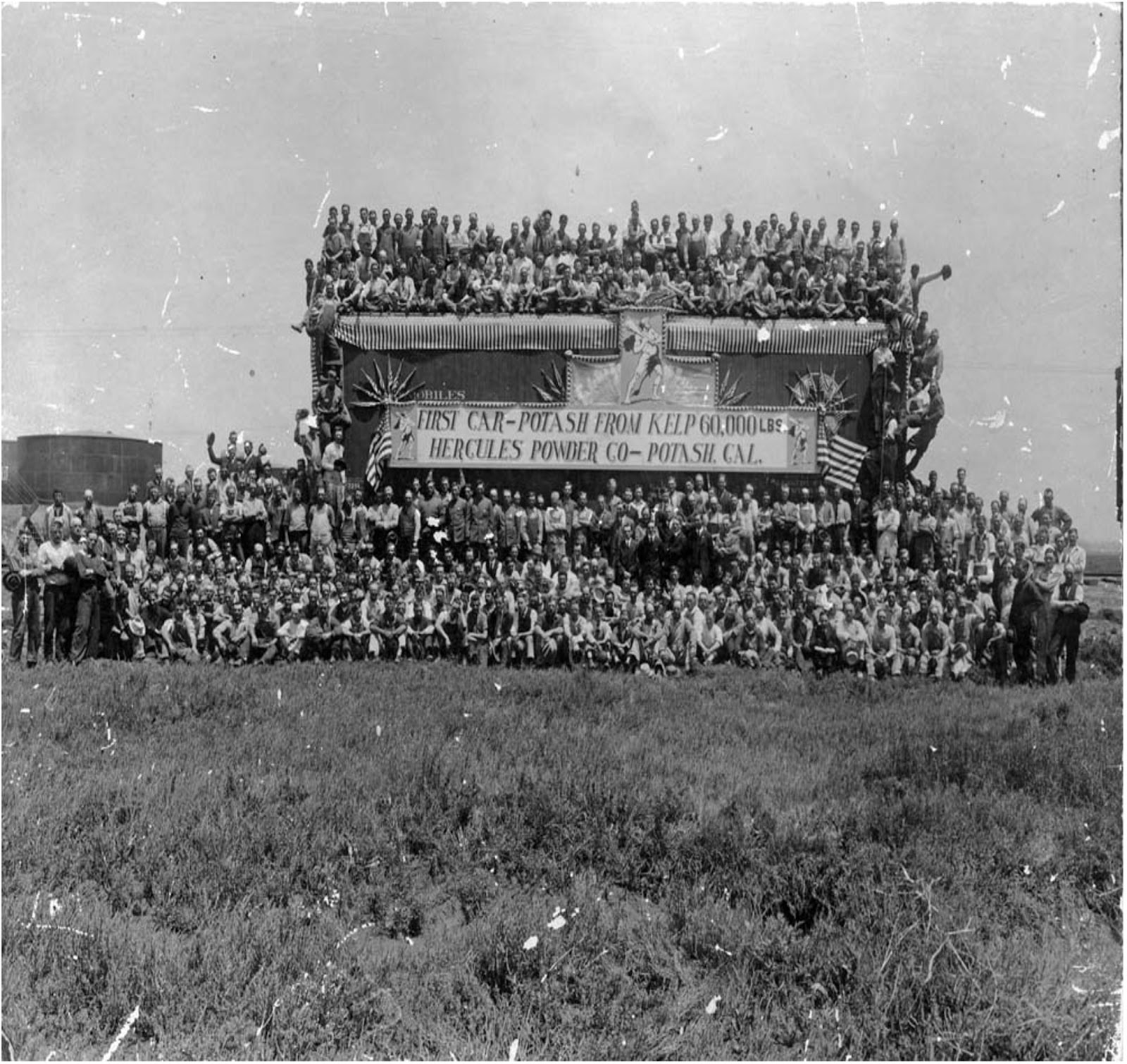
             Hercules’s management investigated making acetone from beer slop, molasses, and wood pulp without much success.  The company’s situation was bleak when George Markell, vice-president and general manager of the company’s New Jersey operations, read in an old encyclopedia that Scots living near the coast once gathered kelp from the ocean, dried and burned it in retort-like ovens recovering potash which they used as a fertilizer.  After he learned that acetic acid could be produced by fermenting kelp, Markell developed a plan to harvest kelp from the Pacific Ocean off the coast of Southern California, put it in vats, allow it ferment like beer, capture the acetic acid given off in the fermentation process, and make acetone from the acetic acid.

           Markell knew a huge bed of kelp existed a short distance from San Diego and best of all, it was essentially free.  Markell went to California in 1915 and began buying up land near Chula Vista, then contracted with a Midwest farm equipment manufacturer to design and build a large hay-mower capable of operating in sea water.  Hercules wasn’t the only explosives company seeking to cash in on the skyrocketing demand for acetone so Markell concocted a cover story claiming his company was going to “farm” kelp to make potash fertilizer.  Soon 1,500 Hercules employees were using the special mowers to harvest tons of kelp, load it onto barges which transferred it to shore where some of it was used to make potash while the rest was put into two-hundred 50,000-gallon wooden tanks and allowed to ferment producing acetic acid that was further processed yielding not only acetone, but other useful ketones such as methyl-ethyl ketone, a lacquer thinner, as well as potassium nitrate (saltpeter) one of the ingredients of black gunpowder. By the middle of 1917, nearly one million pounds of acetone, produced from 600,000 tons of kelp, had been loaded into railroad tank cars and shipped to New Jersey where 5,000 tough, brave powder men and women working in hazardous conditions made cordite for Great Britain at a rate of 100,000 pounds per day.

           After the war, Hercules closed its Chula Vista operation in 1919 and today the site is a nature center.

           Recently, I ran across a 2022 scholarly article describing new efforts to produce acetone from kelp harvested off the coast of Scotland.  This article ran to forty-two pages, had eleven authors, and contained eighty-five footnotes but not a single word about the Americans who fermented kelp, produced acetone, and made the cordite that helped Great Britain achieve victory in World War I.


    Dr. Dragon teaches a course at Rutgers University, New Brunswick, New Jersey on the New Jersey explosives industry.


    Related essays by Dr. Dragon:


    The Maxim Machine Gun and Smokeless Powder


    New Jersey Artillery Explosives Production in World War I


  • Trump’s World: News and a Little Bit of Gentle Satire

    Trump’s World: News and a Little Bit of Gentle Satire

    I HEARD THE NEWS TODAY


    THESE ARE NOT SATIRES. TRUMP AND HIS OFFICIALS ARE TRYING TO PUT ME OUT OF BUSINESS!


    The acting head of the Federal Emergency Management Agency told employees that he did not know the United States has a hurricane season.


    Kash Patel, the new head of the FBI, has called the FBI “Government Gangsters.” He has started giving FBI agents polygraph tests to root out leakers and disloyal agents. Many FBI agents have been fired; 21% are reassigned to immigration cases. American criminals and Russian spies in the U.S. rejoice.


    Michael Boren, an Idaho ranch owner and a Trump donor, is Trump’s nominee to oversee the very agency, The Forest Service, he has had a long-running feud and legal conflicts with over his decision to build an airstrip on protected land. Trump intends to visit him when he receives his new 747 from the UAE.


    A number of Republicans who voted for Trump’s “big, beautiful” budget admitted they didn’t read the entire bill and didn’t know it contained laws they bitterly oppose. They are begging Democratic and Republican senators to remove the offending sections of the bill. Many, like Musk, are “shocked, shocked” it will probably increase the yearly budget deficit.


    Hyundai is building a $21 billion integrated EV assembly and development complex in Georgia. As part of Trump’s campaign to encourage foreign investment to America, immigration cops arrested, shackled, and deported 300 South Korean workers building the Hyundai battery plant there. Some had improper or out-of-date work visas. Construction has stopped. South Korea is very angry. Hyundai has not found any qualified Korean-speaking Americans to replace them. Construction is delayed.


    Trump issued a memo that called trespassing a “politically motivated terrorist” act. Apparently an exception was made for any mob storming the Capitol Building.


    Tariffs are a tax on Americans. But they may raise the government’s tax revenue by about $300 billion a year. The tariff will probably raise the inflation rate. Nominal interest rates will rise. If the interest rate on the national debt rises 1%, this will raise government expenditures by about $250 billion.


    President Trump has extorted over $200 million from large corporations and cryptocurrency entrepreneurs to build a ballroom onto the White House. It will hold 999 people.  The ballroom’s windows will be bullet-proof, which I think is a perfect symbol of the Trump presidency. The men who financed it will be invited to its inaugural dance “if I still like you.” Sounds like a bad gangster movie.

    David Richardson, the acting administrator of FEMA, resigned yesterday. According to the New York Times,

    When he was tapped for FEMA, Mr. Richardson was the assistant secretary at the Homeland Security Department’s office for countering weapons of mass destruction.” Apparently  he couldn’t stop the coming mass destruction of FEMA.

    Coast Guard enacts policy calling swastikas, nooses ‘potentially divisive.’ (Washington Post, December 16, 2025) It follows logically that a Ku Klux Klan lynching is “potentially painful” and a German concentration camp is “potentially harmful to health.”

    President Trump announces a new class of warships called the “golden fleet.” These large ships are intended to strike fear in all other countries, except those with modern anti-ship weapons. The weapons systems proposed for these ships were under study for more than a decade by the navy before being abandoned as failures. In keeping with the imperial tone of the administration, the hallways will be lined with marble and the toilets will be gold-colored. The ships will be assigned to Pearl Harbor, where the last ships like these were berthed.


    The Environmental Protection Agency finalized a regulation delaying standards aimed at limiting the leaching of heavy metals like arsenic, lead and mercury into water supplies from coal-ash dump sites. The EPA? I feel I’ve been beamed into an Orwellian nightmare.


    AND IN OTHER NEWS. THIS IS NOT A SATIRE!


    Water often runs in the streets of Miami and the surrounding area. Some of the area has septic tanks. When it rains a lot or there are storm surges, the water table rises and the septic tanks overflow into the streets. 


    In a rich community in the area, everyone was on septics. Some citizens began a movement to build sewer lines. The federal government would pay part of the cost. Residents objected. They didn’t want to pay. To defeat the referendum, opposition leaders argued that the fecal matter in the streets was not caused by the effects of global warming but rather by the defecating manatees in a nearby canal! The obvious answer to the problem of rivers of shit in the streets is to kill the manatees!


    The referendum to build sewers was defeated.


    A LITTLE BIT OF GENTLE SATIRE

    U.S. Marines Invade California

    U.S marines in battle-dress storm ashore, securing the beaches of Santa Monica. They fight their way thru sunbathers, skateboarders, volleyball players, and joggers. Some marines are surprised on how poorly clothed the natives are. Deployed to defend deportation centers, the marines are faced with angry but unarmed demonstrators from the barrios of Beverly Hills and Brentwood. The Marines are ordered not to protect Tesla showrooms. After completing their mission, a grateful president promised them liberty passes to Tijuana. Marines with Latino/Chicano names are barred reentry into the United States.

    President Trump says the 700 marines will make Los Angeles, a city of 3.8 million people, “free, safe and clean.” Apparently, the only part of L.A. the marines went to was Disneyland.

    The marines, their mission accomplished, had to be airlifted out of Los Angeles. They were gridlocked on L.A. freeways and couldn’t make it back to Santa Monica. 


    U.S. National Guard Units Invade Washington, D.C.


    National Guard units from three states and Washington D.C. were mobilized to invade the nation’s capital. What President Trump hopes they will accomplish is a little vague. Washington’s violent crime rate is the lowest in decades. President Trump, in his announcement, mentioned that one of the major problems in Washington was potholes. This suggest the National Guard could fill up potholes with asphalt and tamp it down with the butts of their rifles. Hopefully they will remember to first remove the bullets.


    NEW WORK VISA PROGRAM


    The majority of industrial robots used in America are imported. 


    To limit the number of imported robots, the U.S. government is starting a new R1-B program for imported robots, modeled on the H1-B work visa program. Robots will be chosen by lottery. The visas are temporary; robots can be deported after three years by a division of ICE called RICE. In addition to new, higher tariffs, sellers and users of foreign robots will now have to pay a $100,00 application fee. Industry users estimate these new costs will more than double the cost of industrial robots. This may slow down the administration’s goal of automating industrial plants. But it hopes this will encourage American and foreign companies to design and produce more robots in America. Chinese robot manufacturers need not apply. One prospective producer, Tesla, applauded the program. Tesla is designing robots for its assembly plants. Earlier robots were designed to assemble the CyberTruck but they kept dropping panels and were fired.

    President Xi of China records the song “I Shot the Tariff.”


    Pete Hegseth, Secretary of Defense, accidentally reveals the nuclear weapons launch code in a late-night email to former Fox News colleagues.


    Pete Hegseth instructs the armed forces to close down one wing of the Pentagon, declaring, “This is a blatant example of government waste. Why isn’t the armed forces satisfied with four walls like everyone else?”


    Kristi Noem, the Homeland Security Secretary, believes that habeas corpus is the same thing as deportus corpus, the motto of her department.


    Linda MacMahon, the Secretary of Education, says she will cancel student debt for any student who wrestled in college.


    When Trump went to Saudi Arabia, the country, knowing his addiction to junk food, outfitted a large truck as a McDonald’s. Trump visits Mexico, where the government outfits a donkey cart as a TACO stand.

    Trump admits in an unlimited number of white Afrikaner immigrants: “Any university that wants federal aid has to hire a white Afrikaner for its African Studies program.” Elon Musk said he would endow African Studies chairs to further the program.


    Trump says he will not cut federal funding of public television if the Cookie Monster is replaced by Donny the Big Dog.


    Trump tells Republicans to slash trillions of dollars in spending on scientific and medical research, Medicaid, foreign aid, and nutrition programs for the poor. Despite these deep cuts in spending, the House Republicans’ budget bill will increase the yearly deficit before the tariff revenue is added. The House Republican leadership is fighting a proposed bill by Democrats that all members must pass a third-grade remedial math test.


    Trump asks drug companies to lower prices. Mexican drug cartels refuse. But they are willing to compromise. They agree to offer new customers free samples.


    The United Arab Emirates gives President Trump an old 747 they wanted to get rid of but no one wanted to buy. Security officials in the Pentagon estimate it will cost $1 billion to install security and telecomm features. In 2028, the U.S. government leases outgoing President Trump’s “Air Force One” jet for 20 years at $50 million a year. President Trump, who negotiated the lease with himself, said this was a good example of “the art of the deal.”


    Elon Musk transfers himself, his women, and his children to the moon to avoid the wrath of Trump. He intends to commute to work on earth as soon as his SpaceX rockets stop blowing up. The IRS rules that he qualifies for a commuter tax credit of $500,000 per round trip.


    Elon Musk or Humanoid Robot?

    Elon Musk says the future of Tesla is humanoid robots. I think I know the perfect face for his humanoid robots.


    Harvard, after losing all its federal funding, merges with the University of Abu Dhabi. The United Arab Emirates (UAE) promise to fund all scientific and medical research, including AI development, and set up industrial parks and data centers to commercialize discoveries. Harvard’s $35 billion endowment fund is transferred to Switzerland; half of it is exchanged for dirhams and the other half for cryptocurrencies. UAE students go for free; all others pay at most $10,00/year. The Emirates give the university a 747 jet for free student transportation between Abu Dhabi and Cambridge, Mass.


    TARIFF AND TRADE POLICY:  HOW TO KNOW THAT TRUMP’S POLICIES ARE WORKING


    Tens of thousands of American citizens apply for new jobs sewing clothes in NYC’s revitalized garment district. They work 12 hours a day, 6 days a week for $144/week ($2/hour) with no benefits or pensions. The White House orders 10 million MAGA caps.


    The U.S. begins producing pineapples and bananas in Hawaii again. Dole (pineapples) and United Fruit (Chiquita Banana) buy large tracts of land where pineapples and bananas were grown in the past. They also buy and demolish the luxury hotels and condo developments sitting on the land. The price of Hawaiian bananas is $10/pound.


    U.S. farmers apply for food stamps.


    In the Christmas shopping season, the prices of Barbie dolls and Legos double. Parents experience sticker shock. Children beg and cry for Barbies and Legos. Parents give in. Children are abandoned on the doorsteps of grandparents living in The Villages. Grandparents organize and lobby for higher government childcare payments.


    Santa Claus declares bankruptcy. North Pole Inc. can’t afford to buy toys for deserving girls and boys. The unemployed elves are denied U.S. work visas because of a new regulation barring short people from inside the Arctic Circle. Barbie becomes a social media influencer.


    About 50% of toilets are imported from China. Most of the rest are also imported. The U.S puts a high tariff on all imported toilets. As a substitute, American companies manufacture and install outhouses. America becomes one of Trump’s “shithole” countries.


    The U.S. has not imposed any tariffs on our allies Russia and North Korea. In return, both countries promise to remove any non-tariff barriers against buying American nuclear weapons. President Trump says this will reduce the government’s trade deficit.


    International trade, both imports and exports, plummet. The American trade deficit goes down. President Trump declares victory. A global recession follows; America’s unemployment rate doubles to 8%. Trump vetoes a large fiscal stimulus bill because it will add to the yearly deficit, saying “Americans will have to suffer a little while longer.” Tens of thousands of unused shipping containers are repurposed as low-cost housing.


    Penguins from McDonald Island, wearing MAGA caps, demonstrate in front of the White House, chanting “We deserve a break today.” Trump revokes tariff on penguins. Penguins rejoice, dancing on happy feet and chanting “Make Antarctica Great Again.”


    Canada and Mexico strengthen border security as large numbers of Americans try to enter illegally. 


    DOMESTIC POLICIES:  HOW TO KNOW THAT TRUMP’S POLICIES ARE WORKING


    Trump directs nurseries to only sell native plants.


    Florida is hit by another series of destructive hurricanes, causing extensive damage. Home insurance companies declare bankruptcy, don’t pay claims, and pull out of Florida. Trump sets up a relocation program to pay affected Floridians to move to Greenland. They will receive $1,000 and a free airline ticket. $2,000 if they promise to wear a MAGA cap.


    Canadian “snowbirds” stop flocking to Florida in the winter. Canadian geese stop flying south.


    Latin Americans stop laundering dollars to buy Miami condos for cash. Prices of Miami condos fall. Many Miami condos were already underwater.


    All national parks and national monuments are put up for sale. Smokey the Bear is fired. The Trump family buys Mount Rushmore. A fifth face is planned.


    30% of Walmart’s products are imported from China. An epidemic of TPSD (Traumatic price shock disorder) breaks out among Walmart shoppers. This syndrome is not covered by Medicaid or Medicare.


    Trump cuts funds to fight global warming. Summer temperatures reach 120 degrees in Phoenix and Las Vegas for 30 days in a row. Trump waives the tariff on imported suntan lotion.


    Trump proposes to cut Social Security benefits in half. He states that American retirees wouldn’t be able to play 30 games of pickle ball per month but will still be able to afford 2 games/month.


    After Trump cuts funding for scientists and researchers, the most popular class at MIT is Mandarin. The president of MIT proposes the university opens up a new campus in Abu Dhabi, across from Harvard. Between them will be Imam Square.


    Trump says he will not cut federal funding of public television if the Cookie Monster is replaced by Donny the Big Dog.


    Egg Smuggling. EGG-TRA, EGG-TRA READ ALL ABOUT IT!


    Because imported eggs from Mexico go through a long inspection process and retail for only $2/dozen in Mexico, there has been a big increase in egg smuggling on the Mexican border. ICE agents now search cars and trucks for contraband eggs. ICE has set up a task force of hard-boiled cops to stop gangs running eggs into America. The task force has cracked its first case.


    Border police have been given an explicit instruction when confronted by armed egg smugglers: “Don’t shoot until you see the whites of their eggs.”


    Egg smugglers boast on how easy it is to get eggs across the border. They’re known as eggs over easy.


    Airplanes and boats that criminal gangs used for running guns into the United States are now used for running eggs.


    Cracklin’ Rosie, the story of a breakfast cook, is the most requested song on Spotify. New version by Yokol Ono.


    A USDA yokesperson said President Trump is aware of the situation. He is scheduling a photo op in front of the White House where he will buy a dozen American eggs  — and raffle them off to the highest bidder.


    Urbanites who are paying higher prices for eggs have stop calling egg ranchers yokels.


    The trade group Egg Ranchers of America (ERA) has lobbied Trump to ban all imports of Mexican eggs. Their argument is that imported eggs are reducing the demand for American eggs. To quote:  “They’re taking away sales from hard-working American chickens.” If that doesn’t work, they want to government to force ranchers to put a sticker on all American eggs – “Laid in America.”

    .


    AND A SALUTE TO MY FAVORITE HEALTH CARE COMPANY


    UnitedHealthcare’s Corporate Song

    With apologies to Sam Cooke’s wonderful song “Don’t Know Much about History” and Harrison Ford’s great scene in Witness.

    Don’t Know Much about Hysterectomy

    Don’t know much ‘bout hysterectomy

    Don’t know much biopsy

    Don’t know much ‘bout a medical book

    Or the appendix your doctor took

    But we know 10K and 10K are two

    That’s how much we’re billing you

    What a wonderful world it’s for me


    Optum, a divisional UnitedHealth that employs most of the doctors I see, sent me an email with a bill the day after I visited a doctor. I emailed back, informing them that the payment was on hold.


    Further news from the health care industry. This actually happened.


    I was on hold, trying to make a doctor’s appointment at a local hospital. The hospital took advantage of its captive audience with messages extolling its improvements. Including:

    “Our newest surgical unit uses cutting-edge technology.”


    I should hope so.


    =================================================

    For more satire, see


    Future News

    The Saying of the Don, the Capo Maga of Washington
  • Why Germany Lost World War I

    Why Germany Lost World War I


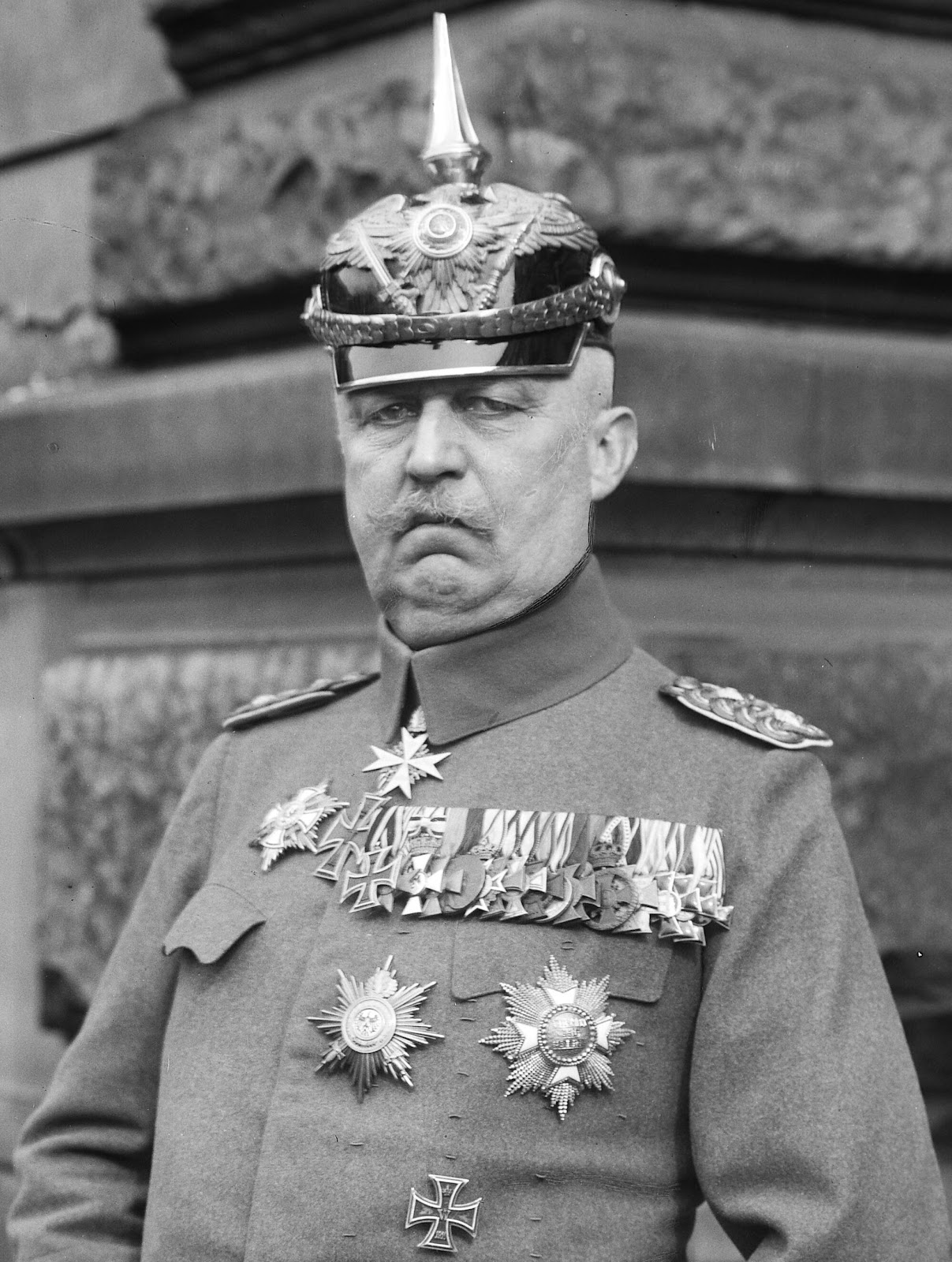
    Erich Ludendorff


    This is a summary of the reasons Germany lost World War I.


    The Entente was the alliance of France, Russia, and England, later including the United States. Sometimes called the Allies.


    German Planning (Schlieffen Plan)

    Germany’s strategy was based on the Schlieffen Plan, first developed by the head of the German General Staff in the 1890s. The essence was that most of the German Army would quickly attack France and defeat France in six weeks, before Russia could fully mobilize. Then much of the army could be quickly transported on Germany’s superb railroad system to the east to defeat Russia. The Plan was reviewed and updated by the German General Staff every year up to 1914, first under Schlieffen and then under his successor, von Moltke. Helmut von Moltke was the nephew (and namesake) of the general that led German forces to victory over France in the Franco-Prussian War of 1870-71.

    The German General Staff never seriously considered any alternative scenarios.


    The elder von Moltke, thinking about Germany’s future after his famous victory, believed that Germany, and its army, should fight the next war in the East. Block France’s expected offensive, concentrate on defeating Russia, and occupy Central and Eastern European territory. Then, if necessary, turn to defeating France. Schlieffen and the younger von Moltke changed the focus, expecting to defeat France quickly with a massive offensive before turning on Russia. In their private diaries, both expressed doubts about the success of their plan. 


    When World War I started, von Moltke led the German Army and was responsible for the success of the Plan. In six weeks, when Germany had failed to conquer France, von Moltke had a nervous breakdown and was relieved of command.


    • ·      Germany did not win a quick victory over France as planned and expected. 
    • ·      Underestimated how fast Russia mobilized and moved its army to attack Germany. German General Staff panicked and transferred a substantial number of soldiers from its armies in the West to the East.
    • ·      Believed (hope?) Britain would stay neutral. Then underestimated how fast the British army deployed in France. Although small, the British army was crucial in slowing down the German advance and later counter-attacking along the Marne.
    • ·      Hoped that Belgians would not fight. When they did, slowed down the advance into France.
    • ·      Underestimated logistical problems of a huge army moving by foot and horse in enemy territory.

    Could Germany have won the war in the West in 1914? Despite miscalculations, they came close (how close is still a matter of debate). The original attack almost succeeded. The two massive German armies that led the attack were commanded by generals who did not like each other and did not communicate with each other. At a critical moment when victory was possible along the Marne, one of the generals changed the direction of his army without telling the other general or von Moltke’s command center. This opened up a gap between the two armies which French and British units exploited, mauled one of the armies, and forced the Germans to retreat. When they stopped retreating, they took out their shovels and began to dig. The series of trenches they created became their front line for almost four years.


    Trench Warfare and Artillery


    Despite huge offensives on both sides, there was static trench warfare in the west for almost four years. Until the summer of 1918, all offensives failed with huge causalities.


    Both sides realized the quick offensive war had become a war of attrition after stalemates in France and in the East. Despite this, the Germans launched a huge offensive in 1916 against Verdun; to relieve pressure, the British launched its Somme offensive. Both offensives failed: there were massive causalities on both sides. 

    World War I became primarily an artillery war. Artillery was the largest cause of death. 

    Huge artillery barrages preceded attacks on lines of fortified trenches. The other side launched counter barrages against advancing infantry. 

    At the beginning of the war, Germany had advantages in deployed artillery and artillery production. In the long run, though, Germany could not keep up with British and French production of artillery shells and explosives.

    By 1917, England alone was producing more artillery shells and explosives than Germany.


     1917


    Again, World War I was a war of attrition. Germany had a chance to win the war in 1917. In 1917, the Russian Army collapsed and Russia was out of the war, the British Army’s size and effectiveness was diminished after the very heavy losses from the Somme offensive, and part of the French Army mutinied. Germany had to attack before large numbers of American troops began arriving and prepared for combat. But Germany had suffered huge losses in its attack on Verdun.

    In 1917, Germany’s submarine warfare in the Atlantic threatened to put England out of the war before American could enter in force. Britain depended on imports, especially for food. About 80% of grain for bread (and beer) was imported. By April, 1917, when America entered the war, Britain and France had only a few weeks inventory of wheat. But Germany’s U-Boot campaign to deny England food from Canada and American was never fully successful.

    Americans began to consider joining the war in 1917 as a result of the German navy’s renewed unlimited submarine warfare. Germany’s navy assured the kaiser they would starve out England before America could send over troops. Americans were also incensed on learning in March that the German government secretly offered German assistance to Mexico if it would attack the United States (the Zimmerman telegram).  That was the final straw; America declare war less than a month later.


    The American army was not ready for European warfare in 1917. The American army was very small and ill-equipped. Although America sent over a total of 2 million troops in 1917 and 1918, they were poorly-trained and lacked weapons like machine guns and artillery. France and England had to arm the American soldiers and teach them how to use the weapons to fight a new kind of war. But by the spring of 1918 about one million Americans were ready for combat.


    1918


    By 1918, German civilians were starving. This was mostly due to the English Navy’s blockade of Germany. 


    Ludendorff had to delay the massive offensive until the spring of 1918. The German Army in France was increased by 500,000 troops transferred from the Eastern Front after Russia collapsed.

    Again, the outcome was in doubt. Reasons for his failure were that the French Army had partly recovered from mutinies, draftees replaced volunteers in the decimated English Army, which was also fortified by Canadian and Australian corps. Both the French and English armies now contained large American divisions (an American division was twice the size of depleted French and English divisions). In addition, Americans helped stop the last German offensive and a large American army took part in the counter-attack (the Meuse-Argonne offensive). The Entente also now had an advantage in artillery and began to effectively deploy tanks and airplanes. After being hammered by the Germans for months, the Entente had sufficient troops to mount a counter-attack all along the German lines. The German army no longer had reserves to plug gaps in their lines. The Entente armies breached the Hindenburg Line, Germany’s last line of defense. The German army collapsed. Ludendorff fled to Holland, but only after advising Kaiser Wilhelm to surrender. Instead, Wilhelm also fled to Holland. The war was over.


    Other Factors

    Germany did not develop the new war technology of airplanes and tanks as fast as the Entente, although this was not a decisive factor in Entente victory. Germany produced very few tanks. Germany also produced fewer airplanes than England and France combined. By the end of the war, the Entente controlled the skies.

    Poison gas warfare gave Germany some advantage early in the war but Entente counter-measures and poison gas production partly neutralized the effect.


    The Entente had resources beyond the national resources of men and weapons. Germany had to rely mostly on its national resources.

    o   France had military manpower from its colonies, mostly from North Africa.

    o   England had manpower and resources from Dominion countries (Canada, Australia, New Zealand, and South Africa), India and its other colonies, and the United States, even before America entered the war. After the United States entered the war, America sent over approximately 1.4 million troops who fought or supported fighting in 1918.

    §  Food, horses, mules, steel, and artillery shells and high explosives from Canada and the United States, even before the United States entered the war. By 1916, the United States was providing England with 30% of its food.

    §  In 1914-1915, the soldiers provided by England’s India Army were critical in stopping German offensives after trench warfare began.

    o   The Entente imported approximately 300,000 Asians, Indians and Africans into labor brigades – to man supply depots and move supplies, and help build and repair railroads. Released manpower for the armies.


    As war continued, Germany’s ally Austria-Hungary became more of a burden than a help. German and Austro-Hungarian objectives were at odds. In the beginning of the war, Austria-Hungary wanted to use most of its army to attack Serbia. Germany wanted Austria-Hungary to use most of its army against Russia to help limit Russian attacks on Germany. Germany only had 1/8 of its army in the east to stop the Russian offensive. It depended on a large Austria-Hungary force to engage much of the Russian army. Austria-Hungary’s redeployment of troops did little to help German in the crucial first month of the war. 


    Austria-Hungary failed to defeat Serbia and suffered huge casualties in the four months of 1914 fighting on the eastern front. Later in the war, Germany had to divert troops at the western front to rescue Austria-Hungary in its war against Italy. By 1918, the new Austrian-Hungarian emperor began secret negotiations to take Austria-Hungary out of the war.


    Saul David, BBC, “How Germany lost the WWI arms race,” February 16, 2012.


    Niall Ferguson, The Pity of War:  Explaining WWI, 1998.


    Two essays on this blog by Professor Andrea Dragon documents the vital assistance America gave England and Russia even before entering World War I.


    New Jersey Artillery Explosives in World War I

    KELP IS ON THE WAY: How American Kelp Helped Save the English Explosives Industry in World War I

    Hal Brand, The Eurasian Century:  Hot Wars, Cold Wars, and the Making of the Modern World, Chapter 2.

    For a discussion of the weaknesses and problems of Austria-Hungary in the period leading up to World War I, see

    The Austro-Hungarian Empire Before World War I


    There are other posts on this blog that explore the period before World War I and what led up to the outbreak of the war:

    Bismarck and the Origins of World War I


    The Beginning of the Twentieth Century:  The Path to World War I


    Wealth and Power in Pre-World War I Europe 


    Europe on the Brink of World War I

    World War I had long-term consequences. Some are discussed in:


    The Immediate and Long-Run Historical Consequences of World War I


    The effect of WWI on the Stock Market Crash of 1929 and the Great Depression is discussed in:


    The Stock Market Crash of 1929 and the Beginning of the Great Depression


  • American Tariffs and the U.S. Economic War with China


    SUMMARY AND UPDATE (12/2025)

    America’s trade deficit was $918 billion in 2024. It is expected to be higher in 2025. China’s goods trade surplus in 2024 was just under $1 trillion; based on the first eleven months of 2025, it will be over $1 trillion in 2025. The sharp decrease in exports to the United States has been less than China’s increase in exports to the rest of the world. Exports to countries in Asia and Africa

    were substantially higher.


    President Trump has partially rescinded the U.S. ban on exporting high-end Nvidia chips to China. The price is that Nvidia has to give part of the sales revenue on these chips to the U.S. government. Trump is negotiating similar deals with the other American chip designers and producers.


    TRUMP’S TARIFF STRATEGY

    The Trump tariff offensive is couched in domestic economic terms and objectives – to reduce the trade deficit, to reduce the fiscal deficit, and to increase domestic manufacturing, especially in technologies with good growth potential or necessary for national security. The economic issues used to justify the higher tariffs are less important than the geopolitical issues – the geopolitical rivalry between the United States and China, and part of a broader objective – to weaken China’s domestic economy..


    BACKGROUND


    The conflict with China has been recognized as far back as the Obama administration. Even before then, the United States has used economic tools as political weapons – sanctions, denying other countries access to the international payments systems, attempts to limit imports such as oil. The main economic tool aimed at China before general high tariffs has been the virtual embargo of Chinese exports of electric vehicles (EVs) through very high tariffs and attempts at embargoing high-end chips.


    The United States has been running trade deficits for over 65 years. Trade deficits are partly a function of a Cold War strategy of giving non-Communist countries access to the large American market and partly due to domestic tax and fiscal strategies (low taxes, fiscal deficits, subsidized mortgages, expanding social welfare). Trade policy in the new geopolitical world has to be more nuanced. Fiscal policy must be changed because interest on the national debt is eating the federal budget and jeopardizing America’s influence in the world. For example, interest on the national debt is a larger expense item than national defense.  


    The worst part about it is that Trump probably could have gotten his original tariffs, outlined when he was running for president, without all the drama – across the board 10-15% with negotiated exceptions and a starting negotiating offer of 30-60% with China. Of course it would have forced all other countries to impose countervailing tariffs on American exports. But he has now pissed off most of the world; there will be longer term geopolitical repercussions. Countries and trade blocs of countries are accelerating treaties and understandings with each other to avoid trade with the U.S. Chinese exports to the world ex-US are up. The financial side is to avoid pricing imports and exports in dollars and bypass the international payments systems denominated in dollars. In the long run, the objective is to change the global structure that depends on the dollar as the reserve currency. This will have adverse economic consequences for the United States. One estimate is that having the dollar as the world’s reserve currency confers about $100 billion in benefits on the U.S. All this may be inevitable but could be managed over a longer period with less impact on the U.S. economy.


    There is also unnecessary damage to the U.S. economy. The U.S. economy stopped growing in the first quarter of 2025. All the stated objectives – reshoring, reviving old manufacturing, eliminating trade deficit, greatly reducing fiscal deficit – are important goals but are self-delusional if Trump thinks they can be accomplished in the short run through higher global tariffs. 


    Domestic economic adjustments will not come from higher tariffs on imports but will have to come from radical changes in the domestic social and economic structure of the United States. If anything, Trump’s domestic policies are moving in the wrong direction.


    If the United States imposes a 10-20% blanket tariff on the world and other countries retaliate, plus a higher tariff on globally-traded inputs like steel, plus a higher tariff on China (who will also retaliate), there is an increased chance that there will be a global recession, although companies and countries will adjust to the tariffs. Relative prices will change; there will be somewhat higher prices in the United States. All this will cause disruptions to the global supply chain that provides inputs and consumer goods to America.


    The world will blame the United States; there will be short-run and long-run economic and political consequences.


    It will be another step in lessening American influence in the world. It will damage the American economy if foreign institutions decide to hold fewer American financial assets. This might lead to higher interest rates the U.S. government has to pay to finance its high and rapidly-expanding national debt of about $40 trillion at the end of 2025. Without tax increases, the yearly deficit will continue to be structural; a higher percent of total government expenditures, including interest on the national debt, will be fixed by law and not subject to yearly budgets approved by Congress. For details and analysis, see Government Finance 101.


    The U.S. economy didn’t grow at all in the first quarter of 2025. Analysts pointed out the surge in imports to beat the higher tariffs as a major reason for the slowdown (imports are subtracted from measured GDP). But higher imports should lead to increased inventories and greater consumer sales (increases GDP) in subsequent quarters. The longer this drama continues, the greater the damage to the American and global economy. 


    TARIFFS


    The tariffs on imports are a tax, mostly paid directly or indirectly by American households. But it is not collected directly on final sales like a sales tax. Tariffs that are placed in inputs and the wholesale cost of consumer goods that are open to negotiations create uncertain costs and prices. Corporate planning becomes difficult and riskier. 


    Whatever revenue tariffs raise for the government will be balanced by higher prices and lower income for all American households. Think about that – an income transfer in the hundreds of billions of dollars from American households to the government. Is that what Trump was elected to do?


    A global tariff of 10% on imports, with exceptions and even assuming a 20% tariff on Chinese imports, will not do much damage to the American economy. A bit of inflation at the retail level. Most large American companies in oligopolistic markets and consumers can adjust. Many small businesses will be hurt. Tariffs could lead to a slightly higher unemployment rate.


    Or much good. Current estimates average around an extra $200 billion to $250 billion in extra tariff revenue. The higher number is over 20% of the current trade deficit and about 8% of the current fiscal deficit, before proposed tax cuts.


    The currency exchange value of the dollar has fallen 9%, a direct consequence of the uncertainty created by Trump. This is a large move. It makes American imports (exports to America) more expensive to the exporting company, independent of tariffs. When the exporter goes to exchange its dollars for the local currency (yen, yuan, euro, pesos, etc.) the given amount of dollars earned buys fewer units of the exporter’s domestic currency. The domestic currency is necessary to pay the costs of producing the exports. One strategy is to raise the dollar price of the imported products to earn the same amount of the exporter’s domestic currency.


    The fall in the price of the dollar relative to other currencies should help American exports. The importer has to buy dollars to pay the American exporter. A 10% fall in the value of the dollar compared to the importer’s currency means it now takes 10% more domestic currency to buy a given amount of dollars. The American producer could lower the price of its exports by 10% to earn the same amount of dollars. American exports are now more competitive in foreign markets. 


    It is also an added incentive for any country not to price its exports in dollars. The spot price of most commodities is denominated in dollars. But two countries, such as the Russian sale of oil to China, could set to ruble-RMB (yuan) exchange rate, also avoiding dollar-based exchange institutions. China is trying to set up similar arrangements with other countries. Their central banks could set up swap arrangements to guarantee that enough of the other’s currency is available to finance trade.


    Foreign companies, financial institutions and central banks like to hold dollars because dollars are considered the safest, most liquid currency (issued by the largest economy and most trade currency in foreign exchange markets). Dollars also reduce the transaction costs of international trade. But by creating uncertainty risks about the future value and safety of the dollar, including the large and increasing American national debt, other countries may trade more without the dollar.


    TRUMP’S TARIFF STRATEGY


    Trump’s apparent strategy was to unilaterally impose insanely high tariffs on all countries (and penguins), based on a sketchy formula that if all other countries paid the tariffs and didn’t retaliate or change their trading patterns, much of the U.S. trade deficit would disappear. Of course, that wasn’t going to happen. It was a fantasy. If it did happen, the world, including the United States, would have gone into a global recession (or worse).


    Some people said this was just a negotiating tactic; some countries would settle for higher tariffs than they wanted to. What Trump didn’t count on was that American financial markets, which are forward-looking, immediately began to estimate the future damage and reacted by selling off dollars and American public companies (expecting lower future profits and share prices). The 500 largest American public companies receive about 40% of their sales and 50% of their profits from foreign operations.


    Millions of small businesses depend on imports from China. Generally, they find it harder to pass on the higher costs from tariffs to customers.


    U.S. ECONOMIC WARFARE WITH CHINA


    China’s growth rate of real GDP in 2024 was probably about 3%. It was officially 5%, but this is likely a political-motivated overestimate. This is also a substantial slowing of past Chinese growth rates. Major reasons for the slower Chinese growth rates are a slow-down in export growth, drastically-lower net foreign direct investment, and internal problems such as the housing crisis.


    On May 12, Trump blinked. Trump temporarily reduced most tariffs to 10%, with a surprisingly low tariff of 30% on China.  “The Geneva agreement [with China] represents an almost complete U.S. retreat that vindicates Xi’s decision to forcefully retaliate,” said Scott Kennedy, a China expert at the Center for Strategic and International Studies. The 30% tariff rate is not that much higher than the current effective average tariff on China. Trump’s threat to impose higher tariffs during negotiations now lacks credibility.


    At the same time, Trump imposed higher tariff rates on steel and aluminum, and threatened higher rates on imported pharmaceuticals. This will hurt the economies of allies, particularly Canada and Europe.


    Many analysts, in the U.S. and China believe that a tariff level around 50-60% would cause serious damage to the Chinese economy. This is the geopolitical tariff. Trump has thrown away this weapon.


    Trump greatly reduced the tariff on China before his embargo-level tariffs could do any real damage to the Chinese economy. There was a fall in shipments in April and probably May. China did not agree to any of the “reforms” Trump wanted. China could now reduce the damage with a partial, moderate rebate program to Chinese companies that lose American sales. 


    China will be in a strong position to get an even lower tariff when permanent tariffs are negotiated during the 90-day trial period. I doubt if Trump will now be able to impose a tariff above 10%, with exceptions, on any country. Qatar will probably get a 0% tariff. That would make a higher tariff on China, say 20%, look high by comparison. 


    Trump, holding most of the “high cards,” has been playing the wrong card game. The game was not to raise money for the U.S. government or reduce the trade deficit or to “reshore” American manufacturing. The game should have been to weaken the Chinese economy. The goal should have been geopolitical rather than some ill-considered domestic economic American goals. 


    Why would this be possible? Because China has serious internal problems that the U.S. could exploit. 


    • Unemployment in export industries. According to a high Chinese official, about 170 million jobs depend directly or indirectly on exports. About 25% of the total labor force. Much of exports is labor-intensive production of cheap consumer goods for the American market.
    • Lower economic growth rates, exacerbating China’s high unemployment rate among young people, especially recent college graduates. 
    • Massive overcapacity in many industries, which will not be solved if China has a low growth rate. 
    • The housing crisis, which has wiped out much of the savings of Chinese families. A large number of housing units, maybe higher than 50 million, are empty or unsold.
    • The beginnings of a demographic crisis, including a massive decrease in the working-age population and a massive increase in the over-60 population. 
    • Grossly underfunded retirement benefits for a rapidly aging population supported by a falling number of workers. (See posts).
    • Huge environmental cleanup costs.
    • Almost zero net foreign direct investment (FDI). Foreign investment has been a major driver of economic growth in the past. In addition, wealthy Chinese families are smuggling large amounts of money out of China. 
    • An authoritarian government that will do anything to keep control, including cracking down on any protests resulting from economic stress.


    Making these problems worse would probably have a negative psychological effect. Chinese elites and the middle-class would have less confidence about the future. This is in addition to the negative demographics and a peculiarity of the Chinese labor market. In China, there is widespread discrimination again hiring anyone over the age of 35. If people cannot establish a career when they are young or are fired when they are 35 or over, they have little chance of getting a comparable or better job or have rising income until retirement.


    All of this, made worse by American tariffs, would further weaken Chinese expectations about a secure, better future. 

    ALTERNATIVE AMERICAN STRATEGIES


    To minimize the impact on the American economy, Trump could have left tariffs on other countries alone or reduced tariff on some countries or strategic products. Negotiating lower tariffs with other countries, with reciprocity, would further weaken China’s export-driven economy. 


    The obvious example is to lower tariffs on American cars assembled in Mexico and Canada. Even better, treat the region of the U.S., Canada, and Mexico as a tariff-free trade bloc.  


    American consumers, with their insatiable demand for cheap consumer goods produced in China, are helping to finance the huge amount of money the Chinese government is spending on developing innovative new industries. The one cheap consumer product Americans can’t buy is Chinese EVs, effectively banned in the United States. An alternative to tax cuts, mostly for upper-income families, could be a VAT tax that most other developed countries have. Tariffs are an inefficient substitute for a VAT and have unintended consequences.


    In the long run, the real economic competition between China and the United States is which country does a better job in developing and innovating new technologies and selling them in the global economy. New technologies will be the source of both domestic economic growth and growth in global exports. Less dependence on fossil fuels, control of renewable resource technology, efficient manufacturing employing automated systems including AI-enhanced robots, EVs and autonomous-driving cars and trucks, pharmaceuticals and medical technology (for an aging global population), and technologies still in the R&D stage such as quantum computing (which would revolutionize computing) and nuclear fusion (which would probably solve the clean energy problems).


    So the long run geopolitical and economic strategy for the U.S. is close ties with Canada and Mexico, large expenditures on new technology R&D, attracting the best minds in scientific and medical research, move rapidly to renewable energy as the costs of the clean energy systems continue to fall (even before the positive externalities of slowing global warming, a cleaner environment and better health), increase domestic supply chain manufacturing through automated production systems and AI-based management and control software. And produce AI-enhanced robots and drones.


    =============================================


    For an analysis of China that is the basis for comments about China in this post, see


    China’s Economy, Politics and Demographics

    Japan is experiencing the early effects of massive, long-run population contraction. It is likely that China and other countries in East Asia will exhibit a similar downward trajectory. See

    Demographics and Population Projections of Japan


    If the United States can implement policies to mitigate its internal problems and not alienate the people of other countries, it has a more favorable demographic future than almost any other country, unless net immigration becomes negative. For data and analysis, see


    Demographics, Immigration and the Future Economic Growth of the United States


  • The Sayings of The Don, the Capo Maga of Washington


    On domestic policy. “Ask not what your country can do for you, but what you can do for me.”


    On the Republican Party. “It’s my party and I’ll lie if I want to.”


    “You know the mob makes you pay money, right?” says Trump about a proposed US protection fee for defending Taiwan.


    On America’s enemies. “America’s real enemies are American cities run by Democratic mayors. This is where my new Department of War will focus. American soldiers can practice their new warfare ethos by gunning down unarmed American citizens.”


    On dealing with political enemies. “My motto is always get even. When somebody screws you, screw them back in spades.”


    On domestic subversion. “Jaywalking is a politically motivated terrorist act.”

    (Comments. If so, patriotic car drivers should run over jaywalkers. They should be protected by Good Samaritan Acts. Any damage to their vehicles should be covered by the jaywalker’s estate or auto insurance.)


    On deportation. “Convicted illegal immigrants who have been convicted of felonies should be deported.”

    (Comments. Agree. But too limited. Any convicted felon should be deported. Serve sentence, stripped of citizenship, and deported. But to where? Most Americans are descended from Europeans. Procedures based on immigration records to determine country of immigrating ancestors. If more than one country, deported felon can choose country. Regardless, most deported felons will end up somewhere in Europe. This is only fair; over half of English emigrants to America in the 1700s were convicts.)


    On the global economy. “The sun never sets on my golf courses.”


    On foreign relations. “Ask not what America can do for you; I’ll tell you what you can do for America and how much it will cost.


    On fiscal policy. “Tax cuts for the rich, benefits cuts for the poor. Only the rich are able to buy my new government debt.”


    On education. “Everything you need to know is on my media company Social Truth.”


    On Europe. “What a bunch of losers. Anyone with any brains or drive emigrated to the United States a long time ago.”


    On being told his programs will add up to $10 trillion in new national debt over the next four years and $500 billion a year to yearly deficits, he responded, “Not my problem.”


    On why the Trump family doesn’t own any U.S. government bonds. “Only suckers buy the bonds of a failing company.”


    On firing air traffic controllers and compromising air safety. “If flying was limited to private jets, we wouldn’t need air traffic controllers.”


    On being president. Quoting Teddy Roosevelt, “The presidency is a pulpit for bullies.”


    On being president. “I have the right to do anything I want to do. I’m the President of Russia.”


    On Elon Musk. “This country isn’t big enough for two narcissistic egomaniacs.”


    On renewable energy.  “Windmills [wind turbines] kill birds and cause cancer.”

    Trump denies that burning fossil fuels contribute to global warming. “Global warming is caused by hot air balloons.”


    On being told the science journal Nature

    suggested that the large cutbacks in U.S. foreign aid funding of health programs could result in roughly 25 million additional deaths over 15 years. “Fewer illegal immigrants.”


    “I couldn’t care less,” Trump said on Fox News last week when asked how the country comes back together.


    On American history. “The revolutionary troops defeated the British by taking control of the airports.”


    Trump on Trump. “I’m gifted. People and governments are giving me gifts all the time.”


    Trump on Trump. “I’m the greatest.”


    Trump on Trump. “Can’t help myself. I love me and nobody else.”


    Two other opinions.


    Putin on Trump. Putin, quoting Lenin, calls Trump “a useful idiot.”

    From Will Shakespeare’s review of Trump’s autobiography. “…a tale told by an idiot, full of sound and fury, signifying nothing.

    ==================================================

    For more satire, see


    Trump’s World:  A Little Bit of Gentle Satire

    Future News