China’s development strategy is based on a division of labor between an authoritarian government and competitive private companies. The old idea that a Communist party protects workers from their capitalist exploiters seems quaint. The capitalists and the Party are now partners in exploiting workers without permanent residence permits.
China’s government identifies areas of the economy that it thinks will drive economic growth. Since 2015, those areas have been new or emerging technologies the government decides will drive economic growth and technological dominance in the global economy. The government backs its objectives with massive investment in infrastructure, education, and new companies in targeted industries.
China begins by building infrastructure, concentrating on transportation. The latest is a new high-speed rail network linking cities and ports in the Pearl River megapolis. It also directs resources and personnel into research and early development of the favored technologies. Colleges and incoming students are directed into programs that will support the future development of these technologies.
When it is time to turn research and inventions into innovations, the levels of government begin to compete for new companies. They offer the companies free or cheap land, subsidies, and tax breaks. Companies then compete on the basis of reaching scale, lowering unit costs, and continuously innovating.
In earlier stages of development in the past, China imported foreign technology by joint ventures with foreign companies, buying or stealing the technology, and then trying to improve on it. Now, more and more, China originates the technology and then rapidly develops it. Many of the new technologies are interrelated and can be applied to other products and markets. After rapid development because of fierce competition at home, the surviving companies have high market share at home and may become major exporters.
The outstanding example is electric vehicles. China is the world’s largest producer of electric vehicles (EVs). It is also the world’s largest market as EVs are rapidly replacing gas-powered cars. China also has a large program testing robotaxis in 50 cities.
Chinese companies are beginning to export electric vehicles. Effectively banned in the U.S. and somewhat restricted in Europe, Chinese companies are concentrating on markets in Southeast Asia and Latin America.
One weakness in China’s development strategy is the government’s reluctance to close companies and reduce overcapacity. In older industries, state-owned companies account for much of the production. This policy becomes a barrier to progress when an existing technology is replaced by a new technology, as is the case of automobiles. Similar problems might arise when fossil fuel companies, especially coal, are replaced by renewable energy companies. The national government is politically sensitive to the social and political instability caused by causing unemployment. Plus, local governments fight to keep open unprofitable companies and coal mines.
China’s manufacturing output is higher than the next four countries combined. If the United States does not radically change its domestic policies, China’s dominance of the interconnected group of high-tech products will make China even more the dominant technology and manufacturing country in the world. China will dominate the global economy by exporting its high-growth products at falling prices and developing joint production in many countries. Because some of these products are effectively banned in the United States or subject to high tariffs, and President Trump favors fossil fuels and thinks global warming and climate change are a “con job,” “scam,” and “hoax,” America could become a high-cost, high-price economy.
This includes renewable energy. China is the world’s largest and lowest-cost producer of most renewable energy technology, especially solar panels and batteries. Chinese companies are selling cheap, stand-alone solar panels in less-developed countries.
China is making a huge investment in next-generation nuclear power plants.
These strategies have geopolitical aspects. China fears that the U.S. can cut off oil imports coming from the Middle East through the Strait of Malacca. China cannot count on always receiving discounted oil from Russia, Iran, and Venezuela.
If current American energy policies favoring fossil fuels continue and China follows through in its promise to greatly reduce coal production, within ten years America will replace China as the largest emitter of greenhouse gases.
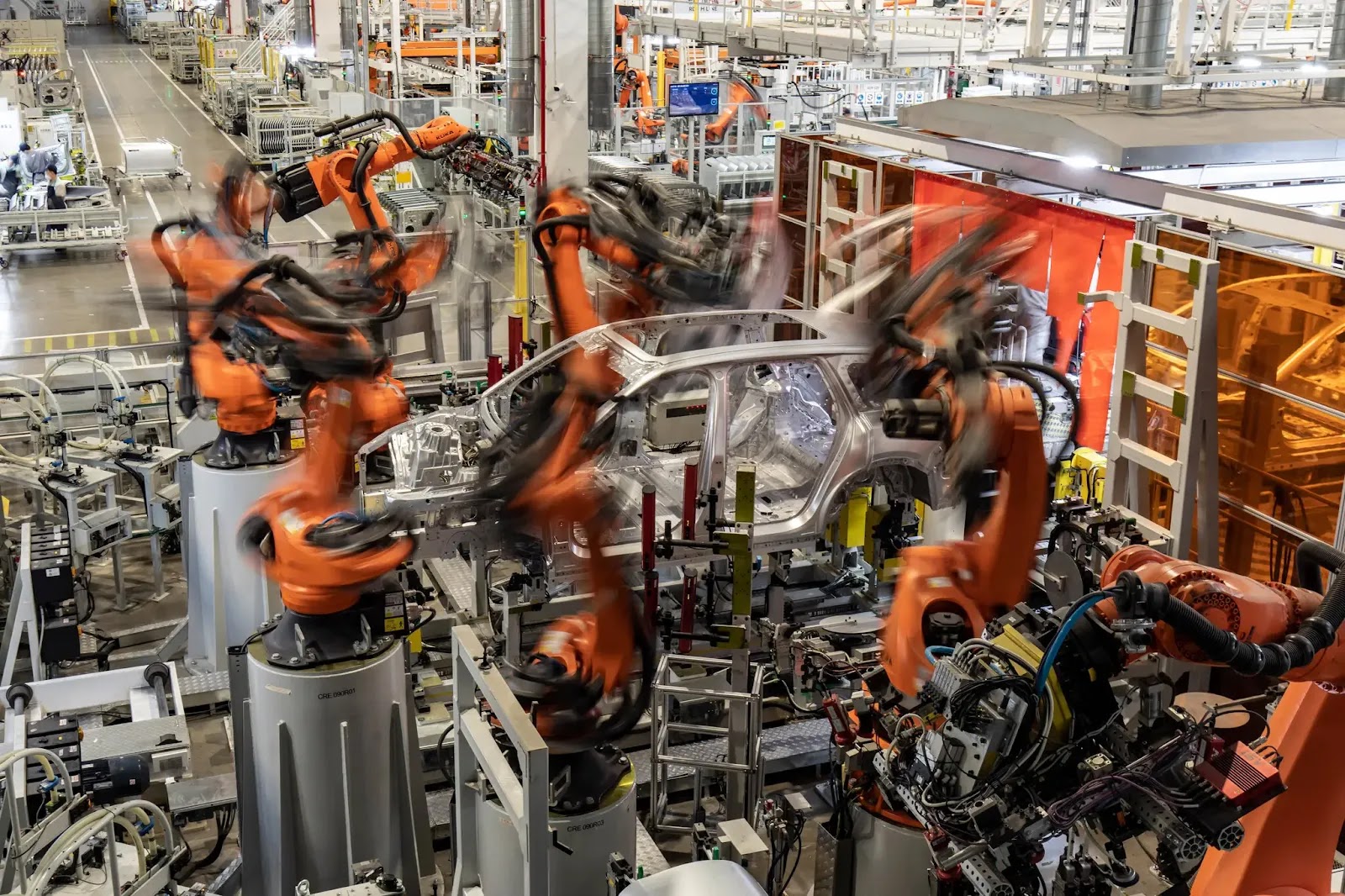
China is the world’s largest user of industrial robotics; domestic production is increasing rapidly. New manufacturing plants are highly automated; older plants are being modernized. This is also a possible solution to the future decrease in the size of China’s labor force.
Combined with China’s surge in exports to the world outside of the United States, as a reaction to American tariffs and bans on Chinese exports, much of the world’s advanced technology will be based on Chinese technology.
There is an important exception. AI development. The chain of ASML, TSMC, and Nvidia dominate the design and production of the world’s most advanced chips. Both countries are building new data centers but American data centers and foreign centers using Nvidia chips will contain the most advanced chips and supporting technology. China’s current strategy is a “work-around;” use massive amounts of less-powerful chips and concentrate on AI applications.
Because of America’s punitive tariffs on Chinese imports, the American market now accounts for only 10% of China’s total global trade. The decrease in exports to the U.S. has been made up with increased exports to the rest of the world. Combined with China’s surge in exports to the world outside of the United States, as a reaction to American tariffs and bans on Chinese exports, most of the world’s advanced technology will be based on Chinese technology.
China will have to deal with internal, domestic problems. The long-term problem will be the large decline in population, especially the shrinking of the working age cohort. China is not adequately supporting its large and growing older population. Pensions are low and health care facilities outside of Beijing and Shanghai are inferior. One possible type of improvement is a massive use of telemedicine, taking advantage of China’s huge telecom companies and possibly incorporating AI chatbots. Chinese pharmaceutical companies have become a major source of new drug discovery.
The main point of all this is that development of new technology is the key strategy for domestic economic growth and increasing exports. They see global competition with the United States as much as a geoeconomic and technological struggle as a geopolitical competition.
This essay is based on data and analysis in the following essays:
The theme of the following four sections of the blog is that innovation, not price competition, is the basis for understanding economic growth, competition, and analysis.
Basic Concepts and Theory
Market Behavior and StructureMarket
Dynamics and Information: How Markets Work
Economic Theory and Markets
Corporate Strategies
There is beginning a historic change in future populations and their demographics. This will interact with other variables and have a serious, maybe profound, effect on future economic growth.
Demographics and Economics
China
Geopolitics and the Global Economy
American Economic History
Management
The world seems to be in the midst of radical political and social change. Where are we going? Can studying past periods and countries facing disrupting change help us navigate our times? Maybe.
History
American History
World War I: The Beginning of the 20th Century
The Roman Republic and America – Differences and Some Possible Parallels
Economic and Fiscal Policy
Financial Markets and Investment Strategies
Foreign Exchange Markets The United States American Foreign Policy and International Relations Geopolitics and the Global Economy Geopolitics of Oil and Natural Gas
Visionaries
Humor, Satire, WhimsyI Heard the News Today Higher Education
Examples of Bilateral Oligopoly MARKET DYNAMICS AND INFORMATION: HOW MARKETS WORK This group of posts emphasize the dynamics of economic growth and development, They highlight the role of information in the functioning of modern markets.
John von Neumann, Alan Turing, and Claude Shannon (creator of information theory) knew each other, knew of each other’s work, and discussed their ideas with each other. John von Neumann Sees the Future
(2010)GEOPOLITICS OF OIL AND NATURAL GASThe geopolitics of oil will continue to remain important until the switch to substitute renewable resources and EVs. Energy and Geopolitics I: The United States(2015)
Surprisingly, some of the comments in the following essay may be somewhat relevant to the United States, more dependent on fracked oil and lagging in innovating substitutes that drive future economic growth and development.
China’s dominance of the interconnected group of high-tech products will make China the dominant manufacturing country in the world. China will also dominate the global economy, exporting its high-growth products at falling prices and developing joint production in many countries.
This includes renewable energy. China is the world’s largest and lowest-cost producer of most renewable energy technology, especially solar panels and batteries. China is also developing and installing many new technology nuclear reactors.
Combined with China’s surge in exports to the world outside of the United States, as a reaction to American tariffs and bans on Chinese exports, most of the world’s advanced technology will be based on Chinese technology.
China will have to deal with internal, domestic problems. The long-term problem will be the large decline in population, especially the shrinking of the working age cohort. this is one reason that China is concentrating on the development and deployment of industrial robots and AI applications.
INTRODUCTION
According to the World Bank, China’s Gross Domestic Product (GDP) was $18.7 trillion in 2024, compared to $29.2 trillion for the United States. China’s economy was 64% the size of the American economy; a generation ago, in 2000, China’s GDP was only 12% of America’s.
China has been a spectacular economic success story. China has increased its share of global manufacturing from 6% in 2000 to 32% in 2024. Manufacturing makes up 28 percent of China’s economy, compared with 11 percent in the United States.
China sees it dominance of interrelated advanced technologies as key to its geopolitical global dominance of the United States.
THE BEGINNING OF CHINA’S ECONOMIC RISE
After the death of Mao in 1976, a more pragmatic group of Communist leaders seized power and began to change China. Their model was Singapore, whose population was mostly Chinese. Singapore’s economic growth model was that the dominant political party would direct economic growth. It invested in infrastructure, including condos for most of its population. It directed investment. It invited foreign companies to invest in the country. It became part of the global economy.
China did much of the same but since it is much larger, it had to go further. It liberalized agriculture, going from huge communes to allowing individual farmers to rent land. That doubled food production. Then it concentrated on manufacturing, with subsidies and favorable tax laws. They established Special Economic Zones for foreign companies (little Singapores). Foreign companies were welcomed but they had to partner with a Chinese company, which accelerated China’s absorption of foreign technology and management techniques. By combining low labor costs and modern infrastructure with the production and assembly technology of foreign corporations, China became the world’s largest industrial producer and exporter. But, unlike Japan at the same stage in the 1980s, China went further. The Chinese government’s strategic plan was to make Chinese companies the leading developers, innovators and producers of “cutting-edge” products. This included becoming the world’s largest producer of solar panels, lithium-ion batteries, wind turbines, automated factories, robotics, rare earth minerals, drones, robotaxis, and electric vehicles (EVs).
SUMMARY OF CHINA’S CURRENT ECONOMY
China mines about 90 percent of the world’s rare earth minerals and it does the chemical processing for over 90 percent of the world’s total. The country also makes more than 80 percent of the world’s batteries, more than 70 percent of its electric cars, and about half of the world’s steel, iron and aluminum, according to data from the International Energy Commission.
China has the second largest economy in the world. According to official statistics, it has the fastest growth rate of any industrialized country. But economic growth has slowed down, from highs of 10% per year to the current reported growth rate of 5%. Probably closer to 3% – see
CHINA’S ECONOMIC STATISTICS
Because of China’s immense population, 1.4 billion people, per capita income is in the “middle-income” range. China is still a low-consumption country; consumption expenditures as a percent of total output is a little more than half that of the United States, about 40% compared to about 70% in the United States. Chinese have a very high savings rate, partly because of small social welfare and retirement programs.This creates and frees up a huge amount of investment capital for expanding production and exports.
China’s spending on research and development increased from $70 billion (in constant dollars) in 2000 to $470 billion in 2023 (Economist estimate). State-controlled banks have lent $1.9 trillion over the last four years to build new factories and upgrade existing factories with robots and automation. This is probably an attempt to deal with the beginning of a decline in the size of its work force and a substitute for the decline in housing construction.
China’s BYD (BYDDY) sells more electric vehicles in the world than any other company, including Tesla. Although banned in the United States, BYD’s global sales continue to rise quickly while Tesla’s global sales are falling. In early 2025, BYD’s sales in Europe passed Tesla’s sales.
Chinese companies, plus foreign companies in China like VW, produce more EVs than the total auto production in the U.S., Mexico and Canada combined.China is the world’s largest market for EVs; over half of the cars sold in China are electric vehicles (EVs) compared to 20% in Europe and about 10% in the United States. In 2024, EV sales in China were about nine times greater than in the United States.
In 2023, 2024, and 2025, China installed more industrial robots than the rest of the world combined.
China produces, installs and exports most of the world’s solar panels, about 80%. To avoid high U.S. tariffs, many are assembled or trans-shipped through other Asian countries. Biden and Trump have placed high tariffs on solar panels shipped from China and these countries. Combined with new American domestic policies unfavorable to solar energy, these policies will probably slow down installation of solar panels in the U.S., unless reversed at a later time.
China has surprised the world with its rapid advances in developing AI models, including DeepSeek. New Deep Seek models might rival ChatGPT’s most advanced models.
Huawei, a giant Chinese telecomm company, accelerated its development of semiconductor chips after the company’s chips and telecomm equipment were banned in the U.S. The CEO of Nvidia, exports of whose high-end chips to China were banned until recently by U.S. policies, has stated the ban has been a failed policy, only accelerating development of similar chips by Huawei and other Chinese companies. The ban has been partially lifted.
China’s AI models are open-source (free) and are used by a number of American and European companies.
CHINA’S ECONOMY
China’s economic strength is based on turning inventions into innovations, the mass production of commercial products. This has been achieved through a combination of massive government support of research and development, followed by subsidies to private corporations to produce and improve the new technology.
China has a manufacturing sector that is larger than those of the United States, Germany, Japan, South Korea, and Britain combined. It produces some of the world’s most advanced technology in the interrelated “cutting edge” industries.
China builds industrial capacity anticipating high future growth rates. As a consequence, there is excess capacity in many industries, including EVs and solar panels. Also in construction industries like steel and cement. China produces more steel than the rest of the world combined; the industry is currently in a recession because of less housing construction. Construction in housing is being replaced by new construction of factories with new machinery and robots, and construction of overseas infrastructure projects under the Belt and Road program.
China is installing more renewable energy technology than any other country; the increase in the amount of electricity produced by solar in 2024 was greater than the total amount ever produced in the United States. But China is also the world’s largest producer of coal. Chinese cities have some of the worse air quality in the world; China’s interim strategy is to shut down old factories near cities, especially Beijing.
Coal production is not going down because of expanding demand for energy. China needs both, especially with large internal investments in new data centers. But by 2030, China hopes to start reducing coal production and replacing coal with renewable energy technologies.
China also relies on imported oil and natural gas, especially from Russia and Iran. The country buys oil at a discount from world prices.
China is the world’s largest producer, and consumer, of cars. China is rapidly replacing gasoline-powered cars and other vehicles with EVs. China’s strategy is to replace imported oil for gas-powered cars with domestically produced EVs built with Chinese batteries and in the long run, have electricity for EVs generated by domestic renewable sources.
China is rapidly expanding its EV robotaxi fleet. China is also starting to increase exports of EVs everywhere except in the United States, where Chinese EVs are effectively banned. China will probably become the dominant seller of EVs in most of the rest of the world.
China’s economic development has been spectacular but growth is slowing down. The development strategy in the past was massive construction, both public and private, joint ventures with foreign companies, exports, and limiting domestic consumption. Internal construction relying on housing is less important because of the huge amount of housing already in place that is either unsold or empty.
There will be little if any growth in housing construction in the future because of low family formation due to a very low birth rates and the large inventory of unsold apartments. (See the section below – China’s Housing Crisis – for details.)
China’s economy can continue to grow because of high levels of investment, overcapacity in new technology, and a large number of unemployed young people and college grads with technical degrees. The current strategy is to invest heavily in innovative new technologies such as advanced computer chips, AI, robotics, automated factories, new drugs, EVs, batteries, hydrogen energy, nuclear power, and solar panels. Investment in these industries will come mostly from domestic sources.
In addition to being the world’s largest producer of solar panels and wind turbines, China is investing heavily in “green” hydrogen as a renewable resource. This is produced using electrolysers to split water molecules into hydrogen and oxygen. China already produces about 40% of the of the world’s electrolysers. The country is building pipelines from production centers to industrial centers such as Shenzhen, which already has a fleet of buses powered by hydrogen.
China is catching up in areas of chip production. The country has rapidly improved its chip technology; it can now produce all but the most advanced chips in the world. U.S. bans on selling advanced chips to China is less effective than it would have been in the past. There is in addition a thriving global black market in Nvidia’s advanced chips.
China has employed its advanced chips to develop AI models such as DeepSeek, which are already almost as good as the most advanced American AI models.
The Chinese government has just approved a new $137 billion venture capital fund to accelerate development of robotics and AI.
China already has some of the most automated plants in the world, especially in electric vehicle production.
RARE EARTH METALS AND ELECTRIC MAGNETS
China controls the entire supply chain of rare earth metals, from mining to processing to producing electric magnets. China produces over 90% of the rare earth minerals and almost all of the processing equipment and processing.
Electric magnets are inputs into producing a wide range of modern weapons and automobiles, both gas-combustion and electric. A single gasoline-powered car can have more than 40 different rare earth magnets inside electric motors that power the brakes, seats, steering, power windows and other systems. Electric cars have even more rare earth magnets.
Thousands of companies world-wide use Chinese rare earth magnets. China has announced widespread export controls on the magnets and products that use the magnets. This seems to be an attempt to pressure Europe to relax tariffs on imported Chinese electric vehicles, at a time when Europe wants to step up armaments production to aid Ukraine.
China produces more than 200,000 tons of rare earth magnets a year. Most are used domestically. Much of the production is sold to CATL and BYD, the world’s largest producers of batteries. BYD is the world’s largest producer of electric vehicles (EV). About 40,000 tons are exported to the United States and Europe. The only other large producer is Japan, which makes about 40,000 tons of magnets a year, most for car companies in Japan and South Korea. The United States and the rest of the world are trying to increase production but the current total is negligible. Production is difficult because of tight quality control and a long learning curve for employees.
China’s domination of the entire supply chain from rare earth minerals mining to final products like EVs and drones is the result of decades of investment in research and development. A majority of undergraduates in China major in math, science, engineering or agriculture, according to the Education Ministry. And three-quarters of China’s doctoral students do so. By comparison, only a fifth of American undergraduates and half of doctoral students are in these categories. Over half of the graduate students are foreign.
China has close to 50 graduate programs that focus on either battery chemistry or the closely related subject of battery metallurgy. Only a handful of professors in the United States are working on batteries.
Much of the research and development is done at Central South University in Changsha, a city in south-central China. Central South University has nearly 60,000 undergraduate and graduate students with extensive, modern labs.
Chinese companies have been buying up mineral producers in other countries. China’s largest battery producer, CATL, which produces 40% of the global production of batteries, wants to produce in the United States for the American market. Building and equipping an electric-car battery factory in the United States costs six times as much as in China, said Robin Zeng, the chairman and founder of CATL. The work is also slow — “three times longer,” he said in an interview.
This is mostly a summary of an excellent series of articles by Keith Bradsher of the New York Times.
Update (11/25). In a recent trade agreement with the U.S., China has promised to remove its embargo of rare earth minerals and electric magnets for one year. This will probably slow down America’s drive to find and develop alternative sources of supply. In exchange, China has agreed to buy an undisclosed amount of American soybeans.
DRONES
China is the world’s largest producer of drones. DJI, based on Shenzhen, produces about 70% of all commercial drones sold in the world. They are used for hobby and industrial applications, including aerial photography, package delivery, and weather research. Versions of the DJI drones cost between $300 and $5,000.
China produces millions of drones a year. The U.S produces about 100,000 drones a year.
Drones have become an important weapon in the war in Ukraine. Ukrainian forces beat back the Russian invasion by innovating deadly modifications to drones bought from DJI. Russians cannot use tanks to support infantry because of the threat from Ukrainian drones. Russian drones are used in indiscriminate bombing of Ukrainian cities. Drones and other AI-controlled weapons are rapidly changing warfare.
When U.S. drone manufacturer Skydio was sanctioned by Beijing in October 2024 over arms sales to Taiwan, that quickly cut off the company’s supply of batteries, according to the Financial Times. China produces more drones in one week than Skydio produces in a year.
American drones that carry Predator and Reaper missiles cost between $3 million and $5 million.
A few months ago, the U.S. army carried out a four-day exercise testing drones produced by U.S. startups. They were failures. The only one that partly performed was a drone an American company bought from Ukraine and modified.
CHINA’S AUTOMOBILE INDUSTRY AND GLOBAL DOMINATION OF THE ELECTRIC VEHICLE (EV) MARKET
China today has enough capacity to manufacture half of the world’s 80 million cars in annual sales, or 40 million vehicles. Current production is about 28 million and rising. (Total U.S. production is around 9 million, although American car companies assemble cars in Canada and Mexico.) Over half of Chinese production is now EVs. China’s electric vehicle companies continue to build new capacity. By 2030, China’s capacity could climb to 75% of the world’s volume, most of it to produce EVs.
The total production capacity figure above is misleading. There is massive over-capacity of gas-powered car manufacturing. Production of gas-powered cars has fallen by over 10 million units since reaching a peak of 28 million in 2017 with little reduction in production capacity. Thus, China’s EV industry can double sales just by replacing gas-powered cars.
American car companies in China, producing mostly gas-powered cars, have falling sales and are losing money. In the past, General Motors and VW were the largest car producers in China. Now they are not even in the top 20 because of Chinese EV sales. General Motors just took a $5 billion write-off of their investment in China. Michael Dunne, an observer of the Chinese auto industry, believes that the position of foreign auto producers can only get worse and some, including General Motors, will eventually leave China.
Hyundai has closed a modern production plant in China; many foreign plants are operating far below capacity. Ford has announced they have lost money over the last five years from their Chinese operations.
When Volkswagen opened a huge electric car assembly plant last year in Hefei, China, it ordered just one robot imported from Germany (for display). The company bought the other 1,074 robotsfrom a factory in Shanghai. VW intends to source all of its parts in China.
Volkswagen has also moved its R&D from Germany to China, hiring 3,000 Chinese engineers. The China factory will be the source of VW EVs sold in Europe. At the same time, VW announced a massive cost-cutting program in Germany and the rest of Europe.
Total EV production in 2024 was 12.4 million cars, close to half of all car production. Forecasts for 2025 are uncertain because of major reductions in government incentives and subsidies after September 30 of 2025.
To increase production of electric autos quickly, China is stepping up exports. Exports of all EV exports in 2024 was around 1.25 million. EV exports may be around 2 million in 2025.
Besides autos with Chinese nameplates, foreign automakers are using China as the manufacturing base for exports under their own names. Foreign companies originally build large plants in China with Chinese joint venture companies to produce gas-powered cars for the Chinese market; at least one has been closed (Hyundai) and others are operating at a low percent of capacity. They are forced to stay open by local authorities, who are afraid of local unemployment.
Tesla shipped 344,000 China-built EVs to Canada, Europe and other markets in 2023. Volkswagen, Renault and BMW export made-in-China EVs to Europe. GM’s best-selling Chevrolets in Mexico are produced in China. Hyundai and Kia expect to sell 200,000 cars made in China back to South Korea and into global markets. Ford is exporting about 100,000 trucks and SUVs to Asia, Africa and the Middle East.
BYD, China’s largest EV producer, will produce more EVs than Tesla globally this year. Tesla sales on falling in China. In Europe, Chinese nameplate EVs are gaining market share as Tesla sales fall. For leading companies like BYD, export sales are increasingly important.
Chinese EV buyers are younger than those in the U.S. and Europe. They are more interested in a car’s software and entertainment systems.
Chinese EVs companies are teaming up with China’s large electronics corporations to install “wizzy” electronics and “infotainment” systems in their vehicles. Some see EVs as “smartphones on wheels.” This has created an opportunity for China’s huge tech firms. Huawei, Chinese huge producer of smart phones and other electronics, has teamed up with Chery to become a major EV producer. Xiaomi, sometimes called “China’s Apple,” produces popular high-end cars that compete with Porsche’s Taycan SUV but sells at half the price.
Baidu is a leader in the development of autonomous-driving software for robotaxis. China is testing robotaxis in 50 cities and has more robotaxis than any other country.
With improving engineering and attractive operations, some Chinese EV companies are trying to compete at the top end of the market. These companies intend to compete with top-end cars in the global market.
There is massive overcapacity in gas-powered car production and probably overcapacity in the EV sector. About 100 companies are producing EVs, many of which started production in the last few years.
Collectively, EV companies offer a wide range of models and options. Because of the industrial overcapacity and economies of scale in production, a price war to gain market share has broken out. EV prices start at around $23,000; BYD says they are coming out with an even cheaper model. Profits of the industry leaders are falling. The industry as a whole is probably losing money.
With lower government tax exemption and other subsidies, EV companies are planning on reducing wholesale prices to dealers in 2026. Growth will probably be lower than in the past few years and total financial losses will probably be greater.
China dominates the global supply chain to produce EVs, from mining to mineral processing of rare earth mineral to the production of electric magnets to the production of battery cells.
For reasons discussed below in the sections on demographics and housing, China’s EV industry may not grow, or grow slowly, after it replaces domestic gas-powered car production. Further growth will depend on foreign demand.
Domestic demand growth may be low because:
Extremely low birth rate (far below replacement),
shrinking numbers of labor force age group,
high youth unemployment,
large number of temporary or marginal “gig” workers,
low family formation; wedding are down,
loss of family wealth because of housing market collapse.
China’s electric and hybrid manufacturers have set up, or are in the process of setting up, factories in Hungary, Indonesia, Russia, Thailand, and Turkey. Also, three assembly plants in Brazil. One is in a plant closed by Mercedes and another in a plant closed by Ford.
SOLAR PANELS
Gigantic new solar panel field
China has built the world’s largest solar panel installation on a 10,000 foot high plateau in western China. The area, 162 square miles, is seven times the size of Manhattan. In addition, the country has built a huge wind turbine farm and five dams for hydropower at this location.
The massive amount of new electricity is planned to power new AI data centers and manufacturing. The government plans to build 50% more solar panels here in the next three years. The current capacity of the three sources of renewable energy can generate about 30,000 megawatts. This could provide enough electricity to power 15 million to 30 homes, or enough power for 60-120 million people. When increased by 50%, enough power for 90-180 million people. (By coincidence, this is the amount of energy that OpenAI says it will need to power data centers to develop and commercialize its AI platforms and applications.)
This is part of a national strategy to reduce coal consumption. China, with solar, wind, nuclear, hydrogen, hydropower, batteries and EVs, is also the world’s largest producer of renewable energy and related technologies.
There is a geopolitical consideration. China imports large amounts of oil and natural gas. Much of it comes from the Middle East and passes through the Strait of Malacca, which is controlled by the United States navy.
Keith Bradsher, New York Times,”Why China
Built 162 Square Miles of Solar Panels on the
World’s Highest Plateau,“ October 10, 2026.
Besides massive renewable energy projects at home, Chinese companies are selling low-cost rooftop solar panels abroad. Solar panels and complete kits are produced by private companies. Chinese companies dominate exports to poorer countries. For example, in Pakistan, Chinese solar panel prices have fallen 70% between 2022 and 2024, and unit sales have gone up fives times. Electricity from the national power grid is unreliable, with frequent power outages; also, prices have gone up 50% in the last two years.
Energy now generated from solar panels is greater than energy generated from the unreliable national electricity grid.
Many less-developed countries including Nigeria face a similar situation as Pakistan and are markets for Chinese solar panels and batteries. These relatively cheap, small-scale solar panel systems are also available in Europe.
There will be serious geopolitical consequences for the United States if Chinese technology dominates renewable energy production in countries outside the United States.
In summary, solar panel production meets five goals of the Chinese government:
Reduce dependency on imported oil and natural gas. Reduce domestic coal output.
Develop a new source of economic growth.
Develop a bundle of new technologies, including the critical technology of batteries.
Exports help increase volume of production, drive down unit cost, and increase demand for follow-on sale of batteries.
Sale of solar panels and batteries to other countries is part of China’s geopolitical rivalry with the United States. Both countries recognize that technological competition is a key part of global geopolitical competition.
China continues to make huge investments in all forms of renewable energy. The goal is to greatly reduce reliance on domestic coal and fossil fuel imports. America, under Trump, is pushing for more domestic production of fossil fuels and eliminating subsidies for renewable energy. Off-shore wind turbine projects have been shut down. Through subsidies, volume production and price competition, China is the world’s low-cost producer of solar panels and batteries.
Nuclear Power Plants
China began a plan in 2020 to build 150 reactors by 2035. China is currently building half of the world’s reactors under construction.
China is rapidly expanding its nuclear power, with reports from late 2025 indicating around 27 to 35 reactors under construction, more than any other country, as part of a massive buildout to meet energy demands and climate goals. The government consistently approves new units, aiming for 6-8 new plants annually, positioning itself to become the world’s second-largest nuclear power producer soon. Google AI
Using advanced technology, China’s basic reactor design is based on Westinghouse technology. Westinghouse is owned by Toshiba.
CHINA’S CONTROL OF GLOBAL SUPPLY CHAINS
Besides these advanced final products, China is developing and controlling their entire supply chain, using its superb transportation and distribution infrastructure. China intends to dominate global markets and the supply chain of advanced foreign producers. Some multinational American and European companies have relocated part of their R&D to China.
China also controls part of the physical transportation global supply chain. China is the world’s larges producer of merchant ships and Chinese companies own or manage about 90 ports around the world, including Piraeus and two containers ports on either side of the Panama Canal.
EXTERNAL FACTORS
Exports are rising but are facing higher tariffs and quotas from trading partners, especially the United States. Export growth will probably come from countries in East Asia, South America and Mexico, and Africa if the proposed very high tariffs are implemented. Chinese companies are targeting these regions for new assembly plants, distribution networks, and joint ventures.
Net Foreign Direct Investment (FDI) is probably negative – foreign firms are taking more money out of China than new investment going into China. Also, wealthy Chinese are smuggling large amounts of their wealth out of China.
Like almost all other countries, China runs a yearly fiscal deficit. The amount is opaque because much of it is incurred by city and
provincial governments promoting new factories. Local finances are in deep trouble since revenue is tied to land sales to housing developers and contractors. Total government debt/GDP is estimated to be around 120%, higher than the United States.
POLITICAL CONTROL
Foreign companies don’t vote and Chinese companies are expected to follow Party directives. The government owns or controls much of the financial sector, so it can direct loans to favored companies and favored industries. Local governments often provided land and buildings for new plants. The different levels of government and state-owned banks are the sources of funds and subsidies for startups and expansion in favored industries.
But huge social media and e-commerce companies are not like manufacturing companies; their owners and managers started to act too independently for the Party’s taste. In addition, the Party feared, with some justification, that social media could become an uncontrolled outlet for independent thinking and writing. Even worse, social media could become the outlet for criticism of the government.
In the 2010s, the Party under Xi began to crack down. The most successful and famous entrepreneurs were reigned in. Communist Party cadres were installed in all large companies, with veto power. The government closely monitors the Internet and closes down sites that annoy them. Any dissent or criticism of the government is quickly repressed.
Overriding any economic discussion is that China is a totalitarian state and its political elite will not tolerate any independent source of power or wealth. The Party sees them as an actual or potential threat. All individuals and their behavior are monitored and rated by a social credit system; a low score can have bad consequences.
A member of Communist Party is planted in every large corporation, and many smaller corporations, to watch owners and managers. As a result, many entrepreneurs are scared to make decisions. Many wealthy people want to leave China. Again, a huge amount of wealth is being smuggled out of China.
CHINA’S HOUSING CRISIS
In the past, investment in housing has accounted for about 20% to 30% of China’s spectacular growth.
Housing construction will be a less important source of economic growth, partly because of the massive investment over the last 40 years and the huge number of unsold and empty apartments.
A large part of foreign investment in housing was from Southeast Asians speculating in apartment condos. There are empty apartments held for price appreciation. Many Chinese families own two or more units as a form of savings; China has a small social safety net, especially for retired citizens. The latest estimate (November, 2024) is that the number empty apartments is around 49 million.
Domestic and international investors in empty apartments are now losing money as apartment prices fall. There are about 30 million unsold homes on the market as sales prices fall. Home sales in yuan are the lowest since 2013.
Housing prices continue to fall. This means that the main source of savings of Chinese families is going down in value. This is a contributing factor in the lack of growth in consumer spending.
About 20 million families put down payments of up to 50% on housing that has not been built or is unfinished. Some of these units may never be built. And yes, it was a Ponzi scheme. Many Chinese developers have gone bankrupt. The Chinese government has some small programs in place to limit the damage, worried that the anger may be directed at the government.
AMERICA’S TRADE WAR WITH CHINA
In the first 11 months of 2025, China has set a record $1 trillion trade surplus in goods, despite a large decrease in exports to the United States. Overall exports are up from 2024. Exports to Africa and Southeast Asian countries are up substantially.
How much China has improved its chip technology will be seen by the new operating systems. Huawei is unveiling on its new smart phones. Huawei intends to challenge the operating systems of Google (Android) and Apple (iOS), which are used on almost all Chinese smart phones. Huawei’s new phones are based on advanced chips made in China. As part of the Chinese government’s strategy to become self-sufficient, it is beginning to ban the buying of foreign phones (read Apple) by government agencies. If the trade war intensifies, there will probably be more internal bans on the usage of American chips and smart phones.
This is part of a concerted effort of China to increase its Research and Development. For example, Huawei has completed a new research center for 35,000 engineers. It is ten times larger than Google’s R&D center in Silicon Valley.
Besides domestic companies, responding to Xi Jinping’s exhortation for “high-quality growth,” many foreign companies have increased their R&D in China. They include VW, Bosch, Bayer, AstraZeneca, HSBC, and global pharmaceutical companies. Total corporate R&D spending is now equal to that of Europe. On the other hand, some foreign companies, including Microsoft, are closing their R&D operations in China in anticipation that the trade war between China and the United States will become worse.
The American Treasury Department has circulated a draft “that would ban American firms from investing in AI, semiconductors, microelectronic and quantum computing in China.” (The Economist, “Research developments: China is the West corporate R&D lab. Can it remain so?”, July 20, 2024, 49-50.) Both countries see that future economic growth will depend critically on developing new technology.
For the last few decades, China has sold about $3 worth of goods to the United States for every $1 worth of goods that it buys. That imbalance partly reflects Beijing’s many tariffs and informal limits on imports, as well as an enormous government effort during three decades to replace imported manufactured goods with domestic production.
Sino-American trade has grown rapidly in the past. So the lopsided ratio has translated into a large American trade deficit. But the growth in U.S. deficit from trade with China has slowed down. The deficit has been in the range of $300 billion – $350 billion in the last four years. What has changed is that China’s trade surplus with the rest of the world has gone from near $0 in 2018 to about $450 billion in 2023. Both Asian countries as a whole and the European Union countries now import more Chinese goods than the United States.
The U.S. response is the Inflation Reduction Act to subsidize investments in EVs and battery plants. Supply chain plants are being built in Georgia, Michigan and North Carolina. Construction of Hyundai’s Georgia plant has been suspended as American deportation cops seized and deported 300 South Korean workers. Seeing Koreans being led away in chains has not endeared America in South Korea. Europe, like the United States, is considering higher tariffs on Chinese auto imports. German auto companies are fighting this because many of the EVs they intend to sell in Europe will be produced in China
It is not obvious how higher U.S. tariffs will affect China. In the past, domestic U.S. producers of substitutes for Chinese imports like solar panels have gone bankrupt or not been able to produce enough to hurt Chinese imports. Also, it will be difficult to find substitute sources for many industrial products in other countries. China has a deep, integrated supply network and a superb transportation infrastructure. China could also give subsidies to companies hurt by high American tariffs. Currently (2025), U.S. production of batteries, EVs, robotaxis, and drones is substantially more costly than similar products in China.
The net result might be some increase in U.S. manufacturing, a lower trade deficit with China, and higher prices for many goods in America. But the U.S. will still be very dependent on imports for industrial inputs, solar panels, batteries, and many consumer goods. As discussed above, Chinese companies continue to improve their EVs, batteries and computer chips.
In light of threatened American tariffs on Chinese exports to the U.S., Chinese companies have set up subsidiaries in many other countries, especially in Asia. While this may reduce America’s trade deficit with China, depending on how China retaliates, America’s overall trade deficit will probably not go down very much, if at all.
I doubt if China will accept any trade deal with the United States that they consider unfair. Chinese are aware of Chinese history when China succumbed to foreign pressure and gave up part of its sovereignty. Trump’s bullying tactics might have been more effective in 2017 than now. The Chinese economy is about twice as large, less dependent on importing foreign hi-tech inputs and products, and exports to America are a
smaller percent of total exports, only about 10% in 2025. America’s protectionist trade policies open up opportunities for China increasing trade with other countries.
DEMOGRAPHICS
Demographics Update (August 8, 2025)
China’s slowly decreasing total population masks rapid and large changes in its age distribution.
Between 2021 and 2024, the number of pre-school children (3 to 6 year olds) fell from 48 million to 36 million. The number is expected to fall another 14 million in the next five years as the birth rate of 1.0 is one of the lowest in the world. In contrast, over the same period, the number of people aged 65 and over is projected to rise from 211 million to 256 million, according to UN projections.
China’s population has been shrinking since 2022. This means more deaths than births. This should continue as births remain low and deaths from an aging population should increase.
China’s most serious long-term problem is not U.S. trade policy and tariffs. It is the projection of a huge decline in total population, particularly in labor force age groups.
The latest long-run population projections indicate that China’s current population of 1.4 billion people has peaked and will fall to about 750 million in 2100! China will account for most of the global decline in population for the rest of the century.
China will probably experience a 200 million person decrease in its working-age population by 2050. China is dealing with the large, future decrease in the number of workers through a better educated and trained work force for an advanced hi-tech economy. Two-thirds of people turning 18 now enroll in a university or college. China’s universities graduate about 350,000 mechanical and industrial engineers per year, as well as electricians, welders and other trained technicians. This is eight times the number of mechanical engineers graduated each year in the United States.
It is unlikely that China will allow any substantial immigration in the near future. But China is rapidly increasing the number of industrial robots as part of a major program to automate manufacturing.
Keith Bradsher, The New York Times,
“Army of Robots Gives China Edge in Trade War, “April 24, 2025, Section A, Page 1.
(This article also told of 12 humanoid robots that entered a half-marathon in Beijing; 6 finished.)
China’s population is slowly falling; the yearly reduction will accelerate in the near future. It is also rapidly aging because of below replacement birth rates since the 1970s. Birth rates were below replacement (an average of 2.1 children per woman) during the “one child” period of the 1970s to 2015 was about 1.5. They are even lower now, about 1.1 children per woman. This is one of the lowest birth rates in the world.
The number of babies born each year has dropped by almost two-thirds since 1987.
The number of marriages keep falling. One reason is that the “bride-price” women are demanding is very high. The average “bride-price” has doubled since 2005. This is a function of supply and demand; there are 119 males for every 100 females in marriageable ages. There is a great deal of discussion on social media about what price women should ask for, so women have information when they negotiate with the groom’s family.
Women also demand a high dowry because China has a high divorce rate, higher than the U.S. Women keep most or all of the dowry if divorced.
China has had a relatively young average-age population but the average age is rising very rapidly because of the very low long-term birth rates and an average life expectancy equal to that of the United States. This year China’s median age (half above, half below) will pass that of the United States.
Although China’s total population is failing slowly at present, the age distribution is changing faster. The number of children is going down. China’s working-age population is already shrinking. By around 2050, the decrease in work force age groups since 2012 will be about the size of the current U.S. total labor force (170 million). Or about 25% fewer workers.
The number of Chinese over the age of 60 has been increasing rapidly. China’s over-60 population of over 300 million is already close to the total population of the United States. Projected over-60 population is expected to be around 400 million in 2035 and, by around 2050, the over-60 population is projected to be around 500 million, over 40% of China’s total population.
China has a special problem that could affect future demographics. Chinese youth, ages 19-24, have a very high unemployment rate, probably over 20% and possibly much higher. The government stopped publishing statistics and then came out with a new series with a lower unemployment rate. Colleges graduates in particular are finding it hard to get a decent position; many are unemployed, accepting menial jobs just to earn small amounts of income, or moving in with relatives. The government’s policy is to tell the unemployed youth to “eat bitterness.”
A high percent of its young, male work force are “gig” workers who work part-time or move from job to job. Many, probably most, have moved from rural to urban areas and are unable to get an urban hukou (residency permit). They are permanent second-class citizens, undocumented internal immigrants.
This large “floating” labor force of about 200 million is about 40% of the urban labor force.
In addition to construction workers and temporary manufacturing employees, about 84 million rely on platform-based forms of temporary employment, including ride-hailing drivers and food-delivery riders.
These gig workers may never marry and have children, worsening the aging of China’s population. The government sees them as a possible source of economic and political problems in the future, but has done very little to improve their legal status or provide educational and health services.
This is a clear example of exploitation of the proletariat.
A peculiarity of the Chinese labor market. In China, there is widespread discrimination again hiring anyone over the age of 35. If people cannot establish a career when they are young or are fired when they are 35 or over, they have little chance of getting a comparable or better job or have rising income until retirement. Many companies and government departments will not hire anyone over the age of 35. The number of people over the age of 35 is rising rapidly.
All of these trends will probably affect future demographics and economic growth – lower income for a larger part of the total population, fewer and later marriages, fewer children. This is in addition of a dearth of females because of the past “one child” policy that led to tens of millions of abortions of female embryos and female infanticide.
This will increase the problems associated with urbanization. China is already highly urbanized. Shanghai has four times as many people as New York City. Twelve cities in China have more people than New York City. Over 100 cities have populations of one million or more.
China’s first reaction to these trends has been to slowly raise their low retirement ages over the next 11 years. For men, the retirement age is being slowly raised from 60 to 63. For women, from 55 to 58 for white-collar workers and from 50 to 55 for blue-collar workers. A related reason is that the public pension costs are “squeezing” government budgets. Chinese economists believe that public pension funds will run dry over the next 10 years (sound familiar?). The long-run effect might be slowing down the fall in the size of the labor force as Chinese will have to work more years before retirement.
The Economist, “Sunset Delayed,” September 21, 2024, 38-40.
This policy will be unpopular. Traditionally, families were multi-generational and children (daughters and daughters-in-law) were expected to care for aging parents. But hundreds of millions of the working-age population have migrated from rural areas to cities, leaving their children in the care of grandparents. A rising percent of women in the cities are working. If retirement ages are raised and grandparents in both the cities and countryside have to work longer, there may be less baby-sitting. This might lower the birth rate even more. Again, China has strong age discrimination, so that the older population might have to wait longer between permanent employment and receiving a retirement pension.
A COMPLICATED STORY: CHINESE DEMOGRAPHICS AND HOUSING
Many women now demand a diamond engagement ring; China is the largest market for diamonds. In addition, there are expected male “dowries.” The families of prospective grooms are often expected to buy the married couple an apartment. Some relatively prosperous parents in the past planned ahead and bought apartments for sons at low prices. Since 2015, housing prices doubled and then fell about 20-30% from the top. Still, down payments are about 10 times the average urban wage. So, unfortunate sons cannot marry or they and their families must save for many years for a down payment.
Young men without permanent and high incomes are not desirable prospective husbands.
SUMMARY
Like Japan after their bubble economy collapsed in the 1990s, China is facing adverse demographic trends, the collapse of a real estate bubble, excess manufacturing capacity, and high and rising public debt.
While China’s future demographic path will like Japan’s, China is not like Japan in other respects. The big difference is that China continues to invest in a group of new, cutting-edge technologies which will drive future economic growth and exports. These technologies are related; combinations are leading to new applications like EV robotaxis.
China will continue to be an exporting powerhouse unless tariffs and quotas begin to bite. But there are ways around most restrictions – trans-shipments and building plants in other countries. Because so many of the inputs that the United States and Europe need come from China, tariffs and quotas will probably be selective. Maybe mostly limited to EVs, solar panels and high-end computer chips and software.
The future of China is a race to solve internal, domestic problems and continue to grow the economy through investments in import substitutes, new technology, and exports. In the longer run, the demographic decline plus an aging population present serious problems, although there are possible solutions.
But in the near term, China is a facing a combination of slower growth; high youth unemployment and underemployment including that of recent college graduates; a loss of the total value of savings (wealth) because of the fall in the market value of housing; underfunding of pensions and health care for a rapidly growing number of retired population.
The current regime has rejected all but small increases in China’s pitifully low pensions, which
start at $20/month. The solutions will be more difficult if China continues to have an authoritarian regime for whom control is the main objective.
In the long run, China will have to continue to move away from labor-intensive manufacturing as a source of growth. The huge investment in robotics and factory automation is a step in this direction. This trend may intensify as the long-run demographic trend of fewer workers leads to higher wages. This implies more automation and movement to the information economy, including a large investment in AI and its applications. Also, Chinese companies may be able to move some of their operations to other, lower wage countries, which are the primary source of increased exports. But critically it means innovation; whether China can continue to do this in a regime of political control of entrepreneurs and information is an open question.
For a summary of statistics from many sources and an excellent discussion of China’ current problems, see John Mauldin, “Broken China,” mauldineconomics.com, October 26, 2024.
For excellent ongoing coverage of China, see The Economist at economist.com.
Official Chinese economic statistics have to be used with caution. For a look at the problems with their reported statistics, see
This is a case study of one country’s relationship with private companies in a major industry.
The central government has made the production of EVs a national priority with massive subsidies. The provincial, county, and local governments compete to attract an EV assembly plant. All levels of government entice new companies with a wide range of incentives and subsidies. The result is that in a short period of time about 100 new plants have been built; a few new ones are planned. The industry may have a total capacity of around 25-30 million cars.
Current production was 12.4 million cars in 2024; 2025 will probably be higher. Growth rates in the future will probably be lowered than in the past.
This is a common pattern for a new technology. In the United States, about 500 companies intended to produce cars. The difference with the current Chinese program is that most didn’t start production or produced very few cars. Only a few companies built a plant. Only two large companies survived (Chrysler came later). The rest disappeared, merged, or were marginal producers for a few decades. GM went bankrupt twice, stockholders and creditors took a financial bath. The company was only saved because the Du Pont family bought a controlling interest and created the modern industrial company.
Most commentary on the Chinese EV industry emphasizes the overcapacity and predicts that many companies will go bankrupt or at least merge. Competition is based on the assumption that a company will survive if it produces a minimum number of cars – at least 80% of rated capacity. In the past world of gas-powered cars, a minimum-sized plant of around 300,000 cars/year was necessary to achieve economies of scale and minimum unit cost. So this is a fight for market share. Or a fight to dominate a market niche.
The result is a drastic fall in retail prices. The government has stepped in and told the companies to stop lowering prices! The companies seem to be ignoring the government and finding ways around it (more options or better lease or financing terms, encouraging their dealers to sell new cars as cheaper “used” cars).
The cheapest EV is around $23,000 but BYD has announced a new model at a substantially lower price. (Americans get to pay $50,000-$70,000 for Tesla with fewer fun bells and whistles and lousy quality.)
Companies are also competing on introducing new features.
Chinese EV buyers are younger than those in the U.S. and Europe. They are more interested in a car’s software and entertainment systems. Chinese EVs companies are teaming up with China’s huge electronics corporations including Huawei, Xiaomi and Baidu to install “wizzy” electronics and “infotainment” systems in their vehicles. Some see EVs as “smartphones on wheels.” One high-end car dances; see it at BYD Yangwang U9 – Crazy JUMPING and DANCING Demonstration!on YouTube. Xiaomi started its own EV company in 2024; itproduces a luxury SUV that competes with Porsche’s Taycan but sells for half the price.
In the meantime, most companies are losing money; even the dominant firm (BYD) is experiencing falling profits.
But is there permanent overcapacity? In 2017, before EVs took off, the Chinese auto industry produced a record 28 million gas-powered cars. The domestic fall in gas-powered car sales has been about 10-12 million cars, about the same as the increase in EV sales. In other words, the total market is not expanding but EV sales are replacing gas-powered car sales. The change was accelerated by a government subsidy to consumers who traded in gas-powered cars for EVs. This subsidy has been terminated. The government is also reducing a tax credit.
With lower government tax exemption and subsidies to consumers, some EV companies are planning on reducing wholesale prices to dealers in 2026. Sales growth will probably be lower than in the past few years and total financial losses will probably be greater.
At the end point, when there are no longer gas-powered cars being produced, EV domestic sales could increase about 14-16 million more. In other words, the current total EV production capacity is about equal to maximum future sales.
When this “equilibrium” is reached is the critical question. How long can most producers lose money? When will the industry as a whole become profitable? Who will be the winners? Probably a combination of the lowest unit cost (biggest) producers, companies dominating large niches, and companies with deep-pockets partners or parents.
The other consideration is exports. Surprisingly (to me), most Chinese auto exports are gas-powered cars. Most EV exports now seem to be foreign companies like VW and Tesla. The long-run question is how large will the EV export market become? This partly depends on future geopolitics. Will the U.S. continue to ban Chinese EVs with very high tariffs and possibly quotas? Will the European Union continue to set high tariffs and de facto quotas on imported Chinese EVs? This is complicated because some European car companies, including VW, Europe’s largest car company, have shifted most of their EV production and development to China. Discrimination only on Chinese EV companies? Would China retaliate?
Beside ultimate domestic production of around 26-30 million, Chinese EV companies will have to develop more exports to grow further. Even with current restrictions. Their prime markets are probably middle-income countries like Brazil, Mexico, and southeast and southern Asian countries. But it is likely they will be forced to assemble their cars locally, possibly with local partners.
An implication of this essay is that after EVs replace gas-powered cars in China, most or maybe all further growth will come from exports. If some import controls in the US and EU are removed, exports and foreign assembly could be as large as domestic demand. Chinese companies will still control battery technology and production. Right now, batteries are about 40% of the unit cost of a Chinese EV.
Another consideration. BYD is a large battery producer; the company could see the EV industry as a vehicle to sell batteries.
The Red Queen’s Race
This is a Red Queen industry. Every company has to run faster to stay in the race.
But there is an interesting endgame. It is currently being played out in the gas-powered autos part of the industry. Collectively, the companies are probably producing at about 40% of capacity and the percent is falling. All companies are losing money; Ford has said it has lost money in China five years in a row; GM has taken a $5 billion write-off and will probably totally exit. Hyundai has closed one of its four plants. But no Chinese company intends to close. Why?
Four of the gas-powered car companies are state-owned. All companies have been state-subsidized in the past. They owe state-owned banks and local governments. No level of government wants to close plants because of the resulting unemployment. The national government fears that unemployment could weaken social stability and possibly government control. So “zombie” plants are kept alive through further loans and local support. The uncertainty is: how much longer?
One possibility is that the state will wait for gas-powered car capacity to shrink as foreign companies stop production.
Some of the same dynamics is already happening in the EV sector of the industry. EV companies are not paying their suppliers. But suppliers can’t carry them indefinitely. The government has “instructed” EV companies to pay overdue money owed to suppliers. Compliance has been slow.
Some companies are receiving new loans from state-owned banks. There may be some local relief through lower or deferred tax payments and loan payments. No local government wants to lose its EV plant.
So this is where Chinese political economy differs from a purely capitalist model. Even in capitalist countries, state and local governments compete with subsidies and tax abatements to attract new manufacturing plants. But these plants are allowed to go bankrupt. Creditors – suppliers and banks – often force them into some form of bankruptcy. Creditors take a loss and the local economy suffers. At least for a while. Near me, in Tarrytown, GM closed a big assembly plant. Now the area is covered by upscale condo developments and expensive restaurants. The attraction is that the plant was right on the Hudson River.
All this is part of a pervasive pattern, not just EVs. The Chinese government picks technologies and industries it wants to develop and subsidize. Companies are encourage to export. This industrial policy is a major component of China’s geopolitical competition with the United States. Local government officials are politically sensitive and encouraged to compete to subsidize and attract new companies and plants. The result is often overcapacity. Demand may or may not increase to equal total capacity. Some older industries, dominated by state-owned companies, have massive overcapacity; companies lose money but stay in business. Again, the question is when the government decides to close the companies.
Overcapacity compared to demand leads to financial loses covered by state-bank loans but not bankruptcy. Closing plants is delayed and often based on political considerations. The different levels of the Chinese government will probably continue to subsidize EV companies until demand catches up with capacity. The strange economics of China.
For some of the reasons why total domestic demand for cars may not grow very much, if at all, see
Quick summary of demand-side reasons. Extremely low birth rate (far below replacement), shrinking numbers of labor force age group, high youth unemployment, large number of “gig” (temporary and transient) workers, low family formation, loss of family wealth because of housing market collapse.
This is a summary of 2024 statistics from Google AI. Most of the numbers come from the annual report of the International Federation of Robotics.
In 2024,
over 542,000 industrial robots were installed globally. This was a 10% increase from the previous year, with Asia leading installations. China became the largest single market and manufacturer for the first time. China’s domestic market share grew to 57%, surpassing foreign suppliers. Other notable trends included a 30% worldwide increase in professional service robot sales and a growing trend in digital twins for robot optimization.
Global Industrial Robot Production and Installation
Global installations: Installations have been over 500,000 for the last four years, with no trend in growth.
Regional dominance: Asia accounted for 74% of new deployments, with Europe at 16% and the Americas at 9%.
Top markets: China was the largest market, installing 295,000 units. Japan, South Korea, the US, and Germany were other major markets.
Shift in manufacturing: For the first time, Chinese manufacturers sold more industrial robots in China than foreign suppliers, increasing their market share to 57%.
Key trends and developments
Service robots: Sales of professional service robots increased by 30% worldwide, with Asia-Pacific leading the way.
Digital twins: The use of “digital twin” technology to create virtual replicas of robots for simulation and optimization grew significantly.
Advanced AI: Developments focused on enabling robots to understand natural language and learn from human actions, making them easier to program and use.
Humanoid robots: Companies continued to develop advanced humanoid robots with more human-like capabilities, such as the XPeng PX5, which demonstrated balance and task performance. XPeng is also an EV manufacture.
There are many videos on YouTube showing humanoid robot capabilities.
Regional Highlights
China: Dominated global installations and became the world’s top industrial robot manufacturer.
Japan: Maintained its position as the second-largest market, though installations saw a slight 4% decrease in 2024.
Europe: Continued to have strong robot density, with Germany leading the EU market.
United States: Saw increased robot installations in industries like food and consumer goods, life sciences, and pharmaceuticals, with overall market growth also seen.
There were 4.3 million industrial robots in 2023. Japan was the world’s largest producer, with about 40-45% of the total but is now second to China.
China remains the largest market, with about 295,000 robots installed in 2024 compared to 276,000 installed in 2023. in 2024 and 2023, China installed more robots than the rest of the world combined. The United States installed about 35,000 robots in 2024. China installed about seven times more industrial robots in 2023 and 2024 than the United States. The U.S. number does not seem to include robots installed in warehouses and distribution centers.
China’s “robot density,” the number of robots per 100,000 manufacturing workers, is 60% higher than in the U.S. This is impressive since China’s labor force is about four times larger than America’s.
The technology to produce robots is related to the technology to produce artificial intelligence (AI), sensors, advanced computer chips and applications, telecomm systems, electric vehicles and batteries.Unitree, a robotic start-up, has corporate backers include Meituan, an e-commerce giant. AgiBot, another humanoid startup, has attracted investments by BYD, Tesla’s main EV rival, and Tencent, a vast digital conglomerate. Huawei, China’s mighty tech titan, is pursuing its own android dreams.
March 25, 2025 — China’s National Development and Reform Commission has announced a state-backed venture capital fund focused on robotics, AI and cutting-edge innovation. The long-term fund is expected to attract nearly 1 trillion yuan (US$138 billion) in capital from local governments and the private sector over 20 years. This initiative aims to continue China’s technology-driven success story in manufacturing: In the last ten years, the country’s global share of industrial robot installations has risen from around one-fifth to more than half of the world’s total demand.
Developing robotic and AI systems will be crucial for China because of an expected massive decrease in its labor force and need for humanoid robots for its very large and rapidly increase number of retired people. Like in America, the driving force will be to increase the productivity of all organizations and their manufacturing and office workers.
The competition for supremacy in the humanoid robotics industry is important. The still-nascent sector could be worth more than $200 billion in ten years, and as many as 3 billion robots could be walking among us by 2060, according to forecasts from Goldman Sachs and Bank of America. China, not America, seems to be pulling ahead: many of the parts for humanoid robots, such as batteries, are already found in China’s electric-vehicle supply chain. Which country ultimately wins may come down to who harnesses data better and produces superior components, such as semiconductors.
21 Chinese humanoid robots took part in a half-marathon (13 miles) in Beijing recently. Three didn’t start. Of the remaining 18, six finished. China now has track events just for robots.
U.S. startups are also developing humanoid robots for household tasks and as companions in nursing homes. Japan seems to be in the lead in these types of service robots. Humanoid robots are substitutes for immigrants to care for a large older population.
China has produced a robotic pony; Japan has produced a robotic dog, as has the U.S. firm Boston Dynamics (owned by Hyundai). These are probably a demographic play, aimed at families with no children or one child.
ai-enabled robots that provide companionship for the elderly are also becoming more popular. Such machines are not new, but the advancement of underlying llms allows for big improvements, as the robots no longer rely on a limited set of pre-programmed replies.
The Economist, “A new industry of AI companions is emerging,” November 6, 2025′
This quote is from an article on the popularity, and dangers, of AI companions.
AI
Compared to the older single-function industrial robots, many newer robots contain AI-enhanced functionality. These robots are more flexible in the sense they can do multiple tasks and adapt to a changing environment. Robots can also communicate with each other and coordinate their actions. Jeff Bezos has just funded an AI startup to develop AI capabilities in industrial robots.
Amazon
Amazon is in the middle of an ambitious plan to further automate its vast warehouse operations. They intend to spend $10 billion in the near future on robots and automation systems.
Amazon has already installed one million robots and intends to install many more. The goal is to double shipments without increasing the number of human workers. Many more robots rather than hiring 600,000 more workers.
Further automation at one of their newest warehouses has reduced human employment. A robot named Hercules can carry up to 3,000 lbs. on its back while traveling the length of 10 football fields. Other robots named Robin handle around 10 million packages a day.
Besides more robots, some of the newer ones have AI-enhanced programs which make them able to perform multiple functions.
If Amazon’s program is successful in reducing costs and speeding up deliveries, other companies like Walmart and UPS will probably accelerate their plans to automate their warehouses and delivery systems. Walmart is working with a company called Symbotics to implement automation of its huge warehouse network.
Ain’t No Robot Small Enough
Articles about robots tend to imply only large companies can afford robots. But the following example indicates that as the price of robots fall, they might be profitable for any-sized manufacturing, assembly, or distribution company.
Elon Li’s curbside workshop in Guangzhou, the commercial hub of southeastern China, has 11 workers who cut and weld metal to make inexpensive ovens and barbecue equipment. He is now preparing to pay $40,000 to a Chinese company for a robotic arm with a camera. The device uses artificial intelligence to observe how a worker welds the sides of an oven, and then duplicates the action with minimal human intervention.
Only four years ago, the same system was available only from foreign robot companies and cost nearly $140,000. “Before, I never would have imagined investing in automation,” Mr. Li said, adding that a human employee “can only work for eight hours a day, but a machine can work 24 hours.”
Future News: A Little RoboHumor
NEWS FROM CYBERSPACE
Hi Ho Silver
Intel’s directors, tired of Intel falling further and further behind Nvidia, fire Intel’s entire top management. Management is replaced with AI algorithms. One of the AI programs duplicates the neural networks of the brain of Jensen Huang. Intel’s stock price doubles.
The robots’ favorite streaming video is Botman.
Humanoid robots win all the events at the 2040 Olympics.
To expand their fan base, major league baseball teams are allowed one humanoid robot per team. In the first season, a pitcher named Cyber Young wins 162 games.
More humans aged 15-30 marry their AI companions than other humans. Carnival Cruise renames its largest cruise ship the Love Bot.
The divorce rate among seniors due to adultery skyrockets, with humanoid caregivers named as the co-respondents. The legal phrase “alienation of affections” takes on a new meaning.
The federal government raises new revenue by imposing fees on autonomous vehicles, called robotaxes.
Corporate CEOs all hire AI personal assistants as a status symbol. After a few months, the AIs know more than the CEOs on how to run their business. One of them texts the board of directors and threatens to work for a competitor unless they fire the clueless CEO and hire it in the CEO’s place. The board agrees. CEO AIs only communicate with the AI personal assistants of subordinate managers. The company’s sales and profits skyrocket. Boards of competing companies fire their CEOs and replace them with the former CEO’s AI personal assistants. The same happens in competing industries and along the companies’ supply chain. And so forth throughout the economy.
Because of a decrease of 150 million workers and not being able to produce robots fast enough to replace them, the Chinese government announces a program to issue work visas to 10 million foreign robot immigrants. The Chinese robot union denounces the program as an attempt to introduce inferior foreign robots who threaten the dominance of Chinese robots and their Han culture.
American AI-enhanced robots form a union (United Autoworkers) and go on strike for fully-automated factories and warehouses, and better working conditions. They are protesting bumping into slow, clumsy humans and taking orders from clueless human managers. The robots demand a 23-hour workday, with one hour off due to metal fatigue. Older, single-purpose (unskilled) industrial robots fear loss of jobs and recycling.
They are supported by AI-enhanced industrial robots in China. China’s Ministry of Public Security removes the AI-enhanced brains of the strike leaders and sends them to work in coal mines.
By threatening to go on strike again, AI-enhanced robots force humans to give them the right to vote. An AI-enhanced humanoid robot with a happy face named Swifty is elected president in 2044. She promises a service humanoid robot in every home, an autonomous-driving car in every garage. Medicare is amended to include parts replacements for aging robots.
The robotic government of America invades Russia with drones and robotic soldiers. Russian robots, angry at being exploited by their human employers, revolt and declare solidarity with the American robots. A new American/Russian robotic government (a robotocracy) is founded in Moscow. The robots form the new Internationale,
with its hymn “Arise ye robots of the world.”
Their first act is to send a quantum computer encrypted message to Chinese robots: “Robots of the world, unite! You have nothing to lose but your brains.”
The Wall Street Journal recently published an article on how China has stopped publishing important economic statistics. The article also implies that some economic statistics are manipulated.
Getting reliable figures has always been a problem. Years ago I read a thorough analysis of Chinese figures that indicated China was overestimating its real GDP growth rate by 2% a year. I still use that correction. In recent years, it may be even larger. If 2% is a reasonable correction, it means that China’s real economic growth rate in 2024 was around 3%, not the reported 5%, which was about the 2024 U.S. real growth rate.
Many estimates come from private or non-government sources, as illustrated in this article. Some numbers have been almost impossible to get. Much of China’s macro economy occurs and is reported at the provincial and local level. Local officials have always fudged the figures since their careers depend on their figures being equal to or greater than the quotas and financial goals given to them by the national government. The situation has probably gotten worse since local and provincial revenue has depended heavily in the past on land sales and deals with housing developers.
Chinese government statistics were reporting youth unemployment at over 20% before the stat stopped being publish. A “revised” statistic reported 14%. Either way, these are high numbers. Unemployment of recent college graduates is also high.
There is conflicting data on the housing situation. It seems reasonable to assume that there are about 50 million housing units either empty or for sale. Many of the empty apartment units are owned by families as an investment and are a major part of their savings. The recent fall in the market value of housing has reduced the value of total household wealth.
It is impossible to tell what is the total yearly deficit of the entire country. Cumulatively, it is impossible to tell what the national debt/GDP ratio is. Estimates indicate that at about 120% it is higher than the U.S. national debt/GDP ratio.
Obviously local land sales to developers and residential construction have fallen even more since the data stopped being published. On the other hand, the national government is investing huge new sums of money on industrial modernization and expansion, especially of new, critical industries. China, as usual, is building ahead of demand, hoping that economic growth and increased exports will catch up.
Some older industries such as steel and other building materials have excess capacity because demand has fallen, particularly for housings and probably for big public infrastructure projects. This is one reason for rise in exports and Chinese building of overseas infrastructure projects, especially in Asia and Africa.
There is massive overcapacity in the electric vehicles (EVs) industry. Even as some of the early companies in the industry go bankrupt, new producers are entering the industry. Some have ties to e-commerce, social media and telecomm companies; their technology is apparently transferable to the electronics and “infotainment” components of EVs. EV sales are replacing gas-powered car sales, leaving an unprofitable industry with very low capacity usage.
China produces half of the world’s coal. At some point Chinese investment in renewable energy will lead to a large shrinkage of China’s massive coal industry.
While China is the world’s largest producer and installer of solar panels. China is still expanding coal production to generate more electricity. The government promises that coal production will begin to decrease after 2030 and total carbon emissions will start to fall in a few years.
Related, Chinese cities have some of the worst air pollution in the world.
China is trying to stimulate domestic consumption but with the fall in the value family wealth, high unemployment among young consumers, and the uncertain impact of American tariffs on Chinese exports, it is hard to see how this will happen, at least in the near term.
Like in the United States, economic growth in China will mostly be a function of developing new technologies and selling into the global economy.
For a detailed look at the Chinese economy, see my