Author: Bennett Greenberg

  • The American Revolution and the New Country:  American History, 1755-1790

    The American Revolution and the New Country: American History, 1755-1790


    The Causes of the American Revolution

    How the Colonials Won

    Creating a New Nation


    Prologue:  America on the Brink of Revolution

    America in 1775 was a very different English colony than in 1700. In 1700, America was a poor “country” compared to England. By 1775, America’s total output was about 40% of England’s. About one-third of England’s total trade (imports plus exports) was with the American colonies. America’s total output and population were growing faster than England’s.

    Besides providing raw material imports that England taxed and exported to other countries, primarily tobacco, America was becoming an important market for English manufactured goods. America also provided ships, shipbuilding, and sailors augmented the British merchant marine in times of peace and the English navy in times of war. About one-fourth of England’s merchant marine was American.

    But England had to be careful. Again, America was a very different colony in 1775 than in 1700. Its population was greater and more diverse. In 1700, almost all the white population in the 1600s came from England. But in the 1700s, about half of immigrants from England were convicts forced to serve long indenture terms in the American colony. German immigrants had no personal or nostalgic ties to England. Many Scot immigrants had good reasons to hate the English. Descendants of Puritans would fight against the French-Canadian Catholics but many had no love-lost for English kings.

    North America was an English colony but it was not primarily a colony of Englishmen.

    American grievances did not just begin after the French and Indian War. There were periods of conflict throughout the colonial period that should have been a warning to England. Americans appreciated the economic advantages of being inside the British imperial system but objected to earlier English attempts to impose stricter political control.

    The French and Indian War, 1755-1761


    History is irony. Things turn out differently than expected or planned, there are unintended consequences, a short-run success can be the source of a long-run failure.


    The French and Indian War (1755-1761) is an example. England, with help from American militias, won the war. But, as a consequence of the war, England changed its policies towards its American colony. And lost America.


    The loss of the American colonies was more important than the gain of Canada.


    The French and Indian War was part of a global conflict between England and France. After England’s victory in North America, they made bad decisions affecting their American colonies. From being an ally, Americans became increasingly angry at English policies. The result was that only twelve years after the official end of the French and Indian War (1763), Americans rose up in revolt against English rule. The American Revolution was on.

    Fighting broke out between English soldiers and their American allies on the one side and French Canadians and their Native American allies on the other in 1755. Americans, especially from New England, fought with the British army against the French Canadians and their Native American allies. American colonists contributed many troops and much material support. Thousands of Americans died or were wounded. 


    The first shots of the war were probably fired by the Virginia militia on a recon mission scouting the French fort in what is now Pittsburgh. The commander of the Virginians was Colonel George Washington.


    This conflict then became part of the Seven Years War (1756-1763), a global conflict between England and France. This war was fought in Europe, India, the Caribbean, and North America. It ended in victory for the English; England took over French Canada and French territory in the upper Ohio Valley.

    A common enemy had been eliminated. Both England and Americans began to reassess their expectations and relationship.

    America and England After Victory

    By helping to defeat French Canada, Americans expected advantages. French forts west of the Appalachians were eliminated. French support of Native American raids on frontier farms and villages ceased. Americans expected that land between the Appalachians and the Mississippi River would now be open to American settlement. They expected protection from Native Americans from English forts and English troops.


    But England had a problem. England had been fighting a series of expensive wars against France since 1689. The English government was deeply in debt. England’s population was being heavily taxed. Americans set their own domestic taxation rates, which were typically less than 1/4 the average tax rate in England. In some colonies, far less. England was hesitant to spend money protecting their American colonists.


    On the contrary. An economically-growing, increasingly wealthy America looked like a good source of new tax revenue.


    England was now a global imperial power, ruling part of India, much of the West Indies, and much of North America. But England had a problem. The war, like the prior three, had been long and very expensive. Taxes were greatly increased at home and the government’s debt went way up. England’s government had to issue new bonds and pay interest to the bondholders. The government of George III looked around for new sources of revenue.


    England had another problem. It had to leave troops in North America to protect Americans along the frontier from Native American attacks, to occupy Canada, and to garrison the former French forts west of the Appalachian Mountains. The Native American tribes west of the Appalachians had fought with France. Conflicts with Native American tribes broke out right after the war ended. American farmers, plantation owners, and land speculators started to move west into former French territory. British commanders estimated it would take about 10,000 troops and £350,000 a year to man the forts and keep the colonists and Native Americans separated.


    To minimize English military expenditures and try to avoid warfare with the Native Americans, the English government decreed that Americans had to stay out of the new territory (all territory west of the Appalachian Mountains, which were effectively the western border of the colonies). Nothing could have dissolved American goodwill towards England faster. Pride in being part of England’s victory quickly turned to anger. Americans believed that access to free or cheap new lands was part of their birthright. Many Americans, especially in New England and along the frontier, saw the new lands west of the Appalachians as an opportunity to own farmland and be independent.


    As if this weren’t enough, England decided it was time to bring its American colonies under stricter English control. Their policy of “salutary neglect” of over 150 years was at an end. English warships patrolled American waters to capture American smugglers. English officials were sent to America to enforce the Navigation Acts and collect tariffs (taxes on imports) and taxes. All governors had to be appointed by London; before, some had been elected by provincial voters. They answered to English government directives. 


    England also felt that Americans benefited from the war and should help pay for it. So the English government passed a series of laws increasing already high tariffs on imported American tobacco and imposing new taxes on their American colonies. Americans were not accustomed to paying taxes, except the low local taxes they voted on themselves. Every time England imposed a new tax, howls of protest went up in America. Then Parliament would repeal (cancel) the tax and try a different one. That just made the Americans angrier. Protests became larger and better organized. Americans from the different colonies set up a correspondence network to share information and coordinate strategies. Local opposition groups called “Sons of Liberty” were formed. Some Americans began talking about their rights as Englishmen, shifting the opposition from new taxes to abstract rights. This is always dangerous. Shouts of “no taxation” became “no taxation without representation,” meaning Americans shouldn’t pay taxes unless they voted for the taxes themselves or were represented in Parliament. This was not going to happen since most Englishmen were not represented in Parliament.

    Tea 

    And then came tea. Americans imported tea from the English East India Company, which had a monopoly to buy and distribute Chinese and Indian tea throughout the British Empire. The East India Company sold tea to English and American distributors and exporters in England. But in the early 1770s, the company had warehouses full of tea in England they couldn’t sell. One reason they couldn’t sell enough tea in England was because there was a very high tariff (tax) on imported tea and some of it was smuggled in without paying the tariff. For English consumers, the smugglers’ tea was cheaper.


    So the East India Company decided to sell tea directly to the American colonies, bypassing the wholesalers and merchants. They would bring tea to America in their own ships and sell tea directly to Americans at a lower price. They believed that, even with the tariff on tea, this would reduce the price of tea to American consumers and American tea drinkers would buy more.


    Everyone focused on the tariff, not the lower price. Another colony-wide boycott was begun. As East India Company ships arrived at American ports, local mobs (or protest groups) blocked the unloading of the tea. In Boston, a mob boarded a ship and dumped the tea into the harbor. This was the final straw for the frustrated English. The damned colonists were destroying English private property! 


    Boston was singled out for harsh punishment. English soldiers were sent to seize Boston, close the port, suspend elected governments, and close the courts. In short, martial law was declared. The head of the English army in North America, General Gage, had total authority. This was probably unexpected. In the past, England always backed down in the face of organized protests and boycotts. Worse yet, English soldiers killed five Americans in the so-called “Boston Massacre.”


    New England Puritans, who had little patriotic feelings for English kings anyway (many supported the beheading of an English king by English Puritans during the English Civil War), increased organized protest and boycotts, and stepped up the size and training of local militias. Weapons and gunpower were stockpiled. Anti-British propaganda, most notably from Sam Adams, became more critical. Puritan ministers began denouncing English actions from their pulpits. Once more, New Englanders strengthened their ties with sympathetic groups throughout the colonies. 


    1775


    War was not inevitable.


    The Boston Tea Party happened in December 1773. The first shots of the Revolution were fired in April 1775. Still, the war could have been avoided. It was more than a year later before the Continental Congress declared independence from England. Until it happened, most Americans did not want a break with England. Many Americans had personal and families ties with England. Wealthy Americans sent their sons to schools in England. Until the very end, most members of the Continental Congress tried to avoid a break with England. But King George and his cabinet were in no mood to negotiate. As far as King George was concerned, the damned colonists were there to be milked like cows, not real or proper Englishmen.


    Until 1775, almost all Americans did not think of themselves as Americans (except Sam Adams). Many, especially the political and economic elite, thought of themselves as Englishmen with all the historic rights of Englishmen. Others identified with different religious, language, and ethnic groups. If anything, most of the white population identified with their own colony. Before 1775 (and after the Revolution), it was common for someone in a colony or state to refer to people from other colonies or states as “aliens.”


    How did the Americans win the Revolution? 


    Before the war began


    Most textbooks tell the story as a David vs. Goliath contest. On paper, the English should have won easily. They were a world power. They had a professional, well-trained, experienced army, considered one of the best in the world. England also had a large and powerful navy. It had proven during the last war that military forces in America could be supplied by the British navy and merchant marine from England. England was not at war with France, so it could concentrate its military might on America.


    Many of its officers and soldiers had fought in North America during the recent French and Indian War. They had fought alongside American militia units. General Gage had been the commander of British forces in America for 12 years. His wife was American. He owned property in America. America was not a foreign territory. 


    If this were a traditional war fought in the traditional European manner, England would have won. But it mostly wasn’t. It was something new. And something modern – grassroots political organization, a vigorous propaganda campaign emphasizing rights, guerrilla warfare, wearing down the will of the occupying country until they decided the cost of trying to stay was too high. I found it amazing in the 1960s that America’s strategic and military planners didn’t see the analogy between a massive American commitment in Vietnam and the massive English commitment at the start of the American Revolution. 


    Each colony was separate and different until years of colony-wide protests and boycotts promoted some cooperation. Political networks throughout the colonies had been established. Local protest leaders and organizers corresponded with similar leaders elsewhere (Americans, like the English, were prolific letter writers.)


    Public opinion shifted quickly in 1775 and 1776 as England cracked down on Boston. The rhetoric of the English government was belligerent and showed no signs of wanting to negotiate differences or grievances. In the colonies, the change in sentiment towards independence accelerated with the publication of Tom Paine’s Common Sense in early 1775. His short book was an instant best-seller. It was read aloud and debated throughout America (often in taverns). It was a brilliant and effective piece of political propaganda. It set out in plain language how England had a tyrannical government, oppressed Americans, and why America should be free of English rule.


    Organized protests and boycotts against tea and other English imports evolved into organization for independence. Local “patriotic” groups like the Committees of Safety, seized local (county) governments and local militias. They demanded that everyone sign a loyalty oath to support American independence. Local Tories (supporters of England) were harassed, humiliated, shunned, attacked, driven from their homes, and occasionally killed. The most politically-active rebels had seized the initiative and silenced active and potential opposition.


    The story of American farmers putting down their plows and taking up their guns to fight the British had some truth, especially in the first months of the war, but is not the whole story. Americans were not quite the untrained and unorganized military amateurs pictured here. Most were already members of local militias, whose training became more serious as the war approached. Many American officers and soldiers had fought in the French and Indian War. Since they fought as detachments of the regular British army, they knew how British officers thought and the strengths and weaknesses of British soldiers. Many future American generals saw combat in the earlier war, including George Washington, Israel Putnam, Philip Schuyler (future father-in-law of Alexander Hamilton), Benedict Arnold, and Daniel Morgan. Two other American generals, Charles Lee and Horatio Gates, had been officers in the English army. Ethen Allen was part of the joint force that captured Fort Ticonderoga from the French. He returned 16 years later, along with Continental Army troops under Benedict Arnold, to take it away from the English.


    Americans had “home court advantage.” They knew the geography. The American colonies were a large area of about 100,000 square miles, larger than the English isles. Much of it was wilderness or sparsely populated. Poor roads. A logistics nightmare. There was no way English forces could occupy this much territory.


    Besides the “home court advantage,” the Americans had a psychological advantage. After the fighting began and King George made it clear there would be no negotiations, the Americans knew their only choices were to lose the war and suffer under harsher English rule (and the leaders would be hung as traitors) or be independent. And Americans were motivated by a radical new ideology of liberty and equality. They knew the potential advantages of self-rule under their own national government. To paraphrase Tom Paine, England might be able to defeat an American army, but they could never conquer the country. And there were armed rebels everywhere.


    Winning the war


    In England, there were groups that supported American independence or favored negotiating differences. They included Adam Smith, political and philosophical liberals, Edmund Burke, manufacturers, merchants, and William Pitt, the former English prime minister who devised the brilliant strategy that won the Seven Years War. But these groups had little political power and were ignored by King George and his ministers. But they persisted and their opposition grew as the war dragged on.


    After the battle of Bunker Hill (June 1775),  fought by local militias, the Americans realized they needed a permanent standing army. They could not continue to fight the British with part-time militias. So they formed the Continental Army under the command of George Washington.

    General Washington, when he assumed command of the new Continental Army around Boston, proposed a toast at an officers’ dinner. He hoped for a short war. But Israel Putnam, one of his three generals, countered with “I expect nothing but a long war, and I would have it a moderate one, that we may hold out till the mother country becomes willing to cast us off forever.” Putnam seemed to understand that a long, indecisive war would ground down the will of the more powerful England and promote American nationalist feeling and cooperation.


    After being forced to evacuate Boston the following spring, because of the surrounding guns the Americans brought down from Fort Ticonderoga. the English government decided on a major commitment of English forces to occupy the colonies and punish the rebels. The obvious first target was New York City. Both sides believed that controlling the port of New York was key. In the spring of 1776, the British sent over about half of their regular army and over half of their navy. In the battle of New York, the Brits routed Washington’s Continental Army, drove the remnants across the Hudson River, and pursued the Americans as they retreated through New Jersey and Pennsylvania. Lord Cornwallis’ cavalry almost caught them. Later, in Washington’s most daring move of the war, his small army crossed the Delaware River, caught England’s Hessian mercenaries napping (drunk) in Trenton, drove north to capture Princeton, and once more eluded Cornwallis.


    In September/October 1777, the Americans won the most important victory of the war. They defeated a large English army at Saratoga, New York. The battlefield American commanders, who were most responsible for the victory, were Benedict Arnold and Daniel Morgan, under the overall command of Horatio Gates. The English strategy of controlling the Hudson River area and isolating New England failed. But just as important, the American victory (and Benjamin Franklin’s brilliant diplomacy in France) convinced the French to support the rebels. England was now at war with France again, not just with the American rebels.

    This was crucial for another reason besides French support of the Americans. England now had to commit forces to protect their valuable West Indies sugar islands and Gibraltar. Both were consider crucial; this lessened the necessity of conquering America. 


    Over the next three years, England won battlefield victories but didn’t annihilate the Continental Army or convince the rebels to give up. The Brits occupied Philadelphia after defeating Washington’s troops, but were overextended and evacuated its army later. George Washington, who started with the conventional belief that you won wars by winning battles, began to realize that the goal of winning independence was avoiding defeat and keeping the Continental Army together.


    On the other side, after Saratoga, the Brits had all but given up the idea of militarily conquering America. About 8,000 British soldiers and ships were assigned elsewhere, mostly to the West Indies to protect the sugar islands from the French. General Clinton, the commander of English forces, knew that his diminished forces could not conquer America and that England would probably eventually leave.


    By 1780, France had made a major commitment in arms and money. A large force landed in New England and preliminary discussions with Washington about joint operations began.


    At about the same time, Clinton and Lord Cornwallis decided on one last attempt at offensive action. They thought if they could conquer the southern colonies, they could at least keep them separate from the other colonies. Starting with the assumption that there was widespread southern support for England, an illusion the Committees of Safety had destroyed years earlier, Cornwallis was to lead a large part of the English army through the South, rally local support, and defeat the Continental Army units sent to oppose him.


    They started by occupying Savannah and Charles Town. Using Charles Town as a base, Cornwallis marched his army north, mostly through wild “backcountry” territory. It was a slow-moving disaster. He was constantly ambushed and harassed by the highly-effective guerrilla tactics of local militias under Frances Marion and a detachment of mobile Virginian cavalry and infantry under Henry “Light Horse Harry” Lee (father of Robert E. Lee). Frustrated and unable to engage the main Continental Army force under Nathanael Greene, Cornwallis approved a terrorist campaign by his ruthless cavalry commander, Colonel Banastre Tarleton, to intimidate the locals (the basis of the Mel Gibson movie, The Patriot). It had the opposite effect. Angry local militias and state troops rallied to the side of the Continental Army; Daniel Morgan came out of retirement. After a campaign of small-scale encounters, Morgan and Greene decided on a battle at a place called Cowpens. Morgan adopted a daring, unorthodox strategy based on his understanding of Tarleton’s aggressive, rash personality. After inflicting heavy losses on the English, especially Tarleton’s forces, the Americans withdrew. Cornwallis continued his pursuit, fought further small engagements but couldn’t force a decisive battle with the elusive Greene. Green’s strategy was fight and retreat. Grind down Cornwallis’ army. It worked; Cornwallis’ army was reduced in numbers and effectiveness, exhausted, and riven with malaria. He headed for Yorktown, Virginia, dug in, and sent a message to Clinton asking for the British navy to rescue his army.   


    This created a dilemma for Washington. Washington always hoped that someday his forces would be strong enough to attack the English stronghold of New York and remove the personal disgrace of his earlier loss. Most of the Continental Army was deployed in a ring around New York. With French support, he felt the time had come. But Rochambeau, the French army commander and deGrasse, the French naval commander, were against attacking the main English force in New York. Yorktown appeared as an alternative. Washington reluctantly agreed and the combined force marched and sailed south.


    Luck was with the Americans and the French. Clinton had sent a fleet to evacuate Cornwallis and his army. But a French fleet under de Grasse, sailing north from the West Indies, arrived just in the nick of time and fought off the English fleet, which returned to New York. The Americans and French started a classic siege, moving closer and closer to British defensive positions. American and French artillery pounded the English. Finally, Colonel Alexander Hamilton stormed a key English redoubt (strong defensive position) and took it. English defenses crumbled. Cornwallis and his army surrendered.


    It was over. The war had been long, expensive, and indecisive for England. England’s national debt doubled. Over 2,000 English merchant ships were captured or sunk by American privateers. Opposition to the war in England was growing. Everyone in the English government, except King George, knew it was time to negotiate a treaty.


    Approximately 25,000 men died on both sides. England could absorb this loss and continue to be a world power. About 50,000 Americans left for Nova Scotia and England. Including Benedict Arnold.


    Independent America


    The American rebels had won the war, but America was not a country.


    There was almost no central (federal) government. The Confederation government had stopped functioning.


    As during the war, the federal government could not tax the people to raise revenue.


    The currency, named the Continental, was worthless. There was no gold or silver to mint coins.


    With England gone, governments in the separate colonies no longer had any strong reasons to cooperate with each other. There were border disputes. Slavery was an issue. Northern states had begun to move against slavery. Southern states didn’t.


    There was no way to resolve conflicts between states.


    America was no longer within the British imperial trading system. Exports fell. Planters in Virginia and South Carolina suffered. As did port cities. There was a general recession.


    English troops continued to man former French forts in the interior, contrary to the treaty agreement.


    France withdrew its soldiers and financial support. France still claimed much of the land beyond the Appalachians.


    The army had been disbanded. Having been occupied by the English army, no one was in favor of a permanent standing army to defend the new country.


    George Washington retired to his plantation.


    There was renewed fighting with Native Americans along the frontier and in the new territories. 


    A small group of the Revolution leaders found this state of affairs intolerable. They decided to do something about it. The result was the Constitution.


    There was some doubt about whether the members of the Constitutional Convention had a legal mandate to write an entirely new federal constitution. But the 55 delegates at the Constitutional Convention including George Washington, James Madison, Benjamin Franklin, and Alexander Hamilton. John Adams was absent because he was America’s ambassador to Great Britain, but he had input through correspondence with delegates. 


    The Constitution they created was an extraordinary document. No other democracy or republic in history, not Athens, Rome, or England, had a written constitution. After much debate and compromise, the Constitution set up the structure of the new government, the responsibilities of different branches of government, and how power and responsibilities were to be distributed. The power of the judiciary was vague but later John Marshall vigorously expanded the power of the Supreme Court.


    Abolishing or limiting slavery was discussed at the Convention. The delegates from the Southern states pointed out that if the Constitution abolished slavery, the Southern states would reject the Constitution and ratification (approval) would fail.


    After the Constitution was written and sent to the states for ratification, it was opposed by many people with good revolutionary credentials. Thomas Jefferson opposed it (he was in France as America’s ambassador) but was convinced to remain neutral after a very long correspondence with his friend James Madison (who wrote the first draft of the Constitution). Opponents included Patrick Henry. John Hancock opposed it for a long time but in the end reluctantly supported it, ensuring Massachusetts’ ratification.


    The Constitution narrowly passed but only after Madison and other backers promised to support amendments that limited the powers of the new federal government. Madison kept his promise. As the first Speaker of the House of Representatives, he wrote the amendments and saw they were passed. These amendments became the Bill of Rights. Later, Madison joined Jefferson as a strong advocate of states’ rights. Some of their arguments were later used by southern states to defend slavery and defy federal laws. (Some of these arguments are still used today; America has never resolved this conflict between states rights and federal laws.)


    After the government was established in 1789, political leaders like Jefferson and Hamilton debated America’s future and what role the federal government would play in it.


    America in 1790:  The First Census


    The census of 1790 counted approximately 3,900,000 people. Over 3 million were white Europeans and their descendants. About 700,000 were slaves, 18% of the total population. This was the highest percent recorded in any census. Over 100,000 Americans had already moved beyond the state borders into what was called the Western Territories, land on the other side of the Appalachian Mountains.

    America continued to have one of the highest birth rates and population growth rates ever recorded. America had a young, rapidly growing population. There were as many whites under the age of 16 as 16 and over. A dynamic, young population began to move west, a mix of independent “freehold” farmers and slave-owning planters. 

     ======================================================

    View the Ken Burns documentary The American Revolution. But be prepared – it’s 12 hours long. Until it is aired again on PBS, you can watch it on your phone with the PBS app. Or buy the series on Amazon Prime.

    See the next post in this series, A New Nation:  America From 1789 to 1860


    For a list of all essays with links, see 


    List of Posts by Topic.


    There are more posts on American History and American Economic History. Essays that provide context to these American history essays –  America position in England’s rise to becoming a world power. Essays on information, innovation, and how markets work. Essays on business, finance and economics. A series of essays on demographics, population projections, and speculations on how decreasing and aging populations will interact with the economics of individual countries and the global economy.


  • A New Nation:  America from 1789 to 1860

    A New Nation: America from 1789 to 1860


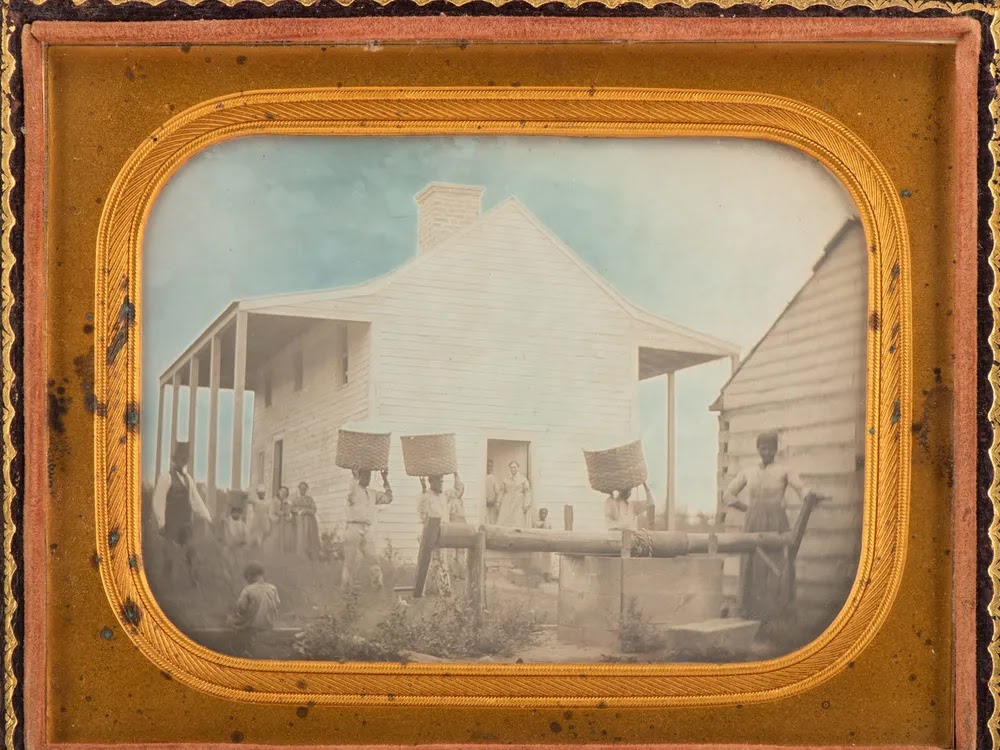
    Earliest known photograph of slaves and cotton, around 1850
    Brigit Katz, Smithsonian Magazine, December 6, 2019

    A New Nation, America from 1789 to 1860

    If you study American history from 1789 to 1860 (just before the start of the Civil War), the political history is very complicated. But remember what caused most of these political conflicts and uneasy compromises – the dynamic changes in the underlying economy. Two in particular – the spectacular increase in slave-produced cotton and the beginning of the Industrial Revolution. They were related.


    What is the Industrial Revolution? At its heart it is power-driven metal machinery producing huge quantities of goods. At first, the power was supplied by steam engines and water wheels. Later, in the 20th century, electricity. All of this used huge amounts of fossil fuels – first coal, later oil and natural gas were added. America had huge quantities of all three.


    A trend that continued from colonial times was the rapid population growth of America. This is part of demographics, the study of populations. America has had spectacular population growth throughout its history, from 4 million people in 1790 to 30 million in 1860 to over 330 million today. Two reasons for this growth were high birth rates, and open immigration until 1924. Also, Americans tended to be healthier than the people in other countries, mostly because of plentiful food. This is an important part of the American story, as discussed in the essay on colonial history. 


    There are lots of numbers when you talk about demographics, economic growth, and the Industrial Revolution. I’ll try to keep them to a minimum, hopefully just the more important ones. I also round up numbers to make them easier to read.


    The New Government, 1789-1798 

    After the Constitution was ratified and the structure of the new government was established, Americans voted in their first elected representatives in 1789. George Washington was elected president. He appointed Thomas Jefferson as Secretary of State (in charge of foreign affairs) and Alexander Hamilton as Secretary of the Treasury (financial affairs). James Madison, who wrote the first draft of the Constitution, became Speaker of the House of Representatives and established the structure and procedures in the House that are still used today.


    The government faced many of the problems left over from the Revolution. Because of the fight with the British army, Americans did not want a large standing (permanent) army.  They saw a permanent army as a threat to their liberties. America could do this because there was no serious threat on the American continent. Also, they didn’t want to get involved in European wars and political conflicts. “No entangling alliances” as Washington said. This foreign policy was possible because America was separated from Europe by the 3,000 miles of the Atlantic Ocean. 


    This was not to be. What happened in Europe during this period would have a profound impact on American history.


    The same year the U.S. government began, the French Revolution broke out. The French revolutionaries used similar ideas as the Americans. They wanted to destroy the power of the French king and the aristocracy. In 1793, they beheaded the king and queen of France and thousands of others. The other countries of Europe – all with kings or queens – were appalled. They declared war on France. One of the countries was England. England would fight France, off and on, until 1815.


    France was taken over by Napoleon. He would fight until he eventually lost in 1815. Wars are expensive and Napoleon needed money. France had laid claim to part of America. But Napoleon, fighting large wars in Europe, knew he could not defend the land from west-moving Americans. In 1803, he offered the land to America. President Jefferson bought it for $11 million. It was called the Louisiana Purchase. It was the land between the Mississippi River and the Rockies. It doubled the size of the United States. 


    After Jefferson bought the Louisiana Purchase, he established the Corps of Discovery to find out the geography of what he bought. The Corps first leaders were Meriwether Lewis (Jefferson’s secretary) and William Clark. Their famous expedition of 1804-06 traveled through the northern part of the new territory, including exploring the Missouri River. This was important for the future. America had more miles of navigable rivers than any other country. With the invention of the steamship, America had a vast internal transportation system that would help join the regional economies of the country together. Unfortunately, one of the region’s economy was based on slavery.


    Hamilton and Financing the Government 

    All governments must raise money to pay for government activities. But the U.S. government was limited in how it could raise money. The Constitution said the government could not tax American exports. No income taxes. The attempt to put a tax on goods, especially whiskey, led to riots and demonstrations that threatened the new government. What was left? Some revenue came in from land sales but not enough. Hamilton was given the task to solve this problem.


    He was ready. He started life as a teenager working for a merchant in the Caribbean. After the Revolution, he spent years studying the history and workings of government finance. His options were limited but he came up with a brilliant (and controversial) plan. He would tax imports.


    There was a larger problem. The currency issued during the Revolution (called Continentals) was worthless. The new government had to establish creditability which included faith in any new currency. Hamilton’s idea was to buy back the Continentals at face value. In exchange, the government would issue government bonds that paid interest and could be redeemed (sold back to the government) in the future. The bonds could also be traded like money. How to pay for them? From the revenue that came from taxing imports. Hamilton figured that tariffs on imports would cover government expenses and the cost of redeeming the bonds. He was right.


    I believe this was part of a larger plan he had. Hamilton saw the beginnings of the Industrial Revolution. He believed that manufacturing would be part of an economically strong country, as was beginning to happen in England.


    In 1791, Hamilton helped found the Society for Establishing Useful Manufactures (S.U.M.), to harness the waterfall energy of the the Great Falls of the Passaic RiverThe society founded Paterson, New Jersey, which became an early site of the industrial revolution in America. The Great Falls would provide tremendous energy to drive many large water wheels that powered machinery. Paterson was America’s first industrial city and would be a major manufacturing center for over 150 years.


    Hamilton’s grand plan:

    ·      Tax imports to raise revenue for the American government.

    ·      Develop domestic manufacturing to produce substitutes for English manufactured goods exported to America.

    ·      Use manufacturing to drive American economic development and growth in addition to agriculture.

    ·      Develop a class of manufacturers, bankers, and merchants.


    Hamilton’s vision was bitterly opposed by Jefferson and most Americans who thought about America’s future. Jefferson, when he was ambassador to France, saw the negative side of the beginnings of the Industrial Revolution in France and England. Dirty, crowded cities. Pollution. A degraded industrial labor force. Banking and finance. He saw all of this as a threat to a democracy based on independent, land-owning farmers.


    These two different visions of the future would be the basis of later bitter political conflicts.


    Slavery and Cotton

    The issue of slavery was mostly ignored at the national level in the early years. It was left to the individual states.


    Some people like Jefferson hoped that slavery would be unprofitable and wither away. This was not entirely wishful thinking.


    Importing slaves became illegal at the end of 1807. The Virginia and Maryland tobacco industry, the largest user of slaves, was in permanent decline after the American Revolution. Planters turned to diversified agriculture, including grain crops like wheat and fruit orchards. It was not obvious that the same number of slaves were needed or that owning and supporting slaves was profitable in the new environment. All this changed with the English demand for cotton. The deep south had a huge area of some of the best cotton land in the world. Many Virginia and Maryland tobacco planters, who owned half the slaves in America in 1790, moved to the deep south, bringing their slaves with them. Other slave owners sold some of their slaves, who were transported down the Mississippi River and sold to the cotton growers. This is where the phrase “sold down the river” came from. 


    It is one of the great ironies of history that the beginning of the Industrial Revolution in England was responsible for the survival and expansion of slavery in America. The first large industry in England was the power-driven mechanical production of cotton cloth. This created a huge and growing demand for cotton. Production of cotton cloth exploded after the war with French ended in 1815. It turned out that the largest and best growing area for the type of cotton that was best for machine production was in the American South.


    Cotton Production, 1790-1860

    Small amounts of cotton had been planted and cultivated in the United States since before the American Revolution, mostly in the islands off the coast of South Carolina and Georgia. But there was a bottleneck to the rapid expansion of cotton growing. After the cotton was picked, the fibers had to be separated from the seeds. This was done by hand. Only about one pound of clean cotton could be produced per day. But, in 1793, a Connecticut mechanic name Eli Whitney was invited by a Yale classmate to visit his mother, Nathanael Greene’s widow in Georgia. He listened to the complaints of the local cotton growers. After tinkering for a few weeks, he invented an improved cotton gin. This was a fairly simple, hand-operated machine that could produce about seven pounds of cotton per day. Further improvements increased output to about 50 pounds per day. By 1860, there were large power-driven cotton ginning factories.


    Cotton planting expanded to the west very dramatically after 1815—all the way to Texas. Planters, growers, and slaves moved from the Eastern Seaboard throughout the South and then to the Mississippi River region. Planters who owned slaves took them with them, thus avoiding the largest cost of starting a large cotton plantation. 


    The growth in cotton production was spectacular. Only about 1.5 million pounds were produced in 1790. Then, after the invention of Whitney’s cotton gin, output increased to 85 million pounds in 1810. By 1840, output rose to 830 million pounds, 10 times that of 1810. In 1860, the South produced the largest crop ever – over 2 billion pounds. 


    It was by far the nation’s main export, accounting for about 60% of the value of total American exports. Cotton exports helped pay for the imports of machinery and iron rails. 


    The South was producing about 2/3 of the world’s supply of cotton. 


    What led to an expansion of slavery was the unexpected huge increase in demand for cotton, first in England and then in the cotton mills of New England. Cotton was grown elsewhere but nowhere could a growing region produce the large and rapidly increasing amount of the type of cotton that manufactures demanded. This was made possible by the large increase in the slave population through natural increase, even after importing slaves was banned. By 1860, a very high percent of the slave population was growing, processing, and distributing cotton.


    Railroads, 1830-1860

    Starting in the 1830s, America built a large railroad network.


    America began building railroads in the 1830s, right after England built the first general-purpose railroad in 1830. By 1850, there was 8,600 miles of track. Then came a railroad-building boom. By 1860, there was 30,800 miles of track. America had by far more miles of track than any other country. New York had the most miles of track, followed by Ohio, Illinois, Pennsylvania, and Indiana. The southern states had about 1/3 of the total trackage.


    Railroad locomotives and tracks were a huge spur to iron production and manufacturing. Railroads were able to move large quantities of output (and people) from one region to another. 


    The Key to America’s Early Industrial Success

    America had abundant natural resources and aggressive “go-ahead” entrepreneurs. America also had poor immigrants who would form part of the new industrial work force. But what really drove industrialization was a new way to manufacture output.

    Thomas Jefferson was ambassador to France where he learned about an experiment to manufacture interchangeable parts to produce guns. He brought this idea to America and it was developed in America’s two armories at Springfield, Mass and Harper’s Ferry, Virginia.  It took thirty years to perfect the system.

    Interchangeable parts means that all produced units of a part are almost exactly alike. If a part of the firing mechanism of a gun had to be replaced, any substitute part would fit in without the former necessity of filing it down, fitting it, and repeating the process until it fit. This also meant that a factory could produce large numbers of all the parts and assemble the final product from any one of the parts. This system was be used to revolutionize the production of sewing machines, clocks, other metal products, and later bicycles and autos.


    The Economic Integration of the Three Regions

    The three regions of the American economy were becoming economically integrated but politically divided over the issue of slavery. America’s first large industry was also cotton cloth production in New England, with its own demand for Southern cotton. About 75% of Southern cotton was exported and 25% went to New England mills. Much of the cotton cloth output was used to make cheap clothing for slaves. The shoe factories of New England made most of the shoes worn by slaves. Southern families bought home furnishings from Northern factories. In addition, much of the cotton trade was financed by Northern bankers. Most exports went through New York. Southern planters borrowed large amounts of money from Northern bankers to expand production by buying more land and more slaves.


    Politicians and commentators debated the future of America. What no one foresaw was that these three parts of the economy of America were going to be connected.


    What would tie the three regions together was the transportation revolution, based on high pressure steam engines that drove railroad locomotives and steamboats. Steamboats exploited the largest system of navigable rivers in the world.


    Southern railroads and steamships brought cotton to Southern ports. By 1860, there were about 800 steamboats on the Mississippi River. Ships, first sailing ships, later supplemented by steam ships, carried the cotton to New York. Transatlantic ships carried the cotton to England, mostly to Liverpool.


    Northern farm families streamed into Ohio, Indiana, and Illinois in search of new farmland. These states had the biggest increase in population between 1850 and 1860. These farmers produced food for the increased population of Eastern cities and for exports. Produce went to market first through canals and then mostly by rail. Beside moving cotton to market, the greatly increase speed and capacity of railroad brought Western grain east and manufactured goods west. The new Western farms also supplied corn and pork to the Southern plantations, much of it sent south on Mississippi steamboats.


    By 1860, America had three sources of economic growth:


    Expansion of agriculture based on population growth, unlimited land for independent farmers, and westward expansion. 


    Expansion of slave-based cotton production. By 1860, Mississippi produced the most cotton, followed by Alabama and Louisiana.


    By 1860, the Industrial Revolution in Americas was well on its way. More money was invested in cotton mills than in any other industry. The second largest manufacturing industry was the iron industry.


    To the Civil War 

    The issue of slavery was the main cause of most of the political battles during this period, including the annexation of Texas and the war with Mexico to make Texas a slave state. There was a rise of anti-slavery sentiment in the North and West. Arguments were increasingly made for the abolition of slavery. There was effective propaganda, like Harriet Beecher Stowe’s book Uncle Tom’s Cabin. In response, the Southern defense of slavery became fierce – no compromises. Slave ownership and cotton production became the basis of the economy, political power, society, and culture of the South. 


    There was a danger to the expansion of cotton production and slavery as more new states in the future would be “free soil” (no slavery) states than new slave states. The South would lose political power in the national government and might be threatened with the abolition of slavery. Arguments on both sides became very emotional. When Abraham Lincoln was elected president in 1860, the South saw him as a threat to the survival of slavery. Although he hated slavery, he did not advocate its elimination. He wanted to stop it spreading to new states. Southern planters believed they needed new land as old cotton lands wore out and produced less cotton per acre. The Civil War – the South’s attempt to leave the union – started even before Lincoln was inaugurated. 


    The 1860 Census – the United States on the Eve of the Civil War 

    Total population – 31.4 million

    White population – just under 27 million (86%)

    Slave population – just under 4 million (13%)

    Free blacks – just under 500,000 (1.6%)

           Does not exactly equal 100% because of rounding


    Number of whites in the South – 5,800,000. This is the number of whites in the South in states that left the United States in the Civil War.


    Number of whites in the North – 21,200,000. This includes slave states that did not leave the Union in the Civil War.


    By 1860, despite continuing immigration, most Americans were native-born. Of the 27 million whites, about 4 million were foreign-born. Just under 75% of the immigrants during this period came from Ireland (because of the famine) and the German States (Germany did not become a unified country until 1871). Of the black Americans, almost all were native-born since the Constitution prohibited importing slaves after 1807. 


    Remember there were about 700,000 slaves in 1790. Most of the increase came from the high birth rates in the number of slaves.


    There were more slaves than whites in Mississippi and South Carolina. Slaves made up at least 40% of the total population in Alabama, Georgia, and Louisiana (almost 50%).


    Almost 400,000 white families owned slaves. But most of them were owned by a small percent of the slave-owners. About 280,000 whites owned fewer than 10 slaves. At the other end, about 11,000 whites owned 50 slaves or more; 14 of them owned 500 slaves or more.


    At the beginning of this period, slavery was legal in all 13 colonies. But the ideals of the American Revolution motivated some Americans to think about abolishing slavery. By the end of this period, all northern and western states had outlawed slavery. The arguments for and against slavery became more shrill. Some attempts at compromise, as advocated by Abraham Lincoln, were rejected by the south. The essay cited below argues that the Civil War, unlike the American Revolution, was inevitable. 

    =========================================================

    For two essays on earlier periods of American history, see


    American Colonial History, 1607-1775


    Revolution and the New Country:  American History, 1775-1790

    For an analysis of:  Was the Civil War inevitable?, see 

    The American Civil War

    For an example of the transition from using hand tools to power-driven machinery for production, see

    Adam Smith’s Pin Factory

    For an essay focused on the industrialization of America in the same period, see

    The Beginning of the Industrial Revolution in America

    For an analysis of:  Was the Civil War inevitable?, see The American Civil War


    For a list of all essays on this blog, with links, see 


    List of Posts by Topic


    There are more posts on American History and American Economic History. Also essays on Rome and the period surrounding World War I.

    Essays on information, innovation, and how markets work. 

    Essays on business, finance and economics. 

    A series of essays on demographics, population projections, and speculations on how decreasing and aging populations will interact with the economics of individual countries and the global economy.


  • The American Civil War

    The American Civil War


    INTRODUCTION


    This is not a military history of the American Civil War. Instead, it tries to answer three related questions:

    Was the war inevitable in 1861?

    Could it have been avoided?

    What were the alternatives to war? 


    BACKGROUND


    America has a peculiar political structure. Major decisions such as abortion, gun laws and legalizing drugs are often made by states, not the national government. The Constitution does not say anything about whether slavery should be abolished or remain legal. So slavery would be legal and protected in the major cotton-producing states. Congress could pass a law outlawing slavery but it couldn’t be enforced in the slave states.


    In 1861, southern cotton production was important to the northern economy. Cotton textile production was the largest industry in the north. New York City handled most of the distribution of the cotton crop and much of the financing of exports to Europe. Cotton was also by far America’s largest export. (For more on the economic integration of the three regional economies of the United States, see my post American History, 1790-1860.


    So, in the foreseeable future, slavery was probably safe from legal abolition. But not from criticism and political pressure. There was increased agitation to abolish slavery.


    THE SOUTH’S ECONOMIC POSITION IN 1860


    The South didn’t need new land in new states to produce more cotton, although many southerners didn’t believe it. There was much unused and underutilized land in the existing cotton states. Southern agricultural publications advocated better farming techniques to increase output per acre and use the land more productively.


    It was very likely that the high growth rate in the southern production and sale of cotton would slow down. Global demand was already high. One reason the South had spectacular growth rates in the past was that the South could fill the increased demand nationally and globally. Besides more land and the natural increase in the number of slaves, much of the slave population was moved from the upper south, tobacco-growing regions, such as Virginia and Maryland, and the cities and towns in the South to the cotton-growing regions. This internal migration was almost over; there were fewer slaves left in urban areas.


    From an economic point of view, the South would continue to benefit from its dominant position of supplying the type of cotton needed by cotton textile mills. There was room for expansion, but not at the spectacular growth rates in the past. Both supply and demand would probably grow slower. Growing cotton in the South would probably remain profitable. In summary, the South would continue to prosper even with the status quo. 


    Growing cotton was still an expanding and profitable business (see the definitive economic analysis, Robert Fogel’s Time on the Cross).


    1859 saw a record-size cotton crop. The crop in 1860 was even bigger. It was profitable to use slaves to produce more cotton. The South could reasonably expect a continuation of the trend of the natural increase in the number of slaves and growing demand for its cotton, even if future growth rates would be slower than in the past.


    THE SOUTH’S POLITICAL FUTURE


    Slavery could only be abolished by a constitutional amendment. This could not happen in 1861 because there were enough slave states to block approval.


    When the South seceded in 1861, there were 34 states. To pass a constitutional amendment abolishing slavery, ¾ of the states, or 26 states, would have to approve the amendment. There were only 19 states without slavery and 15 with, more than the nine states needed to defeat the amendment. Slavery was safe. So why did some of the slave states secede from the union?


    Between 1820 and 1850, politicians crafted compromises to preserve southern political power. The basic tool was that there would be an equal number of slave states and free states, meaning equal representation in the Senate. But continuing western migration of Americans into the Louisiana Territory indicated that most if not all of the new states carved out of the territories would be non-slave states.


    Some southern politicians worried that there would be more “free soil” (no slavery) states in the future. As many as ten new states might be admitted to the Union over the next 20 or 30 years. None of these states would have the natural environment needed to grow cotton. All of them would probably be “free soil” states. Then there would be enough states to pass an anti-slavery amendment.


    Even if this didn’t happen, the slave states would have diminishing power at the national level. A southerner would probably not be elected president and the South would have a declining minority of members in Congress in the future. Non-slave states would dictate domestic economic policies and critical tariff policies. They would favor industrialization and the expansion of western agriculture. 


    Slavery might be threatened with legal abolition in 20 or 30 years as more non-slavery states were admitted to the union. Southern states could try to secede in the future but ratio of resources would be even worse. The wide gap between the white population of the North and the South would become even wider. It could not be filled with immigrants. European immigrants were reluctant to go to southern states because good land wasn’t available; large numbers of white southerners, including Abraham Lincoln’s family, were moving out of the South looking for better farmland. Unskilled immigrants would find few jobs because of a lack of industrial jobs and competition from slaves.


    The North would continue to increase industrial and food production, and the railroad network, widening the gap in total output and material needed to fight a war.    


    The South would be at a worse disadvantage in terms of relative resources to fight the war. The South would be more likely to lose a war in 1881 than in 1861.


    IF SLAVERY WAS SAFE FROM ABOLITION IN 1861, WHY DID THE SOUTH GO TO WAR?


    If slavery was constitutionally abolished, it was likely that most former slaves would remain in the South as free workers. Cotton production would continue, with former slaves as farm workers or sharecroppers. But this was not certain. In addition, slaves were the largest source of wealth in the South. The total value of slaves was greater than the total value of the land. Slave owners would be much poorer in terms of wealth. Debts incurred in buying and maintaining slaves remained. Equally important, owning slaves provided status and power, particularly to the large slave owners who dominated local politics. Owning slaves and growing cotton were the foundations of the southern society.


    Even if southern slaveowners weren’t looking at longer-run trends, there were immediate reasons to be worried. 


    Political pressure from the North to abolish slavery was getting stronger. Anti-slavery sentiment rose in the 1850s because of the Fugitive Slave Act, the Dred Scott case, publication of Uncle Tom’s Cabin in 1852 (an abolitionist, anti-slavery novel focused on the horrors of slavery and the treatment of human beings as property), the violence in “bleeding” Kansas, and John Brown’s raid on Harpers Ferry to seize guns and presumably start a slave rebellion. In reaction, anger and fear ran high in the South. 


    The trigger of the secession and the war was the election of Abraham Lincoln, representing the new Republican party. Many leaders of the party were abolitionists. 


    Lincoln was personally opposed to slavery. But his political position was that he would leave slavery alone in the existing slave states but that no new states would be admitted as slave states. This was a more moderate position than that of many Republican politicians. Even so, the South saw this as a threat to their expansion, their political power, and possibly their long-run survival as slave states. Southern states began to secede even before Lincoln took office.


    WHY DID THE NORTH GO TO WAR?

    More people in the North saw the conflict, and later the war, as a moral crusade, as indicated by the words of the Battle Hymn of the Republic. The conflict between liberty and slavery could no longer be ignored. There would be less chance of negotiations or political compromises than in the past.  


    According to Abraham Lincoln, the North went to war to preserve the Union. In other words, when a state was admitted into the Union, it could not leave. But why not just let the Southern states go? It would greatly weaken the Union. Other states might secede for other reasons. New England states talked about seceding during the War of 1812. There was the danger of the dissolution of the Union. Like during the years right after the Revolution, there would be a very weak national government. It was also feared that the separate states might be at the mercy of European countries. 


    Or each other. There were many disputes among the states before and after the Revolution. They continued. There would be no national mechanism to resolve disputes. States might go to war with each other.


    The United States would now have a powerful new potential enemy along its borders in continental America. The whole point of fighting the Revolution and buying the lands in the Louisiana Purchase was to eliminate threats to the new republic. England, heavily dependent on Southern cotton for its most important industry, might form an alliance with the South. (During the Civil War, many powerful political and economic groups advocated recognizing the Confederacy.)


    The economic integration of the three regional economies of the United States might be weakened or shattered. A Southern government would control the Mississippi River and many of its tributaries. Both countries could put up tariff and other trade barriers against the other. The South might ban the sale of cotton to northern cotton mills. The North could retaliate. 

    Another economic option for an independent South might have been building cotton mills in the South to capture more of the value-added from growing cotton and competing with the northern mills. This began to happen in the 1890s.


    ALTERNATIVES

    • ·      Increased national and international pressure.
    • ·      Industrialize.
    • ·      Have the federal government buy out the slaveholders.
    • ·      Free the slaves.


    After the 1880s, the U.S. would have been the only country in the Americas with slavery. Brazil was the other country. But slavery was unprofitable in Brazil as the country moved away from plantation crops. Slavery slowly faded away. This was not possible in South – the whole economy and society depended on one plantation crop produced by slaves. 


    Maybe international pressure could be brought to bear if alternative sources of cotton expanded. But this was unlikely.  The South filled almost of the global demand for their type of cotton, which was the kind used by most cotton mills. Southerners knew the world (and the North) needed their cotton. They were the one-source OPEC of the 19th century.


    Slave owners didn’t even consider any alternative use of slaves. This was outside of their mental framework. South did not consider industrializing or any alternative investment to slaves. Putting up factories was what Yankees did. The whole culture was against it. 


    Another alternative was for the federal government to buy out the slave owners. When England outlawed slavery in all its possessions, it compensated the slave owners in the Caribbean with long-term bonds. The U.S. could have done the same thing except the cost would have been higher. Voters in non-slave states would probably have to pay most of the cost (higher taxes, tariffs, and fees) and might not have been happy about it.


    What would it have cost? There were about 4 million slaves in 1860. The average market value might have been as high as $500/slave. So, the cost was about $2 billion. The market value of the total output of the U.S. in 1860 was about $4 billion. If the government issued bonds, at say 3%, the total yearly interest cost would have been about $60 million. This was higher than the government’s total yearly revenue. And over a long period of time, the government would also have to pay out the $2 billion.  Maybe some of it would come out of higher future tax revenue. But most of it probably from the sale of new bonds. But the United States had a long history of reducing federal debt.


    The South did not consider another alternative. Free their slaves. It was illegal in the South to talk about it or even to possess anti-slavery publications. Both the Methodist and Baptist churches split over the issue of slavery; there was little moral or religious condemnation of slavery in the South. And it was illegal to free slaves in most slave states.


    As it turned out, this is what happened after the Civil War. Ten years later, the South was producing as much cotton without slaves as before the war. But the white landowners could still exploit black labor. How? Many of the former slaves stayed on the plantations and worked for wages. Or sharecropping. There were no local stores. The planters established stores and charged their workers high prices. Most workers went into debt and couldn’t leave the plantations. 


    ADDENDUM:  FIGHTING THE WAR TO SAVE SLAVERY


    The South should have learned the main lesson of the American Revolution. The longer the war went on, the better the chance the North would have given up. The South fought mostly a defensive war. But the South’s main general Robert E. Lee was aggressive. He invaded the North in 1863 and lost the battle of Gettysburg. Combined with the loss of Vicksburg, (the North now controlled the Mississippi River and New Orleans, and was in a position to invade the deep South), the war was lost as long as Lincoln was president. But many in the North were appalled at the human cost of the war or were tired of it. Lincoln almost lost the election of 1864 to an opponent willing to discuss the end to the war. The South fought on. Why? Because by then there was little chance for negotiations. More people in the North saw the war as a moral crusade to end slavery. There would be no negotiations or political compromises as in the past. The attitudes hardened on both sides as the war produced huge casualties. Like World War I, it was a war of attrition. It was a fight to the end.  


    The South knew it had two choices – independence (keeping slaves) or being dictated to by the North (abolishing slavery).


    No one thought of the cost of the war. Southerners thought they were going to win the war quickly and preserve slavery. But 200,000 Southerners lost their lives; many more were seriously wounded. Much property was destroyed. (See the movie Gone with the Wind and the burning of Atlanta. In the movie, they burned down the set for King Kong.) The South couldn’t sell cotton to raise money because of the Northern naval blockade during the war. It took over 10 years to recover.

    ===========================================================

    For the background on the contentions in this post, see A New Nation:  America from 1789-1860


    For posts on American colonial and early national history, see

    American Colonial History, 1607-1775


    Revolution and the New Country;  American History, 1775-1790

    For posts on American economic history, see 

    The Beginning of the Industrial Revolution in America

    How America Industrialized and Became Wealthy

    The Stock Market Crash of 1929 and the Great Depression


    Alice in Wonderland and the Origins of Silicon Valley


    For a list of all posts on this blog, see List of Posts by Topic with links to all other posts.


  • Alice in Wonderland and the Origins of Silicon Valley

    Alice in Wonderland and the Origins of Silicon Valley

    I reread Alice in Wonderland last year. I’ve been reading a lot of weird books in the last two years but Alice in Wonderland is the weirdest. It’s like a children’s story written by Franz Kafka.

    The book and its images continue to resonate. I’ll skip the cheap shot of recalling the Mad Hatter’s Tea Party because a lot of recent commentators have already used it. Also, there’s a serious idea in game theory called the Red Queen Effect, even a whole book about it by Matt Ridley. (Any book by Matt Ridley is recommended.)

    But the time Alice in Wonderland really resonated was the 1960s. The following are the lyrics from the group and the song that was virtually the anthem of the Berkeley/San Francisco counterculture. It was written by the group’s lead singer, Gracie Slick.

    “White Rabbit” by Jefferson Airplane

    One pill makes you larger

    And one pill makes you small

    And the ones that mother gives you

    Don’t do anything at all

    Go ask Alice

    When she’s ten feet tall

    And if you go chasing rabbits

    And you know you’re going to fall

    Tell ’em a hookah smoking caterpillar

    Has given you the call

    Call Alice

    When she was just small

    When men on the chessboard

    Get up and tell you where to go

    And you’ve just had some kind of mushroom

    And your mind is moving slow

    Go ask Alice

    I think she’ll know

    When logic and proportion

    Have fallen sloppy dead

    And the White Knight is talking backwards

    And the Red Queen’s “off with her head!”

    Remember what the dormouse said;

    “Feed your head. Feed your head.”

    OK, it’s not surprising that the images in Alice in Wonderland seem psychedelic (explicitly so in the Walt Disney movie version of the book) and would appeal to the Bay Area counterculture. But the story gets even weirder. It is documented in:

    John Markoff, What the Dormouse Said: How the Sixties Counterculture Shaped the Personal Computer Industry. 2006.

    The counterculture, anti-establishment, drug-taking environment of this area in this period nurtured the thinking about the possibility of a personal computer. This was a radical idea. Some of the research was funded by the Pentagon!

    Concepts that would later be crucial to using the PC were first conceived here. They were developed as “the office of the future” by PARC, a think-tank owned by Xerox that employed non-corporate locals. Xerox management in Connecticut then declined to develop these ideas (see Fumbling the Future) but their potential was realized by a new company just down the road – Apple. And Steve Jobs and Steve Wozniak (whose idea of developing a PC was turned down by his employer, HP) were members of a loose group of sixties types called the Homebrew Computer Club, which has attained almost mythical status in the development of the new technology. (Bill Gates bought Microsoft’s first commercially successful operating system from a member of the Homebrew Computer Club. He licensed it to the enemy – IBM.)

    There is an interesting question in the history of technology – Why was the personal computer and related technology developed in Silicon Valley (Stanford/SF/Berkeley) and not in Cambridge, Mass (Harvard, MIT, lots of computer companies)? Now you know where to find the answer – go ask Alice.

    But the story has one more weird twist. The Pentagon heard about LSD use in the area because of its funding of personal computer research. The army thought there might be a military application – soldiers on LSD would have heightened perception. So the Pentagon funded the use of LSD around Stanford until its negative side-effects became apparent.

    To steal a quote – you can’t make this stuff up. Reality (?) is even weirder than Alice in Wonderland.

  • Berkeley in the 60s:  A Personal Reminiscence

    Berkeley in the 60s: A Personal Reminiscence

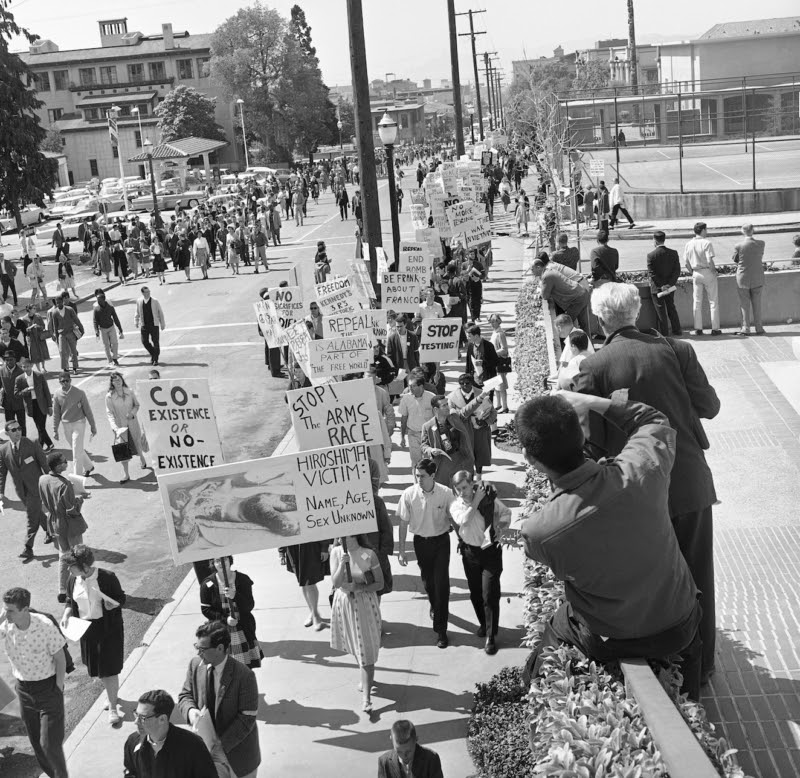
    Berkeley 1962 – 30 students against racial discrimination

    I was mildly political in high school. In 1960, I picketed the Democratic Convention that was in L.A. with a small group of radical Quakers protesting atmospheric testing of atomic weapons. The protest was in front of the Biltmore Hotel, where the candidates were staying. We were outnumbered by federal agents with cameras. After our little protest, I wandered into the Biltmore. While loitering in the main corridor, John Kennedy walked by. He was a few feet away. I didn’t think much about it until his brother was assassinated eight years later in a different Los Angeles hotel. Looking back, I was amazed at the lack of security. A kid in a protest just walks into the hotel – no security at the door, no identity checks, very little security (if any) around Kennedy. I guess all the government agents were too busy developing the film they took of our protest and writing detailed reports on how Quakers were threatening America’s security.


    In high school, I planned to go to Berkeley, as did my liberal friends. I had my life planned. Undergrad major in Poli Sci/International Relations, law school (probably Boalt, Berkeley’s law school), and lawyer in SF (back to LA, if desperate). The Fates laughed.


    I graduated high school in Los Angeles a semester early in 1962 and started Berkeley the next week. I was at Berkeley for one semester as an undergrad in Spring 1962 and one semester as a grad student in Spring 1966. I visited friends at Berkeley in the intervening years.


    My parents drove me up to Berkeley and dropped me off. I decided to see the campus. It was getting dark and the campus was deserted because of the semester break. A little spooky. All the buildings were dark. But at the top of the hill Berkeley was built on was a large building fully lit up. Everyone working on a Saturday night between semesters? I later asked a friend about it and he laughed. Sort of. He told me that was where Edward Teller and associates designed bigger and better hydrogen bombs.


    (A little history for everyone who saw the recent movie about Oppenheimer. Teller helped to design the first atomic bomb at Los Alamos. He was part of a brilliant group of European refugees that came to the United States mostly in the 1930s. When designing the first hydrogen bomb later, he got his fellow Hungarian refugee, John von Neumann, to design and supervise the construction of the first modern computer to solve partial differential equations and thus speed up the development of the bomb.)


    In 1962, Berkeley was more an extension of the post-war 1950s than its later image. Rather quiet, laid-back (hey, we’re talking California here), students hanging out. Folk and folk-rock music, early rock and roll. Peter, Paul and Mary gave a free concert. Students optimistic and career-oriented. We recognized the new opportunity that college provided; almost all my high school friends and I were the first in our families to go to college. 


    There was little political activity on campus. Some interest in hippie culture. The dominant political cause was the civil rights movement but not much active interest. There wasn’t any civil rights group on campus. A friend and I decided to start one. 


    In those days, you had to get permission from the university to set up a table and distribute literature. So these two nebbishes climbed the stairs of a huge admin building called Sproul Hall (Woody Allen stole this scene for one of his movies). We finally found the office. The admin flack-catcher wasn’t in but his secretary was; it was obvious she ran the office. She was a middle-aged white woman who spoke with a southern accent. I figured as soon as we left, she would drop our application into her wastepaper basket. While my friend filled out the form, I talked with her. I mentioned that the group we represented (Southern Christian Leadership Conference) was run by Baptist ministers. I forgot to mention they were black. She immediately approved our application.


    Two years later, the campus exploded in a student protest called the Free Speech Movement against the administration’s right to ban political activity on campus it didn’t like, including setting up tables and distributing political information. Thousands of students protested, including a massive sit-in in Sproul Hall. Mass arrests. Eventually, restrictions on student political activity were lifted.


    The Free Speech Movement had some unintended consequences. Ronald Reagan was unexpectedly elected governor of California on a platform that he would “clean up the mess in Berkeley.” The local DA who had the students arrested became Reagan’s Attorney General after Reagan became president. The head of the California university system, Clark Kerr, whose office was in Sproul Hall, was fired for being soft on student radicals. The steps leading up to Sproul Hall were later named after one of leaders of the movement.  


    Back to 1962. It was the last semester of compulsory ROTC, with weekly drill in uniform. Drill was canceled if it was raining hard or the fields were too wet. The university announced cancellation by ringing the campanile bell. So, at 1 PM on the day of drill, the male student body stopped what they were doing and stared up at the campanile. Campus-wide silence. Sort of like a cargo cult or waiting for divine intervention. I learned a new skill – how to spit-shine shoes.


    This was the last semester of NO TUITION in the Cal university system. The administration announced that the next academic year would have a yearly tuition of $100! The announcement triggered the biggest student protest and demonstration of the semester. (Actually, this was a bigger deal than it seems today. Students had part-time and summer jobs that paid $1/hour. So 2 ½ weeks of summer employment now went to pay for tuition rather than room and board.)


    There was little interest in Vietnam.


    Even in this tranquil setting, it was impossible to avoid politics. Richard Nixon, having lost to Kennedy in 1960, was getting ready to run for governor of California. He was giving “non-political” speeches around the state, including Berkeley. Before he came out of a building to give his outdoor speech, the Cal Prep Band, engaged to whip up enthusiasm for Nixon, played “It Ain’t Necessary So.” The audience went wild. Nixon walked out and thought all the “enthusiasm” was for him. He learned differently as soon as he started to speak.


    President Kennedy came to campus and gave a speech to a large audience in the football stadium. I don’t remember what he said except something about his wife riding an elephant in India. Afterwards, a prof in the Poli Sci department, an expert on China, had organized a debate on whether or not the U.S. should be in Vietnam. His opponent was a member of Kennedy’s cabinet. Oxford debating rules – quiet audience, no clapping, no shouting or any other interruptions. After the debate was finished, the audience voted for who they thought made the better argument. Since it was right after Kennedy’s speech, I guessed a majority would vote for Kennedy’s man. I was wrong. Over 90% voted for the critic. I thought that if the Kennedy administration couldn’t sell the policy to a sympathetic group of liberal students right after a Kennedy speech, there might be trouble for Kennedy’s government if involvement lasted a long time or was expanded.


    By coincidence, I read Thucydides’ Peloponnesian War later that year. I only wish that America’s political leaders over the last 60 years had read it. 


    1966. Back to Berkeley. I had a new plan. Ph.D. in Economics from Berkeley and then teach or work in the SF area. The Fates laughed again.


    Some hippie, counter-culture, feel good vibes but, overall, the atmosphere was different than in 1962. Vietnam changed it. Big draft calls began in 1965. Anti-war protests, rallies and demonstrations on campus and at the army induction center in Oakland. Elected student radicals dominated student government. Darker mood. Angrier, more radical rhetoric, much more critical of all aspects of American life. Usual weed but now more LSD and other psychedelic drugs. Ken Kesey and the Grateful Dead in nearby Santa Clara county, now known as Silicon Valley. Dominant music was psychedelic rock. Beatles still popular but they were moving from teeny-bopper (I Want to Hold Your Hand) to psychedelic/political (Sgt. Pepper in 1967). Jefferson Airplane at the Fillmore and The Doors at Whiskey a Go Go, where I celebrated my 21th birthday. I went to the Fillmore twice; i didn’t see Jefferson Airplane but I did see Quicksilver Messenger Service. I think. Memory a little hazy. Saw Grateful Dead earlier.


    Berkeley had one of the first large anti-war street demonstrations. Thousands of students. It was broken up by the Alameda County cops. I was in another anti-war street demonstration that summer in Los Angeles. This one was broken up by L.A. cops even though ground rules for the demonstration had been worked out with the city. The protest march took place in Century City, a new development of high-rise corporate buildings next door to Beverly Hills. A very west L.A. young adults crowd. Workers of Beverly Hills, unite!


    The war in Vietnam changed everything. Changed the political mood on college campuses and in the country. Even worse was to come after 1966.


    Out of all this did not come hippie counter-culture and communes. Or radical politics or a new political party. Or any swerve from America’s technocratic future. The Chancellor of the California university system, Clark Kerr again, was explicit on what his goals were for higher education – to provide college-educated personnel for the growing industries and corporations of California, especially the defense industry. And, I assume, for Dr. Teller’s operation on the hill. He was just too soft on free speech and students’ rights.


    His program succeeded, just not quite according to plan. The drug-influenced counter-culture of the Bay area produced a disproportionate percent of America’s top entrepreneurs who developed the new digital technology. Out of all this came Silicon Valley, PARC (the digital office of the future), the Homebrew Computer Club and Steve Jobs. Apple in its early years ran a brilliant commercial equating IBM with Big Brother of 1984. Aired, ironically, during a Super Bowl game. Then Apple became the new IBM. The “permanent revolution” of corporate technological change continued. The vision of PCs for the people, a technological counter-culture, became Microsoft, Intel and later, the advertising behemoths Google and Facebook. The Fates laughed. (For a little more detail on how the SF counter-culture ended up creating America’s technocratic and corporate future, see my Alice in Wonderland and the Origins of Silicon Valley.)


    I am not very nostalgic about the 60s. They ended badly. Robert Kennedy and Martin Luther King were assassinated. Richard Nixon was elected president and extended the Vietnam War for four more years. It was possible to see the beginnings of the reactionary “counter-revolution” in the 1970s. It has never stopped.


    And yet. It was the beginning of a long period of positive change – end of legal segregation and most discrimination. The changing role of women, maybe the most widespread change in America over the last 60 years. Beginning of the environmental, organic farms and food movement (America’s national commune? Mass-produced organic foods?). Expansion of legal and civil rights to new groups. More opportunity and alternatives. More tolerance.  But there were limits – fierce opposition to gay rights, abortion, and celebration of “diversity.” A new economic elite not entirely made up of white males. Part of the group who thought they were still running America were left behind because of the digital technology revolution and the resulting global economy. They were not happy. 


    This complicated, contradictory future was not obvious to me at Berkeley in the 60s.


    ——————————————————————————–

    For a list of all the posts on this blog, see List of Posts by Topic

    with links to all other posts.


    Again, a loosely related bit of California history:


    Alice in Wonderland and the Origins of Silicon Valley


  • The 10 Minute MBA – Almost Everything You Need to Know to Manage Organizations, People, and Yourself

    The 10 Minute MBA – Almost Everything You Need to Know to Manage Organizations, People, and Yourself


    Positive Externality


    You need to know three things about management and corporate finance:


    80/20 Rule

    Opportunity Cost

    Compound Growth


    80/20 Rule (Also called Pareto’s Law)


    This idea says that a relatively small percent of actions account for a relatively large percent of outcomes. Find and concentrate your efforts on the important influences on your business (and life).


    20% of your customers account for 80% of your sales.


    20% of your product line accounts for 80% of your sales and profits.


    Often, companies with a large product line with many variations find that 50% of their products account for over 90% of sales. An even smaller percent usually account for most of the profits.


    20% of your SKUs account for 80% of your stockouts (and lost sales).


    20% of your programmers account for 80% of the bugs in new programs.


    The percentages aren’t always 80/20. Some examples:


    McDonald’s accidentally learned that 10% of its customers accounted for 60% of its daytime sales. And it was an identifiable group that they had never aimed its massive advertising at.


    A landmark study by Arizona State University found that over the past century, just 4% of stocks have accounted for the entire net gain of the US stock market The other 96% were either flat, down, or so volatile they gave back everything they made.


    The possibilities are almost endless.


    The 80/20 rule implies:


    “Less is more” … reminds us that much of what we do, when closely analyzed, has negative value. Many activities, customers, products and suppliers actually subtract value, which helps to explain why their very positive counterparts produce such a high proportion of net value.


    Richard Koch, The Natural Laws of Business(182-3)


    Eliminate losing products, customers and functions. This is probably happening because a competitor is more innovative or new companies have entered your markets.


    Look at divisions, regions or product lines that consistently have low sales growth rates and make below the minimum cost of capital. Reduce or eliminate these businesses. This frees up capital and resources to find and fund growth opportunities. Loser operations have a potentially high opportunity cost (see below).


    Look at positions or functions in the corporate structure that don’t add value to the company. Eliminate or outsource. This is a major strategy many companies are now pursuing, which is why a high percent of job losses over the last three decades occurred because the position or function was eliminated.


    Better yet, avoid complexity in the first place. Concentrate on what you’re good at. Pound away at it. No complacency. Continuously innovate. And, with Andy Grove, be paranoid; your actual or potential competitors want to eat your company. (His successors at Intel obviously didn’t read his book. They became complacent. A beast named Nvidia is devouring them.)    


    Growth through mergers and acquisitions is a high-risk strategy with a high failure rate (loss or discounted return below the cost of the acquisition). The seller knows where they bad stuff is hidden; you don’t. (If you missed this in B-school, it’s called “asymmetric information.”) 


    If you get into a bidding war with another company, walk away. The odds of “buyer’s remorse” is high. 


    Opportunity Cost


    After you’ve identified the critical opportunities and problems, opportunity cost is a good guide to deciding what to do about them. It reminds you that time and assets are limited and valuable. Time and assets you spend on one problem or function might be more profitably spent managing something else. For example, if you have a small customer who takes up a lot of your time, either raise prices, reduce service or stop supplying her. The opportunity cost is too high.


    Opportunity cost is a guide for better decision-making. Good managers think in terms of possible alternatives, not simple yes or no decisions on isolated proposals.


    What are the realistic options and alternatives (not a list from a management textbook)? Is there a less expensive (more profitable) way to do something? Lease or rent rather than own? Outsource some of your production?


    What is the net benefit (profit) over time of each alternative?

    Include risk as part of cost. If your company depended on inputs from China, as soon as President Obama (and successors) focused on China as America’s number one geopolitical threat, it was time to diversify your sources to other countries.


    In the extreme, some corporations have learned they are in the wrong business. They could have used their time and assets more profitably doing something else.


    A word about accounting systems. Accounting systems are not set up to tell you which products or services are profitable. They are also poor indicators of return on capital or assets. Asset values should be adjusted from depreciated historical cost to present opportunity cost (often market value if sold or leased). The classic example is that Coca-Cola for decades carried the value of their brand name at $1 on their balance sheet. Really?


    Compound Growth (also known as exponential growth). 


    After you’ve freed up people and resources by applying the ideas of the 80/20 rule and opportunity cost, start looking for growth opportunities. By this time you will have a good idea what are the critical factors for your company’s success, the knowledge and resources that give you a competitive advantage. Develop opportunities that have a good chance for  sustained  high growth rates. Know the difference between unit sales growth rates and dollar amount of sales growth. 


    In the beginning, new ventures often have low sales compared to the size of the company but high compound growth rates. If there are high growth rates, these ventures can become large contributors to sales and profits in the future. Other good things can happen such as continuing reductions in unit costs.


    One application is personal investment. Compound growth rates are the first thing you need to know about finance, particularly personal investing. Earn income. Start saving early, save steadily over a long period of time, invest in high-quality bonds and dividend-paying stocks, and reinvest interest and dividends. Let compound interest (interest on principal and past interest) do its thing. Same advice for investing in stocks generally – start early, invest in index funds. Starting early is important because there will be periods when stock prices go down or stagnate. Spend all the time you save not analyzing or worrying about investments doing more pleasant and productive things (see opportunity cost).


    These three tools work together.


    These ideas applied to starting a new business:


    Opportunity cost is a part of start-up costs.

    Loss of income from the job you quit.

    Loss of income from the saved money you invest.

    What are the critical factors for success?

    Look for sources of exponential growth and exponential reductions in unit costs as volume grows.


    These ideas applied to personal life:


    Eliminate activities and people with high opportunity cost.

    Avoid high-maintenance (high opportunity cost) people (selfish, self-centered, demanding, whiny, long-winded). Life is too short.

    Concentrate on a small number of important people and activities who add meaning to your life.

    Remember the learning curve when starting something new.

    Persevere; learning something new is slow going at first but accelerates. (Again, concentrate on what’s important; 30% of the assigned reading in a textbook will account for 80% of the questions on the tests.)


    ALMOST EVERYTHING YOU NEED TO KNOW ON HOW TO MANAGE AN ORGANIZATION


    BEST BOOK ON HOW LARGE ORGANIZATIONS REALLY FUNCTION


    Joseph Heller, Catch 22.


    BEST BUSINESS MANAGEMENT BOOK


    Andy Grove, Only the Paranoid Survive. Andy Grove grew up in communist Hungary, escaped during the Hungarian Revolution, got his Ph.D. in solid-state physics at 22, and was CEO of Intel during its critical period developing and mass producing the integrated circuit (aka the microchip).


    BEST ADVICE ON STRATEGIC MANAGEMENT FOR A SMALL, DISRUPTIVE COMPANY


    “Hit ‘em where they ain’t.”

    “Wee Willie” Keeler


    One of the greatest hitters in baseball. Only one of 22 men ever to hit over .400 in a season. Also one of the smallest ever to play in the major leagues. Innovative. See biography in Wikipedia.


    “Get there the firstest with the mostest.”

    Nathan Bedford Forrest


    Surprisingly successful Confederate general in the Civil War. Consistently defeated larger Union armies. Not size but speed, surprise and force at the point of attack leads to victory. Same strategy used by Stonewall Jackson and Erwin Rommel against larger forces. Reason for success of guerilla warfare.


    Good general advice but especially relevant if you are going up against a larger competitor with more resources. Hit them hard where they are weak. Toyota almost destroyed the huge and powerful General Motors by first attacking GM at its weakest point (compact cars).


    ALMOST EVERYTHING YOU NEED TO KNOW ON HOW TO MANAGE PEOPLE


    Be consistent.

    Subordinates will then know how to act and what to expect.

    If you are consistently nasty, expect to change jobs every two or three years.


    Business educators, consultants and commentators love sports analogies. But be careful. My favorite.


    Football (American) analogy. Be a pulling guard. You’re a pulling guard, not the quarterback (COO) or coach (CEO). Run interference for your people so they can concentrate on high value-added work.

    Hire good people (independent, flexible, adaptable, cooperative) and have confidence in them. Trust them.


    Never hire a graduate of Harvard Business School or anyone who has only been a consultant. They think they are qualified to run the business. Before they understand it.


    If your company’s management is hiring a lot of management consultants to tell everyone how to run their operations, you should probably update your resume and think about working for a better company. One that has confidence in its employees.


    MANAGING UNDER UNCERTAINTY


    “Nell,” the Constable continued, “the difference between ignorant and educated people is that the latter know more facts. But that has nothing to do with whether they are stupid or intelligent. The difference between stupid and intelligent people – and this is true whether or not they are well-educated – is that intelligent people can handle subtlety. They are not baffled by ambiguous or even contradictory situations – in fact, they expect them and are apt to become suspicious when things seem overly straightforward.


    Neal Stephenson, The Diamond Age, 256.


    This is a key to success in the information age. Your phone can contain more facts than you can learn in a lifetime. It can analyze more data in seconds than you can in a year. But algorithms hate ambiguity. Well, so far.


    Good managers are not afraid to make decisions in uncertain environments. I’ve worked for corporate and divisional managers who talked a good game but were scared to make decisions quickly because they were afraid they would be blamed or fired for a bad outcome. Afraid of the annual review. Stressed by the tyranny of the quarterly report. This is management by fear or blame. This is how Jack Welch and his picked successor ran General Electric into the ground. (BTW, read Greek tragedies. It’s a good way to spot arrogant people who will be destroyed by their own hubris.)


    When the CEO is like this, the company is doomed to mediocrity. Or worse. Update your resume.


    Some decisions fail – lose money, not meet corporate cost of capital, not achieve a tactical or strategic goal. But good managers cut losses and change strategies quickly as they realize their assumptions were wrong or the actual outcome turned out to be different than expected. This takes courage. And humility. 


    A company’s managers don’t have to be right all the time – just more often than the competition. And adapt quicker to changing circumstances.


    George Washington lost every major battle he fought before 1781. But because of his failures, he changed his assumptions about the war and changed his strategy. He inspired his officers and men under terrible conditions. He persevered; he refused to accept defeat. His reward – he won his last battle (Yorktown) and won the war.


    LEADERS AND MANAGERS – KNOW THYSELF


    Are you a leader or a manager? 


    A leader has strategic vision.

    A manager has functional expertise.


    A leader looks outward.

    A manager looks inward.


    A leader thinks abstractly.

    A manager thinks concretely.


    A leader anticipates.

    A manager reacts.


    A leader is able to make decisions in an uncertain environment.

    A manager attempts to reduce uncertainty to routines.


    A leader thinks and worries about the future.

    A manager thinks and worries about the present.


    A leader indicates a general direction for the company.

    A manager wants specific instructions to carry out a function.


    A leader is paranoid and insecure.

    A manager seeks security and certainty.


    A leader thinks in terms of trade-offs and possible scenarios.

    A manager wants to find the one best way to optimize performance.


    A leader is not guided by financial data and short-term financial objectives.

    A manager is directed by her budget.


    A leader thinks strategically in a hostile, competitive environment.

    A manager is concerned with operational efficiency.


    A leader can make decisions in an environment of accelerating change and
          discontinuities.

    A manager can’t.


    A leader sees potential opportunities in an age of radical change.

    A manager sees problems to be dealt with.


    A leader persuades.

    A manager commands.


    A leader adapts, improvises, overcomes obstacles.  (From Heartbreak Ridge)

    A manager waits for explicit instructions.


    A leader looks for talent.

    A manager looks for skills and experience.


    A leader trusts other people.

    A manager controls other people.


    A leader discovers, nurtures and promotes potential leaders inside the company.

    A manager doesn’t.


    A leader reads books and articles about history, the global economy, other cultures and values, new ideas like complexity theory and tipping points, biotech, and science fiction.

    A manager reads books and articles about management and her functional
           specialty.


    A leader reads The Economist.

    A manager reads The Harvard Business Review.


    If you see yourself as a manager, join a large organization. But be warned; you are in danger of having your position eliminated by AI.

    If you see yourself as a leader, think seriously about starting your own company.

    Published 1/23/2019.

    Last updated 8/17/2025.

    There are posts on American History, American Economic History, demographics, and much more. Some essays on information, innovation, and how markets work. Even some essays on business, finance and economics.