Category: Uncategorized

  • Trump’s Tariffs, Foreign Policy, and Their Possible Consequences


    BACKGROUND


    Trump, of all people, does not seem to understand that companies, not countries, import and exports goods and services. Trump does not seem to understand that many American companies and industries have outsourced the production of their inputs, products and services to China, Mexico and Canada to lower costs and increase profits. They have already decided what to produce here and what to produce in other countries.

    Total American imports are around $3.5 trillion. Total exports are around $2.5 trillion. Both numbers include trade in services in addition to trade in goods. so the total trade deficit is around $1 trillion.

    Any higher tariffs the U.S. puts in imports will probably be matched by tariffs on U.S. exports. So while tariffs in imports will hurt foreign exporters, reciprocal tariffs will hurt American exporters and their employees. And imports of commodities like oil and copper, steel and aluminum, plus inputs and sub-assemblies that go into domestic American production make up about 40% of total imports.

    Retailers source much of their products they sell to other countries, particularly China and Asia. 80% of toys sold in America come from China, as does much of the product sold by America’s small businesses. Walmart has 3,000 purchasing agents in China buying over 70% of the products in Walmart stores. A high percent of consumer electronics, clothes and appliances are imported. This is the main reason for America’s trade deficit.

    Tariffs are basically a tax on imported inputs that go into products produced in America and the wholesale prices of consumer goods imports. The results of a higher tariff are higher prices and lower unit sales in the United States. The more money the government raises (the higher the tariff), the higher the price increases to consumers. Again, it is an

    income transfer from households to the government.  The net effect will be higher prices, less after-tax income and lower real spending. Probably more  unemployment, a lot more if higher tariffs cause a recession. Probably less real saving as stock prices fall. A high price to pay for maybe a 10%-20% reduction in the yearly deficit.


    In addition to exports, American companies’ subsidiaries abroad produce and sell about $2 trillion in other countries.

    Most of these sales come from investments in other countries, producing for the local or regional market.These sales are especially important for America’s largest corporations. Of the companies in the S&P 500 Index (500 largest public companies), over 40% of their sales and almost half their profits are earned outside of the United States. As Tesla is learning in Europe, much of this is exposed to retaliation and possibly consumer boycotts.

    Many of the consumer goods Americans buy are imported, including clothes, furniture, food, appliances, toys, plastic products (including most Christmas decorations), and

    consumer electronics including your smart phone. Many “Made in America” products have foreign inputs and parts, including Teslas assembled in America. 


    CAUSES OF U.S. TRADE DEFICITS


    Why does the United States run large and persistent trade  deficitS?

        High levels on consumer spending. Americans want low prices. 70% of Walmart’s products are Chinese imports. The United States probably has the highest ratio of consumption spending to GDP of any developed country. We have high levels of consumer debt. 

    American companies account for a low investment to GDP ratio, partly because much of their investing is in other countries. Part of the solution to the trade deficit is higher savings rates and lower government fiscal deficits (possibly more after-tax income for households).

        American companies outsourcing all or part of

    production chain. For example, Apple’s iPhone has over a hundred of input suppliers, most in Asia. Final assembly by a Taiwanese company in China. If final assembly were moved to the U.S., all of the foreign inputs would become imports. 


    Overvalued dollar. Partly the result of the special position of the dollar as the international reserve currency. Foreign demand for the dollar balances the trade deficit. Solution – depreciate the dollar. This is starting to happen as holders of dollars are selling dollars because of increased perceived risk and uncertainty. Makes imports more expensive and makes exports less expensive. Low interest rates compared to alternative financial investments in other countries. More radical solution – remove dollar as only reserve currency. But this would have other consequences.


    In the last month, the dollar has fallen 9%, a huge move by historical standards. Why? Loss of faith of foreign (and domestic) investors in the future of the dollar because of the erratic policies and rhetoric of the Trump administration. The dollars is not seen as safe and stable, making dollar-denominated financial investments seen as unsafe and unstable. Sell-off of dollar and dollar-denominated financial assets, especially U.S. government debt (Treasuries). Rise of interest rates on Treasuries. Whether or not this helps to reduce the trade deficit depends on stable government trade policies.


    TARIFFS   


    The cost of a tariff is split between manufacturers and consumers. The split depends on the price elasticity of demand (mostly determined by the kind of product and the closeness of substitutes). Manufacturers experience lower operating profit margins and lower profits. The company’s stock price may fall. Ultimately, American pay most (in some cases, all) of the tariff through higher prices, lower real income, unemployment and the fall in the value of financial savings (401ks, IRAs, pensions, etc.).


    Spread out over the whole economy, the originally announced tariffs probably will have a smaller impact on retail price indexes, although some individual products and product groups will see large price increases. Retail prices also cover domestic costs of design, engineering, marketing, distribution and retailing. But as tariffs go higher and are put on more products and countries, tariffs will have a bigger impact. In the extreme, much higher tariffs will cause an American and global recession, higher prices, lower real incomes and unemployment. 


    Noticeable price increases will probably occur in key consumer product groups like cars, gas, consumer electronics, and clothing. For many groups, there are substitutes produced in America (often with taxed inputs but the retail price will not rise as much as finished product imports from tariffed countries) or countries not yet subject to tariffs. But virtually every product manufactured or assembled in the United States depends on a complicated global supply or input chain. It is impossible that the entire input chain of such products as cars or chips could be produce in America.


    Even if the tariffs bring in $200 billion to the government, this will reduce the trade deficit with these three countries by about 20%. The $200 billion would decrease the fiscal deficit of $1.8 trillion by about 12%. This is only half of the increase in the forecasted deficit if Trump’s 2017 tax cuts are renewed this year, which is almost certain. And about half of the increase in the interest cost of the national debt if interest rates stay where they are (April, 2025).


    President Trump has said the revenue from higher tariffs will “pay for” domestic tax cuts. If higher tariff revenue equals new tax cuts, collectively there is no change in total after-tax income. The only change is that prices will be higher and some households will have more after-tax income to pay them. Why some? Over 40% of American households pay no federal income taxes. So all of the tax cut will go to the upper-income 60% of households. Generally, the higher the income, the greater the tax cut.


    Possible extensions of tariffs and intended and unintended consequences are discussed.


    EARLY ANALYSIS


    This is an early analysis of the tariffs on China, Canada and Mexico announced on March 4.


    Some simple math (20-25% tariffs on $1.5 trillion of imports from China, Mexico and Canada) gives a $300 billion tax on Americans, before any adjustments in behavior by consumers and manufacturing companies. This is not going to happen. An analysis by the Tax Foundation, a think tank, indicates that government revenue from these tariffs might be closer to $110 billion. Revenue would be substantially lower if there were “carve-outs” (no tariffs) on imported American cars, oil and naturally gas.


    OVERVIEW


    The tariffs will affect foreign sales and lead to complicated supply chain changes. It will affect all aspects of corporate strategy. American companies are not going to commit investment funds if they do not know the prices of inputs, production and sales in the future.


    Retail prices to consumers will not go up as much as the tariffs. American companies have only outsourced production. Much of the price consumers pay is for design, marketing, advertising, distribution and retailing, all of which is done in America. This is good news for buyers of iPhones and Nikes. 


    American manufacturers will raise prices as prices of competing imports rise (in addition to the higher costs of imported parts, subassemblies and services). Retaliatory tariffs and restriction from foreign countries will hurt American exports. The U.S.’s export have been rising steadily for decades. Currently (2024), total exports (goods and services) are close to $2.5 trillion.


    U.S. farmers are big exporters and are sure to get hurt. China immediately raised tariffs on imports of American farm products.


    Canadian and Mexican exports will cost less in global markets than in the U.S. Some exports will be diverted to other countries. For example, some cars assembled in Mexico or Canada for the U.S. market could be sold in other markets.


    America imports almost all of its solar panels from China. It is too early to tell how much of proposed American production (subsidized by Biden programs that Trump doesn’t like) will replace imports. The net result will be that the costs and prices of renewable energy will go up. The transition to products that fight global warming will be slower in the United States.


    Gas prices will go up in New England because a substantial portion of gas and diesel come from a refinery in Canada. Also home heating fuel. For the same reason, gas prices will go up in the Midwest. Electricity prices will rise in New England and New York.


    The price of toys, stuffed animals, Legos and Barbie dolls will go up because most toys (80%) bought in America come from China.


    Texas has a lot of cross-border trade with Mexico. Texas trade with Mexico will be hurt, according to Texas Senator Ted Cruz (R), a Trump supporter.


    There might be less investment in America. Much of the recent surge in investment has been related to AI, so the overall impact might not be too great for a while.


    Mexico, besides cars, is a major source of fresh fruit and vegetables. A major American importer has already raised prices 20%. There goes the movement of trying to get Americans to eat healthier. The cost of Corona and Modelo beer will rise. Even worse is the increased cost of tequila!


    More smuggling. Unlike Mexican drug exporters, smugglers of many goods will not have to set up new distribution networks. There is already a large distribution network for the related businesses of selling stolen, counterfeit, and black-market goods – eBay and Amazon. Illegally imported food products can be sold at so-called urban “farmers markets.” There has been a big increase in egg smuggling on the Mexican border. ICE agents now search cars and trucks for contraband eggs. 


    RETALIATION


    It is impossible how retaliation will affect the American economy until the final U.S. tariff schedules are known.


    China’s probably response. See post on China.

    Trump has threatened to impose tariffs on Europe. It would be consistent with Trump’s and Vance’s harsh criticism of Europe. This would bring in more tax revenue. It is difficult to see how European countries would react. But, given the changing geopolitical relationship between the U.S. and Europe, I think they would impose “reciprocal” tariffs.


    In yesterday’s speech, Trump promised more “reciprocal” tariffs. Also, there are tariffs on all imported steel and aluminum continue, again, hurting the auto industry.


    Trump’s business experience is to negotiate over one deal and then move on to the next. But the reality is that the tariff game is like a poker game with many players and unlimited raises, which are like rounds of retaliatory tariffs and restrictions. The endgame will be a global recession in the short run and unintended negative consequences in the long run. The game never ends. But the consequences will be someone else’s problem.


    Trump is probably right that American tariffs can hurt Canada and Mexico (“We hold all the cards”) more than retaliatory tariffs can hurt the United States. Canadian and Mexican exports to the U.S. as a percent of their GDP are much higher (20% and 30%) than U.S. exports to these two countries. But the U.S. would also lose. Trump is playing a negative sum game. You don’t win just because you lose less than the other players.


    FINANCIAL AND ECONOMIC CONSEQUENCES


    President-elect Trump made his “love” of tariffs well-known during his campaign and right after his election.


    President Trump has made it clear that tariffs are at the center of his economic strategy. It overlaps with his geopolitical and foreign affairs policies. Trump seems to believe that the government revenue from tariff will help reduce the yearly deficit substantially, reduce interest rates, and make possible the further tax cuts beyond the extension of his 2017 tax cuts.  


    Tariffs may not decrease the trade deficit very much because of retaliation. They are almost certain to be reduced to the 10%-20% level for most countries. Also, American and foreign companies will shift production to countries not subject to American tariffs. Already in the business press there are articles on how to minimize or avoid the tariff tax.


    If Trump puts a high blanket tariff on all imports, as he is threatening to do, the price of foreign and U.S. products will all go up, leading to higher inflation. Aggregate demand (total consumer and business investment spending) might go down; this is a recession. It will be global.


    If the stock market continues to goes down, this will hurt total consumer demand, especially for high-end goods. In economics, this is known as the wealth effect. Also, government revenue from capital-gains taxes could fall.


    The stock market has really tanked this week. The long bull market may be coming to an end. The bond market seems to believe higher rates of inflation are coming, leading to higher interest rates. This is bad news for the housing market, which is already weakening. 


    If tariffs lead to higher inflation rates and higher nominal  interest rates, the higher interest rates on the national debt will increase the yearly deficit. A 1% increase from, say, 3% to 4%, increases the yearly deficit by about $300 billion. This will offset the increase in revenue from tariffs. So a large tax increase on American households will not lead to a smaller government fiscal deficit.


    Consumer sentiment is falling rapidly, partly due to a fear of inflation and general fear and uncertainty. Consumer spending fell in January, partly due to a large decrease in pending house sales. The Atlanta Fed forecast, based on almost real-time data, dropped a bombshell. From a positive increase in the first quarter of 2025’s GDP, they now forecast a decrease of 2.1%. But consumers might rush to buy products, especially cars, before higher prices kick in.


    Tariffs on Mexico, Canada and China, with retaliatory actions, would lead to a major unraveling of the global economy. Even worse would be the additions on Europe or blanket tariffs on such imports as steel and aluminum. 

    Long-standing trade agreements are being smashed.

    Rising inflation and foreign distrust will impact the cost of financing America’s nation debt. $8 trillion out of a total of $32 trillion is owned by foreigners, about half by foreign central banks and half by private financial institutions and individuals. A 1% increase in the interest rate on the national debt increases government expenses by about $300 billion.


    NON-ECONOMIC CONSEQUENCES


    The tariffs will further fuel anti-U.S. anger among European, Mexican and Canadian friends and allies. Already, Canadian politicians are reacting by using strident anti-American language. There is anti-Americanism in Mexico, which could explode. No Mexican government can ignore this.


    By alienating American allies with harsh, derogatory rhetoric, combined with higher tariffs, Trump is stoking anti-American anger throughout the world. The reaction to Tesla may be the beginning of anti-American boycotts in many countries. Much worse, American may become isolationist in an increasingly hostile world.


    Tariffs on steel and aluminum have gone in effect. The biggest exporter to the U.S. is Canada. American auto manufacturers, who have begged Trump not to put a tariff on their imported cars and parts, have now asked him to remove the tariff on steel and aluminum.


    President Trump is threatening to put higher tariffs on European exports to the United States. This would be a major escalation in the deteriorating relations with Europe. It would be consistent with the recent harsh anti-European rhetoric of the Trump administration. This would all but guarantee a break in U.S.- European political relationships. Many European countries are drawing up contingency plans if America pulls out of NATO or cannot be relied on to help defend Europe. America’s attitude towards Ukraine is a wake-up call of that America may stand by if Russia invades a NATO country, such as Poland. 

    Historically, protectionism and isolationism go together. This would be a losing strategy for the United States in an increasingly hostile and economically interconnected world. 


    An economic and political breach with Europe would all but guarantee that Chinese car companies will dominate EV sales in Europe and globally.


    UPDATES (This is more fun than watching the soaps)


    American auto executives spoke with Trump and begged for some relief. Trump has suspended the tariffs on cars imported from Mexico and Canada until April 2.


    Trump has suspended tariffs for one month on most Canadian and Mexican exports to the U.S. Either this is another example of Trump’s “negotiating” style or someone has pointed out to him that the tariffs will add to inflation and probably increase unemployment. This will contribute to the overall weakening of the American economy.


    Trump said Friday that he could impose reciprocal tariffs on Canadian lumber and dairy products as soon as today. Canada is a major source of lumber. Putting a tariff on Canadian lumber (30% of the U.S. supply) will further increase the cost of building houses.

    Canada, of all countries, is being treated as Ameria’s number one economic enemy. 


    Canada has imposed tariffs on imports of American booze. No Canada Dry jokes please.


    Canada has suspended imports from the biggest U.S. pork processing plant, a facility run by Smithfield Foods in Tar Heel, North Carolina, the company said on Friday. Less competition for Canadian bacon (just kidding).


    American corn farmers had a large crop last year in response to high prices. They were planning on planting even more this year. China buys a lot of American corn. China’s retaliatory tariff on corn might affect American exports. Also, a major input – nitrogen fertilizer – may be more expensive if imported oil and natural gas go up in price. Since most of  this corn is fed to animals, meat prices could go up. Soybean exports, a major export to China, could get hit even harder. China has already signed agreements to buy more soybeans from Brazil.


    Canada is launching a C$5 billion program to help Canadian exporters reach new markets as part of measures to support businesses and workers in response to U.S. tariffs, the federal government said in a statement Friday. About 75% of Canadian exports go to the U.S. Canada is a major source of imported oil and natural gas.


    President Trump promised “boom” times if he were elected president. That was easy to promise. He inherited an economy with higher-than-average real growth rates, extremely low unemployment and falling inflation. The stock market was enjoying one of its strongest bull markets. Now he is talking about a possible recession or a difficult transition, mostly due to his higher tariffs. A difficult transition from a strong, growing economy?


    President Trump said he will be increasing tariffs on Canadian steel and aluminum to 50%, starting March 12, in response to Ontario’s 25% surcharge on electricity coming into the United States. 

    Spot prices for steel, aluminum and copper rose in anticipation of the increased tariffs. The U.S. gets 70% of its imported aluminum from Canada. And again, Canada is the largest exporter of steel to the U.S. 

    American manufacturers are paying much higher prices for aluminum, steel and copper than rival plants overseas. The spot price for aluminum bound for America is four times higher than the aluminum spot price in Europe (March 11).

    Companies around the world are rushing to ship products before tariffs are reinstated on April 2.

    Consumers in America are rushing to car dealerships to buy cars before April 2. Maybe this will help America avoid lower real GDP in the first quarter. But then comes the second quarter.

    Trump lowered expected tariffs on Canadian car back down to 25%. He raised the rate to 50% when the Prime Minister of Ontario put a tariff on electricity sold to America. This is a little weird since the amount of electricity exported to the U.S is a very small percent of the total amount consumed in America.

    Europe has retaliated to the tariffs on steel and aluminum by putting tariffs on imported bourbon, jeans and Harley Davidsons. Well, there goes Europeans’ opportunity to imitate the American way of life. Maybe President Trump will buy a Harley Davidson.

    New tariffs on imported steel and aluminum go into effect. Quote from the New York Times, March 13:

    Canada, a major supplier of metal in the United States, said that it would impose new retaliatory tariffs on $20 billion worth of American imports, including metals, computers and sporting goods. And the European Union swiftly announced tariffs on up to $28 billion worth of American goods, including bourbon, boats and motorcycles.

    These tariffs are important because they are global, that is, affecting all countries exporting to the United States. And another source of higher car prices.


    In response to Europe’s retaliatory tariff on bourbon, Trump threatens a  200% tariff on “wines, champagnes, and alcoholic products” if the EU does not remove this tariff.

    President Trump said he would impose a 25% tariff on countries that buy oil or gas from Venezuela. The tariffs are scheduled to take effect next month. China and India are two of the top importers of Venezuelan

    crude.


    Updated March 25.


    A LITTLE INTERNATIONAL ECONOMICS


    Tariffs raise prices, making American consumers poorer. Americans buy fewer foreign goods. Foreigners earn fewer dollars to swap for their domestic currency (to meet domestic costs). Fewer dollars are offered (supplied) in foreign exchange markets. The value of the dollar rises against other currencies, making American exports more expensive. The foreign demand for American goods go down. Among other consequences, employment in exporting companies and industries go down.


    So tariffs are a tax on American exports as well as American imports. If foreign countries retaliate against American exports, there is even less demand for exports, further harming American manufacturing.


    Data


    The 20 product types that were exempted on Friday account for nearly a quarter of U.S. imports from China. Other countries in Asia would be even bigger winners, he said. Should the tariffs on those countries kick in again, the exemption would cover 64 percent of U.S. imports from Taiwan, 44 percent of imports from Malaysia and nearly a third of imports from both Vietnam and Thailand.


    America’s share of world chip manufacturing has fallen to just 12 percent today from 37 percent in 1990, according to industry figures. America buys the most advanced chips, needed for AI development, from Taiwan Semi (TSMC), which manufacturers the chips with machines bought from ASML, a Dutch firm with 5,000 suppliers. TSMC announced a huge new chip-making couplex in the U.S. well before Trump’s election. One motivation was that Taiwan might be taken over by China in the future. Trump’s rhetoric, plus his abandonment of Ukraine, seems to increase the probability that American will not defend Taiwan if China attacks.


    Discuss importance of foreign investments of large American corporations.


    For the absurdity that chips are made in one country, see New York Times, “The Global Effort to Make an American Microchip,” March 20, 2024.


    My personal feeling is that Trump will backtrack on almost all tariffs and have lots of exceptions. Highest ending tariffs on China. Of course the odds of this happening depend on what Trump says tomorrow. 


    A comment about Trump’s tariffs. Before WWII, America could be autarkic (self-sufficient) because we had the vast natural resources to support an economy based on steel (iron and coal), oil, autos, electricity (fossil fuels). But after WII, new technological bases needed global supply chains. (No country is self-sufficient.) One reason is that we gave up labor-intensive, low wage, low value-added products. Another reason is that American corporations outsourced part of their production function, esp. final production or assembly, to reduce costs and increase profits. The long-run result has been a high wage, high consumption (low cost consumer items like food, clothes, toys, appliances, etc.) The key was continuous innovation, especially in the new, complicated technology of computers and communications, with their underlying hardware and software. Also medicine and medical equipment. Entertainment. We gave up low paying jobs in exchange for new high-paying jobs. Also, American companies sold globally. Again, S&P 500 stats. Global index.


    What do we have to do to stay ahead? Have world-class research labs, attract the world’s best of scientific and medical researchers, world’s best graduate schools (attracting foreign students), attract future entrepreneurs and tech managers. Silicon Valley. Trump is attacking all this. Example of govt-supported research like DARPA. 


    Trade deficit, services surplus. Net deficit. Export side – rising exports and profits American companies make abroad. What about the deficit? Financed by foreigners willing to hold American dollars. Safe, certain. Trump is undermining this. Dollar down 9% in last month. Effectively a price increase on imports (lower price of exports). If foreign companies ship fewer American imports, dollar will probably fall more less demand).


    Trump’s tariffs – everyone loses. But in the long run, the U.S. has the most to lose. Much of the rest of the world is busy signing regional free-trade agreements. The regional free trade organizations are now signing pacts with each other. Supply chains and final products bypassing America. Worse, Chinese innovations are beginning to dominate global markets. EVs, batteries, rare earth minerals, solar panels. As EVs replace gas cars, Chinese cars replace American gas cars (and Tesla). 


    The U.S. imports mostly consumer products. Highest consumption/GDP ratio among developed countries. We are the biggest market in the world for consumer products; no wonder we run a trade deficit. I believe that if we had the same savings rate as China or South Korea, we would have a much smaller trade deficit. (U.S consumption is at least 25% of global consumption. 8 times Chinese per capita consumption. The poorest American state in per capita income is higher than most Western European countries. 


    High C, low taxes. High after-tax income. Cause of both fiscal deficit and trade deficit. (about 10% of GDP) is no longer sustainable.  Over 40% of American households pay no income taxes. Interest rates on national debt is eating the federal budget. Less faith in the American dollar.


    HISTORIC ANALOGIES


    At the beginning of the Great Depression, Congress passed the Smoot-Hawley tariff bill of 1930 to protect farmers. Of course, everyone in Congress added their favorite worthy special interest group that wanted protection. Tariffs went up to 60%. 1,000 economists, a rather conservative bunch in 1930, opposed the bill and warned of its negative consequences.

    The main target was Canada, America’s largest trading partner at that time. The more anti-American party won the next election. 

    Anti-American boycotts of American products started in Europe. American exports to Europe and Japan fell.

    England walled off its Dominion countries and colonies from American imports; France and Holland did the same with their colonies. Since imports and exports were a small percent of the American economy, the Smoot-Hawley tariff bill was probably not a major cause of the Great Depression. But, on the margin, it contributed to the length and depth of the Great Depression. 


    Imports and exports are a much higher percent of the American economy now, about 5% in 1930 vs. about 20% now of a much larger economy.

    Protectionism had a higher cost than in the 1930s. 

    Tariffs and other barriers to trade reenforced America’s isolationism. To keep America out of the looming European war (on the side of England and France), a strong America First movement arose. Some of its members, including Charles Lindbergh and a future president of Yale, were pro-Hitler. The organization effectively disbanded in December, 1941.


    Another possible analogy is political. In 1938, Neville Chamberlain, the Prime Minister of England, caved in to Hitler’s threatened annexation of part of Czechoslovakia. He said he believed that Hitler, as promised, would not try to take over any more of  Czechoslovakia or Europe. Chamberlain, on returning to England, announced there would be “peace in out time.” A year later England went to war when Hitler invaded Poland. Chamberlain remained Prime Minister until Dunkirk.



  • The Beginning of the Industrial Revolution in England

    The Beginning of the Industrial Revolution in England


    “The age is running mad after innovation.” Samuel Johnson


    In the Beginning


    Why study economic theory and analysis, read economic history, and make economic forecasts? The short answer is because of the Industrial Revolution and the attempt to understand its dynamics and structure. Economics is an attempt to understand the material world we live in, the environment created by the Industrial Revolution.


    THE BEGINNING OF THE INDUSTRIAL REVOLUTION


    The Industrial Revolution began in England in the late 1700s. It then spread to America and western European countries. This post will summarize its origins in England and describe the early decades of the Industrial Revolution in America.


    The Industrial Revolution was a radical break in history. But in England, many of the preconditions were already in place, as can be seen by the history of the Wedgwood company.


    The revolutionary generation that first adopted steam engines saw the following trends and changes:


    Manufacturing was being modernized by a small group of entrepreneurs. Much of the new raw material processing and manufacturing was concentrated in a small area in the middle of England, away from London. These modernizing entrepreneurs formed a new economic, intellectual and social network.


    Modernizing entrepreneurs like Wedgwood, Darby, Wilkinson, and others tended to be members of Dissenting sects or Nonconforming churches (not members of the Church of England), Whig (liberals) in politics, and believers in “progress.” They were optimistic about the future, influenced by the ideas of Hume, Rousseau, Locke and Adam Smith. They believed their society could be reformed and they were active agents for improvement.


    They believed in studying and understanding the material world through reason, data, experience, and experimentation. They had personal ties with scientists and intellectuals. 


    Like Wedgwood, many came from poor backgrounds. Because of their backgrounds and religious beliefs, they could not attend Oxford or Cambridge. They were cut off from the traditional avenues of social advancement – government official, army or navy officers, and the Church of England. They were not large landowners. The Industrial Revolution gave them opportunities for economic success denied them under a pre-industrial society. Entrepreneurs could develop these opportunities because of a long political struggle in England to establish the rule of law, individual rights, property rights and limits on governmental power.


    The Industrial Revolution began when steam power was applied to drive newly invented metal machinery. A greatly improved steam engine was developed and patented by James Watt. Watt was convinced by a Midlands metal manufacturer named Matthew Boulton to start of company producing his new steam engine. The cylinders of the steam engines were produced for Boulton and Watt by John Wilkinson, who had perfected a method of boring more exact cylinders, first applied to making cannon for the English navy. 

    Steam engines replaced less powerful waterwheels. They also could be used where there were no rivers or streams to drive the waterwheels. The first use in London was to greatly expand a bakery.

    This became the starting point for the development and mass production of everyday products and services. The motivation was private profit. 


    The buildings housing power-driven machinery were the beginning of another innovation – the modern factory with a disciplined industrial labor force. Advancements in production planning, management and control exploiting the new production technology led to increased output and lower unit cost.  


    The most important discovery of the Industrial Revolution in England – what made it a revolution – was the invention of…invention. But inventions then had to be turned into innovations, the design of power-driven machinery, metal tools and machines, and large-scale production of useful products and services that people besides the rich could afford. Final products had to be continuously improved from prototypes to commercial products that customers found to be valuable (however defined), easier to use, and cheaper. Capital inputs and production methods changed together to mass-produce the products at lower real cost.  New markets were created. Companies competed on coming out with new and better products. 


    A detailed look at the early years of the Industrial Revolution in Great Britain reveals a hurricane of inventive activity. Hundreds of mechanics, engineers and tinkerers attempted to improve on the new and existing technology, develop variations, solve specific technical problems, propose new applications, and apply for patents to protect their ideas. Better machine tools and larger, faster machines were invented. New production systems and methods produced large quantities of new and improved goods at lower and lower real cost. The main reason for this explosion was the opportunity to profit from the sale and application of technical knowledge.


    The first industry to be transformed was the cloth industry. Cotton cloth, an expensive luxury product before the Industrial Revolution, was mass-produced by power-driven iron textile machinery. Huge increases in productivity led to a large fall in price and increased demand. Cotton cloth became England’s largest export throughout the 19th century. Power-driven metal machinery would transform the production of many traditional industries.


    We can measure the long-run results of ceaseless innovation in the weaving of cloth. A weaver today using modern looms can produce 100

    times the amount of cloth per hour produced by a hand-loom weaver 200 years ago.


    Many of the advances came together to create the railroad in the 1830s. Railroad locomotives were make possible by the development of high-pressure steam engines, an improvement James Watt decided to ignore and denounce. It took 25 years of experimentation and development to work out the technical details of an efficient locomotive and a practical railroad. Even failures often showed at least one technical improvement, solving one technical problem.


    The first general-purpose railroad was built in 1830 between the port of Liverpool and the new manufacturing center of Manchester. The railroad’s main function was to transport imported cotton to Manchester and cotton cloth back to Liverpool for export.


    =========================================================

    For two excellent books describing the invention and development of the Industrial Revolution in England, see


    William Rosen, The Most Powerful Idea in the World:  A Story of Steam, Industry and Invention. 2010.


    Gavin Weightman, The Industrial Revolutionaries:  The Making of the Modern World, 1776-1914.  2007.


    Related Blog Posts:

    Adam Smith’s Pin Factory At the beginning of the Industrial Revolution. Why Adam Smith’s Wealth of Nations does not explain the origins of the Industrial Revolution. How pin and nail production evolved later.

    For an excellent example of an innovative entrepreneur at the beginning of the Industrial Revolution in England, see


    Josiah Wedgwood, the Wedgwood Pottery Company, and the Beginning of the Industrial Revolution.

    How England lost its economic and technological leads. Moral – keep innovating or fall behind.


    A Cautionary Tale – England and the Industrial Revolution.

    Why America was in an excellent position to take advantage of the Industrial Revolution that began in England.

    The Beginning of the Industrial Revolution in America.


    For a list of related posts, see the Guide to Posts. There are essays on American Economic History, American History, China’s Economy, and the English East India Company. And much more.


  • Ribbit Wins a Ribbon

    Ribbit Wins a Ribbon


    It was a lovely summer day – nice and warm, not too hot. Ribbit hopped down to the pond and decided to tan her legs. She was lying lazily on a lily pad, half asleep. Whenever she felt a little movement in the air, she quickly stuck out her long tongue and caught a fly. Then she caught a grasshopper. Before Ribbit could eat the grasshopper, it cried out “Wait! If I could teach you how to hop better, would you let me go?” Ribbit thought about the frog race that was about to start in the big, open field. Ribbit didn’t enter the races because most of the other frogs were bigger or had stronger legs than her. “OK,” said Ribbit. The grasshopper said, “I’ve been watching all you frogs hop and you’re really not very good at it. Some of you are too big and fat and others hop too hard. That’s why you hop a little bit and then have to rest. I’ll show you how to be a better hopper. When you hop, lean your body forward, push your face up and out and stick out your tongue. That’ll help you hop further with less effort.”


    Ribbit tried it a few times.  She felt awkward. Once she almost swallowed her tongue on landing. But eventually she got the hang of it. Ribbit thanked the grasshopper and went off to the race. She found the leader, Old Toad. Everyone knew he was the leader because he always said “harrumph” in a deep voice.  He looked down at Ribbit and said “harrumph” which Ribbit thought he meant it was OK for her to enter the race. Ribbit lined up with the other frogs. Old Toad filled his cheeks with air and blew into his froghorn. The race was afoot.


    The bigger and stronger bullfrogs jumped off into the lead. Ribbit fell behind but set herself a steady pace. As the race went on, all the frogs started to slow down. They were working too hard. Ribbit kept up her steady rhythm and began passing some of the frogs. Then, near the end, she passed the leaders and won the race.


    Some of the frogs were hopping mad they lost to Ribbit. Others were green with envy. Still others stuck out their tongues. Ribbit didn’t mind. She knew as long as the other frogs didn’t try to figure out how she won, she would win more races.


    She had won the green ribbon for coming in first. And a bottle of flies for dinner.

  • Introduction to Economic Theory


    Introduction to Economic Theory


    It’s not the strongest of the species that survive, nor the most intelligent, but the one most responsive to change.

    Charles Darwin                                              

    Introduction and Summary

    Economic theory, generalizations about economies, and economic history began as attempts to understand the Industrial Revolution.

    The economic theory posts on this blog describe and analyze economic development and economic growth since the start of the Industrial Revolution in the late 1700s. 

    Some writers describe the current economic trends as the Fourth Industrial Revolution. Other observers and commentators believe that information and communication technology and applications have become so central to the economy that we are in the Information Revolution. And others believe that we are at the beginning of the Biotechnology Revolution. These posts will concentrate on the ongoing, underlying dynamics of economic change and, for simplicity, will use Industrial Revolution as the historic label. But it will stress the vital role that information plays in economic development and economic growth. 

    The Information revolution was an integral part of the Industrial revolution. Information, through electronic communication starting with the telegraph in the 1840s, and new internal management and control information systems in the second half of the 19th century, made large and complex economic organizations possible. 

    Any economic discussion should describe or explain the dynamics and the resulting organizational structure of the Industrial Revolution. Market structures are commonly oligopolies, concentrated industries dominated by a few large corporations. One reason is the economies of scale of production that are the result of power-driven machinery. Within these structures, large, established corporations and innovative newcomers compete in a process of “creative disruption.”

    Different types of information are a part of this process and affect different types of economic decisions. One process is central: new information and knowledge are applied to create new technology (“useful knowledge”), new products and services, and new types of economic organizations. Innovation is the central driver of competition and economic change.

    In a capitalist economic system, corporations attempt to turn the commercialization of knowledge, information, and invention into profitable innovation and, collectively over time, economic development. What economics should describe is the continuous  commercialization and application of information and knowledge, summarized as technology.


    Technological innovation and organizational innovation developed together; it was the combination of the two that made economic development and growth possible.

    This innovation process is the driver of economic development. Economic development is the dynamic driver of economic growth. Economic growth is the basis for higher standards of living, increases in real income per capita, lower prices, and a greater variety of goods and services. The innovation process is also mostly responsible for longer life expectancies, reduced infant mortality, and the explosion of drugs and medical technology to fight diseases and epidemics. 

    In summary, this book:


    o   Emphasizes the dynamic forces in an industrial capitalist economy and how they lead to economic growth and higher standards of living.


    o   Describes and analyzes the resulting industry and corporate structures and how they affect competition, market behavior, and prices. Emphasizes the central role played by innovation. Argues that innovation, not price, is central to competition. Feasible strategies of different types of corporations are discussed.


    o   Highlights the role of various types of information in the economy and how different types of information influence competition and market outcomes.


    Descriptions of market mechanisms are presented. After that, the book discusses a competitive, industrial/informational economy. It attempts to describe and explain the dynamics and structure of an economy dominated by large corporations and subject to ceaseless technological and organizational change.


    Economic theory and economic history are taught separately. Economic theory is “ahistorical,” supposedly valid over the 250 years of the Industrial Revolution. This is hard to believe given the incredible technological and organizational changes that have occurred and continue to occur. Theories that lead to equilibrium seem inadequate to explain the “permanent revolution” of ceaseless change and disruption. 


    Any discussion of economic dynamics – change over time – involves history. Here, economic dynamics and resulting structure are illustrated by case studies and examples from economic and business history.


    Most of this discussion assumes a relatively unregulated, private enterprise, capitalist economy.


    The Industrial/Informational economy is facing several crises. The core crisis is the exponentially rising social costs (negative externalities) of industrial production and consumption such as pollution and the effects of climate change. These costs are threatening the long-run survival of the underlying economic system. To survive, much of public and private investment in the future – investment in new technology and organizational structures – will be aimed at reducing the causes and effects of the social costs of the economic system. The also present new opportunities for companies and economies to innovate to reduce social costs.


    Economic growth and development are influenced by underlying long-run trends. Many long-term trends are in the process of slowing or reversing, particularly demographic trends. A stable or declining number of people in the labor force is one cause of the increased investment in capital-intensive and information-intensive production. On the other hand, greater research and investment in biotechnology is partly the result of an aging population.


    Macroeconomics focuses on theories and analysis as support for government economic programs such as monetary and fiscal policies. In addition, I would like to focus on the tensions and stresses between an expanding global economy and a political world of 200 nation-states: in particular, the conflicts between multinational corporations and national governments.  

    My experience as a corporate economist and strategic planning manager, small business manager and director, business consultant, and nonprofit board member has been in the American economy. As a college professor I have taught a wide variety of courses in economics, finance, management, international economics and politics, and economic history.

    Innovation and Entrepreneurs

    Economic theory emphasizes that companies compete on the basis of price. Yet surveys of industries, especially capital goods and input industries, indicate that companies compete primarily on the basis of innovation.

    Existing companies applying core knowledge to develop new products and processes. They also buy innovative capital goods, information systems, and inputs to reduce unit costs, increase efficiency, and improve management control.  

    New companies develop and improve new technology. These new companies are founded by combinations of entrepreneurs and investors.  Their motivation is to turn knowledge and information into commercial technology for profit. 

    There is a long tradition of successful companies being started by a combination of individuals with specialized knowledge and skills teaming up with other individuals with capital and management experience. One current model is research scientists, often molecular biologists, commercializing their research by starting companies with financing from venture capitalists. Venture capitalists often provide initial advice and guidance. As the company develops, new management is brought in, often from large biotechnology companies. Crucial inputs for growth and efficiency are purchased from other innovative companies with new technology.

    The result of this basic dynamic is “creative disruption,” not equilibrium.   

    The Structure of the Economy

    We can think of the modern real sector of the economy as consisting of three parts – digital, physical, and biotechnological. Much of current innovation results from the interaction of these three parts.

    An economy is divided between consumer goods and capital goods. Consumer goods are products and services sold to individual consumers. Most consumer goods are produced by large corporations and sold under either brand names or the name of the company. Producers usually do not sell directly to consumers, although ecommerce websites and digital platforms come close. Most consumer goods markets are mediated by market-makers, particularly retailers, that bring producers and consumers together. The internet version of market-makers such as Amazon, Etsy, Airbnb and Expedia have also reduced transaction costs for consumers; more product information is available to consumers at a reduction in the search costs of time and money. On the other hand, massive amounts of information on individual consumers have made more refined price discrimination possible. The idea that markets are undefined abstractions where producers and consumers come together and create a “market-clearing” equilibrium price does not explain how markets actually work.

    Market-makers may write software eliminating agents, other market-makers. Travel agents and stock brokers are two areas. Tesla sells cars directly to buyers, eliminating car dealerships.

    Much of the economy consists of markets for capital goods and inputs. Markets for capital goods are summarized as investment; markets for inputs are usually summarized as supply or value-added chains. In these markets, both buyers and sellers are usually corporations. Corporations are buyers in some input markets and sellers in others along the supply chain. Efficiency and profit may depend on how well companies can negotiate prices and transaction conditions, and coordinate buying and selling.

    Large corporations account for over half the economy. Most markets are oligopolies, with large corporations producing a large percent of total industry output. When industries dominated by large corporations buy and sell in markets with large corporations on the other side, the market structure is bilateral oligopoly. 

    Small and medium sized companies play vital roles. New, innovative companies start as small companies; they challenge the market dominance of the large, mature companies. Other small companies, somewhere between 20 and 30 million in the United States, add choice and “local knowledge” to the mass production and distribution of products and services from large corporations. They are also a major market for the products and services of large corporations.

    An economy can be divided into mature companies and innovative companies. The increase in sales of mature companies depends mostly on the growth of total nominal disposable income. Many also grow through mergers and acquisitions. 

    Innovative companies are often characterized by sales growth rates substantially higher than the growth rate of total income. Innovative companies provide much of the economic development, and thus economic growth, of an industrialized economy. Mature companies provide stability and structure. Many small companies provide variety and flexibility.

    Information has been an important input since the beginning of the Industrial Revolution. Different types of information pervade all aspects of the economy. Mature companies spend large amounts on marketing and advertising. Capital goods and input companies provide information to their corporate customers. Information, a combination of hardware and software, is now an important output to final consumers and customers.

    Corporations turn public information into private information. Private or proprietary information is a source of corporate profit. Some of the impact of economic information is due to asymmetric information, where a company in an economic transaction has private knowledge or information not known to the other. This affects market outcomes. Some of the transaction costs are the costs of obtaining information to reduce asymmetric information. This creates opportunities for market-makers, organizations and individuals who reduce transaction costs partly by providing specialized information.

    The Economic Role of Government

    Government is a vital part of a modern economy. In the United States, all levels of government provide over 20% of all goods and services, a higher percent in Europe. The fund and manage public goods and services. They usually fund many programs that directly or indirectly contribute to economic development and economic growth. These programs, however, have to compete with funding national defense and social welfare and income distribution programs.

    Governments can provide stability and reduce transaction costs through laws and regulations. They can, directly or indirectly, reduce the social costs of production and consumption. 

    Advances in communication and transportation technology have expanded markets geographically and made them global. Large national corporations are becoming multinational corporations (MNCs) that sell globally and coordinate global supply chains. Through the internet, even small companies can potentially appeal to a global market. National and local companies now depend on global supply chains and information networks. All this is made possible by a dense global fiber optic network. 

    The expansion of the global economy has created new tensions and conflicts between national governments. It had also created tension between national governments and multinational corporations.


     The Themes of These Posts

    The Industrial Revolution is a break in human history.

    The Industrial Revolution, in its capitalist, private corporation version, is “permanent revolution.” It is based on unpredictable change caused by invention, innovation and disruption. Invention can occur anywhere but innovation occurs mostly inside corporations.

    Innovation is both technological and organizational. This determines industry structure, and through supply chains, market structure.

    Price competition is unstable and complicated. Market prices are not a single price determining equilibrium. Market prices and sales conditions are often determined by negotiation between large corporations. Prices (and competition) are influenced by asymmetric information. Proprietary information inside organizations is a source of competitive advantage.

    Information is both an input and an output.

    Companies in most industries compete on the basis of continuing innovation. This is true of the supply side of the economy – capital goods and inputs to other corporations.

    Economic growth is mostly a function of innovation. Innovative products and services turn potential demand into effective demand.

    An economy contains both innovative, disruptive forces, and stabilizing forces. Not all market and industry stabilizing forces are positive.

    An economy is a form of chaos. Part of the economy evolves from disruptive, unpredictable forces into more orderly, predictable structures. They, in turn, are disrupted by new rounds of innovation. Again, “permanent revolution.”


  • AI (Artificial Intelligence) and RI (Real Intelligence)


    By Dennis Schuchman


    Everyone is saying that AI is about to change the world, and they’re right. After decades of missteps and false promises, AI is coming of age and it will change the world in ways that I can’t even imagine.


    I’ve been in the computer industry for over 40 years now, but I’m not a computer scientist. In fact, I’ve never even taken a computer science course. I’ve learned a number of programming languages, how various operating systems work and how to configure hardware and software systems and networks to create computing environments that let users get their work done. So, I’m not a scientist, but maybe more of an engineer. Or maybe just a mechanic. When it comes to AI, then, I’m just as much an outsider as anyone. Well, almost.


    I think that the way the media present AI gives people the wrong idea of what it’s about. People seem to think that AI combines the best of human brilliance with cold, hard computer logic.


    Wrong.


    Let me tell you a story.


    There’s a weekly podcast I like called Skeptics’ Guide to the Universe. The host is Steve Novella, neurology professor at Yale. He and his panel discuss science news and debunk pseudoscience. One of the regular features of the ‘cast is called Science or Fiction. Steve presents his panel with three science news items. The catch is that one of them is fake and the panel has to figure out which one it is. Sometimes there’s a theme; the news items are all on the same general topic. A recent Science or Fiction had a theme, but Steve was going to keep it secret until the end.


    I’ll spoil the ending — the theme was ChatGPT. Steve asked ChatGPT if it was familiar with the podcast and with Science or Fiction. The program apparently gave answers that, if you’d heard them from a person, would lead you to think that the person understood Skeptics’ Guide in general and Science or Fiction in particular. So, Steve took the next logical step of having ChatGPT put together that week’s Science or Fiction.


    When Steve revealed the fake story, I thought, “Huh. I thought that was true.” Turns out I was right. Turns out all three stories were real and none were fake.


    So how could a seemingly intelligent program get something so simple so glaringly, obviously wrong? And that brings up some other questions that are just as important. How does AI ever get it right? And how do we actually know it’s right? The answer, basically, is: we don’t.


    I’m an old school programmer. Any program I write is based on an algorithm, a step-by-step procedure for solving a problem. Writing a program means translating the algorithm into whatever programming language I decide to use.


    Let me give you an example. When I was a kid, my father showed me a little geometric figure. He asked if I could draw it without taking the pencil off the paper and without drawing over any lines. Not having a lot of patience, I didn’t find the answer, so he showed it to me. Many years later, after I’d been working with computers for quite some time, something (I don’t remember what) made me think about Dad’s little puzzle. It was obvious that there was more than one way to do it and it made me curious about just how many solutions there were.


    So I wrote a program to find them all. My programming technique was what we call “brute force”. It basically tried every possible way to do it. Luckily there was a small enough number of combinations that the program could run pretty quickly. And, since I wanted to know if the program was working right, I had it print out every step of every attempt. I could check to see if the solutions it found were right by picking up a pencil and trying them. If any of the solutions were wrong or if the program seemed to be missing correct solutions, I could go back and look at all of the attempts. If I did that, I would find one of three things:


    1. Nothing was wrong and I was just mistaken.

    2. Something in my algorithm was wrong and led to a wrong

        answer.

    3. The algorithm was right, but my coding was wrong.


    Early AI tried to come up with algorithms that that captured the way humans think. But that led to limited success, so modern AI doesn’t work that way. It works via neural nets, which are an entirely different way of simulating how human brains learn things and solve problems.


    Suppose we wanted to create a neural net that could look at a picture and decide whether or not it was a picture of a horse. The neural net would have an input layer which would consist of the pixels of a digital image being examined. The pixels are called input nodes. Then there would be an output layer consisting of two output nodes, which we can call Horse and Not Horse. All of the input nodes are connected to all of the output nodes. It’s called a neural net because the nodes are analogous to neurons and the connections to synapses. After looking at a picture, we would want the neural net to light up either the Horse or the Not Horse node. To start with, the network has to be trained – it’s shown a set of images that are known to be either Horse or Not Horse. What training the net does is to change the strengths or weights of the connections between each input node and each output node. At the end, an output node lights up if the sum of all of its weighted inputs exceeds a threshold value. Needless to say, it’s a lot more complicated in practice, but that’s the essence of it.


    I don’t know if a neural net as simple as the one in my example could really solve the Horse/Not Horse problem and most neural nets today are made more complicated and more capable by adding hidden layers of nodes between the input layer and the output layer. Each node is connected to all of the nodes of the next layer. You may have heard the term deep learning. All that refers to is neural nets with multiple hidden layers. 


    Unlike my little geometry program, which can print out the result of each step in the algorithm so we can understand exactly what it did, the only thing we can learn from a neural net after training is what the weights of the connections ended up being. And that doesn’t really tell us why those particular weights gave us the answer. In fact, you can start with two identical neural nets and train them with different sets of images and you’d most likely end up with two nets with similar accuracy, but with different weights for the connections. And they’d probably get different ones wrong.


    Large language models (LLM’s) like ChatGPT are built on neural nets and add another layer of complexity — generative AI. According to Wikipedia:


    Generative AI models learn the patterns and structure of their input training data and then generate new data that has similar characteristics.


    What’s missing here? LLM’s don’t necessarily evaluate the input data to decide if it’s true or false or relevant or irrelevant or biased or honest. And they don’t check the answers for validity. That’s why ChatGPT didn’t know that its Science or Fiction was wrong.


    This means that AI has some of the same characteristics as RI (real intelligence), namely fallibility and inscrutability. There’s ongoing research trying to eliminate, or at least reduce, the fallibility and inscrutability, but it’s not there yet.


    Don’t get me wrong – I’m not trying to diminish what AI has accomplished and what it will accomplish in the future. If you want a great example, go look up AlphaFold, which has solved a major problem that many, many scientists have been beating their heads against for decades with limited success. That solution will likely lead to a whole new generation of medicines.


    But we just need to be aware of AI’s limitations. Would I trust AI to drive a car better and more safely than a human being within the next several years? Absolutely. Would I trust one to decide whether or not to launch a preemptive nuclear strike? Not any time soon.

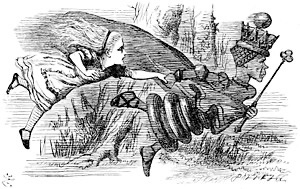
  • Government Finance 102:  Monetary Policy. The Red Queen’s Race

    Government Finance 102: Monetary Policy. The Red Queen’s Race


    The Red Queen’s Race


    TWO DEFINITIONS


    Fed funds rate


    The Fed funds rate is the interest rate banks charge other banks that borrow their excess reserves. It is a very short-term (overnight) rate. An increase in the Fed funds rate increases the cost of capital of large banks (net borrowers) and puts pressure on these banks to raise their lending rates. A change in the rate also changes the rate charged by other sources of short-term funds.


    The Fed funds rate is the most watched interest rate in the United States and probably the world. It is not set by supply and demand in financial markets. It is set (fixed) by the Federal Reserve Bank (the Fed), America’s central bank. 


    The Fed funds rate determines or heavily influences almost all other short-term interest rates in financial markets. It also indirectly influences many other longer term interest rates. It summarizes how the Fed views the economy and near-term changes. It is at the heart of monetary policy.


    Nominal vs. real interest rates

    Nominal interest rates are the reported interest rates, also called current interest rates. Real interest rates are nominal rates minus some measure of inflation. Both nominal and real rates can be negative. For many years recently, nominal interest rates on many countries’ national debt have been negative. No longer. Although almost all countries have raised central bank rates, the inflation rate in the United States and many other countries was above almost all nominal interest rates, making real rates negative. This is no longer true in the U.S., as inflation has come down below the Fed funds rate but the Fed has not started to lower rates. (As of 7/24)


    MONETARY POLICY


    The Fed’s mandate is to make monetary policy. The objectives of monetary policy and the tools the Fed uses to implement policy have changed from the past.  


    In the past, the Fed’s main functions were to fight inflation by raising interest rates and slow down the growth rate of the money supply, and to fight recessions by lowering interest rates. The Fed could also be the “lender of last resort” to banks if the banking system got into serious trouble. Most of the time, however, the economy grew and the Fed had little to do. In the last few years, especially during Covid and after, the Fed has bought huge quantities of federal debt (Treasuries) to keep interest rates low. It is currently slowly selling off its inventory. It is uncertain if the Fed will continue to sell off Treasury inventory when it starts to lower interest rates.


    Although never publicly stated, the Fed seems sensitive to supporting asset prices, particularly stock prices. Bond prices move inversely to interest rates. Rising interest rates lowers prices of existing bonds and raises the interest expense of new debt. The largest single borrower is the U.S. government.


    With the deregulation and globalization of the banking system and the explosion of nonbank financing, the Fed has less direct control of the finance sector than in the past. But as long as the dollar is the international currency and non-bank financial institutions fund their operations by borrowing from banks, the Fed will have indirect influence on the rest of the financial markets. 


    The Fed funds rate is in the range of 5.25-5.50% while the inflation rate is under 3.0%. This has been the Fed funds rate since May, 2022. The Fed started reducing the Fed funds rate to 4.75-5.00% in September. If the inflation rate stays low, this will decrease both nominal and real rates of interest.


    The recent history of Fed policy has been unusual. The Fed under Ben Bernanke and Tim Geithner and the Treasury under Henry Paulson were extremely aggressive during the 2008-09 financial crisis in containing the real threat of a total meltdown of the national and global financial system. They extended loans to and guaranteed debt of banks and non-bank corporations. They promoted shotgun marriages between banks, creating megabanks and accelerating the consolidation of the banking system.  But their policies of historically low interest rates and purchasing of public debt continued long after the economy resumed growing. From 2008 to early 2022, the Fed funds rate has been below 1% in 12 out of the 14 years. This is extraordinary; the last time the Fed funds rate was below 1% was for a short time in 1958. And, during this recent past period, real interest rates were negative. The Fed obviously believed that a massive interest rate subsidy was necessary to get the U.S. economy out of the Covid-caused recession and for continue economic growth.


    A major beneficiary of low interest rates has been the federal government. The government has been able to greatly increase the national debt with little increase in interest expense. Interest rates on government debt before the 2022 inflation, less than 1% on ten-year government bonds, were the lowest they’ve been since the end of World War II. But since 2022, interest expense on the national debt has been rising rapidly and will continue to rise unless there is a large decrease in government borrowing costs. This is unlikely.

    Extremely low interest rates by themselves did not seem to have much of an impact on economic growth rates. But a combination of low interest rates and the corporate tax cuts of President Trump have helped to increase after-tax corporate profits. They have grown much faster than the economy and total income, reaching a record high as a percent of GDP. Over the last 40 years, stock prices have increased faster than wage income. No wonder families with financial assets have seen their incomes grow faster than families without financial assets.


    While the Fed has increased the number of tools it is willing to use, it usually cannot prevent accelerating inflation or a recession. These are often caused by exogenous (outside) events the Fed has no control over. OPEC raising oil prices, Asian and Russian debt crises, Covid, Chinese lockdown policies, global supply-chain problems, war in Ukraine, Russia shutting off oil and gas supply to Europe, disruptions caused by effects of global warming. The Fed is judged on how quickly and effectively it reacts.  

    THE CORONAVIRUS AND MONETARY POLICY


    The Federal government spent trillions of dollars to maintain total income, keep companies and state and local governments from going bankrupt, paying for emergency services and once again backstopping the entire financial system.

    The government’s financial response to the coronavirus was unprecedented in peacetime. Starting with the 2008-10 playbook, the Fed and the Treasury, working together, came up with massive new programs to keep the economy from falling into a prolonged depression, buy time until the virus abated, and guaranteed virtually all debt in the country. In the first round, over $3 trillion will be spent on income maintenance. Congress added another $1.9 trillion in the first months of President Biden’s administration, which will be spent over the next decade.

    All of the government income maintenance programs cost at least $300 billion a month, about equal to the fall in total income. This was extraordinary – a deep recession (fall in total output and rise in unemployment) without a decrease in total income. The economy recovered quickly. There were falling levels of unemployment already in 2021 and near record lows by the first half of 2022.  Since then, the unemployment rate has remained low despite a continuous increase in the size of the labor force.


    The lagged effect of earlier income maintenance programs plus the 2021 “stimulus” expenditures pushed total income above the long-term trend line, resulting in increases in total spending and falling unemployment rates. The inflation rate rose through 2021, reaching levels far above 2% before the Russian invasion of Ukraine and the resulting increases in energy prices. The Fed did not start increasing interest rates until the middle of 2022. But, to make up for a tardy start, it raised rates rapidly.


    The Covid stimulus programs had another effect. Total household liquid financial savings went up by about $3 trillion, about equal to the cost of the programs. Add-on savings from higher income and a stock market boom has kept total liquid savings from declining very much, if at all. In other words, the net financial effect of Covid stimulus programs has been to increase public (federal government) debt offset by increased private (household) savings.


    Assuming a 3% interest rate on the national debt, much of the increase in tax revenue since 2022 will go towards paying the increased interest expense on the national debt. Much of this has already occurred. Interest expense was around $450 billion a year in 2022; it is currently (2024) around $890 billion because of the increase in interest rates. By 2034, interest expense is projected by the CBO to be $1.7 trillion, about double the 2024 expense. By 2034, the increase in interest expense will be abut 60% of the increase in total expenditures minus the self-funding Social Security and Medicare programs. (BTW, the CBO projects that both Social Security and Medicare expenditures will increase about 5-6% a year. I find this hard to believe.)


    For the details behind these projections, see The Congressional Budget Office. (Update as of June, 2024.), especially their Executive Summary.  


    How is the government paying for all this? Borrowing. Selling new debt to cover yearly deficits and rolling over existing debt at higher interest rates. 

    2020-2022

    Much of the new debt created for the Covid programs was financed indirectly by the Fed, that is, the Fed created money to buy the same amount of debt. The Fed also underwrote the risks of virtually the entire debt market, even announcing it was willing to buy junk bonds. Much of the junk bond market consists of bonds issued by frackers who were in danger of going bankrupt because of low oil prices. The government would loan money and provide assistance (guarantee corporate debt) to companies in danger of going bankrupt.

    2022 and 2023:  FIGHTING INFLATION

    All U.S. government fiscal and monetary programs in 2020 and 2021 were aimed at countering the sudden recession and economic dislocations caused by the Covid epidemic. But throughout 2021, the Fed was ignoring the financial effects of the stimulus programs financed by Fed’s buying of the rising national debt and massive expansion of the money supply.

    The Fed has stated for a long time that it will tolerate an inflation rate of 2% but will be concerned if the inflation rate goes above 2%. The inflation rate started to go above 2% in March, 2021. It rose steadily to 7-9% by the end of 2021 (depending on which measurement was used). The unemployment rate fell rapidly, reaching 4% by the end of the year. The unemployment rate has been below 4% since 2022. This is close to what economists consider full employment. Until March, 2022, the Fed continued to purchase large amounts of U.S. government debt.

    The $1.9 trillion stimulus program of March, 2021 was “a bridge too far.” A smaller program was probably needed to continue the recovery. The problem was the size. If you (or Fed economists) added the creation of new income to the trend in total income due to the rapid increase in employment and wage income, the total was greater than the amount of total income leading to full employment. That suggested that sometime in the foreseeable future (the Fed’s planning horizon), the inflation rate would go up, well past 2%.

    Even with the inflation rate around 7% at the end of 2021, the Fed didn’t react. The Fed funds rate was still around zero.  The inflation situation was made marginally worse by Russia’s invasion of Ukraine in March and the rise in energy prices (since reversed, at least the U.S. price of crude oil). Not until May, 2022, did the Fed start getting serious about raising the Fed funds rate and stop increasing its holdings of government debt. The Fed raised rates rapidly to make up for its delayed reaction to high inflation. They raised rates even while the inflation rate was coming down.


    MONETARY POLICY AND MACROECONOMICS

    The Fed made it clear they would keep the Fed funds rate high until the inflation rate would show a substantial downward trend towards 2%. Back to the old-time religion – fight inflation come hell or high water! Don’t support any aggressive fiscal policy to fight a possible recession that might result from rising interest rates. In fact, the Fed, to support higher Fed funds rates, has been selling its holdings of government securities to reduce the money supply. This risks the possibility of a recession before the inflation rate falls below 2%.

    The Fed could get lucky. Many commodity prices are falling, which might counter some of the increased wage and salary costs. Shortages due to global supply chain dislocations started to clear up. Almost all large corporations are saying they are “increasing free cash flow,” a nice way of saying they are slashing costs. A recession might lead to a moderate increase in measured unemployment because the labor force is growing at a much slower rate than in the past. Fewer than expected new entrants. So small increases in the unemployment rate, as are now happening, do not seem to influence the Fed to lower the Fed funds rate. 

    If the price index as measured by some version of the CPI stops going up but stabilizes at the current high levels, the year over year inflation rate will go down. Why? Because the price level – the inflation rate – rose rapidly in the second half of 2021. The same current price level will be divided by increasingly higher past price levels, resulting in a lower yearly inflation rate.

    Leads and lags again. Don’t “follow the data,” which is past news. Since there are lags in reporting economic data and the Fed has to look at trends and averages in the data, it will usually be behind the current and near future data. If there is large and rapid increase in the data, as recently, the Fed has to make up its delays in policy changes by large and rapid changes in instruments like the Fed funds rate. Anticipate the future and build in lags in the impact of policy changes. Like everyone else making financial decisions, the Fed should forecast the future and place its bets. As my old econ prof used to say – you puts down your money and you takes your chances. 

    The Fed should have anticipated that an aggressive monetary policy supporting massive fiscal stimulus to fight the disruptive recession caused by Covid could led to higher inflation rates if taken too far. As it did, the Fed should have started fighting the resulting inflation earlier, before it accelerated and raised inflation expectations. Large, delayed increases in the Fed funds rate chasing higher inflation rates now runs the risk of impacting the future economy as it enters a recession. To continue with cliches – the Fed gets the devil and the deep blue sea at the same time. 

    CONCLUDING REMARKS

    There are indirect effects of the Fed’s monetary policies. Very low interest rates, money creation, bailouts to avoid company bankruptcies, and massive bond buying to avoid debt defaults all directly or indirectly helped stock prices. Asset prices increase while the real economy has falling inflation. But the 2021-22 inflation and rise in interest rates temporarily reversed asset price increases, especially stock prices. Since then, the stock market has had a strong boom, fueled by AI stocks (especially Nvidia) in addition to general rising corporate profits and speculation in crytocurrencies. The increased return on bonds does not seem to have diverted demand for stocks.


    In short, the Fed bought massive amounts of private and public debt and paid for it by creating money. The federal yearly deficit is structural; unless there are radical changes in government spending and/or tax rates, the yearly deficit will continue and the national debt will increase.

    This is short-run Keynesian economic policy on meth. Massive income maintenance through deficit spending. This is unlike government spending in the Great Depression, when some of the government spending led to public investment and new jobs – WPA, PWA, CCC, TVA, dams, rural electrification. The recent infrastructure bill provides potential tax subsidies to private investment in designated industries, particularly public investment, domestic chip production and renewable energy. Even before passage of the bill, large, global chip designers and manufacturers announced investment in new plants in the United States.

    This is also Modern Monetary Theory on steroids – run large fiscal deficits and have the central bank (the Fed) create electronic money to buy the government debt. Keep interest rates low, preferably near zero, so the federal government can continue to run larger and larger deficits with small increases in the total interest expense on the national debt. The government has been doing this for years; only the high inflation rates forced the Fed (and financial markets) to increase interest rates.

    There is research done by Carmen Reinhart, Vincent Reinhart, and Kenneth Rogoff that when government debt rises above 90% of GDP, economic growth slows down. Government debt held by the public is already above this ratio. The CBO projects the ratio will be 122% in 2034. 

    What if the causality is the other way? Or there are feedback effects? What if slowing economic growth and low rates of inflation mean a slowing growth rate in taxable income? In the “everybody wins” fantasy of democratic politics, it is difficult to control total spending or to refuse tax cuts or tax breaks. Rapidly rises expenditures for Social Security and Medicare because of an aging society is increasingly paid for out of general tax revenue. Payroll tax rates for Social Security and Medicare might not rise. When the Social Security Trust Fund goes to zero in the mid-2030s, about 20-25% of Social Security expenditures will come out of the general budget. This could add about $300 billion to yearly deficits. 

    Total tax revenue for the rest of the decade will only cover Social Security, Medicare, interest expense, government pensions and social welfare programs like Medicaid and food stamps. The rest of the budget – defense and discretionary spending – will be paid for out of borrowing. Borrowing more money is politically easier than “fiscal discipline.” Surprisingly, the CBO is projecting that short-term government borrowing rates on national debt will go down, but longer rates will stay about the same. This implies that average rates will decrease and the inverted yield curve will disappear.

    All of these fiscal and monetary trends can go on for a long time but not forever. Japan has been doing this since the early 1990s, soaking up most of the country’s past savings to fight off a stagnant economy, deflationary pressures, an aging population, and lack of any structural reform. Japan has had very low rates of economic growth over the last 30 years; I doubt if the U.S. economy and society could tolerate very low growth rates over a long period of time.

    The U.S. can continue running large budget deficits as long as the dollar is the international reserve currency, interest rates decline from current levels, and U.S. government debt is considered risk-free. Or if the growth rate of national debt is lower than the growth rate of nominal GDP. Currently, interest rates on the national debt are trending higher as the government rolls over the existing debt and attempts to attract buyers of the large amount of new debt.

    In the past, conventional wisdom said that fiscal policy and monetary policy had contradictory goals. Fiscal policy was supposed to encourage and support economic growth and job creation. Deficits would increase if there were a recession or low economic growth. This was in the personal interest of elected officials. But too much stimulus or for too long could lead to higher rates of inflation. The Fed would then raise interest rates until inflation rates eventually came down. This would slow down spending and risk a recession.  But over the last 30 years or so, the two institutions seem to be coordinating their policies. The government now has structural deficits rather than a counter business cycle (Keynesian) strategy. The Fed has a bias towards low (below market) interest rates, which also encourages borrowing and increased aggregate demand. Only if the inflation rate rises to a level that threatens growth will the Fed be aggressive in raising rates. So the CBO can project real growth, rising national debt, and falling government borrowing rates from the current levels. Even as the national debt/GDP ratio rises. Again, this might go on for a long time, but not forever. 

    ===============================================

    See companion post Government Finance 101:  Fiscal Policy. Alice in Wonderland.

    For a list of all posts on this blog, see List of Posts by Topic with links to all other posts.