Tag: Economic History

  • The English East India Company (EIC):  Trade with Asia

    The English East India Company (EIC): Trade with Asia


    The Mughal emperor Shah Alam hands a scroll to Robert Clive, the governor of Bengal, which transferred tax collecting rights in Bengal, Bihar and Orissa to the East India Company. Illustration: Benjamin West (1738–1820)/British Library

    INTRODUCTION


    The English East India Company (EIC) was an innovative new type of corporation. It is a model for the modern limited-liability, stockholder-funded modern corporation.


    The EIC also illustrates that the prototype of the modern multinational corporation was created to develop global trade.


    HISTORIC BACKGROUND


    The creation of the English East India Company (EIC) and its Dutch equivalent (the VOC) were part of the 400-year expansion of European power, trade, and influence. Much of the rest of the world became colonies, part of imperial empires.


    By 1600, both England and Holland had a wealthy merchant and shipping class, bankers, substantial liquid capital (wealth) not tied up in land, and risk-takers. These categories overlapped.


    Both countries had limited monarchies. In England, the king and Parliament were about to begin a long struggle for power. In Holland, the monarch was mostly subservient to Holland’s powerful and wealthy merchant class.


    THE EIC: STRUCTURE AND STRATEGY


    The East India Company (EIC) was chartered in 1600 by Queen Elizabeth I to promote and monopolize English trade with Asia. England, a poor country in the 1600s but with colonial ambitions after defeating the Spanish Armada in 1588, outsourced its colonial ambitions to the East India Company and other private companies. 


    The East India Company was originally privately funded by 218 merchants and other investors. It was the first modern multinational corporation. The EIC was a joint stock company, that is, a company with publicly traded stock bought and sold in a secondary stock market. Like modern companies, the EIC issued financial reports, held annual meetings for stockholders, and had quarterly meetings of the Board of Directors.


    It was also a limited liability corporation. Stockholders’ potential personal financial loss was limited to their investment in the company. Creditors could not go after their personal assets.


    The EIC was vertically integrated. The company designed, built and repaired its own ships, built its own docks and warehouses in London and in India. It had a large corporate headquarters in London. The company held sales auctions of its imports in its headquarters. It was a major employer in London. It was an “enlightened” employer, offering fringe benefits, including pensions. It provided a retirement home in London for sailors.


    The EIC designed and built a new type of ship, called East India Indiaman. They were built for long-distance trade. Because of commercial rivalry with other European states and local hostilities in Asia, EIC merchant ships were heavily armed and often contained marines.


    East India Company Indiaman Armed Merchant Ship

     ©National Maritime Museum


    The EIC had to build forts to protect its warehouses and trading stations. It hired a mercenary army and develop a navy (Bombay Marine) to protect property and trade routes. It negotiated with local rulers and signed treaties. 


    In short, the company built its own self-contained infrastructure and pursued its independent strategies. 


    The company ran its own management training programs and military academy. The selection process of employees was highly competitive, including written exams. Many of its recruits were ambitious young men from the lower and middle classes who were barred from the traditional paths of upward mobility and status. It employed “foreigners,” Scots and Anglo-Irish. Later, the EIC employed Asians and Anglo-Indians in secondary positions.


    Economists have a warm spot in their hearts (yes, economists do have hearts) because the EIC was the first organization to employ and pay economists – Thomas Robert Malthus, James Mill, and his son John Stuart. John Stuart Mill was effectively the CEO for many years. Contrary to their economic writings, they did not support free trade with Asian countries. 


    EIC “officers” and employees were loyal to the EIC. They saw personal opportunities and advancement within the company. They had opportunities for personal power and wealth that were not available at home. Because of their lower class origins and nationality, wealthy returning EIC officers were often resented as upstarts.


    The EIC created a powerful lobbying group in England. The company attempted to get the English government to continue to support its monopoly on English trade with Asia. Important politicians and royal officials were bribed.


    Unlike other private trading and colonization corporations established in England at about the same time, the EIC was set up as primarily an importing company. The company had the problem of how to pay for products bought in Asia. English exports to Asia such as English woolens were in limited demand. Asian sellers wanted silver. This created a drain of silver out of England, which was a source of friction between the company and the government.


    CORPORATE STRATEGIES AND POLITICAL ENVIRONMENT


    Besides the English-Asian trade, the East India Company was willing to trade anywhere in Asia, looking for profitable opportunities. Its resources, both ships and men, were highly mobile.


    The EIC operated in a violent, insecure environment in Asia. Beside pirates and local conflicts with Asian rulers, England was usually at war with one or more European countries. The conflicts extended to trade rivalry in Asia. The EIC had to fight battles with other national trading companies, foremost of which was the Dutch East India Company (VOC, the initials of the Dutch name of the company). The EIC could not expect much support from England, which was unable to consistently project power in Asia until the 1800s.


    The EIC lost out to the Dutch East India Company in its attempts to control the Spice Islands, the source of much of the profitable spice trade. The EIC also lost its footholds in Java and nearly islands, which became the Dutch East Indies (later Indonesia) controlled by the VOC. 


    Many early trading stations failed in other parts of Asia. Eventually, operations were centered on trading ports (entrepots) and stations in India, the traditional transit area for Asian products bound for the Middle East and Europe. India was also an important source of pepper.


    The EIC was caught up in the Seven Years War (1756-1763) between England and France for dominance in Europe, North America (called French and Indian War in America), the West Indies, and India. The EIC, under the leadership of Robert Clive, was able to defeat the French in India and expand alliances with many local rulers. The company’s well-organized military assets with superior firepower made the company a prized ally for local rulers. In exchange, the company was given extensive privileges including the right to collect taxes.


    At the same time, the company was developing what would be its most important trade – importing Chinese tea to England. To support this trade, the EIC established new stations that would grow to be Singapore and Hong Kong.


    They immediately ran into an old problem – China didn’t want any English imports. Chinese merchants only wanted silver, which led to a major drain of silver out of England. The EIC solved the problem by growing and selling opium produced in India to private traders who smuggled it into China. Some of the financial transactions were handled by a bank that eventually became HSBC.  (One the traders was Franklin D. Roosevelt’s grandfather.) 


    Chinese attempts to ban this trade resulted in a war between China and England (the Opium War, 1839-1842). China was defeated by superior English warships; the subsequent treaty was the first of many that opened up China to foreign influence and then domination. This would have important long-run consequences.


    The demand for tea exploded in the 1700s. The EIC had trouble fulfilling the demand with tea from China. Growing and processing tea was a closely guarded secret in China. But the company smuggled out plants to start new tea plantations in northern India (Assam). These plantations were successful and an increasing source of tea for the EIC. By 1770, EIC exports of Indian tea to England reached £800,000.


    ORGANIZATION STRUCTURE, CONTROL, AND GOVERNANCE


    Besides the EIC’s legal, financial, and governance structures which were innovative, the EIC had an internal management and control structure very much like a modern multinational corporation. It had to find a balance between home office control and branch management initiative. Given the problems of long distances, slow communication, and changing local operational information, the company was forced into a decentralized structure. 


    The Board of Governors combined the oversight of corporate managers with the setting of governing rules and regulations. Much of their control was financial. There was also detailed supervision and control of the voyages sent out from England.


    While officers of the company often sent detailed instructions about policy to local managers, direct operational control was difficult. It often took over two months for a letter from London to reach India. Local managers had discretion to react to local problems and trading opportunities. They had their own staff and resources. They were similar to “divisional” managers of early railroads and large industrial corporations. Even more similar to corporate presidents and their local staffs of national subsidiaries of multinational corporations.


    THE EVOLUTION OF THE EIC FROM A GLOBAL TRADING COMPANY TO A VIRTUAL SOVEREIGN STATE


    The painting above shows the moment when the EIC began its evolution from profit-making global trading company to de facto sovereign state. The year was 1765. The Mughal emperor was forced to turn over tax collection in Bengal and two other states

    to the EIC.


    It was at this moment that the East India Company (EIC) ceased to be a conventional corporation, trading in silks and spices, and became something much more unusual. Within a few years, 250 company clerks backed by the military force of 20,000 locally recruited Indian soldiers had become the effective rulers of Bengal. An international corporation was transforming itself into an aggressive colonial power.


        William Dalrumple, The Guardian, “The East India Company:  The Original Corporate Raiders,” March 4, 2015.


    The EIC was profitable in its early years. The EIC started its evolution from a purely private commercial company to an organization with its own substantial political and governmental responsibilities. For almost 100 years after the Seven Years War, it governed much of India from Bombay (Mumbai), Calcutta (Kolkata) and Madras (Chennai). The large areas around company headquarters in Calcutta, Bombay, and Madras were also effectively ruled by the company, often through “concessions” offered by regional rulers.


    The company performed the major functions of a government – collected taxes, funded a military, made laws and regulations, and established a national bureaucracy. Many of its officers became rich because of IPOs (Indian Political Opportunities – aka bribes, private deals, kickbacks on contracts). Stockholders back in London just wanted profits but EIC officials in India saw the personal possibilities as tax collectors and political administrators.


    As the EIC evolved from a commercial venture to ruling much of India, it became unprofitable almost from the beginning. By 1773, low tax revenue partly due to famines contribute to £1.5 million in debt and a £1 million unpaid tax bill owed to the English government. The company asked for a large loan, over £1 million from the Bank of England, but received only £200,000. 


    This began many rounds of negotiation between the EIC and the English government. The company began borrowing large sums of money from the English government. In the early 1800s, the company exchanged loans from Parliament for government over-site and military support. Parliament stripped the EIC of its trading monopolies between Asia and England. Finally, after the 1857 Sepoy Mutiny, the English government took over overall management and supervision of the company and then annexed India as a British colony.  


    The EIC also came into conflict with the English government when the government tried to impose mercantilist goals on the company. The government, under pressure from its woolen textile industry and then the new English cotton textile mills, banned the company from exporting competing Indian cotton goods (calicos) into England. India cotton, not cotton textiles, was exported to England. India became a large market for the export of English cotton goods.


    The EIC start out as a profit-seeking trading company and ended up ruling much of the Indian subcontinent. The costs of administering India would eventually contribute to bankrupting the company; it was forced to turn over the rule of India to the English government.   


    The home nation-states such as England were becoming more powerful and were able to project power and influence globally. They did not need private trading monopolies to further mercantilist or economic goals.

    CONJECTURE

    This conjecture is a bridge to the next essay on the EIC :

    The English East India Company:  Model for Future Multinational Corporations?


    In 1765, the EIC took over the running of a large territory in India – policing, military, tax collection, and administration. By 1772, it would deeply in debt and needed a large bailout from the English government. They gave it. It was followed by subsequent bailouts until the English government finally took over the EIC after the 1857 Sepoy Mutiny.  Why? Why not take it over earlier?


    Subsidizing EIC was the least bad option.  In 1763, England completed its victory over France. It was the third war with France in the 1700s. England was deeply in debt. As a result of incredible stupidity, England had to commit naval and army assets to control the restless American colonies. The English navy also had to protect the sugar islands in the West Indies, and to its primary task of securing the English Channel. It did not have the military assets to commit halfway around the world to India. It was not necessary – The EIC had a private army of over 20,000 troops that grew to 260,000 in the early 1800s, plus a heavily-armed merchant maring, as the EIC took over governing most of India. This number was far larger than the English army.


    Ten years after the EIC became sovereign in Bengal, the American Revolution broke out. England sent a large part of its army and about half of its navy to quell the revolt. After a few years, when English officers realized the cause of subduing the colonies was hopeless, some of the assets were withdrawn but sent to the West Indies. England withdraw its armed forces from America in 1783. Ten years later England was at war with France; the war, mostly with Napoleon, lasted 22 years. At the end, England was deeply in debt.


    With the loss of the American colonies, India was the foundation of the British Empire. Although losing money, the EIC was responsible for generating nearly half of England global trade. India was a major market for English exports. Quite simply, the EIC was England’s surrogate colonial masters in Asia. It was cheaper to subsidize the EIC than to take over direct governing of India.


    Another reason was that the EIC have bribed government ministers and members of Parliament. Returning EIC personnel, often personally wealthy, also formed a strong lobbying group in England.


    But after four decades of peace in Europe and reducing its public debt, England was ready to begin governing India and projecting imperial power throughout Asia.

    ======================================================


    One starting point of reading about the East India Company is:

    K.N.Chaudhuri, The English East India Company:  The Study of an Early Joint Stock Company, 1600-1640, Frank Cass & Co Ltd, London, 1965.

    For the historical background and context on the EIC, and its role in helping England become a global economic and political power in the 1600s, see

    England in the 1600s:  The Beginning of England’s Rise to Global Power and Wealth

    For the argument that the EIC may be a model for future multinational corporations, see

    The English East India Company:  Model for Future Multinational Corporations? 

    Elsewhere in this blog, I argue that the main form of America’s economic competition, and probably geopolitical competition, with China will depend on the success of American companies in developing new technologies and global links. See


    American Tariffs and the U.S. Economic War with China

    For a case study of a country that became independent after World War II and illustrates the internal chaos of many countries, see


    Nigeria


    You might also be interested in

    The Stock Market Crash of 1929 and the Beginning of the Great Depression


    In the 1920s, the United States developed new technologies in virtual isolation from the rest of the world. It didn’t end well.


    For a list of all the posts on this blog, see List of Posts by Topic

    with links to all other posts. There are posts on Adam Smith, the Beginning of the Industrial Revolution, American Economic History, American History and even economics.


  • The English East India Company (EIC): Model for Future Multinational Corporations?

     INTRODUCTION


    The English East India Company (EIC) was an innovative new type of corporation. It was not only a multinational corporations but it was created to exploit the profit potential of global trade. 

    It might be a model for how a multinational corporation (MNC) could survive and prosper in an increasingly chaotic and hostile geopolitical world.

    For a description of the structure and strategy of the English East India Company, see The English East India Company (EIC):  Trade with Asia


    THE EIC AS A MODEL FOR FUTURE MNCs?


    The international political structure is now moving in reverse as the post-World War II economic and political order created mostly by the United States is breaking down. America seems to be less willing to pay for global political leadership, reverting back to its traditional policies of isolationism and protectionism. It hugely expensive military is paid for with deficit financing. Wealthy countries cannot pay for all of their programs; frustrations seem to be expressed in voting for nationalist political parties headed by authoritarian leaders. Most wealthy countries, including the United States, are attempting to limit immigration. Most of the more than 100 new countries created after World War II are dysfunctional or corrupt. Civil wars and local conflicts disrupt the global economy, in addition to terrorist groups, pirates, and criminal gangs.


    At the same time, the global economy dominated by multinational corporations operating on a global scale continues to expand. Markets, supply chain technology and organization, telecommunications, transportation, and finance are now all global. They all transcend national borders. Multinational companies have stronger economic links with companies in their ecosystem in other countries than with the rest of their national economy.


    While the East India Company operated in a different era, it may suggest some lessons for our times because it operated in a fragmented Asian environment similar to the global one currently evolving. The global political system constructed by the United States after World War II is breaking down. There are over 200 nation-states and territories. Many are poor or small. Many are autocratic (not democratic). But all are sovereign within their borders, although in many cases this sovereignty is limited.


    The greatest danger now (2024-25) to multinational corporations, predominantly American, is the American government. President Trump’s pursuit of narrow mercantilist goals — fluctuating tariffs and trade restrictions, attacking universities and greatly reducing research funds, cutting off immigration of technological and scientific personnel, increasing shipping costs, and extorting money from large companies — adversely impact multinational corporations.


    No country, with the possible exception of China, protects and supports its companies abroad. (More detail – similarities and differences from EIC. More instruments of Chinese geopolitical projection of power and influence? What about new high-tech companies?) Many are state owned and share some similarities with the EIC.


    Maybe multinational corporations, in this environment, will evolve to be more like the EIC. They will need some way to protect themselves from the “extractive” policies of political elites. Governments have power – sovereignty, guns, laws, forms of coercion, corruption and cooptation, “populist” support, that can be used against private companies. They have centralized bureaucracies and armies. But companies control most economic resources (except natural resources like fossil fuels and minerals) and innovate new technology. They have large financial resources. Employees of multinational companies may possibly have alternative loyalties.


    MORE SPECULATION ON FUTURE MULTINATIONAL CORPORATIONS


    For a wildly imaginative vision of a future society (not too future) dominated by powerful corporations similar to the EIC (with advanced technology similar to AI), see Neil Stephenson’s The Diamond Age. The book centers around an English global company much like the EIC. This corporation combines nostalgic Victorian culture and loyalties with advanced technology and political power.


    No one seems to be conjecturing how corporate structures and economic organization will be affected by new technologies such as unsupervised AI, AI-driven singularity, and quantum computing. In an environment of shrinking population and labor force, burgeoning national debt, and increasingly dysfunctional (or to be fair, overwhelmed) central governments.


    Another vision is in Donald Westlake’s Good Behavior. It argues that the political structures of nation-states are breaking down. The world is becoming more like the feudalism of the Middle Ages. Kings and emperors (central national governments) had limited power. Local areas were controlled by different types of aristocrats – barons, princes, dukes, etc. The people in a barons’ area of control were loyal to the baron, not the king. Local rulers fought each other. To a large extent, barons were independent of kings and their governments.


    Multinational corporations (MNCs) have some of the attributes of the medieval barons. Sovereign in their own domains, they demand loyalty, negotiate and compete with other. MNCs are part of a hierarchy of organizations with responsibilities to each other. 


    Multinational corporations are increasingly at the whim of national policies, particularly those of autocratic rulers. Autocratic rulers commonly threaten and extort funds from corporations. 


    When the political objectives of nation-states begin to seriously reduce and jeopardize the profits, or even the survival of multinational corporations, MNCs might began to take measures to protect themselves. Some of these measures may bring them into direct conflict with nation-states.


    Already there are large areas where the national governments’ writ doesn’t run. Many groups besides MNCs avoid national power and control. Companies and wealthy individual avoid national laws and launder money, often gained from illegal activities. The more sophisticated, ones who hire lawyers and specialized financial consultants, use shell companies. Cryptocurrencies are used to avoid the financial system and reporting of income. Drug and criminal gangs control large areas. Other areas are controlled by ethnic groups at war with the central government. “Informal” and illegal economic activity beyond government control or oversight make up a large part of the economies of many countries.

    ==========================================

    For historical background and context on the EIC, see

    England in the 1600s:  The Beginning of England’s Rise to Global Power and Wealth

  • Adam Smith’s Pin Factory

    Adam Smith’s Pin Factory

    Adam Smith – Our Founding Father


    ADAM SMITH VISITS A PIN FACTORY


    Adam Smith’s description of a pin factory is on the first page of The Wealth of Nations.  (Chapter 1 – “Of the Division of Labour”)  Drawings of pin factories of this period show workers using hand tools. Smith says the process can be broken down into 18 distinct steps, including packaging the pins. Smith mentions that pin factory workers were poorly paid, despite their high productivity. 


    Adam Smith says he visited a pin factory employing 10 men who produced 48,000 pins per day.  If each of the ten workers had done all the steps themselves, Smith says each worker could produce only 10 or 20 pins per day.  So the pin factory replaces 2,400 to 4,800 pin makers. The increase in labor productivity (output per person per day) is as high as 50 times that of individual pin makers.  


    This reduction in unit cost or average cost (AC) and the huge increase in quantity produced do not just replace older methods of organization and production.  They increase the potential “extent of the market.” Existing users not only buy more pins at the lower price but also think up new ways to use cheaper pins. The geographical limits of the pin market expand; contemporary and future reductions in transportation costs further expand domestic markets and increase exports.


    Adam Smith is considered the Father (or maybe Godfather) of economics.  But this is not economics. At the heart of economics is the concepts of cost and price. No unit price of production or market price are given.


    As Adam Smith says, there are limits to specialization and division of labor, and thus limits to reducing unit costs.  But the major source of these limits is not “the extent of the market.” It is the limit of relying solely on the division of labor using pre-industrial production technology. As a source of the continuous increase in the “wealth of nations,” Adam Smith’s pin factory was a dead end, a one-time increase in productivity due to an organizational change. All that was about to change.


    Adam Smith’s pin factory is his only clear example of how an economy can grow through one type of innovation. But what is missing is any discussion of the Industrial Revolution or power-driven machinery, which had begun during Adam Smith’s lifetime.  Adam Smith knew James Watt, a brilliant mechanic who greatly increased the efficiency of steam engines. Both worked at the University of Glasgow at the same time. Smith was instrumental in hiring Watt. Watt patented his steam engine just as Smith began writing The Wealth of Nations.  A friend of Adam Smith invested in James Watt’s company to produce his new steam engines.  (The same friend, William Smart, was also Thomas Jefferson’s college tutor.) Adam Smith knew Mathew Boulton, the industrialist who convinced Watt to set up a company and factory to produce his steam engine. It was the beginning of the Industrial Revolution.


    Smith mentions “fire-engines” (steam engines) once in the entire book, on page 1, but only to illustrate how workers might improve the working of machines. His example is now considered a myth. He makes a vague statement about “proper machinery,” followed by the sentence, “It is unnecessary to give any examples.”


    It is hard to believe that someone could survive producing 10 pins a day. Someone this isolated and inefficient is a straw man. In reality, almost all economic activity requires specialization, division of labor, and coordination. In the Industrial Age, this means power-driven machinery, specialization by company and coordination of long supply chains.

    A capital goods sector would specialize in producing larger, faster, more efficient power-driven machinery with metal parts. Production became capital intensive; companies became much larger to realize economies of scale.  Economic theorists would continue to ignore the reality of the Industrial and Information Revolutions because the central dynamic – continuous, disruptive innovation leading to new production technology, lower average cost, and new corporate structures – would destroy their key models of perfect competition and general equilibrium. 

    PIN-MAKING GETS MECHANIZED IN AMERICA

    Pin production met the Industrial Revolution in the 1830s.


    Some pins were made in America, most in prisons and almshouses. At a New York almshouse, Dr. John Howe, the resident physician, observed pin making and began to invent a machine to mechanize the process. He made his first machine in 1832. In 1835, the Howe Manufacturing Company was established with capital from New York merchants.


    One of Howe’s pin machines could produce about 24,000 pins in an eleven-hour day.


    Much of the decrease in costs occurred in the packaging of the pins.  About half of the workforce packaged the pins. At first, the pins were “put out” to nearby families. Then the invention of a hand-powered packaging machine brought the operation into the factory. In 1856, a machinist at Howe invented a powered pin-packing machine.  Before his invention, women were paid $1.25 a day to pack about 150 packages; with his invention, women could pack 200 packages a day and were paid only $.75 a day.  (The story of Howe Manufacturing is from Steven Lubar, Engines of Change:  An Exhibition on the American Industrial Revolution, 1986, p. 56.)


    By the late 1970s, two hundred years after The Wealth of Nations, manufacturing plants using computer-driven automated machinery could produce 800,000 pins per worker per day. This is 160 times as many as in Adam Smith’s pin factory.


    EXTENSIONS


    In the United States, before the early 1800s when nails were mass-produced by machines, they were very expensive. If a family built a house using nails and decided to move west, they would often burn down the house to recover the nails for the next house. It is one reason there are so few “vernacular” houses in existence in America before the early 1800s.


    Mechanizing nail production had an even greater effect than mechanizing pin production. Cheaper nails revolutionized construction. They made possible the balloon-frame method of home building, where pieces of lumber were nailed together to make the house’s frame. In the long-run, the result was the American suburb.


    The story of the continuous improvement in the quality and variety of pins, and the decrease in the average (unit) cost, was repeated for related products. Besides nails:


    Spikes – critical input in the building of railroads.

    Rivets – made the mass production of airplanes possible.


    CONCLUSION
     

    Specialization with hand tools can go only so far. But what if power-driven machines continued to become faster, more reliable, more accurate, and more specialized?  Production per plant would go up tremendously and average unit cost would continue to decline. There would be no equilibrium. The Industrial Revolution would be a “permanent revolution.” 


    Specialization and division of labor does not lead to the Industrial Revolution. Production needs power-driven machinery and continuous improvement in machine tools, machinery, and organization. Machine tools make metal machine parts. New and more powerful sources of energy and heat are created. All of this, and more, has to be organize in new organization forms like factories, new types of management, and new types of internal controls.


    ————————————————————————————————————————–

    For an excellent example of an innovative entrepreneur at the beginning of the Industrial Revolution in England, see


    Josiah Wedgwood, the Wedgwood Pottery Company, and the Beginning of the Industrial Revolution.

    For the story of the how the Industrial Revolution began in England in the late 1700s, see 


    The Beginning of the Industrial Revolution in England

    For the argument that the United States was well- positioned to benefit from the Industrial Revolution, see


    The Beginning of the Industrial Revolution in America

    For some of the historical developments that made the Industrial Revolution likely in England, see


    England in the 1600s: The Beginning of England’s Rise to Global Power and Wealth

    The above essay explores the roles of the English East India Company (EIC) in Asia and the Navigation Acts in America and the West Indies in making England a global economic power. It gives context to the next two essays.


    For a more detailed look at the English East India Company, and why it was the first modern multinational corporation, see

    The English East India Company:  Trade with Asia

    For the story of America’s new revolutionary form of government and an outline of the first decades of American economic growth and development,

    A New Nation:  America From 1789 to 1860


    Further commentary on the dynamics of America’s economic development:


    How America Industrialized and Became Wealthy

    A Stylized Model of Innovation:  The Dynamics of Capitalism


    Alice in Wonderland and the Origins of Silicon Valley

    For the story of how England lost its economic leadership, see 

    Innovate or Fall Behind:  A Cautionary Tale:  England and the Industrial Revolution.


    There are a number of essays on American History and American Economic History including


    The Stock Market Crash of 1929 and the Beginning of the Great Depression


    For a list of all posts with links, see 


    List of Posts by Topic.


    There are more essays on American History and American Economic History. Essays on information, innovation, and how markets work. Essays on business, finance and economics. A series of essays on demographics, population projections, and speculations on how decreasing and aging populations will interact with the economics of individual countries and the global economy.

    List of Posts by Topic

    There are more essays on American History and American Economic History. Other essays on:

    Information, innovation, and how markets work. 

    Business, finance and economics. 

    Also a series of essays on demographics, population projections, and speculations on how decreasing and aging populations will interact with the economies of individual countries and the global economy. 

    Essays on a variety of historical topics, including the Industrial Revolution, Rome, and Europe in the World War I period.


    Further comment about Adam Smith. Most of Smith’s book was an argument against mercantilism and restrictions on international trade. At the heart of England’s trade policies was the Navigation Acts. They restricted the development of the economy of England’s North American colonies. American resentment and anger were a contributing factor to the American Revolution. Smith opposed England’s policy of not negotiating with the Americans and then England’s attempt to suppress the Revolution.


  • Demographics and Population Projections of Japan

    Demographics and Population Projections of Japan


    INTRODUCTION


    Japan gets special consideration because it is further along the demographics declining population curve than any other large country. It has the oldest population (highest average age) in the world. It has one of the world’s lowest birth rates. Unless there are major changes in healthcare technology, immigration, public policy, and birth rates, most industrialized countries will follow Japan down the path of declining and aging populations, and smaller labor forces.


    Japan’s demographics and immigration have become major political issues. In the July 2025 elections, two right-wing parties made substantial gains against the long-ruling Liberal Democracy Party (LDP). Two of their main issues were the rapid rise of immigration and the repeal of a 10% consumption tax used to pay for the rising costs of supporting the aged. Both parties appealed to young voters. The LDP has nominated a candidate for prime minister who also takes a hard line on immigration.


    PROJECTIONS


    Japan’s current (2024) population is around 122 million people. This is the 15th year of population decline, down from a high of 128 million. The yearly decreases so far have been small, both in numbers and as a percent of the total. This is expected to continue until 2030. Then population decreases are expected to accelerate to a population of 104 million in 2050 and 87 million in 2070. At the end of the century, Japan’s population is projected to be 60-65 million people, about half its current size.


    The high dependency ratio (the number of elderly divided by the number in working age groups – 46%, the highest in the world) is expected to rise to about 70% in 2050, about 75% in 2070 and about 80% in 2100. Not everyone in the working age group is in the labor force. Thus, by 2100, there will be almost one Japanese over 65 for every employee in the labor force. Government budgets will find it increasingly difficult to raise tax revenue to meet the rising social costs of an aging society. 


    Figures are from The Economist, “Japan’s economic troubles offer a glimpse of a sobering future,” December 5, 2019.


    Japan has one of the lowest birth rates in the world at 1.2 in 2023. Also in 2023, the number of deaths was twice the number of births.

    Japan has the world’s oldest population, both as measured as average age and with the highest percent of residents over 65. 


    LABOR FORCE AND FUTURE ECONOMIC GROWTH


    Over the past 20 years, Japan’s working-age population has declined by more than 10 million workers, about 14% of the workforce. The current labor force (age group 15-64) is 73 million. By 2050, Japan’s working-age population is expected to fall to 53 million. (U.N. World Population Prospects 2022) In 2100, the labor force age group is expected to be about 32 million, about 40 million less than the current size. 


    Japan’s 65 and older population of 37 million is about 25% of the total. As early as 2050, about 40% of the adults will be over 65. Surprisingly, the number of Japan’s elderly is already near the projected maximum.


    Current statistics from Japan’s Internal Affairs Ministry, July 24, 2024.


    Projections from:

    Statistica, ”Forecast of the total population in Japan from 2023 to 2120,” November, 2023. https://www.statista.com/statistics/607427/japan-forecast-total-population/


    Statistica, “Forecast of the total population in Japan from 2023 to 2120, by age group,” November 2023. https://www.statista.com/statistics/612575/japan-population-age-group/


    Japan admitted few immigrant workers in the past to increase its labor force but the yearly number has been rising, up 330,000 in 2023.  In 2025, there were 3.8 million immigrant workers in Japan. This was over 3% of its labor force. Most are on short-term or work visas (Japan calls them “trainees”) and are not expected to stay. Japan rejects 99% of applications for asylum. Under current law, it is very difficult for immigrants to become citizens or permanent residents.


    In Japan, the labor force and the population are decreasing at about 1% per year. Productivity is increasing at about 1.3% per year, giving economic growth of 0.3% per year. But because of decreasing population, output per person is increasing at about 1.3% per year, or about the same as in the U.S. Growth rates are much lower but the increase in output per person is about the same. This may be one reason there is very little call for any economic, political or social reform in Japan despite almost no economic growth. And this has been going on since the 1990s. But the demographic trends may increase tensions between younger workers and retirees.


    Japan’s real GDP has been basically stagnant over the last 25 years. Without structural changes to Japan’s political and economic system, Japan’s real GDP in the future will grow slowly at best and eventually decline along with its labor force and population.


    As the size of the labor force decreases at a higher rate, and faster than the older age group, it is likely that output per capita will start to decrease.


    THE STRUCTURE OF THE JAPANESE LABOR MARKET


    The number of employed Japanese has not fallen as much as the decrease in the number of people in the prime labor force age groups. Until recently, this has been due to the increased participation rates of women in the labor force. But the high current female participation rate suggests little if any increase in workers from this past trend.


    While female employment rates are high, over 50% of female employees hold part-time positions as seasonal or temporary workers. This means they are not covered under lifetime employment or job security guarantees. Many full-time female workers are classified as temporary to avoid giving them lifetime employment protection. As a group, female workers are probably underemployed.


    As in other countries, employment does not stop at retirement age.

    In Japan, as in the United States, many people over retirement ages own or work in small businesses. So the numbers in the prime working ages do not coincide with the number of employees. 


    Japan’s retirement age is 60, although older workers can request to work until they are 65. Many retired Japanese buy or work in small, local businesses such as noodle shops, small grocery stores or other kinds of small stores to supplement public or private pensions. Over 1/2 of Japanese aged 65-69 and more than 1/3 aged 70-75 are employed to supplement small retirement benefits. The percent falls to 12% for over-75. There are about 22 million in the over-75 category. Over-75s in Japan is about the average of over-65s in industrialized countries.


        The Economist, “Japan’s 2025 Problem,” in The World Ahead

        2025, 38.

    As more people work beyond retirement age, countries will have to reassess retirement benefits and taxes on the elderly.


    The Japanese government projects that social-security costs, including pensions, will increase by 60% between 2025 and 2040. A change in the pension system, probably to increase pensions, is scheduled for 2025.


    Over 1/3 of the total foreign workers are from Vietnam, China or the Philippines. They tend to work in manufacturing or construction. Many recent immigrants come from Nepal or Myanmar. There is a lack of Korean workers. Japan is now attempting to attract foreign employees with technical skills or higher education.


    About half of Japanese employees are between 45 and 54 years old. This indicates that about half of Japan’s current labor force could retire in the next 20 years.


    Japan’s unemployment rate is low, between 2% and 3%. There is much discussion about companies finding it hard to hire as many employees as they would like. Government ministries are concerned about a national labor shortage that can only get worse. This would probably contribute to low economic growth in the future.


    A peculiarity about the Japanese labor market. The definition of unemployed is more restrictive than in other countries. No one knows what the unemployment rate would be if Japan used the American definition.


    The low unemployment rate, a slight decrease in the number of employed Japanese and the labor shortage, combined with higher inflation rates, are putting pressure on wage rates. In 2023, the average wage increase was around 5%, which is high for Japan. Wage increases might continue.


    The overall impression is that the Japanese labor market is not very flexible and that workers tend to be less mobile than they might be under different rules and regulations. This may also be obstacle to raising labor productivity and a barrier to higher economic growth in the future. 


    JAPAN AS A MODEL – OLD AND RICH


    Japan might serve as a model for future demographics of other countries in two different ways. One is as a model for countries with a high per capita income. The other is for countries that have a lower, often much lower, per capita income but are aging rapidly. This includes China and most of the countries of east and southeast Asia. They will grow old before they grow rich.


    Most of the countries in east Asia, including China, have a birthrate equal to or lower than Japan’s. They are on a similar demographic curve, only a little behind. The difference is that Japan is much richer, with a substantially higher income per capita. If managed right, Japan has the resources to pay for adequate levels of support for its increasing numbers of senior citizens. The other countries will age before they achieve per capita incomes anywhere near Japan. This will probably put a greater strain on their public finances and they will not be able to provide adequate health and services support for their aging populations.


    In economic theory, deficit-financed government spending is expected to make up for weak private consumption and domestic investment spending to ward off deflation and recession. In the future environment, however, demographics can overcome aggressive monetary and fiscal policy to stimulate economic growth. These policies have already failed in Japan. Zero interest rates on public debt, large budget deficits, high levels of government infrastructure spending and the highest national debt/GDP ratio in the world have not improved very low economic growth. A current (2025) rise in inflation rates and wages will put further strain on the Japanese economy.


    The large budget deficits are financed by borrowing much of the country’s household savings at near zero interest rates. Japan’s central bank has just raised its equivalent to the Fed funds rate to 0.25%. Other central bankers are not impressed.


    There is no chance of balanced budgets in the future. A rise in interest rates would make Japan’s financial problems worse.


    Domestic demand is weak even though unemployment is low. Rather than raise wages, Japanese companies export manufacturing to other countries, especially China and other Asian countries. The is accompanied by substantial investment outside of Japan.


    Japanese companies are starting to substitute robots for workers in Japan. Japan expects to greatly increase its use of robots, partly in health care services.


    An aging population contributes to social and political resistance to structural reforms. The dominant political party substitutes government spending and subsidies, combined with appeals to Japanese traditions, for reforms that might threaten social stability. But there is a political backlash among young voters against the dominant party that they feel represents the interest of older voters.


    All of this is before the economic costs of climate change and global warming. Japan in the past has suffered from devastating earthquakes. A recent tsunami destroyed a nuclear power complex.


    HOW JAPAN IS DEALING WITH DECLINING LABOR FORCE


    Japan is admitting foreign workers to increase its labor force. There are now about 3.8 million foreign workers, about 3% of the labor force. Foreign workers, as in Saudi Arabia, the United Arab Emirates and Singapore, are mostly segregated from the locals. Immigrant workers have no citizenship rights and can be deported at any time.


    If Japan makes up the decrease in the size of its labor force with foreign workers, then by 2100 foreigners will make up about half of Japan’s workers.


    Japan is a major producer of robots but the number of robots as a percent of employed workers is below China and South Korea but above other industrialized countries. This percentage (robots per 1,000 workers) is expected to rise. Japan is using some of its robots to provide services and companionship for senior citizens.


    CONSEQUENCES OF JAPAN’S DEMOGRAPHIC DECLINE


    Small number of children


    The projection for Japan is that in 2100 there will be five times as many senior citizens over 65 then children aged 0-14. Children will make up less than 10% of the total population. No one seems to be thinking about the social and psychological consequences of this trend. Importing children for adoption? Surrogate mothers from other countries? Robotic pets and children as substitutes? (No joke – there are already robotic dogs and ponies.)


    Continued cultural isolation?


    Japan has been the most successful country in segregating its culture and moral values from outside influence, first as an island closed to outside influences (1600-1850s) and even now in the global communication world. Despite surface similarities to other modern economies and cultures, Japan remains opaque to outsiders. This might make it difficult to attract permanent immigrants and integrate them into Japanese society. 


    More outmigration of Japanese?


    As the dependency ratio increases, putting a larger tax burden on working Japanese, it is possible that more Japanese will emigrate. One way might be to work for the overseas operations of Japanese corporations. Or join the Japanese communities in other countries such as Brazil or the United States. Or imitate the strategies of wealthy Chinese who are planning to leave their country. This will further decrease the number of births, the size of the labor force and the tax base.


    Family vs. state care of the aged


    With more Japanese not having children, the cultural imperative of children supporting elderly parents will be impossible to fulfill for many families, putting more of the burden on the state.


    Part of the global economy


    It is hard to see what future role Japan will play in the global economy besides as a source of financial capital. Japan might be relatively less important in the future. Already, Japan is not particularly innovative. The country is not a leader in most new tech industries – mostly robotics companies, a few pharmaceutical companies, some legacy technology in consumer electronics and online entertainment. Japan has already outsourced much of its manufacturing to other Asian countries, particularly China.


    ============================================================


    For a other essays on demographic topics, see


    Global Demographics and Population Projections


    Demographics and Economic Growth


    Demographics, Immigration and Future Economic Growth of the United States


  • A New Nation:  America from 1789 to 1860

    A New Nation: America from 1789 to 1860


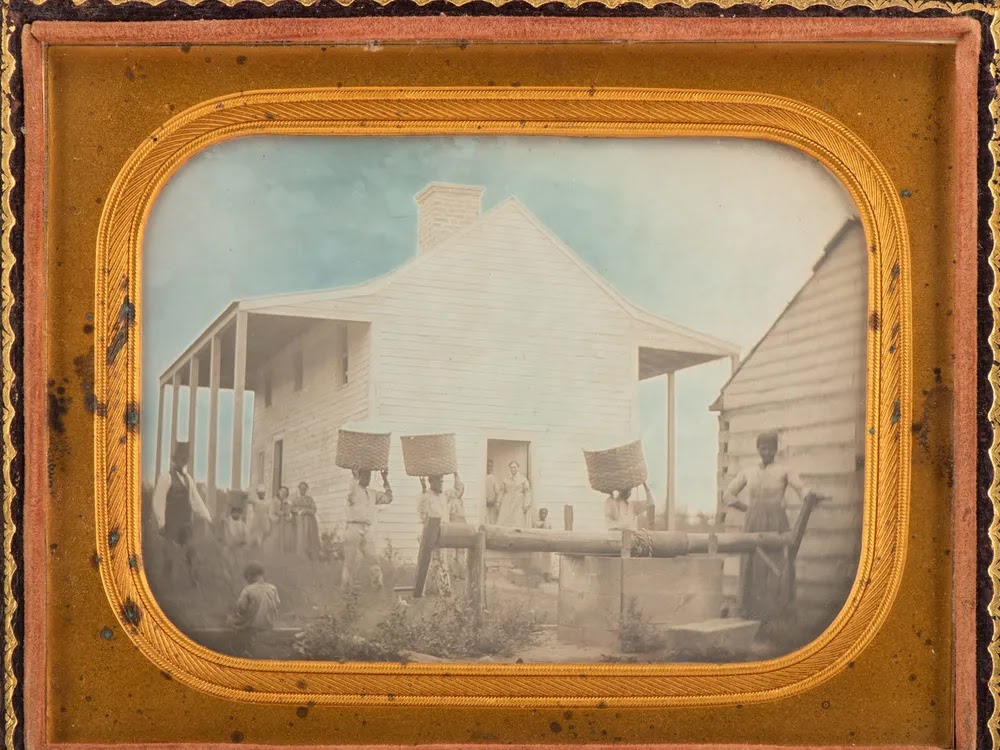
    Earliest known photograph of slaves and cotton, around 1850
    Brigit Katz, Smithsonian Magazine, December 6, 2019

    A New Nation, America from 1789 to 1860

    If you study American history from 1789 to 1860 (just before the start of the Civil War), the political history is very complicated. But remember what caused most of these political conflicts and uneasy compromises – the dynamic changes in the underlying economy. Two in particular – the spectacular increase in slave-produced cotton and the beginning of the Industrial Revolution. They were related.


    What is the Industrial Revolution? At its heart it is power-driven metal machinery producing huge quantities of goods. At first, the power was supplied by steam engines and water wheels. Later, in the 20th century, electricity. All of this used huge amounts of fossil fuels – first coal, later oil and natural gas were added. America had huge quantities of all three.


    A trend that continued from colonial times was the rapid population growth of America. This is part of demographics, the study of populations. America has had spectacular population growth throughout its history, from 4 million people in 1790 to 30 million in 1860 to over 330 million today. Two reasons for this growth were high birth rates, and open immigration until 1924. Also, Americans tended to be healthier than the people in other countries, mostly because of plentiful food. This is an important part of the American story, as discussed in the essay on colonial history. 


    There are lots of numbers when you talk about demographics, economic growth, and the Industrial Revolution. I’ll try to keep them to a minimum, hopefully just the more important ones. I also round up numbers to make them easier to read.


    The New Government, 1789-1798 

    After the Constitution was ratified and the structure of the new government was established, Americans voted in their first elected representatives in 1789. George Washington was elected president. He appointed Thomas Jefferson as Secretary of State (in charge of foreign affairs) and Alexander Hamilton as Secretary of the Treasury (financial affairs). James Madison, who wrote the first draft of the Constitution, became Speaker of the House of Representatives and established the structure and procedures in the House that are still used today.


    The government faced many of the problems left over from the Revolution. Because of the fight with the British army, Americans did not want a large standing (permanent) army.  They saw a permanent army as a threat to their liberties. America could do this because there was no serious threat on the American continent. Also, they didn’t want to get involved in European wars and political conflicts. “No entangling alliances” as Washington said. This foreign policy was possible because America was separated from Europe by the 3,000 miles of the Atlantic Ocean. 


    This was not to be. What happened in Europe during this period would have a profound impact on American history.


    The same year the U.S. government began, the French Revolution broke out. The French revolutionaries used similar ideas as the Americans. They wanted to destroy the power of the French king and the aristocracy. In 1793, they beheaded the king and queen of France and thousands of others. The other countries of Europe – all with kings or queens – were appalled. They declared war on France. One of the countries was England. England would fight France, off and on, until 1815.


    France was taken over by Napoleon. He would fight until he eventually lost in 1815. Wars are expensive and Napoleon needed money. France had laid claim to part of America. But Napoleon, fighting large wars in Europe, knew he could not defend the land from west-moving Americans. In 1803, he offered the land to America. President Jefferson bought it for $11 million. It was called the Louisiana Purchase. It was the land between the Mississippi River and the Rockies. It doubled the size of the United States. 


    After Jefferson bought the Louisiana Purchase, he established the Corps of Discovery to find out the geography of what he bought. The Corps first leaders were Meriwether Lewis (Jefferson’s secretary) and William Clark. Their famous expedition of 1804-06 traveled through the northern part of the new territory, including exploring the Missouri River. This was important for the future. America had more miles of navigable rivers than any other country. With the invention of the steamship, America had a vast internal transportation system that would help join the regional economies of the country together. Unfortunately, one of the region’s economy was based on slavery.


    Hamilton and Financing the Government 

    All governments must raise money to pay for government activities. But the U.S. government was limited in how it could raise money. The Constitution said the government could not tax American exports. No income taxes. The attempt to put a tax on goods, especially whiskey, led to riots and demonstrations that threatened the new government. What was left? Some revenue came in from land sales but not enough. Hamilton was given the task to solve this problem.


    He was ready. He started life as a teenager working for a merchant in the Caribbean. After the Revolution, he spent years studying the history and workings of government finance. His options were limited but he came up with a brilliant (and controversial) plan. He would tax imports.


    There was a larger problem. The currency issued during the Revolution (called Continentals) was worthless. The new government had to establish creditability which included faith in any new currency. Hamilton’s idea was to buy back the Continentals at face value. In exchange, the government would issue government bonds that paid interest and could be redeemed (sold back to the government) in the future. The bonds could also be traded like money. How to pay for them? From the revenue that came from taxing imports. Hamilton figured that tariffs on imports would cover government expenses and the cost of redeeming the bonds. He was right.


    I believe this was part of a larger plan he had. Hamilton saw the beginnings of the Industrial Revolution. He believed that manufacturing would be part of an economically strong country, as was beginning to happen in England.


    In 1791, Hamilton helped found the Society for Establishing Useful Manufactures (S.U.M.), to harness the waterfall energy of the the Great Falls of the Passaic RiverThe society founded Paterson, New Jersey, which became an early site of the industrial revolution in America. The Great Falls would provide tremendous energy to drive many large water wheels that powered machinery. Paterson was America’s first industrial city and would be a major manufacturing center for over 150 years.


    Hamilton’s grand plan:

    ·      Tax imports to raise revenue for the American government.

    ·      Develop domestic manufacturing to produce substitutes for English manufactured goods exported to America.

    ·      Use manufacturing to drive American economic development and growth in addition to agriculture.

    ·      Develop a class of manufacturers, bankers, and merchants.


    Hamilton’s vision was bitterly opposed by Jefferson and most Americans who thought about America’s future. Jefferson, when he was ambassador to France, saw the negative side of the beginnings of the Industrial Revolution in France and England. Dirty, crowded cities. Pollution. A degraded industrial labor force. Banking and finance. He saw all of this as a threat to a democracy based on independent, land-owning farmers.


    These two different visions of the future would be the basis of later bitter political conflicts.


    Slavery and Cotton

    The issue of slavery was mostly ignored at the national level in the early years. It was left to the individual states.


    Some people like Jefferson hoped that slavery would be unprofitable and wither away. This was not entirely wishful thinking.


    Importing slaves became illegal at the end of 1807. The Virginia and Maryland tobacco industry, the largest user of slaves, was in permanent decline after the American Revolution. Planters turned to diversified agriculture, including grain crops like wheat and fruit orchards. It was not obvious that the same number of slaves were needed or that owning and supporting slaves was profitable in the new environment. All this changed with the English demand for cotton. The deep south had a huge area of some of the best cotton land in the world. Many Virginia and Maryland tobacco planters, who owned half the slaves in America in 1790, moved to the deep south, bringing their slaves with them. Other slave owners sold some of their slaves, who were transported down the Mississippi River and sold to the cotton growers. This is where the phrase “sold down the river” came from. 


    It is one of the great ironies of history that the beginning of the Industrial Revolution in England was responsible for the survival and expansion of slavery in America. The first large industry in England was the power-driven mechanical production of cotton cloth. This created a huge and growing demand for cotton. Production of cotton cloth exploded after the war with French ended in 1815. It turned out that the largest and best growing area for the type of cotton that was best for machine production was in the American South.


    Cotton Production, 1790-1860

    Small amounts of cotton had been planted and cultivated in the United States since before the American Revolution, mostly in the islands off the coast of South Carolina and Georgia. But there was a bottleneck to the rapid expansion of cotton growing. After the cotton was picked, the fibers had to be separated from the seeds. This was done by hand. Only about one pound of clean cotton could be produced per day. But, in 1793, a Connecticut mechanic name Eli Whitney was invited by a Yale classmate to visit his mother, Nathanael Greene’s widow in Georgia. He listened to the complaints of the local cotton growers. After tinkering for a few weeks, he invented an improved cotton gin. This was a fairly simple, hand-operated machine that could produce about seven pounds of cotton per day. Further improvements increased output to about 50 pounds per day. By 1860, there were large power-driven cotton ginning factories.


    Cotton planting expanded to the west very dramatically after 1815—all the way to Texas. Planters, growers, and slaves moved from the Eastern Seaboard throughout the South and then to the Mississippi River region. Planters who owned slaves took them with them, thus avoiding the largest cost of starting a large cotton plantation. 


    The growth in cotton production was spectacular. Only about 1.5 million pounds were produced in 1790. Then, after the invention of Whitney’s cotton gin, output increased to 85 million pounds in 1810. By 1840, output rose to 830 million pounds, 10 times that of 1810. In 1860, the South produced the largest crop ever – over 2 billion pounds. 


    It was by far the nation’s main export, accounting for about 60% of the value of total American exports. Cotton exports helped pay for the imports of machinery and iron rails. 


    The South was producing about 2/3 of the world’s supply of cotton. 


    What led to an expansion of slavery was the unexpected huge increase in demand for cotton, first in England and then in the cotton mills of New England. Cotton was grown elsewhere but nowhere could a growing region produce the large and rapidly increasing amount of the type of cotton that manufactures demanded. This was made possible by the large increase in the slave population through natural increase, even after importing slaves was banned. By 1860, a very high percent of the slave population was growing, processing, and distributing cotton.


    Railroads, 1830-1860

    Starting in the 1830s, America built a large railroad network.


    America began building railroads in the 1830s, right after England built the first general-purpose railroad in 1830. By 1850, there was 8,600 miles of track. Then came a railroad-building boom. By 1860, there was 30,800 miles of track. America had by far more miles of track than any other country. New York had the most miles of track, followed by Ohio, Illinois, Pennsylvania, and Indiana. The southern states had about 1/3 of the total trackage.


    Railroad locomotives and tracks were a huge spur to iron production and manufacturing. Railroads were able to move large quantities of output (and people) from one region to another. 


    The Key to America’s Early Industrial Success

    America had abundant natural resources and aggressive “go-ahead” entrepreneurs. America also had poor immigrants who would form part of the new industrial work force. But what really drove industrialization was a new way to manufacture output.

    Thomas Jefferson was ambassador to France where he learned about an experiment to manufacture interchangeable parts to produce guns. He brought this idea to America and it was developed in America’s two armories at Springfield, Mass and Harper’s Ferry, Virginia.  It took thirty years to perfect the system.

    Interchangeable parts means that all produced units of a part are almost exactly alike. If a part of the firing mechanism of a gun had to be replaced, any substitute part would fit in without the former necessity of filing it down, fitting it, and repeating the process until it fit. This also meant that a factory could produce large numbers of all the parts and assemble the final product from any one of the parts. This system was be used to revolutionize the production of sewing machines, clocks, other metal products, and later bicycles and autos.


    The Economic Integration of the Three Regions

    The three regions of the American economy were becoming economically integrated but politically divided over the issue of slavery. America’s first large industry was also cotton cloth production in New England, with its own demand for Southern cotton. About 75% of Southern cotton was exported and 25% went to New England mills. Much of the cotton cloth output was used to make cheap clothing for slaves. The shoe factories of New England made most of the shoes worn by slaves. Southern families bought home furnishings from Northern factories. In addition, much of the cotton trade was financed by Northern bankers. Most exports went through New York. Southern planters borrowed large amounts of money from Northern bankers to expand production by buying more land and more slaves.


    Politicians and commentators debated the future of America. What no one foresaw was that these three parts of the economy of America were going to be connected.


    What would tie the three regions together was the transportation revolution, based on high pressure steam engines that drove railroad locomotives and steamboats. Steamboats exploited the largest system of navigable rivers in the world.


    Southern railroads and steamships brought cotton to Southern ports. By 1860, there were about 800 steamboats on the Mississippi River. Ships, first sailing ships, later supplemented by steam ships, carried the cotton to New York. Transatlantic ships carried the cotton to England, mostly to Liverpool.


    Northern farm families streamed into Ohio, Indiana, and Illinois in search of new farmland. These states had the biggest increase in population between 1850 and 1860. These farmers produced food for the increased population of Eastern cities and for exports. Produce went to market first through canals and then mostly by rail. Beside moving cotton to market, the greatly increase speed and capacity of railroad brought Western grain east and manufactured goods west. The new Western farms also supplied corn and pork to the Southern plantations, much of it sent south on Mississippi steamboats.


    By 1860, America had three sources of economic growth:


    Expansion of agriculture based on population growth, unlimited land for independent farmers, and westward expansion. 


    Expansion of slave-based cotton production. By 1860, Mississippi produced the most cotton, followed by Alabama and Louisiana.


    By 1860, the Industrial Revolution in Americas was well on its way. More money was invested in cotton mills than in any other industry. The second largest manufacturing industry was the iron industry.


    To the Civil War 

    The issue of slavery was the main cause of most of the political battles during this period, including the annexation of Texas and the war with Mexico to make Texas a slave state. There was a rise of anti-slavery sentiment in the North and West. Arguments were increasingly made for the abolition of slavery. There was effective propaganda, like Harriet Beecher Stowe’s book Uncle Tom’s Cabin. In response, the Southern defense of slavery became fierce – no compromises. Slave ownership and cotton production became the basis of the economy, political power, society, and culture of the South. 


    There was a danger to the expansion of cotton production and slavery as more new states in the future would be “free soil” (no slavery) states than new slave states. The South would lose political power in the national government and might be threatened with the abolition of slavery. Arguments on both sides became very emotional. When Abraham Lincoln was elected president in 1860, the South saw him as a threat to the survival of slavery. Although he hated slavery, he did not advocate its elimination. He wanted to stop it spreading to new states. Southern planters believed they needed new land as old cotton lands wore out and produced less cotton per acre. The Civil War – the South’s attempt to leave the union – started even before Lincoln was inaugurated. 


    The 1860 Census – the United States on the Eve of the Civil War 

    Total population – 31.4 million

    White population – just under 27 million (86%)

    Slave population – just under 4 million (13%)

    Free blacks – just under 500,000 (1.6%)

           Does not exactly equal 100% because of rounding


    Number of whites in the South – 5,800,000. This is the number of whites in the South in states that left the United States in the Civil War.


    Number of whites in the North – 21,200,000. This includes slave states that did not leave the Union in the Civil War.


    By 1860, despite continuing immigration, most Americans were native-born. Of the 27 million whites, about 4 million were foreign-born. Just under 75% of the immigrants during this period came from Ireland (because of the famine) and the German States (Germany did not become a unified country until 1871). Of the black Americans, almost all were native-born since the Constitution prohibited importing slaves after 1807. 


    Remember there were about 700,000 slaves in 1790. Most of the increase came from the high birth rates in the number of slaves.


    There were more slaves than whites in Mississippi and South Carolina. Slaves made up at least 40% of the total population in Alabama, Georgia, and Louisiana (almost 50%).


    Almost 400,000 white families owned slaves. But most of them were owned by a small percent of the slave-owners. About 280,000 whites owned fewer than 10 slaves. At the other end, about 11,000 whites owned 50 slaves or more; 14 of them owned 500 slaves or more.


    At the beginning of this period, slavery was legal in all 13 colonies. But the ideals of the American Revolution motivated some Americans to think about abolishing slavery. By the end of this period, all northern and western states had outlawed slavery. The arguments for and against slavery became more shrill. Some attempts at compromise, as advocated by Abraham Lincoln, were rejected by the south. The essay cited below argues that the Civil War, unlike the American Revolution, was inevitable. 

    =========================================================

    For two essays on earlier periods of American history, see


    American Colonial History, 1607-1775


    Revolution and the New Country:  American History, 1775-1790

    For an analysis of:  Was the Civil War inevitable?, see 

    The American Civil War

    For an example of the transition from using hand tools to power-driven machinery for production, see

    Adam Smith’s Pin Factory

    For an essay focused on the industrialization of America in the same period, see

    The Beginning of the Industrial Revolution in America

    For an analysis of:  Was the Civil War inevitable?, see The American Civil War


    For a list of all essays on this blog, with links, see 


    List of Posts by Topic


    There are more posts on American History and American Economic History. Also essays on Rome and the period surrounding World War I.

    Essays on information, innovation, and how markets work. 

    Essays on business, finance and economics. 

    A series of essays on demographics, population projections, and speculations on how decreasing and aging populations will interact with the economics of individual countries and the global economy.


  • Alice in Wonderland and the Origins of Silicon Valley

    Alice in Wonderland and the Origins of Silicon Valley

    I reread Alice in Wonderland last year. I’ve been reading a lot of weird books in the last two years but Alice in Wonderland is the weirdest. It’s like a children’s story written by Franz Kafka.

    The book and its images continue to resonate. I’ll skip the cheap shot of recalling the Mad Hatter’s Tea Party because a lot of recent commentators have already used it. Also, there’s a serious idea in game theory called the Red Queen Effect, even a whole book about it by Matt Ridley. (Any book by Matt Ridley is recommended.)

    But the time Alice in Wonderland really resonated was the 1960s. The following are the lyrics from the group and the song that was virtually the anthem of the Berkeley/San Francisco counterculture. It was written by the group’s lead singer, Gracie Slick.

    “White Rabbit” by Jefferson Airplane

    One pill makes you larger

    And one pill makes you small

    And the ones that mother gives you

    Don’t do anything at all

    Go ask Alice

    When she’s ten feet tall

    And if you go chasing rabbits

    And you know you’re going to fall

    Tell ’em a hookah smoking caterpillar

    Has given you the call

    Call Alice

    When she was just small

    When men on the chessboard

    Get up and tell you where to go

    And you’ve just had some kind of mushroom

    And your mind is moving slow

    Go ask Alice

    I think she’ll know

    When logic and proportion

    Have fallen sloppy dead

    And the White Knight is talking backwards

    And the Red Queen’s “off with her head!”

    Remember what the dormouse said;

    “Feed your head. Feed your head.”

    OK, it’s not surprising that the images in Alice in Wonderland seem psychedelic (explicitly so in the Walt Disney movie version of the book) and would appeal to the Bay Area counterculture. But the story gets even weirder. It is documented in:

    John Markoff, What the Dormouse Said: How the Sixties Counterculture Shaped the Personal Computer Industry. 2006.

    The counterculture, anti-establishment, drug-taking environment of this area in this period nurtured the thinking about the possibility of a personal computer. This was a radical idea. Some of the research was funded by the Pentagon!

    Concepts that would later be crucial to using the PC were first conceived here. They were developed as “the office of the future” by PARC, a think-tank owned by Xerox that employed non-corporate locals. Xerox management in Connecticut then declined to develop these ideas (see Fumbling the Future) but their potential was realized by a new company just down the road – Apple. And Steve Jobs and Steve Wozniak (whose idea of developing a PC was turned down by his employer, HP) were members of a loose group of sixties types called the Homebrew Computer Club, which has attained almost mythical status in the development of the new technology. (Bill Gates bought Microsoft’s first commercially successful operating system from a member of the Homebrew Computer Club. He licensed it to the enemy – IBM.)

    There is an interesting question in the history of technology – Why was the personal computer and related technology developed in Silicon Valley (Stanford/SF/Berkeley) and not in Cambridge, Mass (Harvard, MIT, lots of computer companies)? Now you know where to find the answer – go ask Alice.

    But the story has one more weird twist. The Pentagon heard about LSD use in the area because of its funding of personal computer research. The army thought there might be a military application – soldiers on LSD would have heightened perception. So the Pentagon funded the use of LSD around Stanford until its negative side-effects became apparent.

    To steal a quote – you can’t make this stuff up. Reality (?) is even weirder than Alice in Wonderland.