Tag: Economic History

  • Josiah Wedgwood, the Wedgwood Pottery Company, and the Beginning of the Industrial Revolution in England

    Josiah Wedgwood, the Wedgwood Pottery Company, and the Beginning of the Industrial Revolution in England


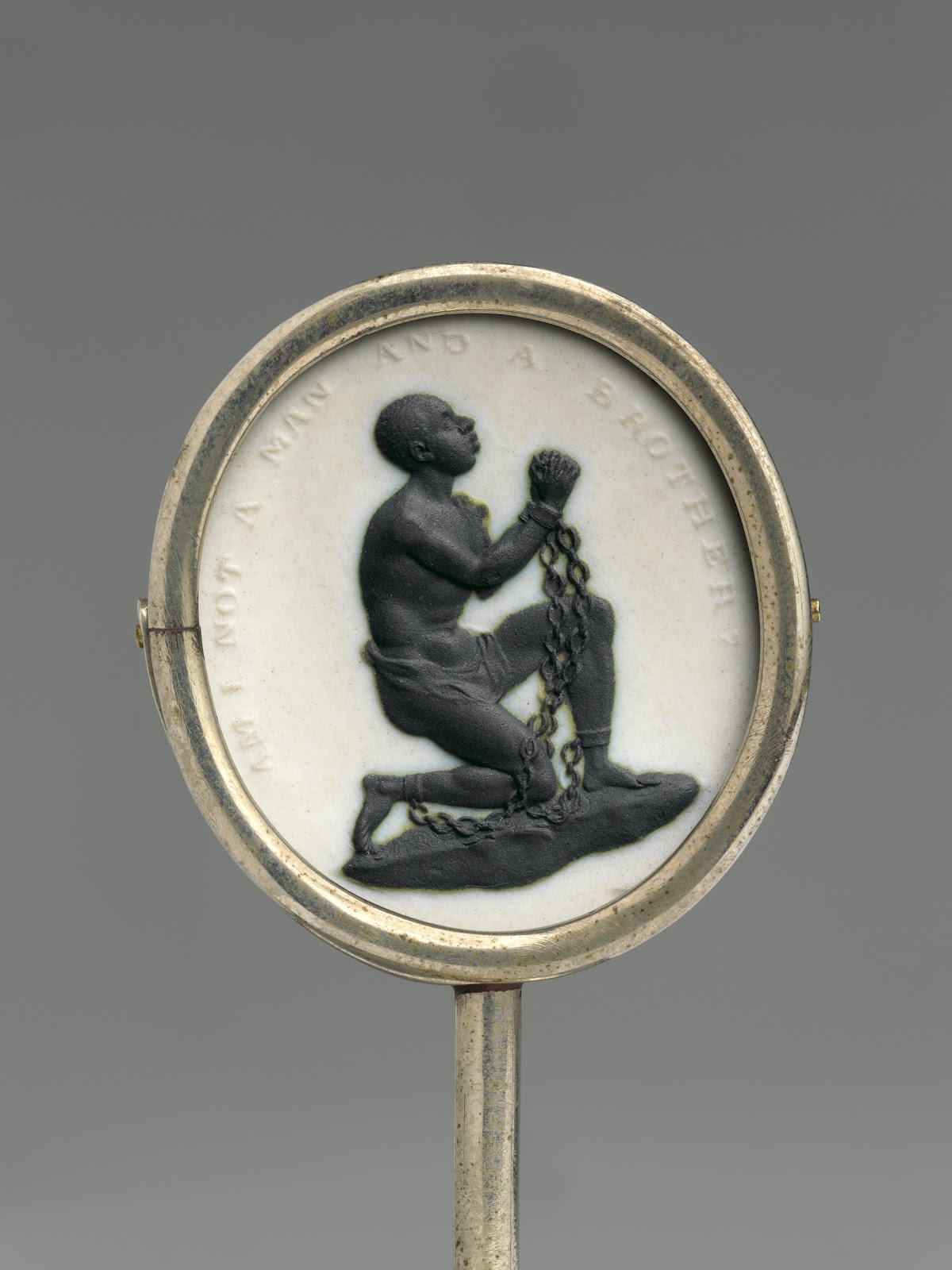
    Wedgwood Anti-Slavery Cameo

    A better introduction to the beginning of the Industrial Revolution than Adam Smith is the history of Josiah Wedgwood and the Wedgwood Pottery Company.


    This is how one company actually ushered in the Industrial Revolution.


    The revolutionary generation that first adopted steam engines saw the following trends and changes:


    Manufacturing was being modernized by a small group of entrepreneurs. Much of the new raw material processing and manufacturing was concentrated in a small area in the middle of England, away from London. These modernizing entrepreneurs formed a new economic, intellectual and social network.


    Modernizing entrepreneurs like Wedgwood tended to be members of Dissenting sects (like Quakers) or Nonconformist churches (not members of the Church of England), Whigs (liberals) in politics, and believers in “progress.” They were optimistic about the future, influenced by the ideas of Hume, Rousseau, Locke and Adam Smith. They believed their society could be reformed and they were active agents for improvement.


    In 1787, Wedgwood produced a ceramic medallion to support the abolition of slavery. It had a chained African pleading, “Am I not a man and a brother?” This was in the country that became rich by dominating the African slave trade and raising Caribbean sugar with slaves working under brutal conditions. 


    They believed in studying and understanding the material world through reason, data, experience, and experimentation. They had personal ties with scientists and intellectuals. 


    Like Wedgwood, many came from poor backgrounds. Because of their backgrounds and dissenting religious beliefs, they could not attend Oxford or Cambridge. They were cut off from the traditional avenues of social advancement – government official, army officer, and the Church of England. 


    The Industrial Revolution gave them opportunities for economic success denied them under the pre-industrial society. Entrepreneurs could develop these opportunities because of a long political struggle in England to establish the rule of law, individual rights, property rights, patents and limits on governmental power. It also helped that they were largely ignored by the king and the landowning aristocracy.


    The Industrial Revolution was a radical break in history. But in England, many of the preconditions were already in place, as can be seen by the history of the Wedgwood company.  


    Josiah Wedgwood came from a family of potters. He founded the famous Wedgwood pottery company in 1759. 


    Wedgwood and many of his business associates and acquaintances were modernizing entrepreneurs. Wedgwood and others built large factories recruited and industrial labor force, and understood the division of labor. They were constantly looking to improve their businesses – better machines, larger and more efficient production, new and improved products, new materials and marketing.


    A limiting factor was power to run the machinery. Waterwheels were inefficient, with not enough power to drive the larger, faster, heavier machinery. English rivers were flat, sluggish, and sometimes dry because of droughts. The solution – Watt’s steam engine, which was first manufactured in 1775.

    James Watt invented and patented a more efficient steam engine but it was Matthew Boulton, a friend and sometime business partner of Josiah Wedgwood, who partnered with Watt and built the factory that produced Watt’s steam engines. Boulton heard about Watt’s engine through a mutual acquaintance in his network of correspondents. Boulton, a successful manufacturer, established and ran a new company (Boulton and Watt) that dominate steam engine production and marketing for a generation. Watt concentrated on improving his steam engine and inventing related technology. Like many later industrial companies, Boulton and Watt was the combination of a businessman and an inventor/mechanic.


    Innovation at Wedgwood was based on science and experimentation. Josiah Wedgwood carried out thousands of experiments in his lifetime analyzing all aspects of pottery manufacturing and decoration, and record the results in detailed notebooks. He read chemistry books and knew and corresponded with the foremost chemists of his day. He tried to reduce the traditional hit or miss methods of producing pottery to more scientific measurement and control. (This tradition of careful observation and scientific understanding of the natural world was passed on to Josiah Wedgwood’s grandson, Charles Darwin.)


    Josiah Wedgwood used power-driven machinery and early assembly line techniques to mass-produce pottery. He was the first manufacturer to install a Watt steam engine.


    Wedgwood was always on the lookout for new styles, better machinery (lathes and kilns) and new production methods. He believed in retaining employees and training them to become increasingly productive. To keep employees, he provided housing and retirement benefits. Wedgwood cooperated with other manufacturers he knew to introduce new materials and new processes into the production of pottery.

    Wedgwood expanded sales and profits by selling in foreign markets. He provided a large amount of specially designed pottery to the English and Russian royal families. Wedgwood turned a luxury product for royalty and the very rich into a mass market product for the expanding upper middle class. In addition to European countries, Wedgwood made a special effort to sell to the American colonies. He designed different styles at different price points for different markets. Today we would call this market segmentation.  


    His experiments with new materials and production methods led to the creation of new styles of pottery, which he believed were necessary to increase sales. Wedgwood changed styles every few years, backed by innovations in marketing such as showrooms and branding that were to become standard in the selling of consumer goods.


    In summary, he exploited new production technology and combined it with scientific production control and management. His innovative design and selling strategies became standard for future consumer goods companies.


    ==============================================

    See the related post, Adam Smith’s Pin Factory.

    For the rise of England as a global economic and political power in the 1600s, see

    England in the 1600s:  The Beginning of England’s Rise to Global Power and Wealth

    These posts analyze the factors behind the start of the Industrial Revolution in England and America.  Pre-conditions were important. They illustrate some of the reasons why, in the long run, America was able to continue industrializing better than England, why England fell behind.


    The Beginning of the Industrial Revolution in England


    The Beginning of the Industrial Revolution in America


    Innovate or Fall Behind. A Cautionary Tale – England and the Industrial Revolution

    Some related posts:



  • How America Industrialized and Became Wealthy

    How America Industrialized and Became Wealthy


    INTRODUCTION


    This post and the next is on
    the topic of economic development and its contribution to economic growth.  Since the beginning of the Industrial
    Revolution more than 200 years ago, this is the central economic dynamic.  


    The following are factors that led to American economic
    development, many in place before the beginning of the Industrial
    Revolution.  The United
    States, more than any other country, was
    positioned to take advantage of the new technology and ideas that were the
    basis of the Industrial Revolution.  The
    following is an outline of those factors. 
    For the full story of the early decades of America’s Industrial Revolution, see Engines of
    Change
    and some of the excellent histories written about America
    after the Revolution.


    FACTORS IN AMERICAN ECONOMIC DEVELOPMENT AND
    GROWTH


    The usual narrative centers on the inventors and entrepreneurs
    who developed and commercialized new production and transportation technology and technological
    improvements.  They also invented new
    organizational structures to exploit the new technology, both on the supply and
    demand side.


    This post looks at contributing factors that made the
    American experience exceptional.  The United States
    began innovation after England, the country that started the Industrial Revolution, but quickly caught up. By the mid-1800s, America has surpassed England in key technologies.  Innovation has continued up to the
    present.  Why?


    RADICAL POLITICAL, CULTURAL AND
    SOCIAL CONDITIONS CONDUCIVE TO SUPPORTING THE INDUSTRIAL REVOLUTION


    The United States
    had developed social, political and cultural institutions that were supportive
    of the market capitalism version of the Industrial Revolution before it began.  Because of the American Revolution, there was
    an aversion to a strong central government, which at the time was dominated and supported favored
    pre-industrial classes or groups.


    • No
      rent-seeking (parasitic) royalty or nobility.
    • No
      state-supported church.
    • Limits
      on government-supported monopolies. (By rulings of the Marshall Supreme Court)
    • No
      guilds to retard innovation, factories and new forms of labor relations.
    • A
      Constitution giving the Federal government wide powers to support a
      national economy and limiting states’ ability to “restrain” trade among states.
    • A
      culture emphasizing individual responsibility and individual opportunity.
    • A
      radical political system, a democracy based on universal white male suffrage.
    • Wide dissemination of information among a literate public.
    • A
      mobile social system and open society that encouraged risk-taking.

    ENGLISH LEGAL INSTITUTIONS, ESPECIALLY PROTECTION OF
    PRIVATE PORPERTY, PATENTS, 
    AND
    ENFORCEMENT OF CONTRACTS


    Strong English tradition of protecting private property
    and enforcing contracts.


    Underlying law and custom protecting the rights of
    individuals.

    Patent law to protect innovations.


    ACCESS TO ENGLISH INDUSTRIAL TECHNOLOGY AND
    APPLIED SCIENCE


    England
    was the first country to industrialize.  Some
    important aspects:


    • Innovative
      methods to smelt iron, increasing quantity and lowering unit cost. 
    • The application
      of more efficient steam engines and water power to drive machinery.  Beginning of factories.  Large increases in quantity and reduction in unit cost. 
    • Steam engine power-driven
      textile mills and then railroads. 
    • More
      accurate machine tools to produce machinery and metal products.
    • Tradition of entrepreneurs and innovative mechanics, machine tool makers and engineers
    • Continuous invention and improvement; cumulative large increases in productivity.  


    Most of this technology, and the ideas behind them, were transferred
    quickly to America,
    changed to fit American conditions, and improved.  Some transmission channels:


    English immigrants.

    An English immigrant named Samuel
    Slater built the first            water-powered cotton spinning mills.


    Welsh ironmasters who knew how to
    use anthracite coal to smelt iron.


    Contacts with England,
    both personal and scientific.      


    Imitating or
    stealing English technology.


    Francis Cabot Lowell and the
    integrated, power-driven textile mill.


    Steam engines and locomotives.  Americans went to England
    to study the English development of locomotives and railroad technology even
    before the English built the first general-purpose railroad.


    Within two years of the first
    English railroad, Americans were importing English locomotives, adapting them
    to American conditions, and manufacturing them.

    Robert Fulton first learned about steamboats in England.


    Access to English scientific and
    technical publications.


    Establishment of American
    scientific societies to discuss new ideas and technologies, and disseminate the
    knowledge.


    HUGE NATURAL RESOURCES


    In early decades, vast quantities of wood, iron ore, anthracite
    coal, fast-flowing streams and rivers for water power.


    The United States
    would continue to be the world’s leading producer of almost all key minerals
    and fossil fuels (coal, oil, natural gas) until after WWII.


    Huge potential agriculture. 


    Development of commercial
    agriculture, starting in colonial     period.

                            Commercial production for market.

                            Surplus
    food for industrial workforce.

                            Main
    source of exports until 20th Century.


    CONTINUING IMMIGRATION


    In the colonial period and until 1860, slaves and indentured
    servants produced most of America’s
    exports that helped pay for the importation of European capital goods and
    technology.


    Over the last 200 years, there have been as many as 75
    million immigrants.  Immigrants have been
    an important factor in American economic development from the very beginning.


    Free human capital.


    Mostly young adults. Much of the
    cost of raising them to adults, their education and acquisition of knowledge
    and skills paid before they came to America.  Crucial “free lunch.”


    Like Sam Slater,
    many brought specialized skills and knowledge.


                Disproportionate number of innovators and entrepreneurs.

                            Created
    vast and growing internal market.


    Early on, America’s
    democratic ethos and the existence of an open society created opportunity for
    advancement for lower-class mechanics and millwrights unavailable in England.  They could become part-owners of new business
    establishments based on their technical knowledge.  This was the beginning of what I call the
    “hustler and the nerd” model of economic innovation.  From Samuel Slater and Amos Brown (cotton spinning) to William
    Clark and Isaac Singer (Singer Sewing Machine) to Silicon Valley
    (scientific and computer nerds and venture capitalists).


    For the first 100 years of the Second Industrial Revolution (1870 – 1970), all industrializing societies, including America, ignored the “negative externalities.” As had all societies before then. This meant the producers, distributors, and consumers did not have to pay the full cost of their activity. Some examples of negative externalities are destroying the natural environment (clear-cutting forests, water pollution, air pollution, dangerous and deadly work places, noise pollution, accidents and death (auto fatalities and injuries), terrible unhealthy slum living conditions). It was only with the exponentially cumulative effect of all negative externalities that governments began to deal with them.


    CONCLUSIONS


    In economics, Milton Friedman popularized the phrase “There
    ain’t no such thing as a free lunch.”  This
    may be true in a closed economy but not in an open society like the United
    States that allowed immigration, imported (stole) ideas and technology, and provided
    the resources and opportunity to develop new technologies and economic
    institutions.


    A more formal phrase for a free lunch is “positive
    externalities.”   A positive externality
    occurs when someone benefits from someone else’s actions without paying for
    it.  For the American private sector as a
    whole over the last 200 years, there has been lots of free lunches.

                Tens of
    millions of young adult immigrants.

                            Brought
    labor, skills, education and knowledge.

                Access to
    knowledge of foreign technology.


    This combination reduced the cost and increased the speed of industrial innovation.


    Immigrants, shut out of traditional and high-status careers,
    look for or created new opportunities. They had to
    be innovative but had opportunities for advancement not available elsewhere.  A recent study concluded that immigrants are twice as likely to start new businesses than native-born Americans.

    The point is that continual economic development depends on a country’s political, cultural, and social institutions, not just on its economic institutions.

    ==================================================

    A related post:


    The Beginning of the Industrial Revolution in America


    These posts on early American history give some detail on the factors discussed in this post:


    American Colonial History, 1607-1775


    Revolution and the New Country;  American History, 1775-1790


    A New Nation, America from 1789 to 1860


    For an excellent example of an entrepreneur at the beginning of the Industrial Revolution in England, see


    Josiah Wedgwood, the Wedgwood Pottery Company, and the Beginning of the Industrial Revolution.

    See related posts:

    After reading this post, you might want to see the related post on the first case study of a source of economic development, Adam Smith’s Pin Factory. 

    For the story of how England lost its economic leadership, see A Cautionary Tale:  England and the Industrial Revolution

    For the economic dynamics within this wider environment, see A Stylized Model of Innovation:  The Dynamics of Capitalism. 


  • Innovate or Falll Behind. A Cautionary Tale – England and the Industrial Revolution

    Innovate or Falll Behind. A Cautionary Tale – England and the Industrial Revolution

    The Rocket – Famous Steam Locomotive


    England, more than any country, started the Industrial Revolution in the late 1700s. And for over 150 years, England continued to discover new products and technologies. Yet England eventually fell behind the United States and Germany in industrial technology, commercial innovation, production efficiency, and economic growth. What happened?


    The seeds of England’s relative economic decline were there right at the beginning. Producing cotton cloth was England’s first big industry. But millwrights, mechanics with specialized knowledge of how to build wool and cotton mills and their machinery, felt frustrated because they seldom became part owners and couldn’t find financing to start their own mills. Some illegally emigrated to the United States and France. Much of the early American textile mill technology was due to English immigrants and English technology. The first cotton spinning mills were designed by an English millwright financed by a Providence, Rhode Island merchant. Much of the early venture capital for the industry was provided by Boston merchants.


    The rapid mechanization of the textile industry displaced British exports as British firms failed to switch from the jenny or mule to the new, faster and cheaper technique of ring-spinning. By the end of the 19th century, the average American cotton spinning mill’s labor productivity was 30% higher than the average English mill. England would eventually lose one of its largest export industries.


    The inability to constantly improve machinery and production processes were part of England’s long term problem. An English company named Platt’s invented and produced an automatic loom for weaving cloth. Platt’s failed to find buyers in the home market but exported the new automatic looms to Japan and other countries. A new Japanese company named Toyoda bought Platt’s looms and began improving their design. By 1930, Toyoda had improved Platt’s technology to the point where Toyoda was exporting power looms to England. Toyoda later changed its name to Toyota.  


    England (actually, a Scot named James Watt) developed a much more efficient steam engine. Later, the improved high pressure steam engine was developed at almost the same time in England and the United States (by Oliver Evans). This engine was critical to the development of the railroad locomotives, steamboats, and later steamships. Steam engines were quickly adopted in the U.S. to propel steamboats on the Hudson River (Robert Fulton) and the vast Mississippi River system.


    The first general purpose railroad was developed in England in 1830. The first railroad locomotives in America were imported from England. Within two years, American engineers and mechanics were modifying the English locomotive, making it more flexible and powerful. American railroad companies developed cheaper and faster ways to lay track. By 1860 over half the world’s track was in the United States and America was exporting railroad expertise and equipment.


    Coal mining was a major industry in England but productivity began to fall until output per head in British coal mining was only half of that found in the American coal industry by 1914.


               Richard J. Evans, The Pursuit of Power:  Europe 1815-1914, 

              300.


    Already in the 1850s, English engineers were alarmed by superior American production techniques, including the new technology of interchangeable parts. They called it “the American System of Manufacturing.” 

    England began to fall behind the United States and Germany
    in the 1870s, at the start of the “Second Industrial Revolution.” Part of the
    problem was the inability of England to stay ahead in the new industries it helped to create.


    England invented the two ways to produce large amounts of cheap steel. But rather than just building steel mills, the inventors licensed the processes to both English and foreign companies. One purchaser was Andrew Carnegie, a Scottish immigrant in America. Within thirty years, America was the world’s low-cost producer of steel and produced over half the world’s steel. Germany produced about the same amount of steel as England, France and Russia combined by 1910.


    This had profound economic consequences. Large amounts of cheap steel were crucial to the development of better machine tools, better machinery, better railroads including steel rails, skyscrapers and automobiles. Also military consequences; at the beginning of World War I, German companies including Krupp were the world’s largest producer of heavy artillery.


    An English chemist discovered the first synthetic dye for cloth. But the development of the synthetic dye industry occurred in Germany. It was the basis for the world dominant German chemical industry. German companies went on to discover and develop new chemical products, including high explosives that gave Germany a decided edge in artillery in World War I.

    Germany and the United States developed the new technologies of electrical equipment. America dominated the global production of automobiles by 1913; America was the world’s largest producer. While Henry Ford was developing the mass production of automobiles, the English car industry still concentrated on producing a small number of expensive automobiles for the wealthy. 

    By 1900, the United States had replaced England as the largest economy in the world. Germany caught up by 1914; Germany was able to build a modern navy that challenged England’s naval superiority.


    The radio was invented and first exploited by an Italian immigrant in England (Marconi). Improvements were quickly made by American inventors. The radio industry’s full commercial potential was developed in the United States by a Russian immigrant (David Sarnoff) using the financial resources and patents of four of America’s largest corporations. Using radio vacuum tubes, it was a short technological step to develop television and early computers. 


    In World War I, England first developed and deployed the tank. But its further development, and a strategy for modern warfare built around the tank, was done in Germany. In 1927, the English army spend more money on hay for horses than fuel for tanks. In 1940, England paid the price as German tanks destroyed the English army and its inferior tanks.


    Before and during World War II, England discovered or developed a host of important new technologies – penicillin, radar, computers, jet engines. But England did not have the resources or industrial technology to develop, improve and mass produce these products. Knowledge of all four was shared with American companies during World War II and became the basis for large new American industries and American companies like Boeing, IBM and Pfizer.

    Losing technological leadership can have serious consequences for a country’s political and military power.


    The structure of DNA was decoded in England. Yet there were no English equivalents of early developers of drugs based on the new knowlege like the American companies Amgen and Genentech. There are now hundreds of American biotechnology companies creating one of the dominant industries of the 21th century.


    Inventing a new product or process does not lead to economic leadership or long-term economic growth if the country does not have the human, production, organizational, financial, and entrepreneurial resources to develop and continually improve them. England did not start engineering, scientific and technical schools on a scale as did the U.S. and Germany; there were no English equivalents of MIT or the German scientific research universities. Engineers (lumped together with mechanics) and entrepreneurs (often from dissenting religious groups or minority groups) were considered social inferiors, and “venture capital” (except for the railroad investment craze in the 1840s) went into trade and overseas investment.


    =====================================================

    Go back to the Guide to Posts by Topic.