Tag: Economic History

  • KELP IS ON THE WAY:  How American Kelp Helped Save the English Explosives Industry in World War I

    KELP IS ON THE WAY: How American Kelp Helped Save the English Explosives Industry in World War I


    Dr. Andrea Dragon


    Seaweed Saves England


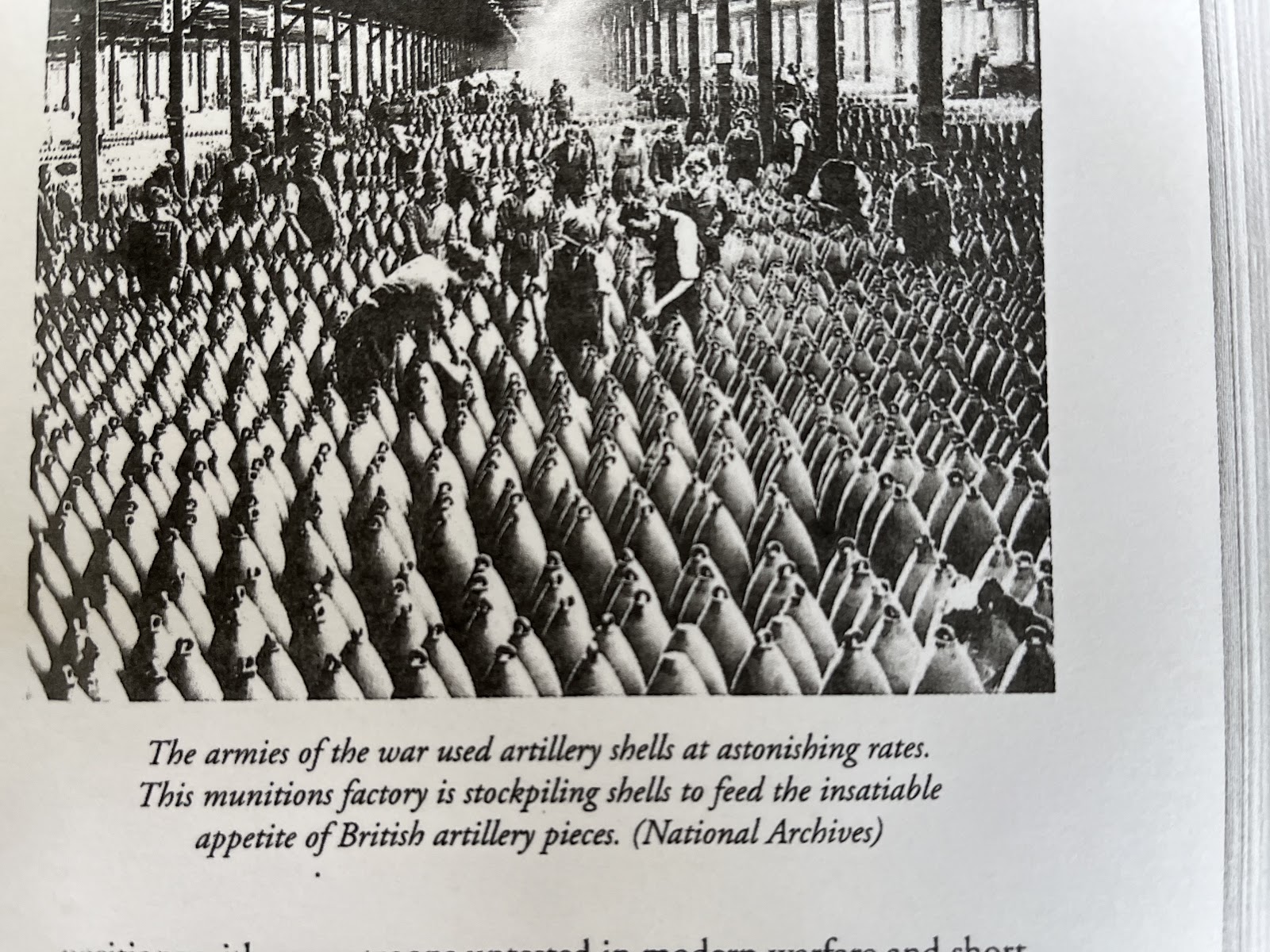
        Each of the hundreds of millions of shells Great Britain fired from thousands of field guns, howitzers and mortars during World War I contained two explosives: cordite, a kind of nitrocellulose (what Americans call smokeless powder) to propel the shell out of the artillery piece and send it flying toward the target, and TNT, the shell’s high explosive payload to blow up the target on impact.  

    In the early months of the war, the demand for cordite far exceeded the manufacturing capacity of Great Britain’s explosives factories.  To meet production demands, in October, 1914, the British Army contacted representatives from DuPont and its 1912 spinoff Hercules, who were the leaders of New Jersey’s established explosives industry, and signed agreements with them to produce nitrocellulose and cordite, load it and TNT into shells, and ship them from New Jersey ports to the Western Front.

           But cordite was different from the nitrocellulose-based smokeless powder products New Jersey explosives pioneers had been manufacturing in “powder towns” since the late 19th century. Unlike American smokeless powder, cordite included nitroglycerin transforming it into a “double-base” explosive.  Although New Jersey’s powder industry had decades of experience with nitroglycerin (at that time, anything, even a liquid, that exploded was a “powder”), no one had ever added it to smokeless powder because nitroglycerin damaged gun barrels.  That’s why the British cordite formula (30% nitroglycerin, 65% nitrocellulose, 0.8% acetone) also included 5% vaseline to coat and shield gun barrels from this kind of damage.

           At first, executives of the New Jersey explosives industry believed nothing much stood in the way of them making tons of cordite and tons of money. Not only was manufacturing nitroglycerin in sufficient quantities fairly easily done, vaseline could be sourced from the large Cheeseborough-Ponds factory in Perth Amboy. America’s vast railroad network could transport the cotton needed to make nitrocellulose from southern states to New Jersey’s powder towns.  Everything seemed to be in place to start building factories for cordite production, but there was still one very big problem the explosives industry had to solve – where to obtain acetone.

           Most readers are familiar with the organic chemical acetone because it’s useful to have around the house not only as a nail polish (which is mostly nitrocellulose) remover but also because there’s nothing better for removing paint or sticky gunk children have spread around.  Bought at the local home improvement center, acetone efficiently cleans off lacquer and oily finishes from metal surfaces before repainting.  Today, it’s one of the many products produced by the petroleum industry and is inexpensive and ubiquitous, but during WWI acetone was scarce because Germany had been the world’s leading supplier.

           It wasn’t as if Great Britain’s early 20th century chemists didn’t know how to make acetone, which was a by-product of burning wood to make charcoal.  The basic principles of acetone production had been known since the Middle Ages, weren’t covered by patents, and didn’t require sophisticated technical equipment. 

    Output estimates vary, but roughly speaking it took a hundred tons of wood to yield just one ton of acetone.  When the war began in 1914, most of Great Britain’s forest reserve was long gone, but Germany’s vast Black Forest had ample trees for making acetone and dominating the market.

           Since 1862, when Louis Pasteur discovered that alcohol was a product of fermentation by clostridium bacteria, chemists had been experimenting with fermentation to learn how the process produced various alcohol-like substances.  One of these chemists, Chaim Weizmann, a Russian immigrant scientist and one of the founders of the modern state of Israel, was researching methods of producing synthetic rubber at the University of Manchester when he discovered that acetone, butanol and ethanol could be created by fermenting starchy grains or potatoes using a type of clostridium bacterium (other, more sinister clostridia bacteria cause botulism and C. difficile) commonly found in soil.  Weizmann patented it two years later.  This breakthrough meant that instead of clear-cutting and burning up Great Britain’s meager remaining forests, acetone could be produced much more efficiently by fermenting an (easily) renewable crop like corn.

           Soon tons of American-grown corn were being shipped to Great Britain to be fermented into acetone, but this process became problematic for three reasons.  First, German U-boat activity made trans-Atlantic shipping  risky.  Second, corn took up precious space in ships that could be used for more high-value cargo.  Third, corn was a food crop and during the war many people in Great Britain were hungry, making it hard for the government to justify turning food into an industrial chemical.  England was importing 30% of its food consumption from U.S. and Canada.  Clearly, other sources of fermentable starch had to be found.  For a while, British children were encouraged to gather horse chestnuts, but fermenting them was unsuccessful and the search for ways to make acetone continued.  

    In 1916, the situation had become so desperate that Prime Minister Lloyd George proposed taking over all distilleries in the United Kingdom and transforming them into acetone factories.

             American explosives manufacturers weren’t sure how they would solve the acetone problem.  Nevertheless, in February of 1915 Hercules Powder Company signed a contract to produce millions of pounds of cordite at its New Jersey nitrocellulose “powder works.”  The contract stipulated that Hercules would have to find an acetone supplier who wasn’t part of any current supply chain to prevent Hercules from either reducing the existing supply of acetone, or from cornering the market.  Not only that, to get the cordite contract, Hercules promised to keep track of all the acetone it used and supply Great Britain with an equal amount. 

           Why was acetone required to make cordite?  Why was a solvent needed to make any kind of smokeless powder?  At its most basic level, nitrocellulose is simply cotton that has been soaked in nitric acid and then dried until it forms a stiff, white mass.  Because ignited nitrocellulose burns first on its surface, forcing a solid mass of nitrocellulose through a large extruding machine not unlike a modern pasta-maker increases its external surface by transforming the single mass into many spaghetti-like strands, or cords.  But before that could happen, the stiff lump of nitrocellulose had to be mixed with a solvent to change it into a gelatinous dough pliable enough to go into the hopper of the extruding machine, be forced through the holes, and come out the other end as strands of cordite.

           Hercules and other American smokeless powder manufacturers used ether-alcohol as a solvent, but the British specified acetone because cordite made with it required less of the gun barrel-corroding nitroglycerin than powder made with ether-alcohol.  At first, Hercules management tried to make acetone from acetic acid bought from manufacturers of table vinegar but weren’t successful.  Then the company tried arranging with industrial distillers of wood alcohol to produce acetone, but the process was developing too slowly and didn’t produce the quantities needed to fulfill the cordite contract.  Not only was Hercules falling behind the cordite production schedule to the tune of a million pounds a month, it was also woefully short on its promised deliveries of acetone to Great Britain.

             Hercules’s management investigated making acetone from beer slop, molasses, and wood pulp without much success.  The company’s situation was bleak when George Markell, vice-president and general manager of the company’s New Jersey operations, read in an old encyclopedia that Scots living near the coast once gathered kelp from the ocean, dried and burned it in retort-like ovens recovering potash which they used as a fertilizer.  After he learned that acetic acid could be produced by fermenting kelp, Markell developed a plan to harvest kelp from the Pacific Ocean off the coast of Southern California, put it in vats, allow it ferment like beer, capture the acetic acid given off in the fermentation process, and make acetone from the acetic acid.

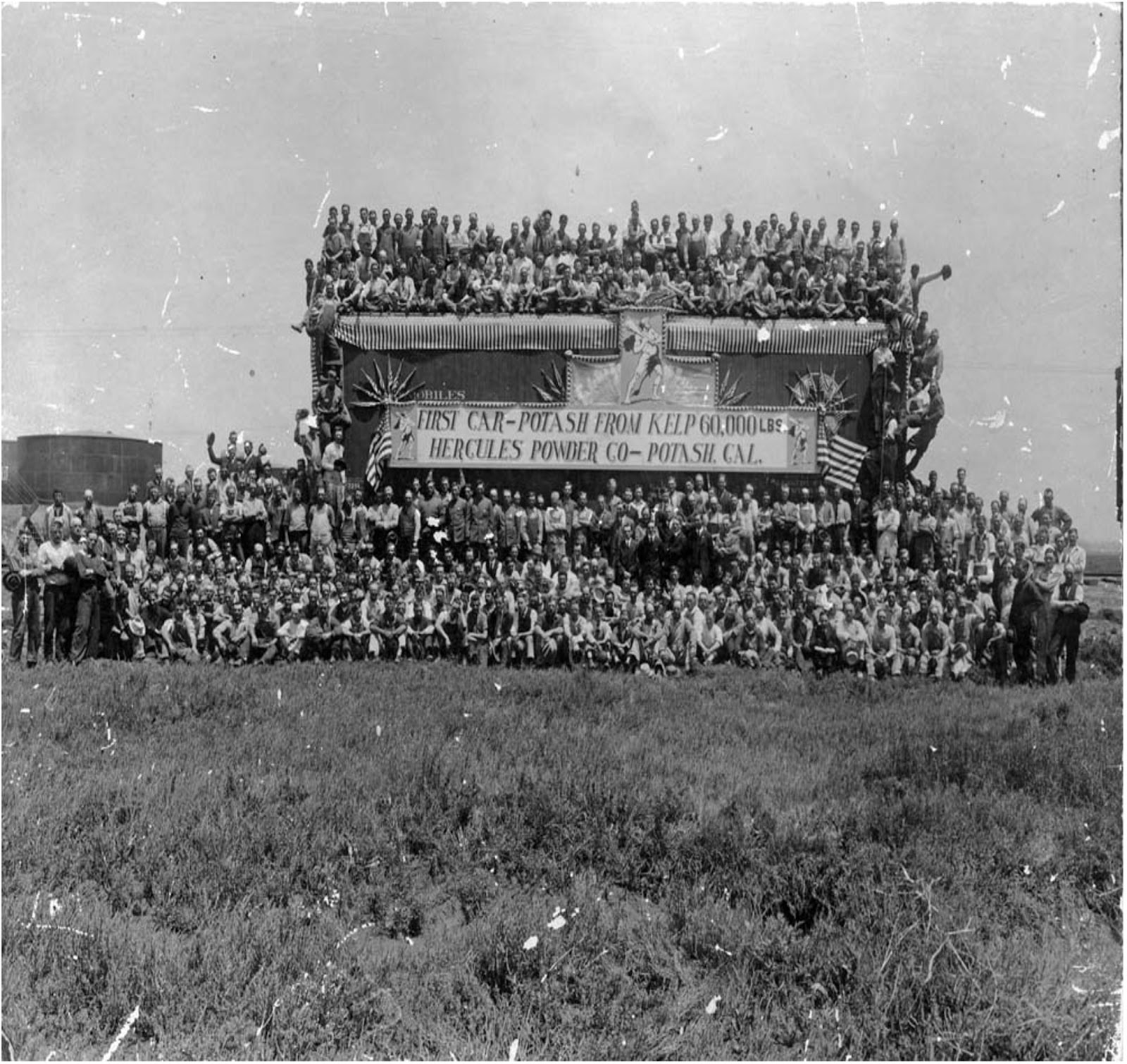
           Markell knew a huge bed of kelp existed a short distance from San Diego and best of all, it was essentially free.  Markell went to California in 1915 and began buying up land near Chula Vista, then contracted with a Midwest farm equipment manufacturer to design and build a large hay-mower capable of operating in sea water.  Hercules wasn’t the only explosives company seeking to cash in on the skyrocketing demand for acetone so Markell concocted a cover story claiming his company was going to “farm” kelp to make potash fertilizer.  Soon 1,500 Hercules employees were using the special mowers to harvest tons of kelp, load it onto barges which transferred it to shore where some of it was used to make potash while the rest was put into two-hundred 50,000-gallon wooden tanks and allowed to ferment producing acetic acid that was further processed yielding not only acetone, but other useful ketones such as methyl-ethyl ketone, a lacquer thinner, as well as potassium nitrate (saltpeter) one of the ingredients of black gunpowder. By the middle of 1917, nearly one million pounds of acetone, produced from 600,000 tons of kelp, had been loaded into railroad tank cars and shipped to New Jersey where 5,000 tough, brave powder men and women working in hazardous conditions made cordite for Great Britain at a rate of 100,000 pounds per day.

           After the war, Hercules closed its Chula Vista operation in 1919 and today the site is a nature center.

           Recently, I ran across a 2022 scholarly article describing new efforts to produce acetone from kelp harvested off the coast of Scotland.  This article ran to forty-two pages, had eleven authors, and contained eighty-five footnotes but not a single word about the Americans who fermented kelp, produced acetone, and made the cordite that helped Great Britain achieve victory in World War I.


    Dr. Dragon teaches a course at Rutgers University, New Brunswick, New Jersey on the New Jersey explosives industry.


    Related essays by Dr. Dragon:


    The Maxim Machine Gun and Smokeless Powder


    New Jersey Artillery Explosives Production in World War I


  • The Beginning of the Industrial Revolution in England

    The Beginning of the Industrial Revolution in England


    “The age is running mad after innovation.” Samuel Johnson


    In the Beginning


    Why study economic theory and analysis, read economic history, and make economic forecasts? The short answer is because of the Industrial Revolution and the attempt to understand its dynamics and structure. Economics is an attempt to understand the material world we live in, the environment created by the Industrial Revolution.


    THE BEGINNING OF THE INDUSTRIAL REVOLUTION


    The Industrial Revolution began in England in the late 1700s. It then spread to America and western European countries. This post will summarize its origins in England and describe the early decades of the Industrial Revolution in America.


    The Industrial Revolution was a radical break in history. But in England, many of the preconditions were already in place, as can be seen by the history of the Wedgwood company.


    The revolutionary generation that first adopted steam engines saw the following trends and changes:


    Manufacturing was being modernized by a small group of entrepreneurs. Much of the new raw material processing and manufacturing was concentrated in a small area in the middle of England, away from London. These modernizing entrepreneurs formed a new economic, intellectual and social network.


    Modernizing entrepreneurs like Wedgwood, Darby, Wilkinson, and others tended to be members of Dissenting sects or Nonconforming churches (not members of the Church of England), Whig (liberals) in politics, and believers in “progress.” They were optimistic about the future, influenced by the ideas of Hume, Rousseau, Locke and Adam Smith. They believed their society could be reformed and they were active agents for improvement.


    They believed in studying and understanding the material world through reason, data, experience, and experimentation. They had personal ties with scientists and intellectuals. 


    Like Wedgwood, many came from poor backgrounds. Because of their backgrounds and religious beliefs, they could not attend Oxford or Cambridge. They were cut off from the traditional avenues of social advancement – government official, army or navy officers, and the Church of England. They were not large landowners. The Industrial Revolution gave them opportunities for economic success denied them under a pre-industrial society. Entrepreneurs could develop these opportunities because of a long political struggle in England to establish the rule of law, individual rights, property rights and limits on governmental power.


    The Industrial Revolution began when steam power was applied to drive newly invented metal machinery. A greatly improved steam engine was developed and patented by James Watt. Watt was convinced by a Midlands metal manufacturer named Matthew Boulton to start of company producing his new steam engine. The cylinders of the steam engines were produced for Boulton and Watt by John Wilkinson, who had perfected a method of boring more exact cylinders, first applied to making cannon for the English navy. 

    Steam engines replaced less powerful waterwheels. They also could be used where there were no rivers or streams to drive the waterwheels. The first use in London was to greatly expand a bakery.

    This became the starting point for the development and mass production of everyday products and services. The motivation was private profit. 


    The buildings housing power-driven machinery were the beginning of another innovation – the modern factory with a disciplined industrial labor force. Advancements in production planning, management and control exploiting the new production technology led to increased output and lower unit cost.  


    The most important discovery of the Industrial Revolution in England – what made it a revolution – was the invention of…invention. But inventions then had to be turned into innovations, the design of power-driven machinery, metal tools and machines, and large-scale production of useful products and services that people besides the rich could afford. Final products had to be continuously improved from prototypes to commercial products that customers found to be valuable (however defined), easier to use, and cheaper. Capital inputs and production methods changed together to mass-produce the products at lower real cost.  New markets were created. Companies competed on coming out with new and better products. 


    A detailed look at the early years of the Industrial Revolution in Great Britain reveals a hurricane of inventive activity. Hundreds of mechanics, engineers and tinkerers attempted to improve on the new and existing technology, develop variations, solve specific technical problems, propose new applications, and apply for patents to protect their ideas. Better machine tools and larger, faster machines were invented. New production systems and methods produced large quantities of new and improved goods at lower and lower real cost. The main reason for this explosion was the opportunity to profit from the sale and application of technical knowledge.


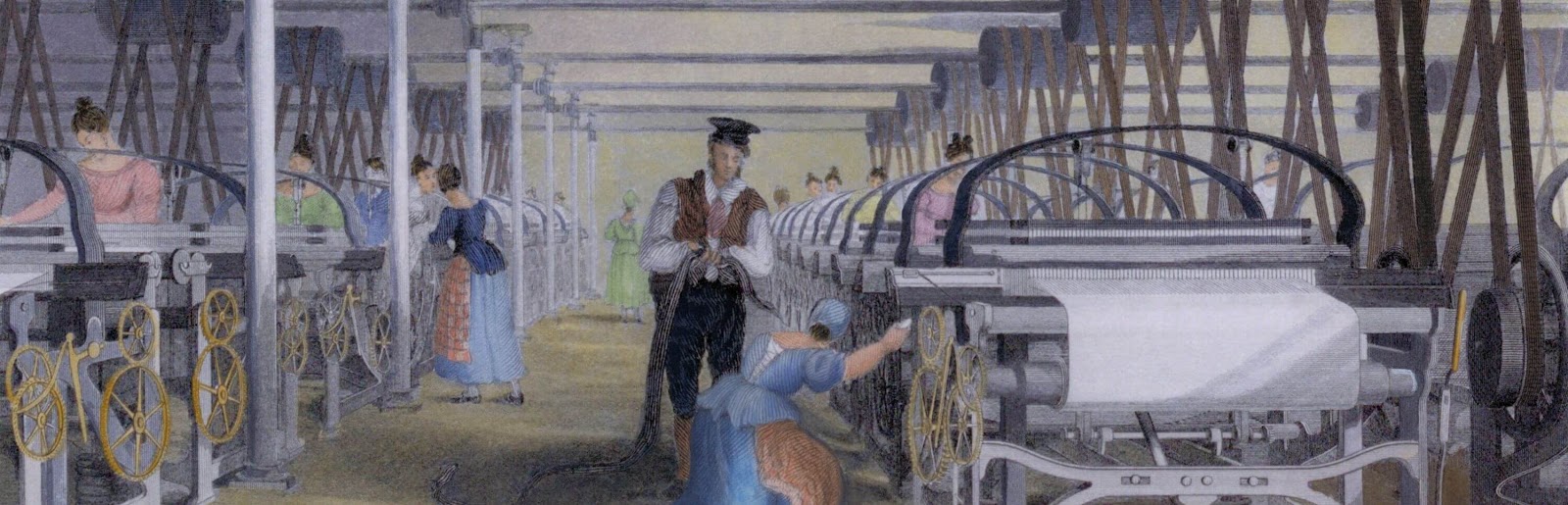
    The first industry to be transformed was the cloth industry. Cotton cloth, an expensive luxury product before the Industrial Revolution, was mass-produced by power-driven iron textile machinery. Huge increases in productivity led to a large fall in price and increased demand. Cotton cloth became England’s largest export throughout the 19th century. Power-driven metal machinery would transform the production of many traditional industries.


    We can measure the long-run results of ceaseless innovation in the weaving of cloth. A weaver today using modern looms can produce 100

    times the amount of cloth per hour produced by a hand-loom weaver 200 years ago.


    Many of the advances came together to create the railroad in the 1830s. Railroad locomotives were make possible by the development of high-pressure steam engines, an improvement James Watt decided to ignore and denounce. It took 25 years of experimentation and development to work out the technical details of an efficient locomotive and a practical railroad. Even failures often showed at least one technical improvement, solving one technical problem.


    The first general-purpose railroad was built in 1830 between the port of Liverpool and the new manufacturing center of Manchester. The railroad’s main function was to transport imported cotton to Manchester and cotton cloth back to Liverpool for export.


    =========================================================

    For two excellent books describing the invention and development of the Industrial Revolution in England, see


    William Rosen, The Most Powerful Idea in the World:  A Story of Steam, Industry and Invention. 2010.


    Gavin Weightman, The Industrial Revolutionaries:  The Making of the Modern World, 1776-1914.  2007.


    Related Blog Posts:

    Adam Smith’s Pin Factory At the beginning of the Industrial Revolution. Why Adam Smith’s Wealth of Nations does not explain the origins of the Industrial Revolution. How pin and nail production evolved later.

    For an excellent example of an innovative entrepreneur at the beginning of the Industrial Revolution in England, see


    Josiah Wedgwood, the Wedgwood Pottery Company, and the Beginning of the Industrial Revolution.

    How England lost its economic and technological leads. Moral – keep innovating or fall behind.


    A Cautionary Tale – England and the Industrial Revolution.

    Why America was in an excellent position to take advantage of the Industrial Revolution that began in England.

    The Beginning of the Industrial Revolution in America.


    For a list of related posts, see the Guide to Posts. There are essays on American Economic History, American History, China’s Economy, and the English East India Company. And much more.


  • New Jersey Artillery Explosives Production in World War I

    New Jersey Artillery Explosives Production in World War I

    Written by Andrea Dragon, Ph.D. Dr. Dragon investigates and writes about New Jersey’s industrial history. Professor Dragon will be teaching a continuing education course on “New Jersey’s Explosives History” at Rutgers – New Brunswick on October 8, 2025. See details at the end of this essay. 


    1914:  World War I Breaks Out


    Russia started to modernize its army in 1913, with substantial French financial and weapons support. The beginning of a five-year plan, one of the main goals was to expand artillery to catch up with Germany. But war broke out. 


    After the first four months of the war, all combatants realized they were in for a long war with deadly modern weapons. Every country’s strategy of a quick victory through offensive warfare failed. Germany did not defeat France and England in the west, and the Russian offensive against Germany in the east ended in disaster. The result was four years of trench warfare in the west and three years of large-scale but inconclusive warfare in the east. Russia stayed in the war only because of imports of weapons, especially through large orders in the U.S.


    Russia, like all combatants in World War I, was not prepared for a long war. Russia’s stockpile of shells was inadequate for the high rates of fire. The Russian army used up most of its inventory of shells in the first four months of the war. Russia did not have the production capacity to resupply shells for its large army.


    Financing Russia’s Need for Artillery Shells and Explosives: First England and then J. P. Morgan and American Loans


          Russia needed foreign loans because it couldn’t produce the quantity of war materiel needed to engage in modern warfare. When the war began in the late summer of 1914, Russia had a large standing army of over one million soldiers and through conscription and reserves Czar Nicholas II had the ability to draft and call up millions more for the army. What Czar Nicholas didn’t have was the industrial capability to manufacture artillery, artillery shells and ammunitions in the quantities necessary to turn his large army into a modern fighting force. 


          The Czar’s cousin, King George V of England, and his parliament, were willing to spend whatever it took to keep the Czar’s army fighting on Germany’s eastern borders because every German soldier sent east to fight the Russians meant one less soldier to fight British soldiers in the trenches of France and Belgium.


          In the early months of the war, Britain loaned Russia money to buy armaments on the world market, but Britain attached conditions to the loans (buying in England?). Although the munitions themselves would be made to Russian specifications, the contracting for their manufacture would be handled by the British.


          Russia chafed under these conditions and wanted a free hand to choose the manufacturers, delivery times, and most important of all, how and when the contracts would be paid.  Russia tried to go around Britain and seek loans directly from bankers in the neutral United States believing those conditions would be less onerous than the British ones.  


    Obtaining U.S. Financing


    J.P. Morgan was an investment bank. It did not have the financial assets of a large commercial bank. Morgan syndicated loans through wealthy corporate and individual clients and other banks. It made its money from commissions.


          A compromise of sorts was reached in the fall of 1914 when Chancellor of the Exchequer and later Minister of Munitions David Lloyd George asked J. P. Morgan, Jr. who was heading up his father’s banking house, to loan Russia $12,000,000 (about $300 million in today’s dollars) to buy weapons and ordnance. A few months later, Morgan responded to additional requests by beginning a long process of bundling a staggering $500,000,000 worth of loans from his bank and from other American banks.


    Only a few people in the United States outside of the government knew that seventy-five percent of the Morgan-brokered money was designated to be funneled through obscure channels to Russia to buy munitions from American ordnance companies. Although these direct loans from privately owned banks to governments at war with Germany were not illegal because they did not violate America’s official policy of neutrality, they were the subject of fierce debate among members of President Wilson’s cabinet.  The new loans granted Russian officials the ability to act without British oversight enabling them to add layers of regulations to manufacturing contracts by inserting a boggling array of parties, terms, penalties and conditions. The U.S. government refused to make or guarantee loans because of Wilson’s policy of neutrality. America was still strongly isolationist, so any government loans would probably be politically unpopular. And Wilson was facing reelection in 1916.


          On September 22, 1915, representatives of the Russian and British government, with J.P. Morgan, Jr. acting as purchasing agent, signed a contract with New Jersey’s Union Powder Company for the manufacture of several million rounds of both high explosive and shrapnel shells for the Russian version of the French 75mm (76.2mm due to Russia’s unique system of measurement) field artillery gun. These were the first Allied shells made in America.


    New Jersey Artillery Explosives Production and Shipping for Russia


    Russia contracted with American companies, mostly in New Jersey, to produce shells and explosives as early as 1915. 


         ”Soon to be erected on the north side of the Raritan River between the towns of Fords and Metuchen will be the world’s largest munitions factory.”

          Daily Home News, New Brunswick, New Jersey, July 17, 1915.     


          The newspaper didn’t name the Raritan River factory, but it was the Nixon Nitration Works and its sole customer was the Russian Imperial Army.  It was owned by New Jersey explosives pioneer Lewis Nixon.


    Lewis Nixon was the top graduate of his 1882 U.S. Naval Academy class.  After graduating, he pursued graduate work in naval architecture at the Royal Naval College in England where the future King George V was his classmate.  After finishing his studies in England, Nixon moved to Russia where he spent a few years building torpedo boats for the Czar’s navy before returning to the U.S. and managing shipyards in Philadelphia and Elizabeth, New Jersey. In 1897, he supervised the building of the U.S. Navy’s first commissioned submarine.  


          Despite his success in ship building, Nixon lost interest in naval architecture and decided to switch to manufacturing the explosive propellant nitrocellulose, commonly known as smokeless powder.  Even though he knew the basics of smokeless powder manufacture (soaking cotton in nitric and sulfuric acid with the aid of a solvent) Nixon couldn’t just start manufacturing because unlike gunpowder, smokeless powder was proprietary and he risked being sued for patent infringement if he proceeded without a obtaining a license from a patent holder.  He contacted a Naval Academy classmate, John Baptiste Bernadou, who was conducting research on smokeless powder at the Naval Torpedo Station in Newport, Rhode Island.  Like Nixon, Bernadou had traveled to Russia and spoke the language which came in handy because he was also the naval station’s official translator of international research articles including those written by the Russian chemist Mendeleev, the same Mendeleev who devised the periodic table.  In 1897, Bernadou and a colleague, George Converse, received an American patent for smokeless powder that was very similar to the one Mendeleev had patented years earlier. (For the story of the development of smokeless powder, see my post The Maxim’s Machine Gun and Smokeless Powder.)


          After buying a license from Bernadou, Nixon began manufacturing smokeless powder in the Raritan River town of Sayerville.  Unsurprisingly, right away Nixon received orders from the U.S. Navy and from several European armies and by 1902 his factory was producing 6,000 pounds of power a day.


           In 1904 Nixon sold his business to the explosives giant DuPont and returned to naval architecture. But the advent of war revived his interest in smokeless power and utilizing his knowledge of Russian, and his royal contacts in Britain, he obtained a contract to supply Russia with 1,000,000 pounds of smokeless powder in 1915. In his new company (the world’s largest munitions factory referred to in the above quote) which was spread out over twelve square miles along the Raritan River, hundreds of powder men and women and their Russian supervisors produced 75,000 pounds of smokeless powder a day, producing over 200,000,000 pounds by the end of the war.


          Nixon wasn’t the only New Jersey powder man who made explosives for the Russians in WWI, but he was among the largest.  One thing all manufacturers had in common was all received payment for the powder and shells they produced from the money Russia had borrowed via a bewilderingly complex system of loans.


    Union Powder company was owned by another New Jersey explosives pioneer, T.A. Gillespie, who had no experience making munitions but as owner of an important New York civil engineering firm he had experience getting government contracts.   His company was one of several New Jersey shell-loading subcontractors doing business with the lead contractor, Canadian Car and Foundry, a Montreal-based manufacturer of heavy railroad equipment.  In October, 1914, just few weeks after the war began, Canadian Car had received a contract from the British government to manufacture 5,000,000 shells for Russia even though the company had no experience making munitions.  Early in 1915, Canadian Car purchased fifty acres of New Jersey swamp land near the town of Lyndhurst and began building what was billed as the world’s largest shell-loading facility, “Kingsland,” where hundreds of employees working under Russian supervision would load smokeless powder propellant that had been made by Nixon and other powder men plus shrapnel and high explosives into shell bodies shipped to Kingsland via railroad.


          Only about half of the shells specified in the contract had been delivered in January of 1917 when a devastating explosion nearly destroyed the facility, but Canadian Car partially rebuilt and loading operations limped along at a reduced pace until August of that year when the political situation in Russia began to change following Lenin’s return from exile.   Because the Russian Imperial Army was Kingsland’s only customer, the facility’s future depended on whether the new government in Petrograd was going to continue to fight on, or get out of the war altogether.  Sensing which way the wind was blowing, Canadian Car closed down their Russian shell-loading operation in Kingsland a few weeks later.


    The three largest shell-loading plants in the United States were in New Jersey.


    The United States Enters the War


          Russia left the war late in late 1917 because of the Russian Revolution. The new Bolshevik (Communist) government defaulted on Imperial Russia’s obligations to pay for the munitions it had received from American suppliers and subcontractors. Fortunately for New Jersey explosives manufacturers, the United States entered the war in April, 1917.


    After the U.S. declared war, the New Jersey explosives industry shifted into a much higher gear. For example, an all-female crew working at DuPont’s explosives plant in Carney Point, New Jersey, produced 1,000,000 pounds of powder a day


    The United States army had little artillery. The French “rented” artillery to the U.S. Army who paid the rent in picric acid (TNP) filled shells. The French supplied the hardware and the U.S. supplied the manpower and the explosive shells. This was General Pershing’s deal. New Jersey workers made the picric acid, loaded it into shells, then shipped the shells to Europe via South Amboy and Jersey City.


    For security reasons, shell production figures were never published and exact numbers remain elusive. A reasonable guess is that between four and five million high-explosive shells were manufactured at all the shell-loading plants in the U.S. between April 1917 and November 1918.


    In the summer of 1918, the U.S. government contracted with Gillespie to build a giant shell-loading facility, one of the largest in the world. 


          How many of that number Gillespie’s Morgan plant produced may never be known because on October 4, 1918, the Gillespie plant was destroyed by an explosion that killed over 100 workers, many of them women and teenage girls.  The explosion destroyed twelve million pounds of high explosives. 


          No evidence of sabotage was ever found.


    Conclusions


    This is a good example of two key aspects of World War I.


    First, the United States as the world’s largest and most diverse industrial power could provide Russia and later France with war materiel they could not produce themselves in sufficient quantity.


    Second, England, France and Russia had resources beyond what they could domestically produce or provide. In this example, access to artillery shells from Canada and the United States. In addition, England and France could call upon substantial numbers of troops from colonies and Dominion countries (Canada, Australia, New Zealand and South Africa).


    NeJersey’s Explosive History 


    WednesdaysOct. – Nov. (weeks10:30 a.m. – 11:30 a.m.

    Locationinperson in New Brunswick Member$40 NonMember$60 

    The explosives industry in New Jersey began in the late 19th century when handful of entrepreneurs built an industry and powder town” near the Raritan River with the help of few eccentrics including crook or twoand former New Jersey resident sharpshooter Annie OakleyDecades later during WWIthe New Jersey explosive industry had expanded to other sites in the state and had grown so large it was able to supply half of the explosives used by all the AlliesAlthough their story is largely forgottenthousands of brave New Jersey menwomen and teenage girls made millions of tons of explosives and loaded them into shells destined for the battlefields of Europe and over hundred of them lost their lives in terrible explosions(course code NBV38

    InstructorAndrea Dragon


    ========================================================


    For related posts by Dr. Dragon, see


    The Maxim’s Machine Gun and Smokeless Powder


    KELP IS ON THE WAY:  How American Kelp Helped Save the English Explosives Industry in World War I


  • The Maxim Machine Gun and Smokeless Powder

    The Maxim Machine Gun and Smokeless Powder

    Written by Andrea Dragon, Ph.D. Dr. Dragon investigates and writes about New Jersey’s industrial history. Professor Dragon will be teaching a continuing education course on “New Jersey’s Explosive History” at Rutgers – New Brunswick, starting on October 8, 2025. For details, see the course description at the end of this essay. 


    Hiram Maxim and his machine gun

    Hiram and Hudson Maxim:  Inventors of the Machine Gun and Developers of Smokeless Powder


    New Jersey’s eccentrically brilliant brothers, Hudson Maxim (1853-1927) and his cantankerous, womanizing older brother Hiram Stevens Maxim (1840-1916) were both born into a poor, rural Maine family. Hudson claimed receiving his first shoes when he was sixteen. He rarely attended school and was self-taught. Astonishingly, Hudson Maxim’s earliest claim to fame was as the author of a popular “teach yourself” book on penmanship. He also possessed a breathtakingly large ego, once bragging that he could write an article on almost any subject in the world without doing any research.


    Both brothers were prolific inventors; Hiram received 200 patents in his lifetime, the most significant was for the machine gun. Hudson was also a serial inventor and tinkerer who received 60 patents, including one for smokeless powder. 


    In 1881, when he was twenty-eight, Hudson sailed to London to help his brother Hiram establish an English branch of Hiram’s company, U.S. Electric Lighting Company headquartered in New York. Hiram was not only the company’s founder, but he was also the chief engineer who supervised the installation of the first electric lights in a New York office building. Hiram also claimed to be the original inventor of the light bulb, saying Thomas Edison knew more about patent law than electricity. When the brothers sailed for London, Hiram Maxim had a home in Fanwood, New Jersey, where he lived with his wife and three children. He may have had business reasons for travelling to England, but in addition he wanted to escape the public uproar over his bigamous marriage to his mistress who was traveling with him. He had another reason to beat it out of New Jersey – he may have fathered a child by a 15-year-old girl who claimed he had bigamously married her.


    The Maxim Machine Gun


    Hiram may have begun developing the machine gun while living in New Jersey, but after moving to England and with financial backing from Albert Vickers, Hiram was able to build a workshop where he refined his machine gun, receiving a patent in 1883 then establishing the Maxim Gun Company in 1884. It wasn’t until 1889 that Maxim was able to sell a manufacturing license to the British Army. 


    In 1888, Maxim hit the road selling his gun. One of his early targets was the German army but negotiating a license with arms manufacturers there was a cumbersome process involving several entities that already had interests in his British operation as well. He finally sold a seven-year license to his machine gun to the German company Ludwig Lowe in1892.  The Lowe Company joined with Mauser in 1896 to form Deutsche Waffen-und Munitionsfabriken AG and the Maxim license was re-negotiated.


    Long before the war, the Vickers company had become a major shareholder in the Maxim Machine Gun Company and in 1897 Hiram Maxim sold all his remaining shares to Vickers.


    Hudson Maxim

    Smokeless Powder


    The Maxim brothers knew Hiram’s machine gun could revolutionize the way artillery was used in warfare, but until a way could be found to reduce the smoke it produced, promoting the gun was challenging. While the Maxim gun could fire up to 600 rounds per minute, the smoke generated by that many gunpowder-fired rounds produced a black cloud so large and so dense the gun’s eye-watering, coughing three-man crew couldn’t see the target, but the enemy could easily locate the position of the gun.


    Of all the late 19th century American and European explosives pioneers eagerly promoting smokeless powder as a replacement for black gunpowder, Hiram and Hudson Maxim are among the most intriguing. Although their contributions to the development and commercialization of smokeless powder are largely forgotten, the Maxim brothers were important early participants and merit greater recognition. 


    Some kind of smokeless powder was needed to make the machine gun more commercially viable. Fortunately, the Maxims had invented one, or rather each brother had invented one. Hudson claimed he had developed a type of smokeless powder before 1881 when he left for England, while his older brother Hiram claimed he invented smokeless powder long before his brother did. But neither brother invented smokeless powder. The real inventor of nitrocellulose, what Americans call smokeless powder, was a Swiss chemistry professor named Christian Schonbein who was working at his home in 1845 in Basel, Switzerland, when he accidently spilled nitric acid onto his kitchen table. Fearful of being scolded by his wife who didn’t approve of his kitchen-based experiments, Schonbein grabbed the nearest cloth, his wife’s cotton apron, used it to wipe up the spill then hung the apron over the oven door to dry. After it was dry, a “flash,” or a “spark” (depending on who’s telling the story) occurred igniting the apron that instantly burned up without producing any smoke.


    Whether or not that story is true, Schonbein recognized that soaking cotton (cellulose) in nitric acid created a new molecule, nitrocellulose, that burns without smoke and could replace smoky black power in ammunition. He attempted to commercialize his discovery by selling a manufacturing license to a British company, but shortly afterward an explosion leveled the English factory killing eighteen workers. Schonbein returned to teaching chemistry.


    As word of Schonbein’s discovery spread, other European chemically-inclined entrepreneurs filed nitrocellulose patents. Among them were Paul Vielle of France in 1884, Dimitri Mendeleev (of periodical table fame) of Russia in 1892, and Alfred Nobel (the dynamite king) of Sweden in 1887. Each man established companies with production facilities, claimed their ideas had been stolen by at least one of the others, and devoted much time and energy suing each other for patent infringement.


    European armies were becoming increasingly interested in smokeless powder and in 1889, coinciding with the British army’s purchase of the Maxim gun, the British Explosives Committee began the process of selecting a nitrocellulose-based powder to replace the black gunpowder used to propel shells and bullets from guns large and small. The powder selected would become the official military powder of Great Britain to the exclusion of all others. Because all inventors were invited to submit samples to be tested, the American Hiram Maxim submitted a sample of his smokeless powder, and so did the Swede Alfred Nobel.


    Neither the American nor the Swedish sample was selected. The winner was a type of nitrocellulose called “cordite” submitted by British citizens Frederick Abel and James Dewar. As members of the British Explosives Committee, they had examined all the submissions and read all the accompanying documentation before submitting their sample. The inventors who weren’t selected claimed the selection process was rigged to favor the British citizens. Both Hiram Maxim and Alfred Nobel sued but lost in British courts and cordite became the official propellant for all artillery in the British Army. 


    Twenty-five years later during WWI, vast quantities of it were used to fire bullets from the Vickers-Maxim machine gun, which may have been responsible for as many casualties as cordite-fired shells from field artillery pieces. Because the British army was unable to produce the tremendous quantities of cordite needed to fire all that ammunition, it contracted with New Jersey explosives manufacturers to make millions of tons of cordite and load it into shells which were shipped to Europe via South Amboy and Jersey City.


    The Later Years of the Maxim Brothers 


    Wealthy from the proceeds of the sale of his machine gun company, Hiram Maxim became a British citizen and settled into a comfortable life in England but became estranged from his brother Hudson, who had returned to New Jersey. Hiram was knighted in 1902 and the French awarded him the Legion of Honor. In his final years he wrote about philosophy and Christianity. In 1946, Hollywood released a modestly successful feature film about him, “So Goes My Love” based on the memoir A Genius in the Family written by his son, Hiram Percy Maxim, inventor of the gangster-friendly handgun silencer. The film, starring Don Ameche and Myrna Loy, is said to be a comedy. 


    In 1890, Hudson Maxim established a smokeless powder factory in central New Jersey in a newly created town called “Maxim.” He hoped to make a powder that would become the official powder of the U.S. army in the same way that cordite had become the official powder of the British Army. Although he sold Maxim powder to the army, it never became an official powder. Hudson Maxim retired to his mansion on Lake Hopatcong where he wrote The Science of Poetry and the Philosophy of Language, publishing it in 1910.


    COMMENT.  About one million machine guns were produced in World War One.  England was able to greatly increase its cordite production after a chemist developed a new and more efficient way to produce it. The chemist later became the first president of Israel.

    After the United States entered the war, large quantities of another type of explosive was produced for French guns in exchange for France “loaning” artillery to the American army.


    Dr. Dragon is teaching a course at Rutgers University, New Brunswick, New Jersey:


    NNew Jersey’s Explosive History 


    WednesdaysOct. – Nov. (weeks10:30 a.m. – 11:30 a.m.

    Locationinperson in New Brunswick Member$40 NonMember$60 

    The explosives industry in New Jersey began in the late 19th century when handful of entrepreneurs built an industry and powder town” near the Raritan River with the help of few eccentrics including crook or twoand former New Jersey resident sharpshooter Annie OakleyDecades later during WWIthe New Jersey explosive industry had expanded to other sites in the state and had grown so large it was able to supply half of the explosives used by all the AlliesAlthough their story is largely forgottenthousands of brave New Jersey menwomen and teenage girls made millions of tons of explosives and loaded them into shells destined for the battlefields of Europe and over hundred of them lost their lives in terrible explosions(course code NBV38

    InstructorAndrea Dragon

    Osher Lifelong Learning Institute at Rutgers University


    =====================================================================

    Related posts by Dr. Dragon:

    KELP IS ON THE WAY:  How American Kelp Helped Save the English Explosives Industry in World War I


    New Jersey Artillery Explosives Production in World War I

    For a related article on Hiram Maxim, see


    https://digitalcommons.library.umaine.edu/cgi/viewcontent.cgi?article=1243&context=mainehistoryjournal


    For the beginnings of World War I, its consequences, and a bibliography, see 

    The Beginning of the Twentieth Century:  The Start of World War I.

    Bismarck and the Origins of World War I


    Europe on the Brink of World War I


    Also see other related posts:


    Wealth and Power in Pre-World War I Europe 

    The Austro-Hungarian Empire Before World War I

    It is argued in the following post that the First World War was a major cause of much of the violence and disruptions of the 20th century.

    The Immediate and Long-Run Historical Consequences of World War I

    For a list of all posts, with links, on this blog, see List of Posts by Topic

  • Examples of Bilateral Oligopolies

    Examples of Bilateral Oligopolies

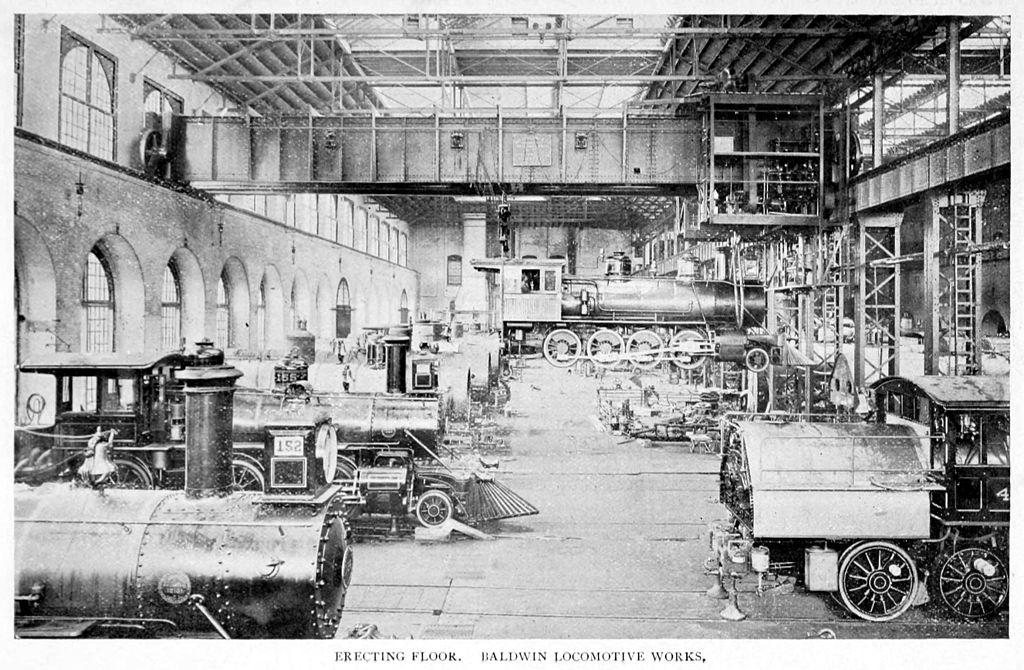
    Baldwin Locomotive Works:  Erecting Floor

    BALDWIN LOCOMOTIVE WORKS:  A HISTORICAL EXAMPLE OF BILATERAL OLIGOPOLY

    Baldwin, the largest producer of steam locomotives in the nineteenth and early twentieth centuries, faced problems typical of a dominant company in a bilateral oligopolistic industry. A highly cyclical, almost unpredictable competitive environment conditioned almost everything that happened at Baldwin. A high level of business risk followed from sudden, large fluctuations in demand from railroad companies. This meant that Baldwin often had excess capacity with substantial fixed investment. There were few opportunities for economies of scale. 

    Baldwin also depended on a skilled labor force with firm-specific knowledge and experience that was exposed to sudden and massive layoffs followed by the company’s attempts to rehire the same workers.  It is hard to imagine a more challenging competitive environment.  

    Baldwin was a large and dominant firm, accounting for approximately one-third of all steam locomotive production.  The buy side of the market was dominated by a small and increasingly concentrated number of railroad companies, five by the early 20th century, which were some of the largest corporations in America in the nineteenth century.  The sources of market power of the locomotive builders were their specialization and flexibility in production, although some of the larger railroads – Baldwin’s largest customers – also built locomotives in their own machine shops.  The sources of market power of the railroads were their large purchasing power, technical knowledge of their “master mechanics” who ordered equipment, and knowledge of the optimal mix of equipment for their particular company.  In such an environment, Baldwin had market power because of its size and assembly expertise, but never enjoyed the market control of a mass producer of standardized products.  Market power based on marketing to final consumers was not feasible; railroad customers did not demand that railroads use Baldwin engines.

    Every large railroad developed its own specifications and demanded customized equipment from Baldwin.  In addition, there was continuous technological improvement of the basic steam locomotive, often innovated by railroad technical staffs.  As a consequence, Baldwin could never control the pace of design change.  The company could not totally incorporate mass production techniques because of constantly changing customized design and finish.  On the other hand, by working closely with its customers over a long period of time, Baldwin probably had lower transaction costs than if its sales were arms-length market transactions.

    This mutual dependence, along with railroads’ credible threat of internal production and the importance to Baldwin of every sale, usually gave the railroads a bargaining advantage when negotiating design customization and price with Baldwin.  But working closely with its largest customers, particularly the Pennsylvania Railroad, also increased the probability of Baldwin’s long-run survival. 

    This symbiotic relationship between steam locomotive builders and the railroads worked as long there was no fundamental innovation in engine design and both sides benefited from continuous improvement in the steam locomotive. But the market radically changed with the introduction of the diesel-electric locomotive. Baldwin and other steam locomotive companies could not compete with the new technology and went bankrupt.  

    The bilateral relationship would be much different in the later market for diesel engines in which General Motors controlled the technology and forced railroads to buy standardized products.

    Baldwin’s management objectives were to minimize risk and maximize operating flexibility by sharing risk with suppliers through subcontracting out much of its parts production.  Since production was to order, Baldwin managed a “just-in-time” parts inventory system that minimized working capital requirements. When times were bad, Baldwin could delay payment to its suppliers and thus use them as a major source of working capital.  This was one way the company dealt with severe cash flow problems in economic downturns.

    The company countered the potential loss of skilled workers after massive layoffs with high wages, skill development through apprenticeship training for employees and sons of employees, and the hope of higher income for long-term employees through a system of internal promotion and inside contracting.  Inside contracting, usually managed by long-term employees, put pressure on contractors to keep labor costs down.  This led to cooperative, less confrontational labor relations policies than those of other large-scale employers like Carnegie Steel.

    Because of the complex nature of its production, Baldwin needed sophisticated internal systems to keep track of parts, subassemblies, and final production schedules.  The company substituted detailed cost and internal job flow information for management control bureaucracies. While Baldwin did little internal product development, it was very quick in applying advances in product design and production technology. 

    When diesel locomotives became less expensive to operate and maintain than steam locomotives, Baldwin tried to adjust but its technology and skill base was too specialized to adopt the new technology.  Baldwin did innovate, designing and producing more powerful and efficient steam engines.  But to no avail.  Baldwin was doomed, another victim of “creative destruction.”

    COMPANIES SIMILAR TO BALDWIN

    Many transportation companies – companies that produce airplanes, ships, or railroad equipment – are similar to Baldwin. The American companies most similar to Baldwin are capital goods and information technology companies that sell large, complicated systems to other large corporations. Corporations that offer oil field equipment and services to large oil drilling companies fit this category.

    Boeing and Airbus are in a similar position as Baldwin. As are the three remaining corporations that produce jet engines.

    Strategies adopted by organizations such as financial software companies that build large, complex systems for large corporate customers, such as SAP or Oracle, are similar to Baldwin’s. These companies start with offering complicated systems and then work with their corporate customers to customize them to meet a company’s particular requirements.

    A special case is the market for the most advanced chips. ASML dominates the market for the machinery that produces the chips. Taiwan Semiconductor (TSMC) dominates the market for the actual production of the chips. Nvidia dominates the market for advanced GPU chips. Competition is often a matter of new technology leading from one dominant company to another – from IBM to Intel to Nvidia. On the other side of the market are the data center companies – Microsoft, Amazon and Google.

    A suggestive line of inquiry might be the similarities between Baldwin’s strategies and those of Japanese companies in keiretsu supply chains to minimize risk, coordinate strategy with subcontractors, and maximize innovation in highly uncertain and changing environments.  Large Japanese companies followed similar strategies in the early phases of their industry growth. A big difference was that zaibatsu risk before WWII was underwritten and reduced by the actions of the Japanese government and related financial institutions.


    The New York Times Discovers Bilateral Oligopoly


    On Sunday, November 1, 2015, The New York Times ran an editorial titled “How Mergers Damage the Economy.”


    The article begins by citing an article in the Wall Street Journal summarizing a study done by two finance profs that estimate “nearly a third of American industries were highly concentrated in 2013, up from a quarter of all industries in 1996.” Much of the editorial mentions a few of the recent proposed large mergers and goes on to list the possible evils from large companies merging.


    But why do large companies merge?  One reason the article gives, without naming the concept, is bilateral oligopoly. To quote:


         Mergers tend to lead to more mergers. In the health care industry, big insurers like Anthem and Aetna say they need to get bigger to have more leverage in negotiations with hospitals and doctor’s practices that have become bigger through acquisitions in recent years.


    Anthem attempted to acquire Cigna ($48 billion) and Aetna attempted to acquire Humana ($38 billion).  There would have been only three large health insurance companies (UnitedHealth is the third). Both mergers were blocked by the Justice Department and the courts. Instead, insurance companies are buying or signing exclusive contracts with pharmacy benefits managers, hospital chains, clinics, and other health care providers. 
    Even without mergers, the five largest health insurers cover over 130 million people, about half of Americans with health insurance. Since then, Aetna was acquired by CVS Pharmacies.
    Pharmacies make the same argument.  Walgreen’s, the country’s largest pharmacy, wanted to buy Rite Aid, the country’s third largest pharmacy.  This is an industry that has seen massive consolidation over the last few decades.  Walgreen’s argument to the government is the same as the health insurers.  They have to get bigger to be in a stronger position when negotiating drug prices with the huge drug companies and pharmacy benefits managers. CVS, the second largest pharmacy chain, took it a step further. They acquired Aetna. CVS combines a dominant pharmacy chain, a health insurer, clinics, and a pharmacy benefits manager.


    Every sector of the health care industry makes the same argument. Hospitals are merging into regional health systems which dominate local and regional markets. Physicians are also joining local and regional groups.  As any one part of the health care supply chain consolidates, partly through mergers and acquisitions, their suppliers and corporate customers feel pressures to also consolidate. In game theory, this is called an “arms race.”
    Health care providers are consolidating because over half of all health care costs are paid by various government programs. Prices are set by negotiations with the government, not by supply and demand. With third-party payment, ultimate consumers can demand high levels of health care with no or low out-of-pocket costs.    


    Corporate managers may not believe in the economists’ quaint ideas about competition but they understand the advantages of market power, the power to influence prices.  They believe they have to gain market share not necessarily to be more competitive in their own industry but when dealing with their suppliers and customers in increasingly concentrated industries.  If not, they believe they will be forced during negotiations to accept lower prices and profits.


    By the 2020s, all markets have become more concentrated. About 2,500 hospitals have closed or merged into regional chains. Walgreen’s and CVS dominate retail pharmacies. Pharmacy benefits management, a key link in the drug supply chain, is dominated by three companies, as is the wholesale drug industry. Independent doctors are joining doctor’s groups, some of which are being bought by Optum, a subsidiary of United Health. Health insurance is dominated by three companies, including United Health. While rural clinics (and hospitals) are closing, private clinics, often owned by hospitals or large healthcare companies, are opening in urban areas.


    This mergers and acquisition activity is a new form of vertical integration, where companies are buying companies on the other side of bilateral oligopoly markets.


    The drug industry is more complicated. Very large companies have been formed through mergers and acquisitions. But most of the new drugs have been developed by hundreds of new drug companies. Some of these companies have been acquired by the large corporations. Others have drug development or marketing arrangements with large companies. (In effect, the large companies have become venture capitalists in their own industry.)


    Mergers and acquisitions continue to be a major corporate strategy.


    Mergers and acquisitions in the United States have averaged over $1 trillion a year in the last five years. Globally, mergers and acquisitions are over $3 trillion a year, creating larger and larger multinational corporations.


    The government bailed out the entire financial sector (and General Motors) during the last recession.  Rather than breaking up the big financial firms, the government allowed (or forced) them to buy other large firms. The number of banking companies is rapidly declining; mergers and acquisitions are creating large regional banking corporations. The banking industry is now more concentrated than before the financial crisis.  


    The article really doesn’t make a strong case for “how mergers damage the economy.”  Maybe the “damage” isn’t so great because of the “countervailing power” (a phrase from John Kenneth Galbraith, used in a different context) of a small number of large companies on both sides of a bilateral oligopolistic market. But health care mergers across industry lines, creating dominant companies in local or regional markets, reduces the “countervailing power” effect.

    ===========================================================

    For the concept of bilateral oligopoly and why this is often the dominant form of market structure, see Bilateral Oligopoly.


  • The Beginning of the Industrial Revolution in America

    The Beginning of the Industrial Revolution in America


    In the Beginning

    PRECONDITIONS OF THE INDUSTRIAL REVOLUTION IN AMERICA

    Before industrialization began in the 1820s, there was a set of political institutions and cultural values, mostly inherited from England, that encouraged profit-seeking individuals to start new companies.  They included fairly secure property rights, increasing legal limits on monopolies, an independent judiciary that enforced contracts, emphasis on individual rights rather than social obligations, patents, tolerance of markets, and less government regulation of markets than in the past.  Much of this was stated or implied in the Constitution; an activist Supreme Court under John Marshall extended these trends. The Constitution also helped to create a national market and reduce transaction costs by mandating a national currency and limiting states’ ability to make economic policy that favored their own residents.


    What America did not inherit from England was important. Unlike England, the new United States did not have a king and a landowning nobility to siphon off capital. Settled by members of dissenting sects and persecuted religious minorities, there would be no state-supported national religion. As a consequence, capital would not be diverted to royal palaces, aristocratic castles, or cathedrals.


    Economists interested in economic development often advocate land reform in a traditional agricultural society as a necessary first step to modernization. This breaks the power of the conservative landlord class. America did not have to go through this step. Laws were passed even before the Constitution that made free and cheap land available to everyone. America began as a nation of landowning farmers. Thomas Jefferson saw independent farmers as the foundation of a democratic society.


    By winning the American Revolution, the new United States retained from England the political policies and ideas that would encourage individual economic “striving” and reject most of the English institutions opposed to progress and change. America was fortunate that it created a political structure, a democratic society, and an ideology that would support the coming Industrial Revolution. 


    In the early period of industrialization (1820-1870), a rapidly growing population (from 3 million in 1790 to almost 10 million in 1820 to 30 million in 1860) created an increased potential demand for new consumer products. Western expansion generated an agricultural surplus of commercial crops that were exchanged for cash to buy manufactured goods. Exports of cotton helped pay for imports of machinery, locomotives and manufactured goods.


    These conditions together could encourage economic growth but not necessarily industrialization, the large-scale production of capital goods (machinery) and consumer goods using inanimate power (steam engines and waterwheels) to drive faster, more powerful machinery. For that to happen, mechanics, tinkerers, investors, and entrepreneurs had to invent, innovate and organize new finance, production, distribution and marketing methods. Economic development drove economic growth.

    THE BEGINNING OF THE INDUSTRIAL REVOLUTION IN AMERICA

    A key factor explaining why America industrialized so early and so quickly was the country’s continuing ties with England after the American Revolution. Americans quickly understood the profitable opportunities of the new production methods being created in England. Americans also had access to much of the scientific and technical knowledge being created and applied in England. Ambitious Englishmen with technical knowledge, like Samuel Slater the founder of the American textile industry, came to America because they had more opportunity here to get rich. Americans read English scientific and technical journals; often, American like Robert Fulton went to England to see the new methods and machinery. The future Baltimore and Ohio Railroad sent an engineer over to England to find out about English railroad technology even before England had completed its first general purpose railroad. American mechanics and engineers quickly adapted English railroad technology to the American environment.

    One reason industrialization spread was the association of entrepreneurs with investment capital looking for new profit opportunities with mechanics interested in designing and developing new power-driven machinery, especially metal-working machinery.  In the beginning, many of the machine tools and power-driven machinery could be built using traditional craft skills, using traditional materials like wood and hand (or foot) operated tools. The power sources to drive the machinery were not a problem. Waterwheels had been used for hundreds of years in Europe; steam engines could be imported from England. They would soon be designed, improved and produced in America.

    America’s wealthy merchant class was more willing than England’s merchant class to invest in new industrial ventures.  The exception was railroads. There were speculative railroad investment booms in England in the 1840s and 1860s. 

    There were inspired geniuses like James Watt in England and Oliver Evans in America who greatly improved the steam engine, which had been in use in England since the early 1700s. Then modifications and adaptations of existing power-driven machinery and machine tools like lathes often led to large increases in productivity of particular products. In one early example, an American axe manufacturer hired a mechanic to design and development a die forging machine to produce axe heads. His machine increased the productivity of a single skilled striker and an assistant from 12 to 300 axe heads per day. It was these kinds of innovations that drove the Industrial Revolution.

    Americans often surpassed the English in their ability to mass-produce products at a lower cost. American products were generally not as good as English products but their lower cost, plus constant improvement, led to a great deal of innovation and high growth rates. Americans developed a reputation of making it fast, making it cheap today and improving it tomorrow. 

                                                                                                                 
    LABOR

    There was no labor shortage for the factories and mines because of high birthrates, high rates of population growth, open immigration, and the use of women in the industrial workforce. This was also a high quality labor force with high literacy rates among native-born workers. Also, there were no entrenched guilds of craft workers to discourage introduction of new production techniques or influence the organization of work in the factories.

    ADVANCES IN RAW MATERIAL PRODUCTION

    The Industrial Revolution would have been a limited affair if not for the huge increase in the production of metals, especially iron. The new steam engines, machine tools, and machinery were made out of iron and other metals. Fortunately, much of the new production technology – smelting iron ore with anthracite (hard) coal or coke and puddling pig iron to reduce the carbon content for forging – had been worked out in England and Wales in the 1700s. Americans had access to or knowledge of this technology when the demand for iron skyrocketed after 1820. Entrepreneurs built larger furnaces, brought over the new Welsh technology of smelting iron ore with anthracite coal, installed steam engines to heat and blow air into the furnace, and recycled waste heat to raise temperatures. The result was a big increase in iron production at a lower cost per ton. The increasing production of iron for casting and forging eliminated a potential bottleneck to rapid industrialization.

    Large amounts of iron would be vital to the development of the railroad industry.

    TRANSPORTATION COSTS

    The single largest transaction cost at the beginning of the Industrial Revolution was transportation costs. High overland transportation costs because of long distances and rugged terrain limited the size of markets and made products expensive.

    These high costs were first attacked on a large scale with the building of canals, inspired by the spectacular success of the Erie Canal (fully opened in 1825). Overland transportation costs fell by about 80%. At the same time, steamboats on Western rivers reduced costs and permitted upstream navigation. America had the largest navigable river network in the world. Then, starting in the 1830s, came railroads, another new technology developed in England. Within two years, American mechanics and engineers were modifying English designs to match America’s harsher conditions. American companies began producing locomotives and other rolling stock. American railroad companies figured out how to lay down track quicker and at a lower cost than the better built railroads of England. This was an early example of the American business ethos – build it fast, build it cheap, get it up and running, generate revenue, then fix and improve it.

    Compared to canals and steamboats, railroads offered huge increases in total carrying capacity, year-round operation, lower cost, greater flexibility and reliability, and big savings in time moving goods, people, and information. The explosion of needed information to run a large railroad created serious management problems, to say nothing of trains crashing into each other. The problem was partly solved by the creation of the telegraph. Railroads financed many of the early telegraph lines, often strung alongside railroad tracks. 
    Railroads also pioneered the decentralization of operations management into divisions that suggested the organizational structure for later industrial corporations.

    Throughout the Industrial Revolution, America had by far the largest railroad transportation system in the world. It overcame large distances and supported western expansion. Railroads moved agricultural goods to urban markets and ports, and manufactured goods to rural areas. They were vital to the creation of a national market.

    THE SPREAD OF THE INDUSTRIAL REVOLUTION

    The thinking of Francis Cabot Lowell, a Boston merchant, was indicative of a new kind of mentality that was crucial to the success of the Industrial Revolution in America. He was a newly rich merchant looking for new investments. Lowell saw cotton textile production as an integrated system in one factory. He thought about how the different production steps could be coordinated in one, large mill to reduce handling costs and increase overall productivity. Lowell raised the investment funds from fellow Boston merchants to pay for the high upfront capital costs of constructing large buildings and textile machinery. He was the founder of America’s first large-scale manufacturing industry – cotton textiles. He is also famous because he went to England to steal the designs of power-driven looms.

    What mill managers and mechanics subsequently learned from experience was that whenever they increased the productivity in any part of the production system it created bottlenecks elsewhere in the system. Better, faster machines would then have to be designed for other stages of production. This would create new bottlenecks; the process was one of continuous improvement in the production flow.

    Back to the axe example. When die-forging machines made many more axe heads per hour, this created a serious bottleneck problem in the milling (or grinding) of the head into the right shape.  New power equipment was invented to plane (or sand) the heads faster than the old technology. This, in turn, put pressure on the methods to temper (or harden) the heads; innovative new specialized ovens were designed to increase the product flow and improve quality. This same process worked in all successful companies in all industries that adopted power-driven machinery.

    Americans like Thomas Jefferson, Eli Whitney, and the technically trained officers of the army realized early the potential of the mass production of interchangeable parts that could be fitted together quickly by unskilled labor to produce and repair guns. Interchangeable parts, when fitted together with other interchangeable parts, eliminated the slow and expensive need for hand filing and fitting to make metal parts fit together. It took over 30 years to make the system operational. It made possible the mass production of new metal products such as sewing machines, typewriters, and automobiles. This new manufacturing process was so radical that English engineers called it the American System of Manufacturing.

    The cumulative effect of this industrializing process was increasing productivity, higher volume of output, better quality and lower unit cost. This trend spread to other industries with the application of general-purpose machine tools to new uses. Itinerant mechanics adapted their knowledge and experience to modernize the production of new products. Techniques developed in one industry were often transferable to new industries. Success in one industry inspired entrepreneurs to apply the same methods in other industries.  This is how the Waltham Watch Company got started; the founder was inspired by a visit to the Springfield Armory, famous for the mass production of rifles. Sometimes this occurred in the same company; Remington went from producing guns to producing sewing machines to producing typewriters.

    At first, industrial products were familiar products just produced at a lower unit cost by power-driven machinery in factories. Examples included cloth, shoes, paper, nails, clocks, and guns. Lower prices had the same effect as higher income; consumers had money left over to buy more of other products. But as production technology advanced – new and more specialized machine tools, the mass production of steel and the ability to work new materials – it became possible to design and produce new, complicated metal consumer and producer durables. New production techniques developed, such as the stamping rather than the grinding of parts. This led to the mass production of the automobile.===============================================================

    For a general discussion of American history between 1789 and 1860, see


    A New Nation, American History from 1789 to 1860


    Compare the American experience with that of England:

    The Beginning of the Industrial Revolution in England


    For the limits of Adam Smith’s thinking in explaining the origins of the Industrial Revolution, see

    Adam Smith’s Pin Factory


    For an excellent example of an entrepreneur at the beginning of the Industrial Revolution in England, see


    Josiah Wedgwood, the Wedgwood Pottery Company, and the Beginning of the Industrial Revolution.

    For the story of how England lost its economic leadership, see 

    A Cautionary Tale:  England and the Industrial Revolution.

    For a list of all posts, see List of Posts by Topic.