Author: Bennett Greenberg

  • “Pax Americana”:  America as a Global Power

    “Pax Americana”: America as a Global Power

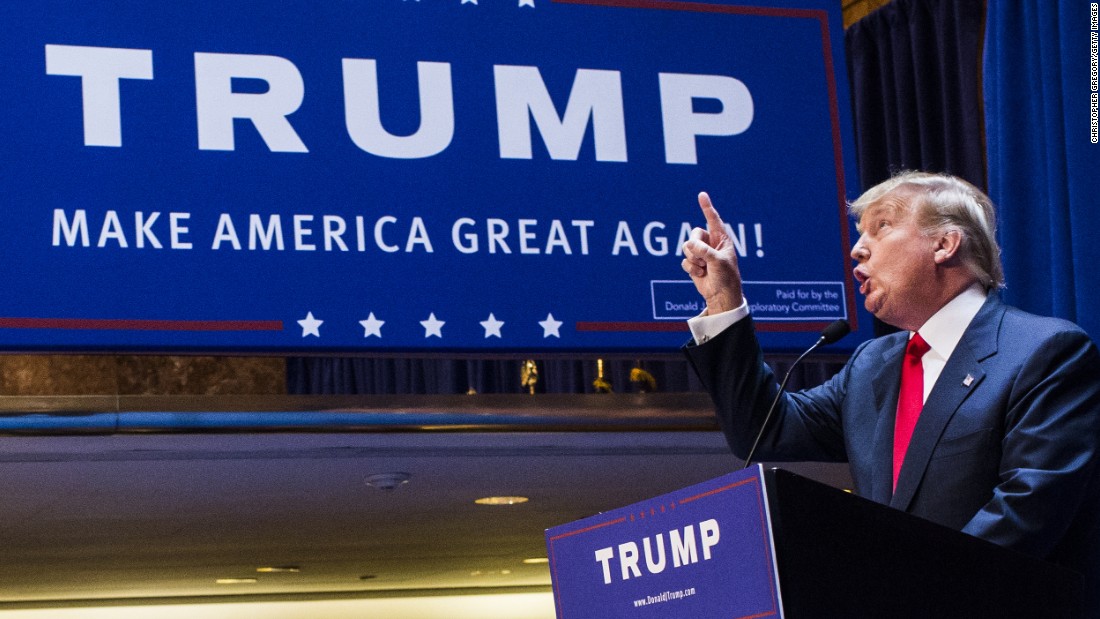
    President Trump

    Might
    Washington, like Rome, fall victim to imperial overstretch?

    Could
    military force abroad eventually have to be withdrawn because of bankruptcy at
    home?

    Might
    the whole idea of America eventually be challenged and destroyed by some
    charismatic new faith: some fundamentalist variant on Christianity?

    Or
    will nature disrupt America’s new world order?


    Robert Harris, “Does Rome’s fate await the
    US?,” The Mail on Sunday, October 12, 2003 (1)


    INTRODUCTION:  FOREIGN POLICY AND DOMESTIC POLITICS

    This post will discuss American foreign policy, with an emphasis on economic aspects. It will focus on the structure of America’s trade treaties and policies, and the interaction of America’s foreign economic policies and domestic politics. The companion post, “Pax Americana”: The World That America Made, the will discuss America’s projection of global power and influence through military power, security arrangements, global economic institutions, and ideological influence.


    During the Cold War (1940s – 1991) and until recently, Americans tended to separate foreign policy and domestic policy. This is no longer true.


    For Americans, there was prosperity at home and security abroad. There was a foreign policy consensus around anti-Communism, that America should take the lead in containing the Soviet Union and China. This consensus made possible large military and national security expenditures. Fortunately, this was a prosperous time for America. There was economic growth, fueled by new technology and pent-up demand following World War II. America was by far the world’s largest economy and American companies did not have to worry about imports from other countries. There were some concerns – Vietnam in the 1960s, supply and price of imported oil in the 1970s, and Japanese competition in the 1980s – but they were peripheral to the core objective of defending western Europe and matching Soviet military forces. 


    Americans no long see foreign policy and domestic policy as separate. Al-Qaeda’s attack on the World Trade Center came as a terrible shock. America’s subsequent attempt to contain Islamic fundamentalism has been inconclusive at best. China is now the main concern. Unlike Russia or Japan earlier, China is seen as a foreign rival and a threat to the domestic economy. America’s networks of military and economic alliances seem to be unraveling. The value of the most important military alliance, NATO, is being questioned. Multilateral agreements are attacked as constraints on national actions and concerns. 


    America is no longer isolated from the global economy. Imports and exports as a percent of GDP are rising, although still lower than most industrialized economies. Industrial supply chains are global. The largest American corporations have become multinational, making investment decisions increasingly independent of America’s national economic interests and policies. 


    President Trump believes in negotiating bilateral (country to country) economic agreements and ignores multilateral organizations. Multinational companies generally prefer global rules. They are opposed to President Trump’s nationalistic economic policies of increased tariffs and other barriers to trade.


    TRADE TREATIES AND AMERICAN FOREIGN POLICY


    What we might be seeing in
    the United States and globally is the end of the post-WWII era, the “American
    Century.” Why have a majority of Americans stopped supporting the global
    institutions that the United States created after World War II? Will America
    react creatively to guide the world to a new set of rules and regulations? Or
    will the United States revert to isolationism and protectionism, as it did
    after World War I, the last time America tried to impose a “New World Order”? 


    America, through many
    rounds of multilateral and bilateral trade negotiations since World War II, has
    set the rules and regulations for the current global economy. These trade
    treaties had three aspects:


    ·     
    Reduce barriers
    to trade such as tariffs and quotas.

    ·     
    Economic and
    political integration of the non-Communist world.

    ·     
    Access to the huge American market in exchange for military alliances and bilateral security
    agreements, including American bases abroad.


    With the collapse of the
    Soviet Union in 1991, it appeared that the economic and the national security aspects
    were separated. The global economy continued to expand. The combination
    of relatively free trade and new communications and transportation technology made it possible for
    large national corporations to evolve from exporters into multinational
    corporations. Technology, capital, management, finance and labor became mobile,
    creating complex financial structures and supply networks.


    AMERICA AND THE GLOBAL ECONOMY


    But there was growing opposition in America to the global economy. Presidential candidate
    Donald Trump tapped into and focused widespread discontent with free trade and
    the global economy.


    89% of Americans
    think that the loss of US jobs to China is a somewhat or very serious issue,
    according to Pew Research statistics…Only 46% of Americans think NAFTA was good
    for the economy.

    Business Insider, November 13, 2016.


    As in Europe, nationalist,
    anti-immigration politicians have turned long-standing economic problems and
    rising discontent into a political agenda. Rather than dealing with them
    domestically, these politicians blame outside groups and institutions –
    international organizations, immigrants, “unfair” foreign competition.
    Strangely, they don’t blame the organizations that actually moved jobs and
    investment overseas – multinational corporations. Top managers and owners of
    multinationals with large overseas investments are well represented in the
    current administration – Rex Tillerson, Wilbur Ross and Donald Trump.


    What is the source of this
    discontent? One source is the change in the global economy. From the 1940s to
    roughly the 1980s, American corporations owned the American economy and didn’t
    worry about foreign competition. The rest of the world was devastated by World
    War II. There was new technology to develop, pent-up demand, and wartime
    savings. The result was rising real wages and employment security.


    By the 1980s, that began
    to change. The success of Japanese exports of autos and consumer electronics to
    the U.S. created a U.S. trade deficit with Japan, which became a political
    issue. American corporations found themselves competing with foreign companies
    at home and abroad. Capital (automation) continued to replace production and
    assembly labor even as industries such as autos and steel recovered. Real wages
    and real incomes stagnated for workers in the older industries. Job security
    and pensions disappeared.


    REALITY CHECK: 
    THE GLOBAL ECONOMY


    President Trump has a
    simple-minded view of global trade and the structure of the global economy that
    is at least two generations out of date. As a consequence, there is a disconnect
    between economic reality and political rhetoric.


    In outline:


    ·     
    Countries don’t
    trade, corporations do. About 60% of “Chinese” exports are produced by foreign multinational corporations. 

    ·     
    The mental
    picture of a country’s companies producing at home and then exporting is
    obsolete.

    • o  
      There are complicated
      global supply networks and an every-changing dynamic international division of labor.
    • ·     
      Where goods are
      produced is less important than where value is added.
    • o  
      Nike does not
      produce any shoes in the U.S. but most of the value-added occurs here. Same for
      Apple and many consumer electronics companies.
    • ·     
      There are
      complicated relationships between American and foreign companies.
    • ·     
      Over 25% of
      American manufacturing is owned by foreign corporations.
    • o    Foreign car
      companies account for most of American production.
    • ·     
      About 20% of
      America’s merchandise trade is intra-company.
    • ·      About half the
      sales and profits of America’s 500 largest corporations are outside the United
      States. Overseas operations account for most of their growth in investment, sales, and profits.
    • ·     
      A large part of
      American imports is of products and services created and marketed in the United States and
      produced by American companies abroad.
    • ·     
      The fastest
      growing part of American exports is high value-added services. This creates high-paying jobs. The U.S. runs a large trade surplus in services.


    ·     
    As discussed
    later, consumers in the United States, not “Mexico” or “China,” pay increased
    tariffs (taxes) on imports.


    The economic reality is that
    multinational corporations, made possible by the global economic order that
    America created, are crucial to American economic growth. A return to
    nationalism will increase conflict between domestic politics and the economic
    growth needed to address domestic problems.


    As discussed below,
    attempting to reduce America’s trade deficits through increased tariffs and
    other trade restrictions will not work.


    TARIFFS AND TRADE


    What would happen if U.S.
    unilaterally renounced trade agreements and imposed tariffs? A tariff is a tax.
    The income from tariffs goes to the U.S. government. It is a tax mostly
    paid by American consumers. It would raise prices on imports, including imports
    of inputs like parts and subassemblies. It would also raise prices on some
    American-produced products that compete with imports. 


    Other countries would
    retaliate. (2) The net result for America would be higher costs and prices
    (inflation), and lower standards of living. There would be few if any net new
    jobs in assembly or manufacturing. 
    Multinational corporations would direct new investment to countries that
    were not threatened, that didn’t retaliate or to countries that depreciated
    their currencies against the dollar since they would have relatively lower costs. Chinese and American
    companies in China are already moving labor-intensive production and assembly to countries like Vietnam,
    Bangladesh and Malaysia. Even hi-tech companies like Chinese solar panel
    producers have started doing this. (3)


    American exports would
    suffer as other countries retaliate. Companies in the U.S. would accelerate
    research and investment in robotics and AI in the United States, substituting
    fully automated assembly lines for manufacturing workers.


    America’s economic growth
    depends on innovating new products and services, keeping the high value-added
    part in the U.S., outsourcing the low value-added part to the global supply
    chain, and selling in the global market. Much of U.S. imports are raw materials
    such as crude oil and other inputs into processed or final assembled products
    with high labor, low wage content. Much of America’s exports are processed or
    manufactured goods with high capital and human capital content such as refined
    petroleum products and aircraft. We also run a trade surplus in services such
    as financial, consulting, and software. Any retaliation will damage American
    research and development, the source of economic growth. So will the proposed
    cutbacks in federal support for basic research, especially in the area of
    biotechnology.


    The stated goal of
    reducing the U.S. trade deficit might not happen. A reduced trade deficit could
    lead to an appreciation of the dollar against other currencies. This would
    increase the cost of American exports and reduce the cost of all imports,
    offsetting the economic effects of increased tariffs.


    Jobs leave the U.S. for
    other reasons besides lower wages. In the Carrier example, the president of the
    parent company, United Technologies, said the Mexican workforce is not only
    cheaper but also more productive, easier to train, and has lower rates of absenteeism
    than the American workforce.


    REDUCING DOMESTIC AND GLOBAL ECONOMIC GROWTH


    President Trump can reduce
    global growth through his trade and tariff policies. A president can raise
    tariffs or label a country a “currency manipulator” through executive
    privilege, without Congress’ approval.


    Candidate Trump promised to
    put a 45% tariff on Chinese exports, brand China a currency manipulator, tax
    Mexican imports, increase tariffs on German and Japanese cars, “rip up”
    existing trade agreements and kill the Trans-Pacific Partnership (TPP), which
    he called “a rape of our country.” If he did all this, he would ignite a global
    trade war, which the chief economist of Citi said “could easily trigger a
    global recession.” Other bank economists have said that even modest increases
    in tariffs on Chinese and Mexican imports could reduce real GDP growth by 0.5 –
    1.0%. (Business Insider, November 13,
    2016)


    Summarizing his analysis,
    Citi’s chief economist, Willem Buiter, concluded:


    The
    U.S. has been the champion of free trade and open borders for decades. A
    retreat from globalization by the US would likely lead to reciprocal actions
    from other countries, and reinforce the latest shift towards deglobalization
    and could be another nail in the coffin of the liberal global economic world
    that has supported prosperity since 1948. (Business
    Insider
    , November 13, 2016) 


    DOMESTIC AMERICAN POLITICS AND FOREIGN POLICY


    Imperial overstretch, also
    known as imperial overreach,
    is a hypothesis which suggests that an empire or world power can extend itself
    beyond its ability to maintain or expand its military and economic commitments.
    The idea was popularized by Yale University historian Paul Kennedy in his 1987
    book The Rise and Fall of the Great Powers.


    America has financed its
    global military and economic commitments through borrowing, much of it in
    recent years from foreign governments and institutions. The Federal budget
    deficits over the last 16 years have been roughly equal to Defense Department
    spending. (Total spending on national security is higher.) The Chinese
    government is the largest foreign holder of U.S. government debt.


    A great power like the
    United States can also retreat into isolationism and protectionism if its
    people lose the will or ability to pay the costs or believe they are not
    benefiting from foreign commitments. A sense of frustration sets in. Foreign
    economic ties may be seen as a source of domestic economic and social problems.
    The American president and foreign policy strategists stop talking about the
    primacy of democratic governments and American ideals in foreign affairs.

    During the Cold War with the Soviet Union, Americans were willing to accept the idea of prolonged conflict without certain victory. Since the collapse of the Soviet Union, domestic support for prolonged wars and political conflicts to contain enemies rather than defeat them has been seriously eroded.

    There is irony when the
    country that built the greatest wall in history is now talking about open trade
    while the country that has led the post-war campaign to expand trade is talking
    about extending a wall. As Chinese emperors knew, walls are as much
    psychological as physical.


    Domestic problems may take
    precedence and divert resources. The combination of the rapidly rising cost of
    health care and social security for an aging population, large military and
    national defense expenditures, a rising backlog of public investment, proposed tax
    cuts, larger fiscal deficits, and large trade deficits is not sustainable. The
    proposed programs of the Trump administration will make the problem worse and
    probably accelerate the crisis.


    Decades of fiscal deficits
    and trade deficits, financed increasingly by foreign borrowing, have led to
    high and rising levels of the national debt-to-GDP ratio. Borrowing at low
    interest rates has made this possible. If the Federal government had to borrow
    at the post-war average, it would add over $250 billion to annual deficits.


    The next round of tax cuts
    for upper-income households and corporations will lead to larger structural
    deficits even in years of economic growth. The United States will find it
    increasing expensive (higher interest rates) to finance national defense and
    global commitments. This will reinforce President Trump’s call for reduced
    American involvement abroad. (4)


    Donald Trump blamed job loss
    and stagnant incomes on imports, particularly from China. While economic
    studies show that over 80% of job loss is due to technological change, and some
    of the rest to domestic trends like leveraged buyouts and corporate cost
    cutting, blaming “unfair” trade rules and other countries had more political appeal. As president,
    Donald Trump has said he will oppose the trade agreement with Pacific Rim
    countries (TPP), intends to unilaterally change some of the tariffs and trade
    rules of NAFTA, and has no intention to continuing trade negotiations with the
    European Union (this may change). Candidate Trump also singled out Japanese and
    German auto companies as targets for increased tariffs, despite the fact their
    investment in the United States revitalized the American auto industry.


    The related campaign theme
    was the emotional issue of immigration, both legal and illegal. Donald Trump
    demonized Mexicans and Muslims, blaming them for job loss of Americans, crime
    and domestic terrorism. Travel bans on Muslim countries, revoking of visas, and
    mass deportations were begun as soon as he became president. Combined with
    rhetoric that was racist and xenophobic, this will not endear the United States
    to its Latin American and Muslim allies, and fuels anti-American feeling. 

    President Trump has
    encouraged similar rhetoric in European and South American countries. He has
    antagonized and isolated America’s strongest ally on the European continent,
    Germany.


    Immigrants are vital to
    American economic growth and development. Graduates of elite foreign
    universities often came to the United States; “over 75 percent of the graduates
    of the Indian Institutes of Technology in the 1980s emigrated to America.” (5) Over
    half of the science and math graduate students in American universities are
    foreign. Keeping them in the U.S. with H1-B visas is vital. Immigrants and
    their children are entrepreneurial, accounting for a disproportionate share of
    new businesses. Managers from all over the world are necessary if American
    multinationals are to remain competitive.


    Mr. Trump’s call for
    economic nationalism and isolationism reverses 70 years of American foreign
    economic policy. Global economic integration will continue but without the
    United States setting the rules. The United States has pulled out of global organizations attempting to reduce global warming and intends to loosen domestic environmental regulations. China, on the other hand, is taking up leadership to
    combat climate change.


    Exports, including tourism,
    will suffer, thus reducing a major driver of American economic growth and job
    creation. Tariff and trade wars will hurt U.S. economic growth and development.
    They will increase the insecurity and frustration of more Americans. 


    Blaming the social costs of
    technological and economic change on foreign scapegoats will make it more
    difficult to deal with these ongoing problems. This will continue to fuel
    domestic anger and support for isolationist and protectionist policies.


    President Trump does not
    believe that government is responsible for dealing with the “negative
    externalities” or social costs of industrialization and rapid economic and
    social change. The Trump administration is not concerned with pollution and
    climate change. This reduces American influence in dealing with these important
    global problems. This makes the transition to non-fossil fuel energy more
    difficult. It also means that new energy technologies such as solar panels and
    wind turbines cannot expect any government support, ceding these high-tech,
    growth industries to corporations in other countries.


    The issue of global warming
    illustrates the loss of American leadership in international attempts to solve global
    problems. The American denial of global warming will have consequences to
    American influence. Candidate Trump denounced global warming as a “hoax.” As
    president, he has quickly supported of fossil fuel companies by relaxing environmental
    rules on the production of oil, natural gas and coal, particularly on the
    release of methane and carbon into the atmosphere. His first proposed budget
    slashes support for climate research, solar and wind turbine power, and
    electric cars. President Trump has also announced that he does not support the
    latest global agreement setting targets to reduce carbon emissions. Appointing
    the CEO of Exxon/Mobil as Secretary of State, in charge of America’s foreign
    policy, is a clear message.


    POSSIBLE SHIFTS IN FOREIGN POLICY


    President Trump is pessimistic
    about the global order and America as a global power. If he believes America
    can influence global events from behind “Fortress America,” he is deluding
    himself and the American people. If he thinks he can be isolationist, protectionist,
    and xenophobic without damaging American power and influence, he is deluding
    himself.  If he thinks he can praise Putin
    and support right-wing, anti-EU parties in Europe without damaging American
    influence, he is deluding himself. If he thinks he can insult the governments
    of Germany, England and other allies without consequences, he is deluding himself. If he
    thinks he can denounce, repeal or unilaterally change trade treaties without
    consequences to the U.S. economy, the global economy and American leadership,
    he is deluding himself. If he thinks he can reduce America’s commitment to NATO
    without reducing American power and influence in Europe, he is deluding himself. And us.


    The damage has already been
    done.  Even if President Trump backtracks
    on some of his threats, no one can trust that what he says
    at any moment will not change. For domestic political reasons, he will probably
    return to the nationalist, anti-global themes that got him elected, and could
    get him reelected. America has become an unreliable ally. Allies will reevaluate their national interests and foreign policies in light of uncertain American support.


    CONCLUSION


    The last presidential
    election shows that many Americans, probably most, are no longer willing to pay
    the cost of maintaining American power and influence in the world. Domestic
    problems are blamed on “unfair” global competition, global institutions,
    immigrants and foreign governments.


    It matters little if
    President Trump does not follow through with his threats. The damage has been
    done. Increased tariffs and trade restrictions will hurt the American economy
    and make it more difficult to deal with domestic political issues. Scapegoating
    foreign governments, minority groups and corporations will fuel anger and discontent,
    making it less likely America will react creatively to its economic challenges. The coming massive disruptions of robotics and artificial intelligence will increase domestic tensions.


    More Americans are against
    global institutions and against the United States bearing the cost of being the
    world’s global power. Pew Research polls showed that this trend started well
    before Donald Trump ran for president. Mr. Trump has tapped into these feelings,
    making them the driving force of a successful presidential campaign. His continued focus on these themes will probably continue to erode American support for the post-war economic institutions and rules America established.


    America’s commitment to
    promoting democracy and free trade around the world is waning. America’s
    current president seems comfortable with authoritarian rulers and
    anti-democratic far-right political leaders in Europe. Many of these leaders
    want to dismantle the European Union and return to national currencies and national economic policies. Some,
    like Marine Le Pen of France, want out of NATO.


    China has replaced Japan as
    the cause of America’s economic problems. America’s relationship with China is
    moving from détente to confrontation.
    America’s allies in Europe and Asia are recalibrating their relations with
    Russia and China as the American president talks of isolationism. America is
    becoming an unreliable ally.


    America’s resolve to bear
    the costs of being a global power is waning. America’s domestic social and
    economic change has generated a politically powerful backlash. Most white
    Americans do not want their government to support or promote social change, do
    not support the open global economic order America created, do not want to bear
    the cost of being a global superpower. These are related. Continued
    presidential rhetoric, despite his policies, will encourage and broaden these
    beliefs. Trump’s dark, pessimistic picture of America’s isolationist,
    protectionist future may be a self-fulfilling prophecy.


    America’s “New World Order”
    is coming apart. The last election and opinion polls indicate that most
    Americans do not believe in it. America’s allies in Europe are under attack
    from nationalist groups that want to dismantle it and appease the Russian
    autocrat. These groups are given vocal support and encouragement by the
    American president.


    President Trump, by
    renouncing TPP, has signaled America’s abdication of influence in East Asia;
    allies now have to look to a combination of nationalism and accommodating
    China. New national security and economic arrangements among Asian countries will be considered. For example, South Korea has taken the first steps to signal easing tensions with North Korea, over the objections of the United States. The TPP countries intend to continue with the treaty without the United States.  China has started an ambitious economic and strategic program called “One Belt, One Road” to circumvent American military and strategic containment. Economic growth for East Asian countries will be increasingly tied to economic
    alliances and trade agreements with China.


    All of the political and
    economic institutions that the United States created or supported after World
    War II, mostly in response to the Communist challenges of the Soviet Union and
    China, are now under domestic attack. One group believes the post-war
    framework has outlived its usefulness, that it no longer deals with changed
    geopolitical and economic circumstances and is need of drastic reform. Probably
    a larger group no longer supports the foundations of the American world order.


    ——————————————————————————————————

    1. For
    suggestive analogies between America and the Rome, see “The Roman Republic Commits Suicide:  A Cautionary Tale for America,” June 19, 2011.
    https://politicaleconomicsprof.com/2011/06/pax-americana-i-washington-imperial.html


    2. Reuters, “China prepares
    to counter any U.S. trade penalties:  sources,”
    March 20, 2017

    http://finance.yahoo.com/news/china-prepares-counter-u-trade-093343375.html


    3. The New York Times, “When
    Solar Panels Became Job Killers,” April 9, 2017, page 1 of the Sunday Business
    section.


    4. “The Economy After the
    2016 Elections,” November 26, 2016

    https://politicaleconomicsprof.com/2016/11/the-economy-after-2016-election.html


    5. Fareed Zakaria, The Post-American World, 129.


    ============================================================


    See the companion post:  “Pax Americana”:  The World That America Made.”  https://politicaleconomicsprof.com/2017/03/the-beginning-of-end-of-pax-americana.html

    If you like history and speculative historical analogies, you might like the following two essays:

    The Roman Republic and America

    The Roman Republic Commits Suicide:  A Cautionary Tale for America

    For a list of all posts and economic tutorials in Pages, see Guide to Posts.


  • Breaking Away:  Britain and the European Union

    Breaking Away: Britain and the European Union

    Breaking Away – Now What?

    INTRODUCTION

    No one, especially the British leaders who advocated Great
    Britain leaving the European Union, have any idea what is going to happen.  But the short-run economic problems from the breakup are easier to deal with than the underlying social and political problems.  It is these underlying problems that could tear the EU apart.  

    PRELIMINARY THOUGHTS

    Some preliminary thoughts on Britain breaking away from the
    European Union:

    Direct economic effects will be minimal, both for Britain and
    the EU.

         London will remain the financial capital of Europe.  The alternative isn’t Frankfurt; it’s New York.

         Much of Britain’s trade with EU is part of complicated supply chains within or between multinational firms.  This will also continue.  Both sides need each either.


         This will accelerate the current trade negotiations between the U.S and the EU.  Both sides want a deal in place before President Obama leaves office.  Both sides, and Britain, see this as a partial solution to the problems caused by the breakup.

    In longer run, lots of
    alternatives and economic agents (read multinational corporations) will adjust.


    Adjustment process in Britain probably not too difficult because:

    Britain not in Eurozone, so already controls own monetary
    and fiscal policy.

    Britain did not sign the EU free labor movement treaty, so
    already controls borders.

    Does get rid of stupid EU regulations but England has
    enough itself.

    Getting out of EU will not bring back British coal mining,
    steel industry, shipbuilding, textiles or fishing.


    The break weakens the EU more than Britain.  If all the uncertainty and panic leads to a global recession, Britain will survive. The EU might not.


    The discussion about future EU-Britain trade agreements is mostly irrelevant.  The EU does not have trade agreements with China, Japan and the U.S.  Most trade is governed now by the WTO, and bilateral and multilateral agreements. Neither side can afford to disrupt financial and trade flows.

    British voters may have also destroyed Great Britain.  Increases odds of Scotland leaving Great Britain and taking the North Sea oil with them.

    Scottish National Party got creamed in last national
    election; basis for comeback?

    Political effects in EU could be serious, with possible
    follow-on economic effects in the future.

    Now OK for people in other countries to vote to get out of
    EU.

         Questions of national sovereignty and immigration not limited to Britain.

    Continued attraction of nationalist parties appealing to
    racism and xenophobia, many anti-democratic.

    Long-term danger of reversion to nationalist economic policies that would damage global economy.

    Partial break-up of EU, maybe back to primarily free-trade zone
    agreement.

    Reverse of drive to further European integration as expense of national sovereignty.

    German economy depends critically on exporting to EU countries.  Would probably give up support of EU objectives to preserve free-trade zone.

    Further erosion of influence of U.S. in Europe and U.S
    commitment to NATO.

               Signaled by weak U.S. response to Russian pressure on Ukraine.

    Russia attempts to exploit EU weakness and eliminate economic sanctions.  Germany resists. European politics in the future will center on German-led
    Central European bloc, direct geopolitical rivalry with Russia.

               Poland becomes a major geopolitical player in
    Europe.

               If EU holds together, Germany becomes even more
    dominant.

    Most of European national governments just as dysfunctional as
    EU.  Unlike Britain after Thatcher, they do not have national economic policies that promote economic growth.

    Free markets and financial sector dominated by large,
    multinational corporations.  England
    becomes less attractive to foreign (non-European) multinationals as an entry
    point into the EU.

    Maybe British MNCs got it wrong; maybe they’ll be better
    off without EU regulations.

    Overall, Europe and the EU are increasingly less important to
    the world, both economically and politically. 

    The current American administration recognizes this with
    its “pivot” towards Asia.

    Britain leaving EU part of this trend.

    COMMENTS

    This vote brings out some wider questions about the EU and
    European politics.

    It is important to remember what were the original objectives of
    the EU:

    Promote free trade (low tariffs, no quotas, less national
    preference), economic recovery and economic integration of Europe.  Why?

    Reduce chances of another European war.


    Promote economic growth and development through
    cooperation.

    Promote democracy and democratic political institutions,
    often in countries where they were weak or historically non-existent.


    Contain Germany in an economically-integrated Europe.


    Provide economic foundation to oppose Soviet Union


    Lessen appeal of Communist parties in Europe.

    Has the EU fulfilled its original objectives and is less important
    today?  How relevant is it to the
    economic and political future of Europe? 

    How effective has the EU been in defining and meeting its new
    objectives since the collapse of the Soviet Union? 

    As the EU has taken on more ambitious objectives, become more complicated (bureaucratic?), and usurped more of the
    functions of national governments, has it become less effective and lost
    political support?

    The EU is no longer a vehicle for economic growth for the more developed countries of Europe.  Structural unemployment has been high for the entire EU for a long time.  National governments have used EU assistance and loans to avoid domestic reforms.

    It is the EU, not Britain, that is facing a political and economic crisis.  I would suggest that if the
    EU is to survive and be an effective set of institutions and policies in the
    future, it has to undergo a radical rethinking of its objectives, procedures
    and structure, including its relationship with the national governments of
    Europe.  And it has to do it now.  The British vote was a wake-up call.

    FOOTNOTE. By coincidence, I’ve been doing a lot of reading about Europe during the generation before World War I and evolving German political objectives during World War I.  Much of my reading has been on the Austro-Hungarian Empire and the rising tensions in Central Europe.  There are some similarities to the current situation, including the class and social tensions partly driven by technological change.  

    One way to understand what is happening, in Europe and throughout the world, is through geopolitical thinking.  Two place to start:

    George Friedman, his articles in stratfor.com, Geopolitical Futures, and his book Flashpoints.


    Robert Kaplan, The Revenge of Geography.  Half of the book is an introduction to past geopolitical thinking and the other half is an application of geopolitical analysis to current conflicts.

    President Obama’s announcement of a “pivot” towards Asia echoes the founding article of modern geopolitics, H. J. Mackinder, “The Geographical Pivot of History,” 1904.  Copies are on the Internet.

    =====================================================================

    For a list of all posts and economic tutorials in Pages, see Guide to Posts and Pages.

  • John von Neumann Sees the Future

    John von Neumann Sees the Future

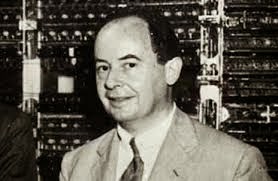
    John von Neumann

    JOHN VON NEUMANN CREATES
    THE FUTURE

    If you want to understand the world we live in, you
    have to know about the thinking of three men – Alan Turing, Claude Shannon and
    John von Neumann. I’ve talked a little
    about Alan Turing in an earlier essay. 
    All three men knew each other, discussed their thinking with each other, and
    promoted each other’s ideas.

    John von Neumann has been called the smartest
    individual of the 20th Century (by his brother-in-law, who won a Nobel Prize in Physics).  An outline of von Neumann’s accomplishments, which you can read about in 
    Wikipedia, is hard to believe. He invented game theory, which I discussed in
    two earlier posts. He belonged to a group
    of mathematicians who invented new statistical techniques at Los Alamos that
    made the atomic bomb possible. He invented game theory. In 1944,
    he wrote a memo that outlined the structure of the modern computer. He then managed the design and building of a
    modern general computer (to sped up solving partial differential equations his friend Edward Teller had to solve to produce hydrogen bombs) and consulted on the building of virtually all the
    early computers.

    JOHN VON NEUMANN SEES THE
    FUTURE

    In the early 1950s, von Neumann, like Alan Turing, became interested in
    the similarities and differences between computers and the human brain. The study of both was in its infancy. But von Neumann already saw that comparisons
    between computers and human brains could benefit both computer science and
    neuroscience. In the far future, he
    believed they might even converge.

    In 1956, von Neumann was asked to give a series of
    guest lectures at Yale, summarizing his thinking.  Unfortunately, he was dying of cancer and
    couldn’t personally deliver the lectures. In 1957, they were published in a short book, The Computer and the
    Brain.

    Although it was not certain at the time, von Neumann assumed
    (correctly) that the output of neurons was digital. Either a neuron fired or it didn’t.  From this, he argued that a computer could
    simulate the processes of the brain but that the converse wasn’t true.

    Von Neumann calculated that the processing speed of
    the brain was very slow but the brain overcame this through massive parallel
    processing. All of the neurons, about 100 billion, are
    processing at the same time; through synapses between neurons, they are all
    computing simultaneously.  This is how
    supercomputers work – parallel processing through the interaction of many
    computers or servers. Only at vastly faster speeds
    than the brain. The total processing,
    measured in operations per second, is approaching that of the brain.

    But von Neumann saw even further into the
    future. He believed that we were at the
    beginning of a turning point in human history. He foresaw that the exponential increase in knowledge of computer
    technology and how the brain worked would have profound effects on humanity’s
    future. In the early 1950s, he told Stan
    Ulam, a brilliant mathematician, that

    the ever-accelerating progress of
    technology and changes in the mode of human life give the appearance of
    approaching some essential singularity in the history of the race beyond which
    human affairs, as we know them, could not continue.

    The possible implications of this statement,
    especially the use of the word “singularity,” are scary.
     T
    he entrepreneur and inventor Ray Kurzweil, who is now an intellectual in residence at Google, has been the biggest champion of the Singularity. Mr. Kurzweil wrote The Age of Intelligent Machines in 1990, The Singularity Is Near in 2005, and has now written The Singularity Is Nearer. By the end of the decade, he expects computers to pass the Turing Test and be indistinguishable from humans. Fifteen years after that, he calculates, the true transcendence will come: the moment when “computation will be part of ourselves, and we will increase our intelligence a millionfold.” This is also one description of artifice general intelligence, or AGI. At Meta, it is known as “super intelligence.”

    Geoffrey Hinton developed the ideas behind neural networks decades ago. He educated many of the scientists who developed the AI statistical methods that “trained” some of the first AI foundational models. Professor Hinton, the “godfather of AI,’ recently said on Ian Bremer’s show GZERO World that within at most 10 years computers would be “smarter” than humans. He didn’t sound too happy about it.


    If you would like to know just how scary all this could be, read Ray Kurzweil, The Singularity is Near:  When Humans Transcend Biology. I would not recommend reading this just
    before you try to go to sleep.

    A LITTLE HISTORY:  WATSON PLAYS JEOPARDY

    In 2011, IBM’s supercomputer Watson played against
    the two best Jeopardy players.  Watson’s
    predecessor, Big Blue, had defeated the world’s best chess player, Gary
    Kasparov.  Chess is a highly structured
    game where Big Blue’s ability to evaluate millions of combinations of future
    moves gave it an advantage over the more limited memory of Kasparov. But Jeopardy was different. Besides knowing a vast and varied amount of
    information, the supercomputer had to understand natural language and come up
    with the most probably answers. Jeopardy
    clues included puns, metaphors, double entendres, humor and worse, word
    combination and rhymes not found in normal speech. Rather surprising, Watson beat the two of the most successful human Jeopardy competitors. For some computer
    scientists, this meant that Watson had passed the Turing Test. For a few others, Watson had gone beyond it.

    We now know what came next. It took magnitudes of increase in computer processing capacity and speed, partly based on massive parallel processing. This led to the large learning models of artificial intelligence. Von Neumann would not be surprised.

    THE FUTURE STARTS TO ARRIVE

    The following is a summary of an article in The New
    York Times, “Brainlike Computers, Learning From Experience,” December 29, 2013.

    “Computers have entered the age when they are able to
    learn from their own mistakes.”  They can
    automate programming, like how to move a robot’s arm, and tolerate errors.  The new computer chips are based on
    neuroscience, “how neurons react to stimuli and connect with other neurons to
    interpret information.”  The new approach
    to artificial intelligence will allow computers to do many things humans do
    with ease – “see, speak, listen, navigate, manipulate and control.”  Some of this, such as SIRI voice recognition,
    is already here.

    The big difference is that computers will no longer
    be limited to what they have been specifically programmed to do. Computers use statistical algorithms to
    learn. Last year, Google researchers
    used a type of algorithm called a neural network into a computer, which was
    able to learn without detailed instructions or human supervision.  The computer was fed 10 million images and
    taught itself how to recognize cats.

    The new processors are not programmed in the usual
    sense.

    Rather, the connections between the
    circuits are “weighted” according to correlations in tagged data and images that the processor
    has already “learned.”  Those weights are
    then altered as data flows in to the chip, causing them to change their values
    and to “spike.”  That generates a signal
    that travels to other components and, in reaction, changes the neural network,
    in essence programming the net actions much the same way that information
    alters human thoughts and actions.

    This is how the brain works.  A neuron (nerve cell in the brain) receives
    information from hundreds or thousands of other neurons.  If a critical level of cumulative inputs is
    reached, the cell “spikes” and sends an electrical impulse down a filament
    called an axon.  This releases chemicals
    called neurotransmitters that are picked up by other neurons and may contribute
    to their “spiking,” possibly changing other neurons.  These changes lead to changes in human
    thoughts and actions.

    An advantage of the new approach is that the
    algorithms can adapt and continue working even when there are failures to
    complete prior tasks.

    Computers are combining biological and statistical
    techniques to overcome the limitations of traditional programming.

    It seems to me that the logic of this approach is
    similar to Bayesian statistics. The
    general nature of the algorithms, neural networks and genetic algorithms, has
    already been developed.

    This is another step away from the rigid programming (deterministic algorithms), and error-free hardware of computers. There will be feedback effects as scientists learn more about how the
    brain works and how computers are programmed to simulate the brain.  Already, there is a field of research called
    computational neuroscience.

    The largest class at Stanford last fall was a
    graduate course on applying biological and statistical techniques to computer
    learning.

    All of this returns us to the early speculations in
    the 1940s and 1950s on how information theory and computers were going to
    influence other disciplines, particularly the biology of the mind
    (neuroscience).  The difference is the
    incredible advances in our knowledge of the brain and the equally incredible
    increases in the processing capacity and speed of computers.  A “thinking computer’” is no longer a
    metaphor or an impossibility.  The
    convergence and feedback of the two areas are leading us into a future even
    beyond the wildest dreams of the early thinkers.

    Except John von Neumann. I imagine he would not be surprised by artificial intelligence.

    ====================================================================

    Related Earlier Posts:


    Alan Turing and Strategic Management

    Limits to Strategic Planning


    The Limits of Negotiation:  A Little Applied Game Theory


    President Obama Learns Some Game Theory

    Go back to the Guide for Posts.

    Many of the posts are about how information influences markets and market behavior. The next step is to conjecture on how AI will affect economic development through innovation, the structure of markets, and the management of corporations. We will all be waiting to see what ChatGPT has to say about all this.


  • Alan Turing, Computers, and Strategic Management

    Alan Turing, Computers, and Strategic Management

    Alan Turing


    Alan Turing developed many of the basic concepts for digital computers in the 1930s. His ideas were promoted by John von Neumann.
     In 1943, he came to the United States to exchange ideas and experiences with scientists and engineers at Bell Labs. He spent a great deal of time talking with Claude Shannon, the father of modern information theory, about their mutual interest in digital computers. 

    One day while having lunch in an AT&T executive dining room, Turing was describing his ideas about what a “thinking machine” could do.

    “His high-pitched voice already stood out above the general murmur of the well-behaved junior executives grooming themselves for promotion within the Bell corporation. Then he was suddenly heard to say: ‘No, I’m not interested in developing a powerful brain. All I’m after is just a mediocre brain, something like the President of the American Telephone and Telegraph Company.’”

    Andrew Hodges, Alan Turing: An Enigma, 251.

    Given the abysmal record of AT&T top management since the divestiture in 1984, even a mediocre brain, human or computer, would have been an improvement.

    I don’t believe that large corporations in a global, rapidly-changing competitive environment can be managed in any meaningful way by humans. Failure rates are high, mediocre financial performance common. Integrated planning systems like those from SAP and Oracle are an intermediate step towards computer-based strategic management. This is an area of application for artificial intelligence (AI).

    Strategic management might be based on computer simulations of different sets of short-run and long-run strategies. In an uncertain, often discontinuous external environment and with strategies interrelated in complicated ways, operational and financial outcomes are often highly uncertain. Computer simulations that could capture some of this complexity would be an improvement over current planning methods.

    At a minimum, companies will be able to react faster to unexpected change and have a better idea of the financial consequences of changing different sets of strategies. This would be a source of competitive advantage.

    Computer simulations compared to human top management strategists have the advantage of continuity. Managers come and go, often with large gaps in specific knowledge and implementing disruptive changes in strategy based on personal past experience. In contrast, computer simulations of an organization embody continuous knowledge and experience. As assumptions and forecasts are replaced by actual data, strategies can be revised in intervals closer to real time.

    Simulations can also learn over long periods of time, even suggesting new strategies and probably chances of success.  A few companies are already using algorithms based on concepts from chaos and complexity theory to forecast and plan. Neural net models hold out the possibility that computer programs will be able to choose among competing strategies.

    The drawback will be that simulations will, to some extent, be “black boxes” to human managers, producing unexpected results in unknowable ways. This will change the training and mentality of managers.

    ==================================================================

    For an essay on John von Neumann, see


    John von Neumann Sees the Future

    For all the posts (with links) on this blog, see

    List of Posts by Topics

    There are posts on: 

    American History and American Economic History.

    Information, innovation, and how markets work. 

    Business, finance and economics. 

    Also a series of essays on demographics, population projections, and speculations on how decreasing and aging populations will interact with the economies of individual countries and the global economy. 

    Essays on a variety of historical topics, including the Industrial Revolution, India and the English East India Company, Rome, and Europe in the World War I period.


  • Nonprofits in the American Economic System

    Nonprofits in the American Economic System

    Jane Addams’ Hull House

    INTRODUCTION AND ISSUES

    Nonprofits are the third part of the American economy and society but discussed less often. About 1.6 million nonprofits accounted for about 12.3 million paid employees in 2016, more than 10.2% of the entire workforce. Nonprofits sold about $940 billion of goods and services in 2014, about 5.4% of GDP. Some of the goods and services of nonprofits are given away; they are considered transfer payments and not counted in GDP.  Total revenue, including imputed value of donated goods and services of nonprofits was $2.01 trillion in 2015, about equal to the total revenue of all state governments. 

    Employment and charitable giving data indicates that nonprofit revenue continues to grow.


    Private charitable giving in 2018 is expected to be around $410 billion. The average household’s cash contribution is around 
    $2,100.


    Have you ever:

    Gone to a private school or college?

    Entered a nonprofit hospital?

    Attended a cultural event such as a concert, museum or play?

    Watched a public TV channel or listened to a public radio station?

    Belonged to a church?

    Been active in an environmental group?

    Belonged to a “Y?”

    Belong to a fraternal club or organization?

    This is only a sample of the many specialized goods and services nonprofits provide. 

    Until recently, nonprofits have been peculiarly American phenomena.  One source has been evangelical Protestantism.  Starting with the Second Great Awakening of the 1820s-1830s, born-again Protestants and others have been exhorted to struggle against social evils and improve society.  Religious groups like the American Bible Society (still in existence) printed and distributed Bibles and other religious material to spread the Gospel on the American frontier and abroad through missionaries. Out of this impulse came many of the 19th century reform movements, including abolition, suffrage and temperance (later Prohibition).  Ken Burns’ documentary on Prohibition emphasizes how the highly organized Anti-Saloon League was able to tap into native-born Protestant beliefs and organizations to amend the Constitution to abolish alcohol, an extraordinary accomplishment.

    It is hard to imagine any other country funding the development of a polio vaccine through the March of Dimes. Or the huge amount of medical research funded by charitable giving. Every disease or medical problem seems to have a targeted nonprofit dedicated to its eradication or control.

    Unlike other countries until recently, many of America’s wealthiest individuals and families have given away most of their fortunes or continued to support nonprofits through foundations.  A personal note:  The small town I grew up in had a Carnegie library, the most imposing building in town.  If it weren’t for that library, I would probably have ended up picking oranges in the nearby Sunkist orange groves. 


    Before 1945, most of America’s colleges, hospitals, museums and major cultural groups were started and funded by private philanthropists. As far back as the 1830s, de Toqueville commented on the puzzling American behavior of forming private, volunteer organizations to attack a perceived public problem or start a socially beneficial institution.

    Open software companies are an interesting new type of nonprofits. They have also generated new opportunities for for-profit companies that offer value-added software and support. This is another example, like for-profit hospitals and colleges, where nonprofits have developed a new market and for-profits attempt to find profitable niches. 

    Social and political reform movements continue to proliferate outside of the political party structure. There are an incredible number of similar groups today; I seem to be on all of their mailing lists.

    Nonprofits are decentralized, local providers of social goods and services. This may be more efficient than a system of centralized governmental organizations.

    WHAT IS A NONPROFIT?

    The name is somewhat misleading.  Nonprofit doesn’t mean that the organization doesn’t make an accounting profit (revenue greater than costs).  Like any organization, it must at a minimum cover its costs, like a for-profit, and generate a profit for growth and capital investment.  

    The big difference is that nonprofits do not pay some taxes – Federal income taxes, state income taxes, sales taxes and local property taxes.  They do pay other taxes, such as payroll taxes (Social Security, Medicare, disability, unemployment). The other major difference is that less than half of revenue comes from the receivers of nonprofit goods and services. Even when paid by customers, much of the customers’ expense is ultimately paid by third-party payers.

    Some private contributions and donations are tax-deductible.  This mostly benefits corporations and higher-income households who itemize deductions. Under the new tax laws, only about 5% of all households itemize deductions. Wealthy individuals and families also set up foundations and other nonprofits to create wage income and to avoid inheritance taxes.

    Larger, well-known nonprofits like large hospitals and private universities can market tax-exempt bonds at lower interest rates.

    So the main difference is that  “nonprofits” are primarily “non-taxed.”  In exchange, nonprofits provide “community benefits.”  To an economist, this is a fuzzy and arbitrary legal distinction.  Some communities agree.  Princeton residents are suing Princeton University, contending that some of the University’s policies (sharing patent royalties with faculty) constitute for-profit operations and the University should lose its nonprofit status.  Pittsburgh challenged the University of Pittsburgh Medical Center’s nonprofit status. The new mayor dropped the suit in exchange for the city’s hospitals and Carnegie-Mellon University negotiating with the city to find “areas of mutual interest.”

    What do nonprofits do?

    Deal with the negative externalities of a capitalist industrial economic system.

    Analyze and lobby to ameliorate social and environmental problems.

    Deal with the consequences of inequality and poverty in the economic and political system.

    Fund high-risk activities, like specialized medical research.

    Provide social goods, which probably become more important as the real price of profitable goods become relatively less expensive.

    If nonprofits sometimes perform services government doesn’t, they also develop markets for services that are not a government monopoly.  For-profit companies then look to the potentially profitable niches of these markets.  Two examples:  

    Hospitals in the suburbs.  

    Professional degrees for adult college students (University of Phoenix).

    Many nonprofits compete with for-profits and government institutions, such as in the areas of health care, education, entertainment, and culture.


    WHY DO NONPROFITS EXIST?

    A paradox. Why are there so many nonprofits in an economic system driven by the desire to maximize income and earn profits?  According to the assumptions of economic theory, they should not exist. If you read any economics textbook, they do not exist.

    Why are so many people willing to work for nonprofits when they could make higher incomes and benefits working at for-profits or in government?

             Why do people volunteer their time, knowledge and services?

    Why do people contribute money and time to nonprofits from which they receive no direct benefit?

    All of this widespread behavior implies that decisions on how people earn an income, spend their money or use their time is more complicated than the assumptions made in economics.

    SPECIAL CASE:  NGOs

    Global Non-Government Organizations (NGOs) are taking over some of the goods and services provided by national governments.  One reason is that sovereign nation-states do not want to pay for supra-national goods and services.  Another reason is that many poor or “failed states” countries will not or cannot afford to provide basic services.  Some problems can only be analyzed or attacked on a regional or global basis and governmental institutions have not been established to do so.  One example is Doctors Without Borders, which has an operating budget of over $400 million.  Many environmental groups are global.

    NONPROFITS A GROWING PART OF THE ECONOMY

    Between 2001 and 2011, the number of nonprofits increased by 25%.  The number of for-profit businesses increased by one-half of one percent. This is a function of increased demand and need in the areas of health care, child care and care for the elderly, environment, and education.These numbers come from the Urban Institute.  (Somewhat worrisome, the number of for-profit companies in the U.S. has been decreasing since 2008.)

    Like the for-profit sector, the nonprofit sector is concentrated. About five percent of nonprofits account for 87% of total revenue and expenses. Nonprofit organizations with revenue over $50 million account for about 75% of total revenue. 

    Revenue is also highly concentrated by type of institution.  Health care organizations take in 60% of total nonprofits revenue (hospitals alone – 50%) and private education an additional 17%. (National Center for Charitable Statistics, “Quick Facts About Nonprofits.) But about 66% of all nonprofits have budgets of less than $500,000.


    GDP and employment figures do not include the number of volunteers or value of goods and services not paid for by recipients.  The Urban Institute estimates the value of volunteers at about $170 billion a year.  (The New York Times, “For Nonprofits, A Bigger Share of the Action, 3/9/14.”)

    Some reasons for the growth in the number of nonprofits:

    As the population ages, there has been a large increase in the demand for health care services.  Many of these are provided by nonprofits.

    The number of charities has grown as the number and problems of the poor has increased during and after the Great Recession of 2007-2009. 

    Growing demand for the goods and services provided by nonprofits such as in the areas of education and cultural goods and services.

    Many areas of the economy are considered unprofitable or too risky for for-profits.

    Government programs don’t exist or are limited by resources or politics. Governments are willing to “outsource” management of what are government goods and services in most countries to private organizations.

    Creation of new groups to publicize and combat new social, political and economic problems, such as pollution and protecting the environment. In economic jargon, nonprofits exists because individuals and private groups have organized to publicize and reduce the social costs of a rapidly changing industrial society.

    Increased awareness that many of society’s problems can only be attacked on a regional or global scale (beyond national borders) and that there are no international agencies to address them. 

    HOW ARE NONPROFITS FINANCED?

    Government programs, government subsidies, private donations, private foundation grants, payment for services.  Fees for services (tuition, private health insurance, ticket sales, etc.) account for about 50% of total revenue.  Government grants and payments account for another 32%, or about $550 billion.  Private contributions are the source about $350 million. One-third of private contributions go to religious organizations.

    NONPROFITS AND MANAGEMENT

    Based on my experience in both corporate life and involvement with a number of nonprofits, I believe that it is more difficult to manage a nonprofit than a similar size department, division or the whole company of a for-profit company.  

    Managers in the hierarchy of a for-profit have the tools, incentives and authority in a “command and control” hierarchical structure often missing in a nonprofit.  Managers of a nonprofit often don’t have the threat of firing employees, especially volunteers, or the incentives of promotion, big raises or stock options. 

    In nonprofits, there is often a need for consensus, which takes social skills many corporate managers lack. The boards of nonprofits often take a more active role in managing and monitoring managers than in for-profit companies.  Nonprofit managers often lack the resources and have less of the support structure that corporate managers take for granted.  Nonprofit managers must routinely be more “entrepreneurial” than corporate managers.

    NONPROFITS AND EMPLOYEES

    The existence and growth of nonprofits may also indicate that people work for more complicated reasons that economics assumes.  Nonprofits offer managers and employees opportunities for autonomy (less command and control from above; more independence), mastery and growth (improving skills and knowledge that matter) and purpose (wanting to provide service to others – objectives beyond the individual).   All this suggests that individuals can derive satisfaction on the supply side by working at jobs and for organizations they consider meaningful, rather than just working for a paycheck.

    SUMMARY:  NONPROFITS IN A CAPITALIST ECONOMY

    In the capitalism vs. socialism debate, nonprofits represent a third way to organize economic activity. Nonprofits have no owners (no shareholders), indicating that private (non-government) companies can be formed without private ownership. Also, profit is not the primary motivation in starting a nonprofit.

    Nonprofts are a viable organizational form for a service economy. The growth of nonprofits as a percent of the economy may reflect the shift in demand towards services as health care, education, organized religion, concern with social and environmental problems, cultural institutions, local issues, and funding special interest groups and their projects.

    Much of the revenue of nonprofits comes directly or indirectly from tax money. This allows government to pay for programs without actually managing them as in a socialist economy. Much of government-funded basic research and health care services are done in nonprofits. This reduces the costs of bureaucracy and adds flexibility, as many nonprofits are local or deliver specialized services.

    Nonprofits develop new markets. For-profit companies then look for profitable niches such as suburban hospitals, career/adult private colleges, and drug development based on basic research. In addition, for-profits provide a wide variety of services to nonprofits.


    CONCLUSIONS (FOR ECONOMISTS)

    Nonprofits will continue to be a larger part of both the national and global economy as the social costs of production and consumption grow exponentially, as populations age faster than the revenue of government programs, as dysfunctional governments cannot cope with technological change or even provide basic services, and as environmental and social problems further transcend national borders. 

    If you believe the basic assumptions of economic theory, it is strange that nonprofits exist at all because they embody much non-economic behavior.  People are willing to work for less money.  They become volunteers and donors, motivated by altruism, social conscience, sociability, empathy, or a sense of fairness.  In short, nonprofits are based on different value systems.

    Economists ignore nonprofits because it would require a richer set of psychological motivations than the simple assumptions of economic theory. 

  • Nonprofits II:  Issues, Costs and Benefits

    Nonprofits II: Issues, Costs and Benefits

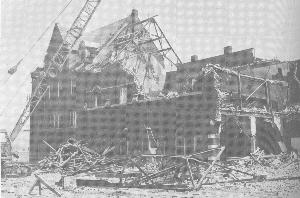
    Demolishing Hull House

    Property Tax-Exempt Status: 
    Case Study

    The town
    of Morristown, New Jersey has a lawsuit against Morristown Medical Center
    attempting to take away part of the hospital’s property-tax exemption.  Started as
    a small building providing free medical services to the poor, Morristown
    Medical Center is now part of a health conglomerate with revenue of $1.7
    billion a year.  Much of its revenue comes from providing facilities for
    private doctors and managing ambulatory and testing services.

    The town
    won an earlier suit classifying part of the hospital’s operations as
    taxable.  If Morristown wins, the
    hospital will be liable to up to $3 million per year in property taxes.  Since the case is almost certain to go to the
    state supreme court, the nonprofit status of all hospitals in New Jersey with
    similar operations and relationships with doctors could be at risk.  The court’s ruling could potentially affect
    all nonprofits in New Jersey and then be used as a precedent in other states.  (Newark Star-Ledger, “For towns,
    nonprofits, tax case looms large,” February 22, 2015, A1)

    Morristown
    Medical Center is the largest employer in Morristown.  The hospital is growing and will probably
    increase employment in the future.  But its
    parent company, Atlantic Health Systems, could decide to expand its services at
    another hospital or a new location.

    The hospital attracts doctors and other healthcare
    professionals and services to the area.  For
    example, there are three nursing homes and two assisted-living facilities
    within two miles of the hospital.  Two of
    the nursing homes, privately-owned, are across the street from the hospital.

    New Jersey has high property taxes.  The existence of large nonprofits in a town
    increases the local tax burden on privately-owned property.

    The town and the hospital might negotiate a “in
    lieu of” voluntary contribution agreement.  Either way, this conflict might affect other nonprofits in
    Morristown.  Two large tracts of land,
    with specialized buildings, are owned by Seeing Eye and three private colleges. The smallest of the colleges owns land with an estimated market value of over $50 million.

    Issues, Costs and Benefits

    Nonprofits
    exist in a very different economic environment than when they were originally
    created and given tax exemptions.

    Again, fewer
    than 5% of all nonprofits receive 87% of total revenue.  These are large operations with substantial
    assets.  The image of small, local
    nonprofits providing services to the poor and underprivileged, financed by local
    private donations, is somewhat out-of-date. Nonprofit managers often make corporate level salaries. Many nonprofits conduct large donation and marketing campaigns well beyond their area of operations.

    Many of
    services provided by nonprofits are also provided by for-profits that pay
    taxes.  My local suburban YMCA primarily
    provides a fully equipped health club, physical rehab services, exercise
    classes, a pool, summer camps and programs, and baby-sitting services. It raises money by selling Christmas trees, in competition with two
    private nurseries within seven blocks. In the past, the “Y” may have offered “community services” that were not
    provided by private companies but this is no longer true.

    Other
    “Y’s” and churches in the area sponsor government-subsidized and/or property
    tax exempt senior citizen housing. Many
    of the apartments are empty during the winter.

    Some
    nonprofits provide goods and services that are only tangential to their
    original mission, such as the social, cultural and recreational services
    provided by some churches.  There is a
    “Y” in New York City that runs a kindergarten with tuition of $50,000 a year.  It is more difficult to get your kid into
    this school than Harvard.

    It will
    be political dynamite if nonprofits lose their property tax exemptions and the
    rulings are applied to churches.

    Nonprofits
    use municipal services, the same as payers of property taxes.  Some nonprofits pay property taxes indirectly
    when they rent office or other space. 
    Some pay “in lieu of” donations for municipal services.  I would guess that overall these payments are
    a small fraction of foregone property taxes.

    I have
    not seen what the total tax savings of nonprofits are.  On the other hand, nonprofits, primarily
    hospitals and colleges, receive about $500 billion a year in tax money.  I have seen a few studies that indicate
    eliminating the itemized deduction to nonprofits would have little effect on
    total private giving.  This is not
    surprising since much of this goes to churches and related religious
    organizations.

    If some
    communities charged property taxes and others didn’t, it might affect where nonprofits locate in the future.  Also, some existing
    nonprofits might relocate.

    Social
    services to the poor are a small percentage of the total expenditures of all
    nonprofits.

    A lawyer
    has told me that judges and the IRS have become somewhat more critical of the
    “community services” provided by some nonprofits.  More nonprofits are basically tax shelters or
    scams.  A long, recent article in the New
    York Times
    discussed how rich families have set up private art museums,
    sometimes on their residential properties, and “donated” part of their private
    art collections to avoid future estate taxes.  Public access to these
    museums is often limited.

    Full
    Disclosure:  I once taught at one of the colleges mentioned in this post.  I am currently on
    the board of a nonprofit in Morristown that owns tax-exempt property.  (Not the hospital)

    Sources:

    Linda
    Stamato and Sanford Jaffe, The Newark Star-Ledger, “Finding common ground
    for tax-exempt charities and municipal services,” March 15, 2015, D5.

    =======================================================

    For background and description of nonprofits, see Nonprofits I:  Nonprofits in the American Economic System.