Author: Bennett Greenberg

  • Limits to Strategic Planning


    Strategic and Tactical Planning


    For thirteen years, I was a corporate economist and a
    corporate planner manager for three Fortune 500 companies.  I discovered that I could do my job as a
    corporate economist while ignoring all but the simplest of economic
    concepts. As a corporate planner, I
    learned that the planning processes of large corporations were, at best, mostly
    a waste of time and resources, and at worst, contributed to the relative demise
    of the companies. Of the three companies
    I worked for, one has been sold three times, one has gone through a bankruptcy,
    and the other merged with (actually sold to) A Brazilian company.  This is becoming typical; the failure rate of
    large corporations is accelerating.


    Other disciplines in business are no better.  Marketing is still based on ideas, usually
    summarized by the four P’s, that are a formula for stagnation at best and
    decline at worst.  Mass-media
    advertising, born at the beginning of a rapid growth in consumer affluence and network
    TV as a novel medium to mass-market branded products, doesn’t work any
    more.  There are vastly more products,
    markets are fragmented and we hit the mute button when the ads come on.  Cable and the Internet are the new advertising
    and marketing tools. Advertising on the Internet is dominated by the social media and search companies Google and Meta. Think of one TV ad
    campaign that actually convinced you to change products.


    What about financial planning?  Financial control was a brilliant innovation
    80-90 years ago, with its full potential realized by General Motors in the
    1920s.  It made possible the huge,
    multi-division corporations of today. 
    Although operations were “decentralized” into division, corporate
    control was strengthened through the financial controls of budgeting and
    allocation of investment funds.


    Financial planning and control often has a negative effect
    on corporate performance as the budgeting and planning numbers have taken on a
    life of their own.  “Hitting the numbers”
    has had a chilling effect on innovation and risk-taking.  Executive bonuses and the value of their
    stock options are tied to short-term profit increases. The system invites
    acquisitions and cost cutting (massive lay-offs, less investment and
    outsourcing) as major strategies. Manipulating the accounting system has become an important business
    skill.  At worse, it gives us Enron and
    massive fraud in the entire financial system.


    Almost all studies show that drastic cost cutting by firing
    large numbers of employees does not increase profits (rates of return) after
    two years.  


    Acquisitions, despite
    reducing duplication and head counts, seldom make a minimum rate of return. For two reasons – asymmetric information (sellers know more than buyers) and buyers remorse (bidding competition of very 
    competitive corporate executives). The result is optimistic assumptions about future growth in sales and profits or ignoring discounted rates of return analysis when bidding. Buyers pay too much to make an acceptable return on investment.


    Think of all the business fads of the last few decades.  Total quality management.  Reengineering.  Matrix or decentralized decision-making
    organizational structures.  Benchmarking.  Six Sigma. 
    Many of them are still in management and organizational development
    textbooks.


    As a manager, how can you make good decisions if you do not
    understand the economic environment, consumer motivation, how to reach and
    influence consumers, distrust the numbers but work under the tyranny of the
    budget, are worried about the next “down-sizing,” and have to adapt to the
    consultants’ “fad of the month?”


    But what about new ways to manage?  What about Mission Statements and strategic
    visions? What about Project Management and cross-functional teams,
    “intrapreneurs,” process change, Black Belt Swat teams that swoop in and
    quickly solve problems? 
    What about the belief that software like SAP will solve your company’s problems? What about the
    most advanced advice from consulting firms? If corporate managers feel they must call in management consulting firms like McKinsey to tell them how to manage, then the board of directors should fire the managers.  


    The Reality


    With all these ideas on how to improve corporate
    performance, why are so many big corporations in deep trouble?  Leave aside the dotcoms.  Leave aside the criminal conspiracies
    disguised as corporations, their accountants, their lawyers and their
    investment bankers.  Think about the
    cutting-edge companies of 30 years ago, the ones that were praised in books
    like In Search of Excellence. 
    What happened to IBM, Xerox, Polaroid, K-Mart, Digital Equipment and the
    other companies that have since disappeared? 
    Even many of the pharmaceuticals no longer make a superior rate of
    return and continuing to merge.  To some
    extent, they have become the venture capital and marketing arms of small
    biotechnology companies.


    In the 1980s and the early 1990s, everyone studied Japanese
    management to try to figure out how to emulate the success of Japanese
    companies.  Actually, it turned out, only
    a very small number of Japanese companies were successful or world-class.  The rest of the economy was very inefficient,
    the political system corrupt and bureaucratic, and small, innovative companies
    could not get financing or even be allowed to compete against entrenched large
    companies.  The result – starting in 1991, 30 years of economic stagnation.  Even
    the great consumer electronics companies are firing employees and merging
    operations, two strategies that would have been unthinkable 10 years ago.  When was the last time anyone pointed to Toshiba or Sony
    as a corporate model?


    How can a company have Project Management teams,
    decentralized decision-making and encourage risk taking when their main
    strategy is firing employees, particularly middle managers, and outsourcing?  If there is no loyalty or trust on either
    side, no strategy will work.  The
    corporation, more than the economy, becomes a Darwinian jungle, not a means to
    coordinate activity towards a common goal. 


    What is extraordinary about the capitalist system is how
    vulnerable huge, market-dominant companies are and how fast they are wounded or
    killed by new, small, innovative companies. 
    Innovating new technology and developing new industries are usually done
    by new companies, with a disproportionate percent of them founded by
    immigrants, members of minority groups, and social outsiders. 


    But that’s not the whole story.  Pickles are at least three thousand years old
    (the Egyptians made them).  How could
    Heinz, who dominated the pickle market for decades, get clobbered within 10
    years by a new company called Vlasic, headed by a family that never made a pickle
    until they started the company?  There
    are no secrets to making ice cream (the Romans made it); yet a couple of
    ex-hippies in Vermont made the largest dairy products and ice cream company in
    America look sluggish and stupid?  In a
    declining market dominated by two huge companies – coffee – a Seattle company
    called Starbucks reinvented the basis for competition and turned coffee into a
    growth industry.  No industry was more
    moribund or boring that the sneaker industry but Nike turned it into both a
    growth industry and a fashion industry.  When Fred Smith wrote a paper at Yale Management School outlining the future FedEx, his business prof gave him a C and advised him to forget the idea. Every college business department in America looked to Harvard or
    Wharton as the model but an entirely different approach by a for-profit company
    called University of Phoenix has revolutionized professional education at the
    college level.


    Strategic Planning – Good and Bad


    So what is good about
    strategic planning?  I see the following
    benefits:


    Corporate and divisional management must make their
    assumptions about the competitive environment explicit. It is then possible to change strategies if
    something important in the competitive environment changes.


    It lengthens the planning horizons of operational managers,
    unless quarterly financial goals become the main focus. It introduces long-run trends into
    operational planning.


    It encourages corporate management to develop a strategic
    vision, which includes what the corporation is comparatively good at doing and
    what it is not.


    This helps define what businesses
    or markets the company should be in and which ones it shouldn’t be in.


    It makes explicit the division of capital resources between
    operational efficiency and strategic investments in new products and new
    markets.


    It introduces and attempts to analyze potential sources of
    risk to the business and suggests how to adapt to unexpected change.


    What is bad about strategic
    planning?


    It often degenerates into financial objectives, encouraging
    behavior that increases the risks of long-run failure of the company.


    It concentrates on operational efficiency and marginal improvements
    in the current business as the expense of thinking and funding strategic
    investments.


    Goals are set and resources allocated mostly based on the
    relative power of top managers.


    Yearly planning schedules are too rigid and too slow to react to
    major changes in the competitive environment. Large amounts of real-time or almost real-time data and analysis are now available to make operational decision.


    I believe that a company should not establish long-run
    financial objectives.  The long-run
    financial performance should be the result of business decisions, not financial
    pressure.  The time saved from setting
    long-run financial goals could be spent analyzing the competitive environment
    and devising “what-if” strategies for different possible scenarios.


    I believe that radically new analytical tools and models that study nonlinear dynamic systems will be more useful than planning systems based on current economic and financial models. 


    Your Future and Strategic Planning


    You will probably end up working for a mediocre
    company.  Most companies, especially large
    ones, grow along with the economy.  Most
    of what the company does, and most of what you do, will be fairly routine.   Even small changes will meet resistance and
    be difficult to make, unless there is a crisis. 
    The company will make small changes to its products and product lines,
    increase its advertising on TV and in magazines or switch some advertising to Google, try to cut costs by moving
    production, assembly and software programming to lower-wage countries, and put
    increasing pressure on its managers and employees to produce results faster
    with fewer resources. You will be
    insecure and stressed. Top management
    will make speeches about the need for radical change but will have golden
    parachutes if they mess up. They will avoid major risks.  Middle managers will oppose almost all
    attempts at change, fearing loss of power and possibly employment. Acquisitions will be made for financial
    reasons, often followed by massive lay-offs, power struggles and organizational
    chaos. Your main competitors will be
    multinational corporations but small innovative companies below your company’s competitive
    surveillance radar screen will do the most damage. Welcome to the future.


    You have four choices – start your own company (highly
    risky), go to work for a start-up that could be the next big thing (risky),
    join a nunnery or monastery (the best choice), or become a better employee and
    manager with new transferable skills. Update your resume and join LinkedIn. 
    Cultivate your network. Look for
    opportunities in new industries and innovative companies. Your company may not really have a strategic
    or long-range plan but you should.

    ====================================================================

    Also see Alan Turing and Strategic Management



  • President Obama Learns Some Game Theory

    President Obama Learns Some Game Theory


    INTRODUCTION


    For background, see prior post
    on The Limits of Negotiation.


    ECONOMIC NEGOTIATIONS


    Basic game theory works best
    in economic negotiations.  The players
    have the same assumptions (act rationally, make money), enter into the negotiations
    voluntarily and negotiate which positive payoff matrix they will agree on.  Economists usually assume that people are
    playing a positive sum (win – win) game. 
    That is, how to divide up the monetary or utility gains.


    Game theory indicates there
    is a better chance at cooperation or reaching good faith agreements if the
    players know they will be playing the game repeatedly or if both players see an
    advantage to a long-term agreement.


    Economic rationality implies
    that an agent will not agree to an outcome if the individual will be worse off
    than not negotiating. The alternatives
    are not to negotiate or find another party with whom to reach a positive or
    better agreement. A competitive economy,
    however imperfect, provides alternatives.


    ECONOMIC GAMES AND
    INFORMATION


    In simple games, the players
    know what the payoff matrix looks like when the two players try to decide which
    strategy to use and what their opponents’ strategy is.  Economists know that even a simple, deterministic
    outcome is unlikely.  One reason is
    asymmetric information.


    Economic theory usually
    assumes that all parties (agents in econspeak) have total information.  This is especially true in finance
    theory.  But in the real world, this is
    often not true.  The agent with superior
    information has a negotiating advantage. 
    It is likely that the outcome will be different than the full
    information outcome.  The more informed
    agent will probably end up with a larger share of the profits.  The increased profits may be a function of
    the difference in the relative information known by the players.  But it is still a positive sum game.


    POLITICAL NEGOTIATIONS


    Political negotiations are
    different.  Other factors are important –
    ideology, moral beliefs, coercion, threat of violence, and a sense of fairness, in
    addition to not negotiating.  Zero and
    negative sum games are more likely, especially if an alternative strategy is
    violence. History is full of  such examples, where politics is seen as a
    kill or be killed zero-sum game. Since the end of World War Two, there have been over 150 civil wars. 


    The payoff matrix of
    political games is often measured in power, not money. The value of the payoffs is more difficult
    to quantify and more uncertain.  Often,
    negotiations are delaying tactics and agreements are broken. 


    In American politics, there
    are political incentives not to agree. 
    An example occurs when there are term limits, especially in the second
    term of the president.  The opposition
    has no incentive to agree to a reasonable policy if they believe the
    president’s party will benefit politically. 
    They have every incentive to attack the president’s policies, even if
    they agree with the objective.  Even
    members of the president’s own party may not support him as they maneuver to
    become future presidential candidates.


    CREDIBLE THREATS

    An important aspect of political conflict is the concept of “credible threats.”  If a country or group wants another country or group to change its behavior or negotiate, one means is to threaten it with some action.  A threat is like a bluff. If an opponent calls a country’s bluff, the country must be willing to carrying out the threat. If if doesn’t, it loses credibility and is more likely to be ignored when it makes future threats. It is more likely that other countries or groups will continue or increase their behavior. Power and influence declines.


    PRESIDENT OBAMA LEARNS GAME
    THEORY


    President Obama became
    president with a belief that he could negotiate rationally, that he could use
    logic and persuasion to convince
    political opponents and special interests to compromise for the general good.  He played an economic game. His opponents here and abroad played political
    games. President Obama has finally
    realized that.


    He has had to deal with an
    increasingly conservative Republican party, many of whose most active members
    personally detest him. 10% of Americans, presumably Republicans and
    conservatives, believe Obama is the Anti-Christ.  Internationally, he has had to deal with
    Islamic fundamentalist groups, Iran, Syria, Iraq, Afghanistan, North Korea, armed militias
    of ethnic groups, the chaos of the aftermath of the overthrow of Quadaffi in
    Libya, Hugo Chavez in Venezuela and Vladimir Putin in Russia.  None of these groups and their leaders fit
    the rationalist profile of a game theory player.

    President Obama inherited a number of immediate and
    long-term problems.
     He believed that
    there were rational solutions to the problems, which could be reached through
    logical arguments based on facts and reason, leading to negotiations and
    mutually beneficial compromises.
      His
    political opponents didn’t share this assumption.
     Again and again, President Obama appeared
    exasperated by the irrationality of his political opponents, both at home and abroad.
     He shouldn’t be surprised any more. 

    ========================================================

    Please see related post, American Foreign Policy Since 1991.


    Also, The Limits of Negotiations:  A Little Applied Game Theory


  • The Limits of Negotiation:  A Little Applied Game Theory

    The Limits of Negotiation: A Little Applied Game Theory

    INTRODUCTION

    Much of the political news
    is about negotiations.  American
    politicians, in both domestic and foreign disputes, don’t seem to know much
    about negotiation strategy.  Maybe a
    little applied game theory would help.

    IS NEGOTIATION POSSIBLE? 

    The first question is
    whether or not negotiation is possible or just a waste of time and effort.

    Negotiations will be
    fruitless if at least one party believes there are no possible outcomes that are
    better than not negotiating.  Compromise
    is impossible.  Fanatics, true believers,
    proponents of “Victory at any cost” or “Give me victory or give me death” or
    parties who believe their opponents are evil are not likely to negotiate.

    Sometimes leaders act to
    limit their options or those of their followers.  The famous historical example is when Cortes
    burned his boats that brought him and his men to Mexico.  Returning to Cuba was no longer an
    option.  Cortes forced his men to make
    the “credible” commitment to conquer the Aztecs.  By their past actions, Israel’s policy of
    never negotiating with airplane hijackers is credible.

    Bashar al-Assad of Syria has
    put himself and his regime in this situation through the brutality of their
    past actions.  He has eliminated any
    option for himself except being dictator or being killed.  At this point, there is nothing to be gained
    by negotiating a political settlement.

    In business and other types of negotiations, there are two stages. Both sides of a potential agreement must believe that they will benefit from an agreement – increased sales, reduced costs, increased profit. This is the “win-win” or “positive sum” stage. The second stage is how the increased benefits are to be split. This is a “zero-sum” negotiation.

    THE LIMITS OF NEGOTIATION

    There are limits to what a
    party to a negotiation will accept. 
    These limits are set mostly by a party’s perception of the consequences
    if no agreement is reached.   When
    President Obama negotiated budget reductions in 2011 under House Republicans’
    threats to shut down the Federal government, he was facing reelection and felt
    pressure to compromise.  In 2013, after
    winning reelection, he felt he was in a stronger position to resist Republican
    demands.  The consequence of losing an
    election had disappeared.

    Knowing this, why did the
    Republicans again threaten to close down the government?  Because they perceived that the consequences
    of not challenging the president were greater than challenging the president
    and losing.   The Republican Party was
    becoming increasingly conservative.  The
    vast majority of House Republicans knew they came from safe districts.  The major threat to reelection in 2014 was
    losing to a more conservative Republican in the primary.  By again threatening the extreme action of
    shutting down the government they eliminated the main argument of a potential
    Republican primary rival.

    In addition, although
    circumstances had changed, President Obama’s compromises in 2011, seen as a
    victory by many Republicans, cast doubt on the credibility of his threat not to
    negotiate. 

    INCREASING THE CHANCES TO
    NEGOTIATE

    One way to increase the
    chances the other party will negotiate is to change the “payoff matrix” or
    cost/benefit of analysis of the other party, preferably before negotiations
    begin.  The idea is to raise the cost of
    not negotiating or increasing the options of the other party in negotiations.

    Iran is a recent
    example.  For years, Iran went through
    the motions of negotiating a moratorium on enriching uranium to develop an
    atomic bomb.  As long as the rest of the
    world thought there might be a chance of Iran slowing or stopping its atomic
    bomb project, there were no consequences to Iran of continuing the program.  They were even able to buy thousands of
    centrifuges from a West German company. 
    It was only after the United States and Western Europe finally imposed
    economic and financial sanctions that Iran was willing to seriously
    negotiate.  The sanctions had wrecked the
    economy and threatened the ayatollahs’ rule.

    THE ULTIMATUM GAME 

    This has become one of the
    most famous games in game theory.  It has
    been played many times by different groups in different countries.

    There are two players.   One player is given an amount of money.  He has to offer part of the amount to a
    second player.  If the second player
    accepts, they split the gain.  If the
    second player refuses, neither player gets any money.  This puts a limit on the number of possible
    outcomes.  One party maybe be better off
    accepting a proposal than refusing to negotiate but may decline the proposal
    because it is not “fair.” 

    To an economist, the offer
    is obvious.  If the amount is $1, the
    first player offers the second player the minimum, one cent.  The second player is better off accepting
    than refusing, so he accepts.  But that’s
    not what happens when the game is actually played.  For almost all groups and across different
    cultures, the second player typically rejects offers below 25-30% of the
    total.  There is an almost universal
    sense of “fairness.”  Even worse, the
    second party may feel insulted by the offer, making future and better offers
    more likely to be refused.

    MORE THAN TWO PLAYERS 

    In general, the more players
    there are in a game, the more difficult it is to reach an agreement.  Even a relatively weak or unimportant player
    can threaten to “hold up” an agreement at the last minute unless they get a
    better payoff.  This is true of global
    trade agreements and close votes in Congress.

    This is also one reason that
    the Assad regime in Syria has a good chance of surviving.  There are at least 20 anti-government
    organizations fighting the regime.  They
    have different sponsors and different visions of what a post-Assad Syria should
    be like.  Recently, they have been
    fighting among themselves.  In addition,
    the Syrian regime can count on financial and military support from Iran and
    military assistance from Hezbollah.  The
    regime also has some military support and diplomatic cover from Russia.

    CONCLUSION 

    While much of the discussion
    about negotiation is about how to negotiate, assumptions about the players are
    important.  Negotiations have a greater
    chance of succeeding if all the players share some basic assumptions, see a
    noticeable advantage of negotiating versus not negotiating, see the game as
    fair, and intend to actually abide by the agreement.  Even when negotiations lead to a treaty or
    agreement, they are often only a ploy by one side to buy time, to temporarily
    ward off sanctions or conflict.

    ==================================================================

    Related Post:

    President Obama Learns Some Game Theory

  • Taking a College Course:  What are You Buying?

    Taking a College Course: What are You Buying?

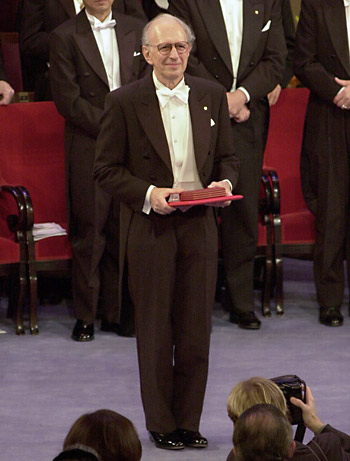
    Eric Kandel Receiving Nobel Prize


    There is a private liberal arts college near me.  They allow outsiders to audit summer courses
    (applying the profound wisdom that if there are empty seats, the marginal cost
    of one more student is zero.  Any revenue
    is pure gain.)  I was interested in a
    course Introduction to Neuroscience. 
    I checked out the course.  That
    got me thinking about the economics of a college course.


    This college charges students about $4,000 a course.  The course is probably taught by a full-time
    professor, probably an Assistant Professor since it fulfills a liberal arts field
    requirement.  There are no
    pre-requisites.  The prof probably is
    paid about $8,000 to teach this course. 
    Assuming 20 students in the course, each student is paying $400 to
    listen to the prof.  About 10% of the
    total cost.  What does the other 90% buy
    you?


    The main reading is In
    Search of Memory
    by Eric Kandel, who won a Nobel Prize for his research in
    neuroscience.  He is an engaging,
    wonderful writer; I had already read another book by him.  So I bought this book for my Kindle; it cost
    $9.99.  I read it.  Much of the book talks about Dr. Kandel’s
    personal and intellectual odyssey that led to his Nobel Prize.  He also patiently summarized the past
    research that laid the foundation of ideas and conjectures for his
    research.  The difficult parts were the
    explanations of his research.  Some
    background in very basic biochemistry and a little bit of explanation on the
    structure of the brain is needed (many illustrations in the book).  I would guess that about two good lectures
    would do it.


    The rest of the readings were supplemental and available on
    the Internet.  One other point.  To really understand Dr. Kandel, it is
    necessary to know more of the background history in the intellectual climate of
    Vienna, especially during the 60
    years before the Nazis marched in, in 1938. 
    Dr. Kandel talks a lot about this and how important it was to him (his
    family, like many others he talks about in this book, were refugees fleeing
    Hitler).  No reading on the historical
    background was assigned. I doubt if the prof knows much about the historical
    background. 


    Another point.  To be
    really prepared to understand the technical material on how the brain functions
    and particularly how we remember, a good course on the structure and dynamics
    of the brain is necessary.  Maybe there
    is a course at this college; if so, it would cost another $4,000.  Or you could spend about $50 to buy and watch
    a great video course on this topic from Great Courses, given by a
    neuroscientist who is the Professor of Cell and Development Biology in the
    School of Medicine, and Professor of Neurosciences in the College of Arts and
    Sciences at Vanderbilt University.  (I’ve
    seen it.)  But this college won’t give you
    three credits to watch this course.


    So better, far less expensive alternatives are
    available.  So why does the course cost
    so much and why does 90% of the cost go to the college and not the prof?  What exactly are you buying for $4,000?


    First of all, the classroom. 
    But classrooms can be rented cheaply and not necessarily at the
    college.  The local public library has a
    meeting room that is equipped as well as any classroom.  In fact, profs from this college teach
    lifelong learning courses there to idle adults like me.  At $75 a course.  Let’s hear it for price discrimination. The
    difference?  I don’t get any college
    credits for taking the course.


    You are also buying a whole bundle of goods and services
    that the college offers outside the classroom.  
    This college has a modern gym and pool it just built.  So you are saving $50 a month so you don’t
    have to go to a comparable gym and pool a mile away.  You are buying psychological counseling,
    tutoring, cultural events, social events, networking opportunities, career
    counseling and other services.  You get
    to play sports.  You get access to an
    excellent library, which might not be worth much to you, given the
    Internet.  What is all this worth to
    you?  It depends (you knew I would say
    that somewhere in this blog).  But I
    doubt if all this adds up to anywhere near $36,000 a year.


    Go to the admin buildings. 
    You will probably be amazed at how many people it takes to administer a
    college.  How many vice-presidents, deans,
    associate deans, assistant deans, directors, assistant directors and onward
    down the bureaucratic food chain.  Marvel
    on how nice their offices are.  Notice
    particularly the size of the admissions department and read in the annual
    report how much the college spends on marketing.  This is a very competitive industry.  It takes a lot of money to convince a few
    hundred students to come to this college. 
    The ones who choose to go there pay for all this marketing.


    But the most expensive thing you are buying is a
    degree.  Colleges form a self-regulating
    cartel that determines who can issue a college degree.  Inexpensive alternatives are simply
    forbidden.  Well, not simply.  You would not believe the state and
    self-accrediting requirements to be a degree-issuing college. No wonder it
    takes so many people to do so much paperwork. 
    But very little of this has anything to do with the cost or quality of
    the education you receive.  A few
    accredited for-profit colleges strip away much of the auxiliary services,
    charge lower tuition and still make a good profit.


    This is also a strange business.  The buyer (you) has virtually no say in the
    courses offered, the requirements for graduation, when the courses are taught,
    or what they contain.  The immediate
    service provider, the prof, is probably also tenured, which means he can’t be
    fired for incompetence.  You can’t
    complain.  It also means he can pretty
    much choose what courses he wants to teach. 
    The list of economics electives at this college is rather strange.  Many of them should probably be in the
    sociology or political science department. 
    You won’t learn very much about how the American economy actually
    functions.  For example, there is no
    course on financial markets.


    So, hopefully, you’re mostly buying the middle-class admissions
    ticket.  But wait.  So are a whole lot of other students.  The college industry is one of the great
    growth industries (and one of the worse managed but that doesn’t matter).  So now you have to go to graduate
    school.  This is where education gets
    serious.  You have to choose a narrower
    field of study and really learn it. 
    Unfortunately, you (and/or the rest of society) have already spent
    $160,000 to get you there.  And you
    better be successful because you probably have some big student loans to pay
    back.


    Footnote.  If I
    understand what Dr. Kandel and others have learned about memory, then lazy
    students are rational learners.  If you
    are taking a course you’re not interested in (it fulfills a graduation
    requirement, it’s offered at a convenient time, the prof is an easy grader,
    etc.), then it makes sense not to study very much.  Cram just before the exams.  Develop good guessing skills, especially if
    the prof is lazy and gives multiple-choice tests.  Get as much of the material you think will be
    on the test into your short-term memory just before the test.  Ignore the rest.  After the test, you’ll probably forget most
    or all of it (it doesn’t make it to your long-term memory).  Don’t worry about it – that’s how your brain
    works.  Blame it on evolution.

    ________________________________________________________________________

    You might be interested in the related post, College of the Future.


  • American Foreign Policy Since 1991

    American Foreign Policy Since 1991


    Introduction


    The United States
    has been the world’s only superpower since the collapse of the Soviet
    Union in 1991.  In some ways
    it is more difficult to manage foreign policy without concentrating on one big
    rival.


    The United States
    is vastly stronger in military strength than any possible coalition of enemy
    forces.  But since 9/11 we are feeling
    less secure despite huge military and domestic security expenditures.  Our military and national security
    expenditures of around $1.1 trillion are greater than the military expenditures
    of next ten countries combined (and most are allies).  This is a consequence of a professional
    military, a result of eliminating conscription after the Vietnam War, and the
    highly technical (capital intensive) nature of American military forces and strategy. 


    There is almost no national debate on U.S.
    military interventions in other countries. 
    One reason is that most Americans have no direct involvement; they see
    the professional military differently than if we still had the draft and a conscript army.


    There has been little public debate on national security
    strategy since 1991.  Congress has all
    but abdicated its role in foreign policy to the president. We should be asking:


    Is it the wrong strategy for a rapidly changing world?


    Do we rely on military force at the expense of using other
    means? 


    Did America
    change its political and military strategy enough after disintegration of Soviet
    Union? 


    We focused on terrorism after 9/11.  But are we fighting global terrorism with the
    same strategy we used during the Cold War? 


    There have been a number of successes from the U.S.
    point of view.  But they are not directly
    due to America’s
    military might or even an active American foreign policy.


    Eastern European countries join
    NATO and the European Union after the collapse of the Soviet empire.  This is a historical moment – a chance to
    peacefully unite Western and Central Europe.


    The spread of democracy to
    countries without a democratic tradition or experience, especially in Latin
    America and East Asia.  In some cases, democratic groups were able to
    overthrow authoritarian or military regimes that enjoyed American support.


    The shift in control of most economic
    resources from public to private control. 
    Except for some raw materials, almost all of global economic resources are
    now in private hands, especially those of large multinational corporations.  Private companies develop new technology.  A globally integrated economy, I would argue,
    is in America’s
    national interests.


    I would like to discuss four aspects of American foreign
    policy:


    Reliance on massive firepower and technological solutions.


    Lack of knowledgeable leadership in the United
    States.


    Lack of support for democratic, liberal groups in
    authoritarian states.


    Lack of awareness that domestic and foreign policies are
    intertwined.


    Reliance on massive
    firepower and technological solutions.


    It is difficult for American leaders not to think first of a
    military solution to a foreign political problem when we have such a
    magnificent tool as the U.S.
    military. But military interventions have not been politically successful in Vietnam, Lebanon, Somalia, Afghanistan or Iraq.  American presidents have
    learned that it is easy to invade and conquer but hard to occupy.  Also, as in Iraq
    and Afghanistan,
    lengthy occupations tend to create and strengthen the very political groups we
    seek to destroy. The Taliban is the strongest political group in Afghanistan; the inept occupation of Iraq led to Iran now dominating Iraqi politics and officers of the disbanded Iraqi army joining ISIS.   


    The use of military force without thinking through the
    long-run consequences and how it fits into 


    America’s
    strategic objectives can be futile and expensive.


    Lack of awareness that
    domestic and foreign policies are intertwined.


    For a superpower there is no distinction between domestic
    and foreign policy. Since 9/11, the United States has become a domestic security state; new surveillance powers and technology threaten civil liberties and individual rights to privacy. 

    Domestic economic and social policies have
    consequences for foreign policy and American power.  A few examples:


    Fiscal Policy. 
    After eliminating the self-funding parts of Social Security and
    Medicare, about 40% of the federal budget is currently financed through
    borrowing.  The current deficit is about
    $1 trillion a year.  This is
    approximately equal to total national security costs.  So the high costs of being a superpower is
    being financed through debt. Higher tax revenue because of economic growth will reduce but not eliminate the yearly
    deficit and increase the national debt. The recent combination of a tax cut and increased military spending makes the fiscal situation worse. At some point, American leaders may have to look at the cost of
    national defense and seriously consider major cutbacks.  This will impact America’s
    ability to project force and influence anywhere in the world.


    If large fiscal deficits continue they will eventually
    jeopardize the dollar as the international currency.  Much of international trade is denominated in
    dollars.  This is a source of America’s
    global influence.


    Energy policy. 
    Importing crude oil and natural gas finances, directly and indirectly, America’s
    actual and potential enemies.  In the
    past, oil exports supported corrupt, authoritarian regimes in Libya
    and Iraq.  Oil exports benefit Russia,
    Iran and Venezuela.  Oil revenues help finance Muslim terrorist
    groups. Because of the dramatic increase in domestic production of oil, the U.S. now imports virtual no oil from the Middle East. It is ironic that the United States became militarily engaged in the Middle East just as we no longer needed oil from that region.


    Trade Deficit. 
    The U.S.
    continues to run a large trade and current account deficit.  The reasons are complicated although net
    energy imports are a part of it. 
    We can run this trade deficit as long as foreign holders of dollars are
    willing to invest in and lend to the United
    States. In the long run, this could have
    serious economic consequences.  Changes
    in domestic energy and economic policies could reduce the trade deficit and
    finance more of it from domestic savings. 


    Drug policy.  Current
    domestic drug policy creates huge profits for drug gangs around the world.  Profits from the drug trade help to finance
    terrorist groups and the states that support them.  Drug gangs destabilize Latin American and
    Asian governments and divert resources needed for economic development.


    An important part of American influence in the world is foreign
    perception of America
    as an example to be emulated.  America
    represents both a set of political and social ideals, and a related model to
    achieve economic growth and opportunity.  American influence is jeopardized if the rest
    of the world sees a society with increasing concentration of wealth and income,
    less social mobility, low economic growth, and a political system that appears
    to be intolerant, lacks compassion for the poor, and seems incapable of solving
    domestic problems.


    Lack of support for
    democratic, liberal groups in authoritarian states.


    The United States
    continued to support authoritarian regimes even after the fall of the Soviet
    Union.  There was no
    long-run policy to support democratic groups in authoritarian states after 1991
    or even after 2001.  Potential democratic
    opposition in these states continued to be outlawed, weakened or
    destroyed.  In many countries, the only
    organized opposition was religious fundamentalist groups. Egypt
    is the latest example.


    The United States
    should concentrate on supporting organizations and individuals who organize and
    expand the civil society of countries. 
    The point is that a democratic state can only survive and prosper if it
    has a social, economic and ideological foundation.


    The U.S.
    should support democratic groups in the same way we supported Solidarity in Poland.
    The American people have a role to play by contributing to NGOs that can affect
    change through supporting and advising civic organizations in other countries.


    One area of opportunity where the U.S.
    and Americans should support democratic groups and civil organizations is sub-Saharan
    Africa. This is important since after 2050 all of the world’s population growth will occur in sub-Saharan Africa.


    Part of any strategy is to play for the long run.  It was naïve to expect that Russia
    would overnight transform from a Communist to an American-style democratic
    society, or that long term Russian strategic interests would somehow disappear.  It is possible that Islamic
    fundamentalist political parties will dominate politics in many Islamic states
    in the foreseeable future.  But, as in Iran,
    they will create an internal opposition. 
    They can not keep out information, ideas and images from other
    societies.  For the U.S.,
    giving the opposition moral and material support should be a vital part of a
    long-run strategy.


    Lack of knowledgeable
    leadership in the
    United States.


    The quality of leadership counts.  For a superpower, the ignorance and lack of
    foreign policy experience of every president and presidential candidate after George
    Bush is appalling.  It is ironic that
    almost all of the domestic and foreign policies of George Bush were reversed or
    ignored by his son when he became president.  


    The American people should think about electing national
    leaders who know something about the rest of the world.  The recent presidential debates were
    embarrassing.  Congressional leaders are
    even worse. 


    Questions


    What are America’s
    strategic objectives?


    How are they being met by using overwhelming military force?


    What are
    the limits to our military superiority in a world of “asymmetric warfare,” non-state terrorist groups, and Internet-based propaganda?

                What are
    the tactical alternatives?


    Can we continue to spend $1 trillion a year on national
    security while running large budget and trade deficits?


    Cautionary Tales


    Historical
    analogies must be used with extreme care but they can be suggestive cautionary examples.  I wish that America’s
    political leaders had read Thucydides, especially his detailed analysis of Athens’
    large expedition to subdue Syracuse,
    before committing substantial American military forces to Vietnam. Or how come the most powerful military country of its day could not defeat American rebels. 


    The examples of the imperial democracy of Athens
    and the Roman republic might be relevant to the U.S.
    after the collapse of the Soviet empire. After defeating serious threats from rival powers (Persia
    and Carthage, respectively), both
    city-states rapidly expanded power and influence.  Both became the dominant powers in their main theaters of operation (Greece for Athens and the Mediterranean for Rome). Athenian and Roman political institutions could not adjust to remaining democratic and managing an empire.  Thucydides gives Pericles,
    the architect of imperial Athens, a
    speech justifying Athens’ foreign
    policies that sounds eerily like the “American exceptionalism” speeches of the
    last 20 years. In both cases, foreign power and imperial policies put severe strains on
    domestic politics and society. Athenian democracy was destroyed by a war of attrition with Sparta and then both were conquered first by the Macedonians and then the Romans. The Roman republic expanded rapidly in the last 100 years of the republic but collapsed from internal pressure to become the Roman empire.


    Conclusion


    All of this suggests that there are less expensive
    alternatives than relying primarily on military superiority – U.S.
    image, different domestic policies, changing security and economic alliances, support for foreign civil society
    organizations, becoming more economically
    competitive in the global economy, strategic vision and better leadership.  Since it is possible that military and national
    security spending will decrease sometime in the future because of fiscal constraints, it is time to
    concentrate on alternatives.


  • Sane Asylum:  Suburbs and the American Middle Class

    Sane Asylum: Suburbs and the American Middle Class


    Americans love their suburbs.  Suburban living almost defines the American
    way of life.  Privacy, both homes and
    backyards.  Space.  Peace and quiet, except for power mowers and
    leaf blowers.  Compare this with the high
    cost of space, peace and quiet in cities.


    Suburbs are a refuge from the stress of live and work in America.  They are places where nothing happens.  Little or no violent crime.  No class conflict.  Family oriented.  Acceptable schools at a lower cost than
    private schools in cities.  Lots of space
    for playing fields and organized sports for kids.  I sometimes think this is the main activity
    in suburbs.


    When Americans retire, they move to “senior citizen”
    suburban developments that are often even more isolated and further removed
    from urban life than the suburbs they came from.


    But what about the excitement of a city?  For example, the live cultural events.  There is an improving substitute – electronic
    entertainment.  I can watch all the cultural
    entertainment I want on my big screen HD TV with Dolby sound. Or over the
    Internet.  It is not surprising that
    entertainment is becoming more electronic and passive. 


    Social interaction continues to be more “virtual.”  The high density of cities is less important
    for social and creative interaction.  This
    trend is consistent with the suburban mentality. 


    The housing boom – rapidly rising housing prices leading to
    large positive wealth effects like spending equity, lower savings and increased
    borrowing – covered the stagnant incomes of middle class families.  The housing bust takes away a major funding
    source of a rising standard of living and leaves millions of homeowners with
    little or no equity in their homes.


    .


    The housing crisis is devastating because it undermines the
    foundation of the American middle class – home ownership in the suburbs.  Even those who still own homes have seen some
    or all of their equity disappear.  About
    20% of homeowners with mortgages are “underwater,” holding mortgages that are
    larger than the market value of their homes. 
    More and more are simply walking away from their homes. 


    Foreclosures and short sales continue.  Who is buying foreclosed and short-sale
    homes?  According to a private source,
    about one-fourth of all short sales are to speculators.  Buyers of foreclosures and short sales have
    to come up with large amounts of cash that middle class families don’t have.  


    It is difficult for some young families to buy a suburban
    home despite the fall in housing prices and low mortgage rates.  In the future, first-time home buyers will be
    faced with rising housing prices and rising interest rates on mortgages.   Many
    younger families wouldn’t qualify for a mortgage because their student loans
    are too large.


    In the longer run, it is unlikely that Americans will
    abandon their desire to live in a suburban environment.  There is also the possibility of a reduction
    in the economic, environmental and social costs of suburbs.  The cost of solar energy panels is decreasing
    and this is a decentralized technology perfect for suburban housing.  Electric or hybrid cars may become the
    standard second car for short trips and commuting to work.  The “family” car will probably have a higher
    MPG. 


    A major middle class strategy for upward mobility has been
    to have the market value of their suburban home go up in value and use the
    increased equity as a down payment on a bigger home in a “better” suburb.  This strategy is on hold for at least 20% of
    homeowners who now have “negative equity” in their homes. No one knows when
    suburban housing prices will start going up. 
    It depends on future real economic growth.  When that occurs, so will the demand for
    living in the suburbs.

    __________________________________________________________________________

    Related Posts:

    What Now?  The Crisis of America’s Middle Class